
Listen to the audio version of this article (generated by AI).
Market downturns test more than portfolios. They also test investors’ nerves, habits, and sometimes, even their sleep schedules. MarketWise analyzed three years of Google search behavior across 100 cities, from July 2023 through June 2026, and surveyed 1,007 U.S. investors to see when market anxiety turns into action. The results reveal how far stocks must fall before investors sell, where investors are most nervous about a crash, and how concerns about an AI bubble are influencing portfolios.
Key Takeaways
- The average American investor’s breaking point is an 18% market drop before they begin to sell, though 42% of investors say they would not sell no matter how far it fell.
- 29% of American investors have sold during a downturn and regretted it, at an average cost of $2,858 per investor.
- 53% of American investors say we are in an AI bubble, and 1 in 4 has already reduced their tech or AI holdings because of it.
- Atlanta is the panic-selling capital of America, logging 7,528 searches about market crashes and selling out per 100,000 residents between July 2023 and June 2026.
An 18% Market Drop Is the Average Investor’s Breaking Point
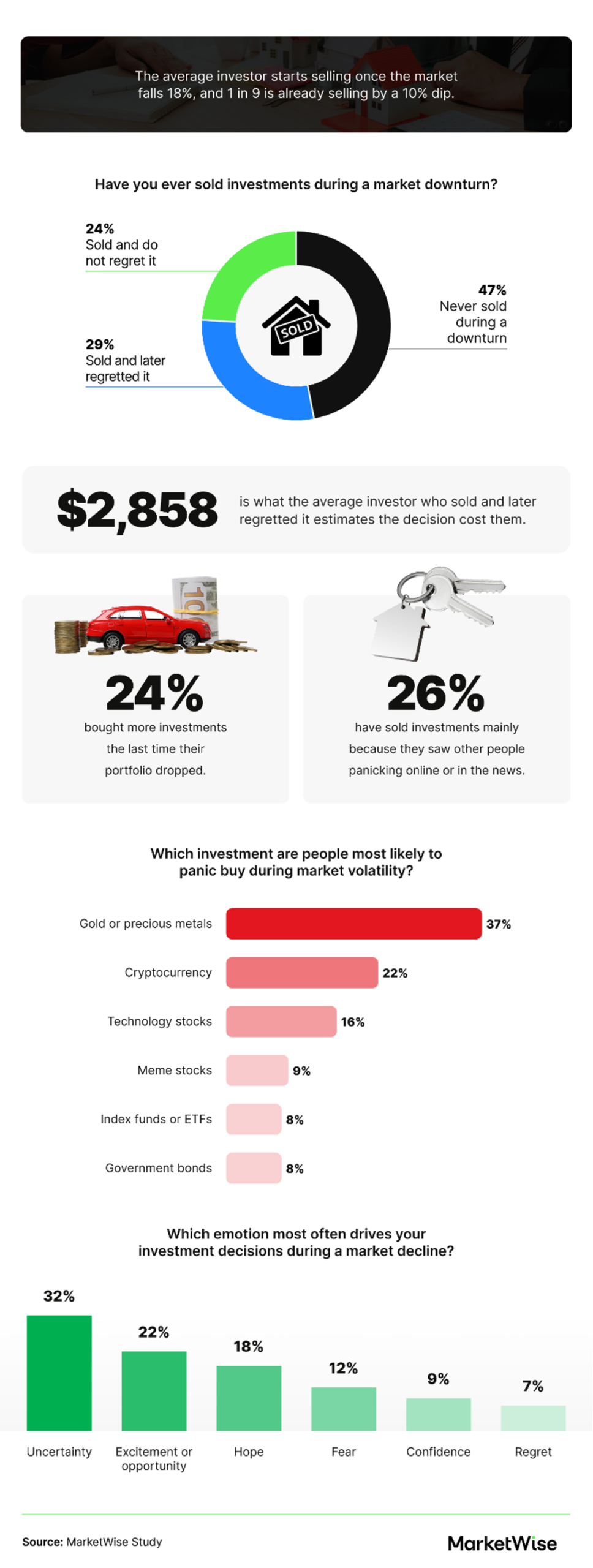
- The typical investor holds on until the market falls 18%, the point where selling starts to feel unavoidable, though 42% say no drop would push them to sell.
- Selling during a downturn has burned 29% of investors who later wished they hadn’t, setting them back an average of $2,858 apiece.
- 1 in 10 investors has sold a stock or other investment because of something they saw on TikTok. Gen Z investors were the most likely to have done so, at 18%, compared to millennials (10%) and Gen X (7%).
- When markets fall, 42% of investors check their portfolios at least once a day, while 20% cope by refusing to look at all. Gen Z investors were the most likely to check at least daily, at 47%, followed by 41% of Gen X and 40% of millennials.
- 13% of investors have hidden an investment loss from a spouse or partner. Gen Z investors were again the most likely to have done so (16%).
- Market downturns have also taken a physical and emotional toll on investors. When there has been a dip:
- 30% felt physically sick or anxious.
- 28% lost sleep over their investments.
- 19% argued with a spouse or partner about money or investments.
- 14% skipped meals or lost their appetite.
- 53% of investors think an AI bubble is forming, and 25% have already pared back their tech or AI holdings because of it.
Where Market Panic Is Highest Across America
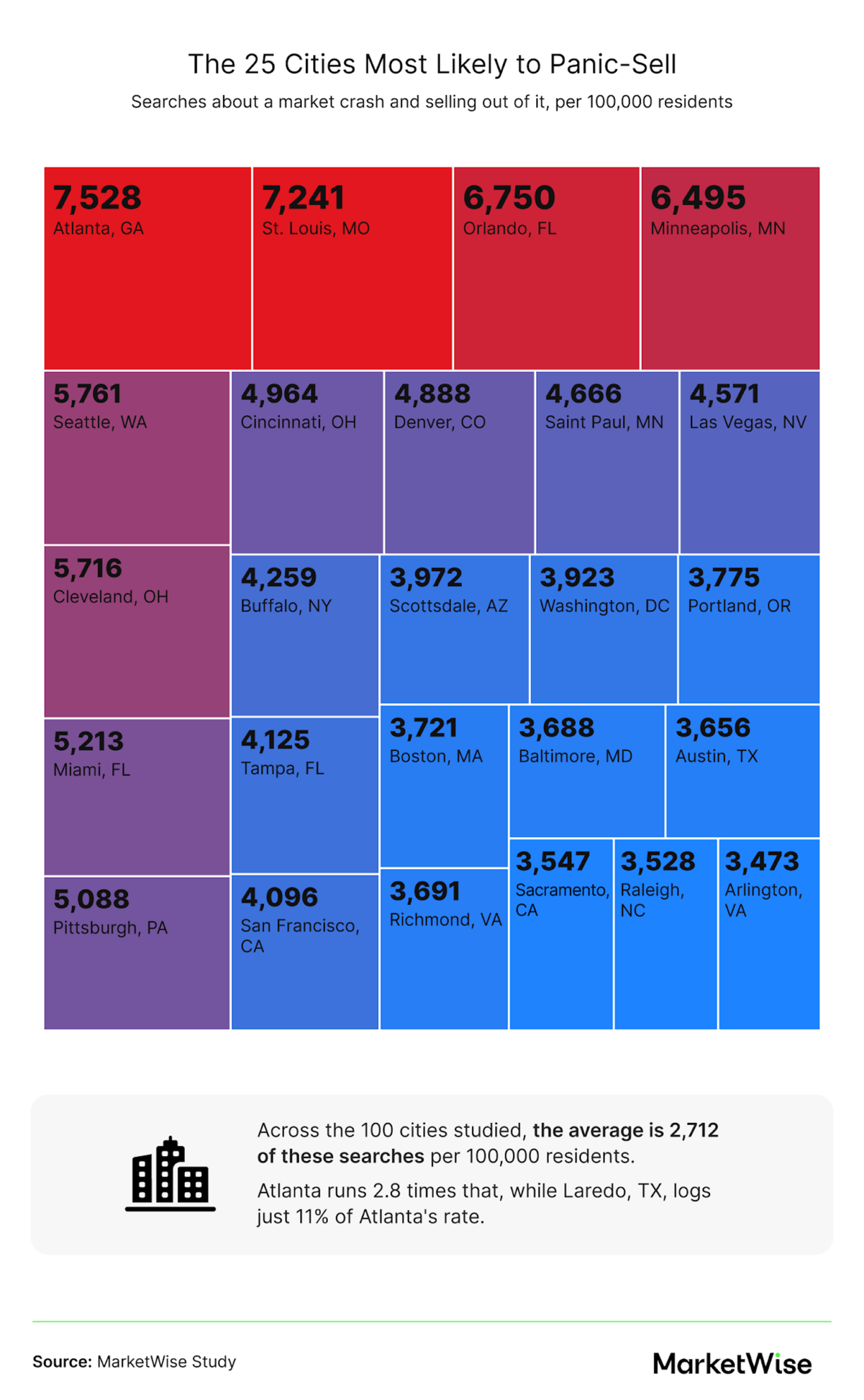
- Atlanta topped every metro studied, logging 7,528 searches about market crashes and selling off per 100,000 residents from July 2023 through June 2026.
- The 100-city average was 2,712 searches per 100,000 residents.
- The 10 metros with the fewest panic searches per 100,000 residents were:
- Laredo, TX: 825
- Enterprise, NV: 1,032
- North Las Vegas, NV: 1,278
- Fresno, CA: 1,330
- Corpus Christi, TX: 1,357
- Chula Vista, CA: 1,378
- Stockton, CA: 1,413
- Bakersfield, CA: 1,426
- Cape Coral, FL: 1,441
- Memphis, TN: 1,442
Cities Most Likely to Move Into Cash
- Searches for high-yield savings accounts, money market funds, and safe investments per 100,000 residents were highest in:
- Atlanta, GA: 45,680
- Miami, FL: 37,184
- Minneapolis, MN: 36,477
- Orlando, FL: 35,423
- Seattle, WA: 28,949
Cities Where Fear Lasts Longest
- In the six months after the market’s decline in April 2025, these cities logged the most excess panic searching, shown as the number of months of normal search activity that the extra searches add up to:
- Greensboro, NC: 6.5 months
- Henderson, NV: 6.1 months
- Mesa, AZ: 5.7 months
- Buffalo, NY: 5.5 months
- Aurora, CO: 5.5 months
Cities With the Widest Gap Between Anxiety and Action
- The highest ratios of crash and bear-market searches to searches about selling off were:
- San Jose, CA: 15 to 1 (14.98)
- Miami, FL: 15 to 1 (14.89)
- San Diego, CA: 14 to 1 (14.19)
- San Francisco, CA: 14 to 1 (14.06)
- Dallas, TX: 14 to 1 (13.62)
What History Says About Riding Out the Panic
The search data captures a familiar reflex. When the stock market drops, fear spikes and fingers hover over the sell button. History offers some perspective on that impulse. Since 1928, the market has weathered roughly two dozen bear markets, and each one was eventually followed by a recovery to new highs. Across those decades of wars, pandemics, and financial panics, the average annual return has still landed near 10%.
For long-term investors, downturns have historically been part of the cost of those returns rather than a signal to head for the exits. The regret data reflects that tension. The investors who sold and later wished they hadn’t were out an average of $2,858, a reminder of what acting on panic has tended to cost. For all the searching that fear sets off, history suggests the steadier move has usually been to do nothing at all.
Methodology
We surveyed 1,007 U.S. adults who own stocks, ETFs, or mutual funds about how far markets have to fall before they act, what they did the last time their portfolio dropped, the emotional and physical toll of downturns, where they turn for information, and how they view AI’s role in the market. The generational breakdown was 46% millennials, 26% Gen X, 20% Gen Z, and 8% baby boomers. Data was collected in August 2026.
We also analyzed monthly Google search volume across 100 U.S. cities for 14 terms related to market crashes and selling out, from July 2023 through June 2026. Search totals were converted to a rate per 100,000 residents using current city population estimates.
About MarketWise
MarketWise is a leading financial research and education platform serving self-directed investors. Through a network of independent brands, including Stansberry Research, Altimetry, Chaikin Analytics, TradeSmith, InvestorPlace, Brownstone Research, and Wide Moat Research, MarketWise delivers independent insights, tools, and software to help individuals navigate complex markets with confidence. Whether you’re exploring emerging opportunities or seeking stability, MarketWise supports every investor with credible research and actionable strategies.
Fair Use Statement
We welcome the use of this study for noncommercial purposes. If you share or reference any part of this content, please include a link back to this page to credit MarketWise appropriately.