
Listen to the audio version of this article (generated by AI).
Today’s issue in preview:
-
This Trump-backed stock trade could generate triple-digit returns
-
An important new development in “the world’s most important trend”
-
Learn our Top Themes to buy now
This Trump-backed stock trade could generate triple-digit returns
Credit: William_Potter
After decades of being indifferent or outright hostile towards mining, the U.S. government is now one of the industry’s best friends.
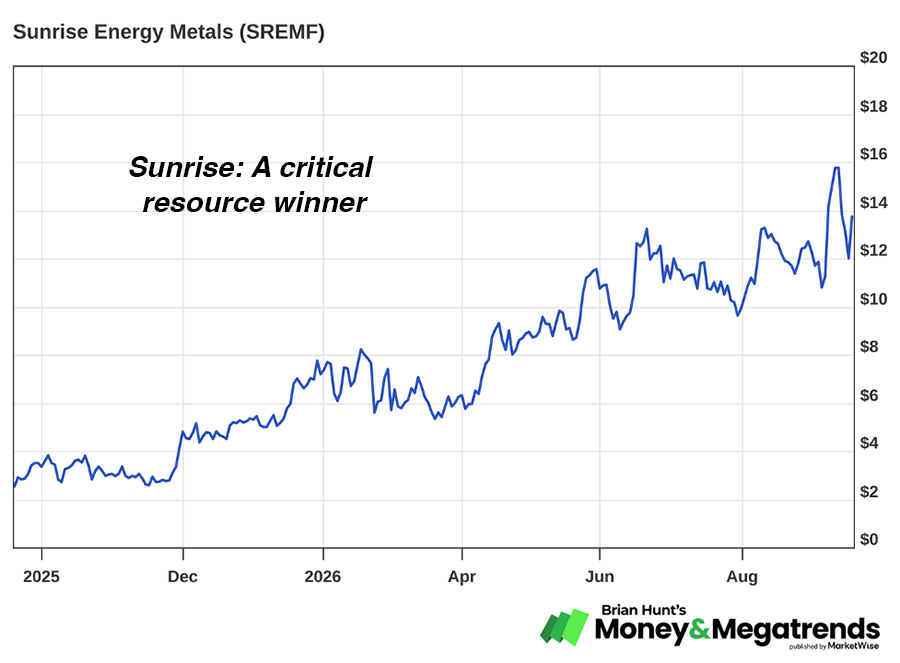
Over the past 18 months I’ve frequently cited how this unique situation is producing large financial opportunities. As evidence, we present the recent new highs reached by Sunrise Energy Metals (SREMF). The stock is up 150% since we first profiled it on March 20.
The megatrend thesis goes like this: President Donald Trump – along with many business and military leaders – believes that the U.S. has outsourced far too much of its industrial capacity to China over the past 25 years.
We outsourced significant portions of our semiconductor, appliance, medicine, weapons, and machinery production. We outsourced the capacity to produce and process critical resources, such as rare earth elements.
The COVID-19 pandemic showed that depending on other countries for critical economic inputs makes the U.S. economy less safe and secure. To put it bluntly, it is very stupid to not make products critical to national security like AI semiconductors within our own borders.
Trump has staked his legacy and reputation on expanding our industrial base… and he’s working with business leaders to invest trillions to pursue this goal.
Apple (AAPL), for example, has committed to invest $600 billion in U.S.-based manufacturing over the next four years. Nvidia (NVDA) says it will invest $500 billion in U.S.-based manufacturing over the next four years. The government is investing heavily in high-tech weapon systems manufacturing as well.
However, any plan to increase domestic manufacturing capacity must overcome a big problem: We don’t have sufficient supplies of critical resources needed to build the required infrastructure.
We don’t have the copper, iron ore, rare earths, lithium, antimony, nickel, and other vital building blocks required to build all those data centers… all those factories… all those robots… all those electric grids… all those power plants… and so on.
To make matters worse, we also lack the refining, smelting, and processing facilities needed to turn the raw forms of those resources into ready-to-use end products. We rely on China for a lot of that.
It’s as if we very much want to build a big house… but we don’t have all the lumber, screws, or nails we need to get the job done.
Solving the big “critical resources problem” is possible… and it is an enormous financial opportunity.
To ensure we have the critical resources to build trillions of dollars in infrastructure, the U.S. government will change any law, kill any regulation, and write any check that will increase production and processing capacity.
This means that after more than 30 years of the U.S. government being hostile to domestic mines and mineral processing facilities and indifferent towards supporting production in friendly nations, it is now supportive of the industry. Trump can’t have his big manufacturing dream without them.
And no matter who is president, the U.S. economy needs a diversified critical resources mining and processing base to lessen its dependency on China. Having that would make the U.S. economy much safer and more robust.
With all this in mind, the U.S. government has struck many important deals to support domestic and friendly country critical resource production over the past 12 months. They include:
-A $450 million preferred-equity investment in The Elmet Group (ELMT) to expand domestic tungsten mining, refining and manufacturing.
-A $725 million conditional loan commitment to Energy Fuels (UUUU) to expand U.S. rare-earth processing capacity.
-A $36.5 million direct equity investment in copper mining firm Trilogy Metals (TMQ), which is developing resources in Alaska.
-A $400 million conditional loan made to Sunrise Energy Metals to develop its enormous Syerston scandium project in Australia.
The U.S. government’s support of Sunrise has made our March 20 recommendation of the stock a big winner. Back then, we noted how scandium is one of the most critical metals you never hear about.
Scandium is a lightweight, rare metal valued mainly for strengthening aluminum. Small amounts added to aluminum create alloys that are stronger, lighter, more corrosion-resistant, and easier to weld – useful in aerospace, defense, and high-performance vehicles.
This is why securing critical minerals like scandium has become a national security imperative. Without scandium, the U.S. doesn’t have the most advanced missiles and drones. As the U.S. rebuilds missile stockpiles depleted by the Iran War, scandium demand will rise.
Scandium also has an “AI demand kicker” that should act as a long-term tailwind. The massive fuel cell maker Bloom Energy (BE) uses a lot of scandium to produce its products, which are in high demand for AI data center power infrastructure.
Sunrise’s Syerston project is one of the largest scandium resources in the world. Its development is seen as a key part of the U.S.A.’s scandium supply chain. Sunrise has signed a five-year scandium option with Lockheed Martin (LMT), giving the defense giant the right to purchase up to 25% of Sunrise’s scandium. The company is backed by mining powerhouse Robert Friedland… and is now backed by the U.S. government.
The Sunrise story demonstrates how the enormous geopolitical and economic forces working to secure critical resources right now can end up producing very large capital gains for investors.
Companies that could benefit greatly from this trend include U.S. firms Idaho Strategic Resources (IDR), Perpetua Resources (PPTA), Energy Fuels (UUUU), and MP Materials (MP). ETFs worth investigating include the Sprott Rare Earths Ex-China ETF (REXC) and the Sprott Critical Materials ETF (SETM).
Our stance on this situation now is the same as it was one year ago. We sum it up like this: Partnering with the U.S. government to increase domestic and friendly-country supplies of critical resources will prove to be one of the most lucrative financial activities of this decade.
Recommended Link:
Log into Our New $5,000 “Super AI” Right Now

It foresees the future prices of 2,334 stocks, to the penny, with 85% backtested accuracy. This year, you could’ve already crushed the stock market by 218%, as of August. Including gains of 46.8% in 5 days on (RVMD)… 36.8% in 29 days on (ALB)… 32.4% in 2 days on (BE), and dozens more. Until Tuesday, get free access here (no purchase required).
An important new development in “the world’s most important trend”

Credit: Black_Kira
Chalk one up in favor of technology stocks this week.
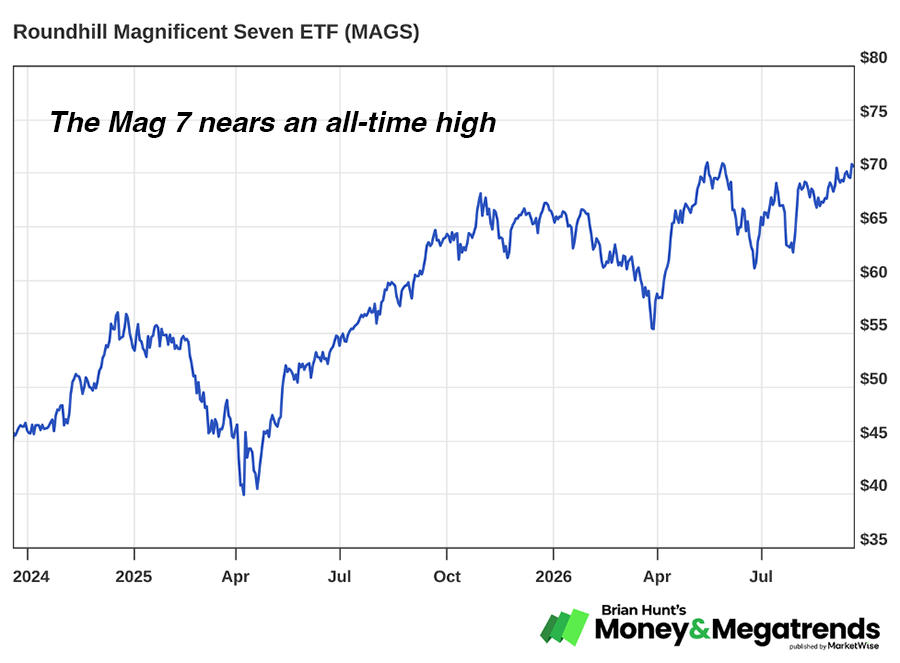
On Thursday, the Roundhill Magnificent Seven ETF (MAGS) reached a three-month high… and is just pennies from reaching a new all-time high.
MAGS is the largest ETF specifically designed to give investors exposure to the “Magnificent 7,” a group of dominant technology firms comprised of Nvidia (NVDA), Microsoft (MSFT), Alphabet (GOOG), Tesla (TSLA), Amazon (AMZN), Apple (AAPL), and Meta (META).
Together, these firms are worth about $24 trillion and make up roughly 31% of the benchmark S&P 500. No group of companies in history has wielded this group’s awesome combination of power, technological expertise, and vast financial resources. This group includes nearly all of the “hyperscalers” leading the AI revolution.
And the ETF that tracks this group is within pennies of its all-time high.
This is an important development for “the world’s most important trend.”
Over the past month, we’ve published a special series of research notes analyzing the AI infrastructure megatrend.
The status of this critical trend has become one of the great sagas of the business and investment world… a source of intense disagreement among industry bulls and bears. It’s a trend whose outcome could have large effects on your portfolio.
Given AI’s enormous promise, the firms above have invested over $1 trillion in AI infrastructure. They are on pace to invest over $700 billion this year alone and more than $4 trillion after that.
Both the scale and the velocity of this investment boom are unprecedented. It is the largest collective investment effort in history.
Big Tech’s historic investment boom has made the entire “AI infrastructure” trend responsible for a large share of America’s GDP growth and stock market returns over the past two years. It has also drawn the skeptical scrutiny of many widely followed investment analysts who claim the trend is a bubble… one that will soon explode and cause tremendous damage to stock prices and the global economy.
If this hugely consequential trend isn’t the most important trend in the stock market, then it is certainly in the top three.
I believe the AI infrastructure trend has years to run. I believe the world’s smartest, most connected tech insiders who know the true state of bleeding-edge AI development and have real-time stats on AI investment ROI, such as Elon Musk, Jensen Huang (Nvidia), Satya Nadella (Microsoft) and Andy Jassy (Amazon) could possibly… perhaps maybe… just might… know far more about AI and their businesses than outsiders know about it.
As much press as AI gets, let’s remember that less than 1% of the global population pays for top-tier AI programs. And I estimate less than 10% of large companies believe AI has made a meaningful impact on their businesses.
This revolutionary technology hasn’t yet proliferated, achieved mass adoption, or had mass impact.
Regular readers know I care a lot more about what the market thinks of any stock, trend or theme than what any one person thinks of it, including me. You can be bullish or bearish on a trend all you like, but if that trend is moving strongly against you, then your idea isn’t worth much in my book.
Over the past few months, we have analyzed price action in critical areas of the AI infrastructure trade – including the VanEck Semiconductor ETF (SMH), computer memory giant Micron (MU), and optical networking stocks – to guide our trading.
Since the Mag 7 plays a central role in AI infrastructure, it plays a central role in our analysis of it. Several of these firms have been singled out by bears for issuing debt to invest in AI data center construction.
However, right now, the market is saying debt issuance and ROI on AI infrastructure spend aren’t much of a worry… and that things are going quite well for the Mag 7. As you can see in the two-year chart below, MAGS is in a clear uptrend and is close to reaching an all-time high. A break above it would be bullish for the AI infrastructure trade, bullish for the tech sector in general, and bullish for America.
Market Notes
-
The Iran War and its constriction of critical resources continue to work in favor of U.S. refiners. Valero Energy (VLO) reached a new all-time high today.
-
Food and beverage giant PepsiCo (PEP) reached a new one-year low today.
-
Fast food giant McDonald’s (MCD) reached a new one-year low today.
-
Home improvement giant Lowe’s (LOW) reached a new one-year low today.
-
Casino giant Las Vegas Sands (LVS) reached a new one-year low today.
Top Themes to Buy Now
🛡 How to invest in an extraordinary new phase of the AI bull market
Regards,


Brian Hunt
Editor, Money & Megatrends
An urgent message from our colleagues:
Emmy-winning analyst releases his next big story

Whitney Tilson shocked the nation on 60 Minutes when he accused a major company of poisoning its customers. The investigation won an Emmy and the stock fell nearly 80%. (He also called the housing crisis and the collapse of Bear Stearns and Lehman Brothers). Now, he’s releasing his next big story. He says a dangerous pattern is forming, and most Americans have no idea how exposed they really are.