
Listen to the audio version of this article (generated by AI).
Today’s issue in preview:
-
This “super theme” is quietly generating large stock market winners. Here’s how to profit
-
How to trade “The world’s most important trend” from here
-
These six risky stocks have enormous upside
-
Learn our Top Themes to buy now
This “super theme” is quietly generating large stock market winners. Here’s how to profit

Credit: gorodenkoff
“We’ll run a test on it.”
If you’ve been following our work for the past year, you know doctors say these words many times each day in America… and what’s driving their use can make you a lot of money in stocks.
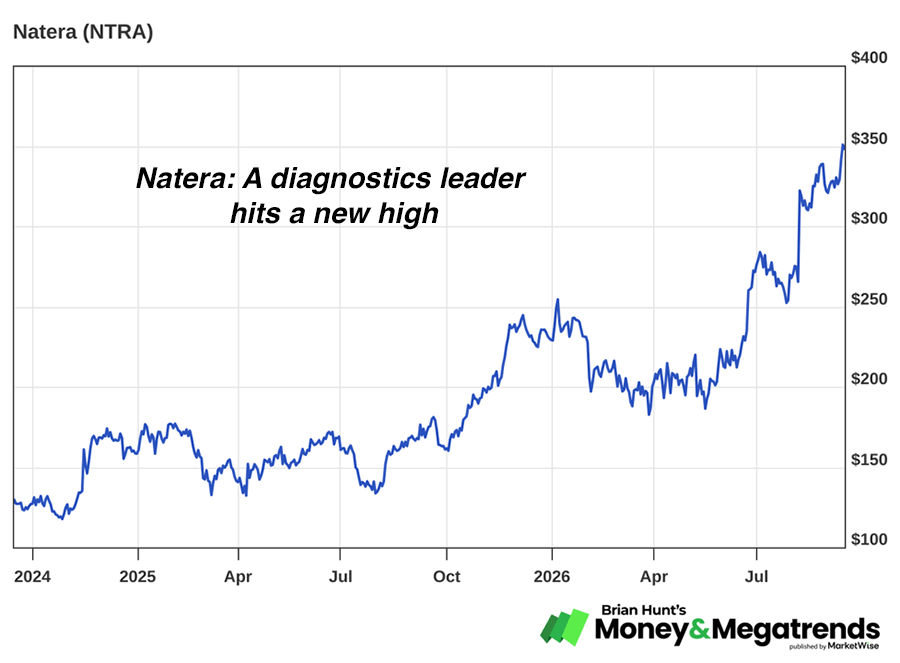
As evidence, I give you the new highs reached this week by leading stocks in the Healthcare Diagnostics theme:
-
Natera (NTRA), a genetic testing company specializing in prenatal, cancer, and transplant diagnostics.
-
NeoGenomics (NEO), a cancer diagnostics company providing oncology testing and pathology services.
-
Guardant Health (GH), a liquid-biopsy company using blood tests to detect and monitor cancer.
-
Quest Diagnostics (DGX), a major diagnostic laboratory providing blood tests and other clinical testing.
-
Illumina (ILMN), a diversified genomic sequencing services giant.
Avid Money & Megatrends readers know the bull case behind this theme and the larger Boomer health care megatrend. More than 10,000 Americans reach retirement age every day. The U.S. population aged 80 and older is projected to roughly double, from 14.7 million in 2025 to 29.4 million by 2045.
This is the enormous Baby Boom generation entering the phase of life where health care and longevity spending skyrockets. For many boomers, a typical month involves going to see at least one doctor to have something looked at, removed, or treated.
This means many health care businesses are experiencing huge demand now – and will for at least the next decade. It means boom times ahead for many “ology” businesses, stocks, and careers. Dermatology. Cardiology. Radiology. Oncology. Anesthesiology. Ophthalmology. The list goes on. Investing in many health care businesses over the next decade will be investing with a gale-force tailwind at your back.
A growing force inside this trend is bleeding-edge preventative diagnostics. We devoted a bullish research note to it on June 12.
Over the past 20 years, preventive healthcare diagnostics have improved dramatically due to advances in genomics, imaging technology, and data analytics. Genetic testing has become faster and less expensive, allowing earlier identification of disease risks. High-resolution imaging and improved laboratory testing can detect conditions such as cancer, heart disease, and diabetes at much earlier stages.
Wearable devices and remote monitoring tools continuously track vital signs and health trends, enabling early intervention. Electronic health records and artificial intelligence help clinicians identify risk patterns and personalize screening recommendations.
Together, these innovations are shifting healthcare from reactive illness care to predictive, preventive, and proactive disease management before serious symptoms develop. The shift from reactive treatment to early detection is still early, but the numbers already reflect its momentum.
The U.S. health care diagnostics market was valued at $35.7 billion in 2024 and is projected to reach nearly $60 billion by 2030, growing at an annual rate of over 9%. Globally, clinical diagnostics is on track to hit $170 billion by the end of the decade. North America commands nearly half of that market.
We expected to see the firms listed above generate new highs this year. But they are even more impressive considering that many themes, industries, and major stock indices are moving in sideways consolidation patterns right now. Healthcare Diagnostics is an area of strength where there are few such areas to be found.
We are in the early innings of a historic revolution in health care. Technological advances in DNA sequencing, AI analytics, imaging, wearables, and testing are moving this area of our lives from the reactive, “one size fits all” shotgun approach to the much better proactive, preventative, customized-for-the-individual approach. This will change the world and create huge amounts of wealth along the way. You can expect to see more new highs in the future from this compelling theme.
Recommended Link:
“Super AI” Opens New Way of Trading on Sept. 22

New form of AI could quadruple your portfolio by foreseeing the future prices of 2,334 stocks, to the penny, with 85% backtested accuracy. It’s opened the most lucrative investment vehicle in our firm’s 21-year history, which has officially crushed the 2026 stock market by 218%, as of August. You can even chat with it! Click here to try it now, free of charge.
How to trade “The world’s most important trend” from here

Credit: KanawatTH
In Monday’s issue, we covered the global AI freakout related to claims that “frontier labs” such as Anthropic and OpenAI need to slow down their AI development.
We made our take on the situation clear: All the current fuss is misplaced. Anthropic and OpenAI are free to slow down their development and ask for more regulation of their kind, but neither they nor the U.S. government can slow down AI development in China, Russia, India, or dozens of other countries. They cannot effectively regulate open-source AI all over the world.
Heavily regulating U.S. firms OpenAI and Anthropic would be like slowing down traffic in one lane of a six-lane highway. Everybody is still getting to their destinations. The prize of advanced AI is so large that it will be pursued, no matter what.
Plus, consider the U.S. government’s position. It rightly sees itself in a massive geopolitical and economic “great power” competition with China. AI supremacy is hugely valuable in this competition. It would be lunacy to slow AI development to the point that we essentially hand China a big victory. Governments are among the dumbest entities on the planet, but they aren’t that dumb.
Given all this, we believe the current fuss over AI development reeks of performative theatrics and will prove to be a tiny speed bump on the long road of breakneck AI advancement and proliferation.
But more importantly, what is the stock market saying about this debate? How is this debate affecting what we call the “world’s most important trend,” which is the historic AI infrastructure investment boom?
Over the past month, we’ve published a special series of research notes analyzing the AI infrastructure megatrend.
The status of this critical trend has become one of the great sagas of the business and investment world… a source of intense disagreement among industry bulls and bears. It’s a trend whose outcome could have large effects on your portfolio.
Given AI’s enormous promise, large tech firms such as Alphabet (GOOG), Amazon (AMZN), and Microsoft (MSFT) have invested over $1 trillion in AI infrastructure. They are on pace to invest over $700 billion this year alone and more than $4 trillion after that.
Both the scale and the velocity of this investment boom are unprecedented. It is the largest collective investment effort in history.
Big Tech’s historic investment boom has made the entire “AI infrastructure” trend responsible for a large share of America’s GDP growth and stock market returns over the past two years. It has also drawn the skeptical scrutiny of many widely followed investment analysts who claim the trend is a bubble… one that will soon explode and cause tremendous damage to stock prices and the global economy.
If this hugely consequential trend isn’t the most important trend in the stock market, then it is certainly in the top three.
I believe the AI infrastructure trend has years to run. I believe the world’s smartest, most connected tech insiders who know the true state of bleeding-edge AI development and have real-time stats on AI investment ROI, such as Elon Musk, Jensen Huang (Nvidia), Satya Nadella (Microsoft) and Andy Jassy (Amazon) could possibly… perhaps maybe… just might… know far more about AI and their businesses than outsiders know about it.
As much press as AI gets, let’s remember that less than 1% of the global population pays for top-tier AI programs. And I estimate less than 10% of large companies believe AI has made a meaningful impact on their businesses.
This revolutionary technology hasn’t yet proliferated, achieved mass adoption, or had mass impact.
Regular readers know I care a lot more about what the market thinks of any stock, trend or theme than what any one person thinks of it, including me. You can be bullish or bearish on a trend all you like, but if that trend is moving strongly against you, then your idea isn’t worth a hell of a lot in my book.
Over the past few months, we have analyzed price action in critical areas of the AI infrastructure trade – including the VanEck Semiconductor ETF (SMH), computer memory giant Micron (MU), and optical networking stocks – to guide our trading.
Today, we continue our special series by looking at the current price action in the world’s largest semiconductor ETF, the VanEck Semiconductor ETF.
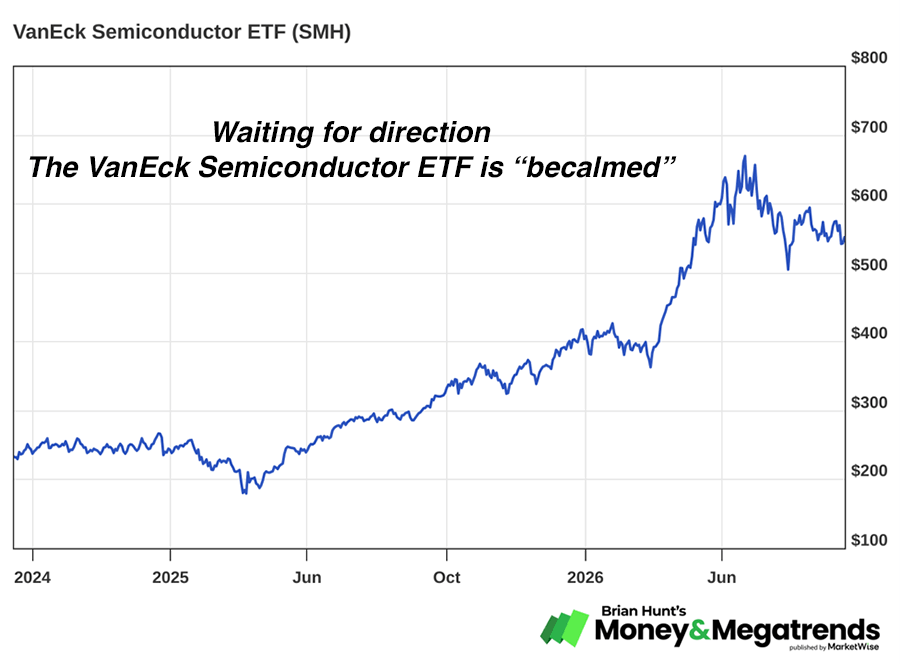
In June 2025, semiconductor stocks broke out of a sideways consolidation pattern and began a rally for the ages. During this rally, SMH gained 147% in just under a year.
When a sector gains 50% in a year, that’s considered incredible. What semis returned was “triple incredible.”
Given its AI drivers and big returns, it’s no wonder semis became the world’s “hottest trade” this summer. And when any theme becomes the world’s hottest trade, it becomes a leading candidate to experience a significant correction or something worse.
That’s just how the stock market works. When a bull market grows very popular and attracts a lot of speculation, it likes to “buck off” market participants with a sharp correction or worse.
That’s what has happened to the semiconductor trade this summer. After soaring from June 2025 to June 2026, SMH declined 24%. Some individual semi names declined by more than 35%.
As you can see in the two-year chart below, the SMH share price declined from the mid-$600s to the mid-$500s. Since reaching a low in late July, SMH has traded up and down, failing to establish a meaningful trend.
It is like a “becalmed” sailboat on a windless sea. The trends of other important parts of the AI infrastructure trade – electric power component makers, computer memory makers, neoclouds, and data center cooling firms – look much the same.
In my July 20 health analysis of SMH, I stated that if long-term AI bulls are proven right by the market, SMH will likely “digest” its summer losses by trading in a sideways consolidation pattern for 3-6 months… and then recover to trade back to the mid-$600 area and beyond.
If the AI bears are right, SMH won’t see that mid-$600-per-share level for years… and we are much better off focusing on other trends.
With all this in mind, short-term traders should see semiconductors as a directionless trade right now, good for monitoring but not for trading. Long-term bulls, of course, can ignore these short-term moves and stay long.
I’ll keep you updated on this world’s most important trend. It won’t be long before we get meaningful price action that provides direction for trading semis, optical networking, and other key components of AI infrastructure.
These six risky stocks have enormous upside

Credit: mustafaU
The moonshot. The grand slam home run. The 1,000%+ winner.
In yesterday’s issue, we introduced our special series on new technologies, new business models, and individual stocks that could generate huge “moonshot” returns over the next five years. There is hardly anything more American than shooting for the stars in pursuit of enormous wins.
I like a moonshot bet as much as anyone. However, at this stage in my life, I’m not investing to get rich. I’m investing to stay rich. That’s why most of my savings is invested in stable stock, bond, and real estate holdings.
Still, I believe taking a small amount of money and investing it in the pursuit of grand slams adds color and interest to our financial lives. It can also net you large returns over time if you pick even just a few big winners.
With all this in mind, we looked at autonomous vehicle leader Aurora Innovation (AUR) yesterday and detailed the opportunity it has to revolutionize the trucking industry and generate great wealth by doing so.
Today, we look at the gene editing industry and its potential to generate enormous returns…
Avid Money & Megatrends readers know we are very long-term bullish on bleeding edge genomics and its potential to treat disease and disorders.
Genomics is the science of analyzing human DNA – often referred to as the “software code of life” – to create tests, medicines, and treatments.
Years of innovation in this field have us on the brink of creating many customized treatments based on an individual’s DNA… and even “editing” genes to cure disease. Bulls on the industry believe it will get a giant “AI boost,” since super-intelligent computer programs can analyze genes and treatment effects so well… and have the potential to create drugs on their own.
The fusion of AI plus genomics should generate dozens of compelling stock narratives over the coming years. Researchers running superintelligent AI programs will be able to run millions of digital simulations of drugs and treatments. This will put medical innovation into overdrive… and create many big stock market winners.
The personalized approach to medicine that genomics offers has us on the cusp of a historic revolution in healthcare. Ten years from now, medicine will be transformed… and a lot of money will be made along the way.
Now that the genomics trend is underway, it’s a good time to understand the potential of the “gene editing” industry group.
Gene editing is a group of technologies that allow scientists to precisely change a person’s DNA. By acting like precision “molecular scissors”, these tools cut the DNA at a specific spot to remove, add, or alter genetic material.
Bulls on the technology believe it will usher in an incredible new era of treating and eradicating many diseases and disorders. The pioneers of this technology won a Nobel Prize in 2020.
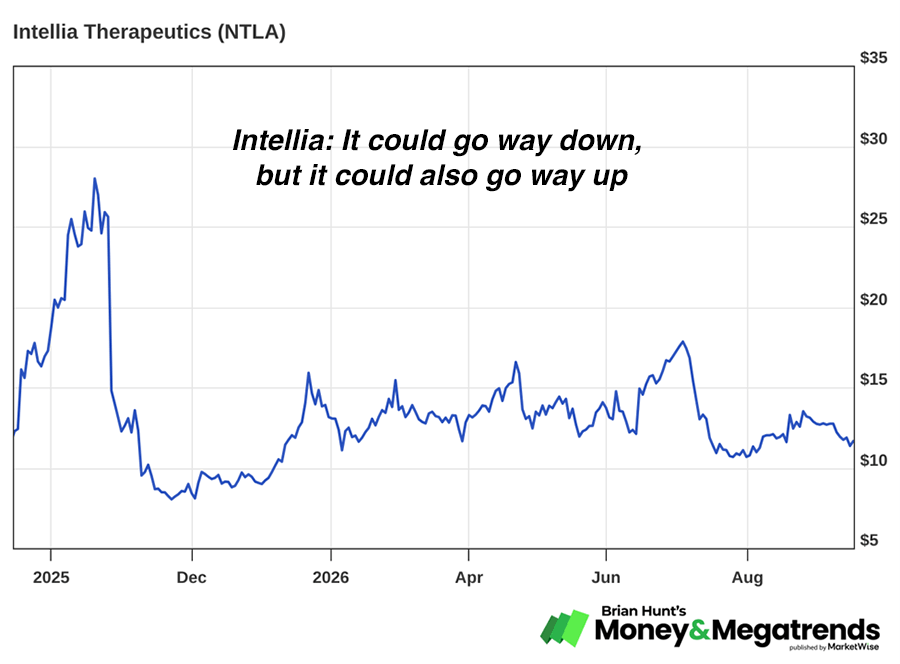
In April 2026, Intellia Therapeutics (NTLA) achieved a milestone in the field by publishing the world’s first successful Phase 3 clinical data for an in vivo CRISPR (a gene editing technology) therapy. The landmark trial evaluated lonvoguran ziclumeran (lonvo-z), a groundbreaking treatment injected directly into the bloodstream to cure hereditary angioedema—a debilitating, life-threatening genetic disorder characterized by severe swelling attacks.
A single, one-time intravenous infusion reduced monthly swelling attacks by 87% compared to a placebo over a six-month period. Even more impressive, 62% of patients became completely attack-free during the study, showcasing the therapy’s potential to eliminate the disease.
There are fewer than a dozen “pure play” gene editing firms.
They include Intellia, CRISPR Therapeutics (CRSP), Beam Therapeutics (BEAM), Prime Medicine (PRME), and Editas Medicine (EDIT).
These firms don’t generate much revenue right now. Owning them is a bet on future breakthroughs. They are more like high-tech science projects than they are profitable operating businesses… and their stocks are extremely volatile. Investing here is like being a venture capitalist in the stock market. Widows and orphans and those with weak stomachs should pass on this group.
Those of us who are comfortable investing relatively small amounts of money in pursuit of “asymmetric” payoffs of 10 to 1, 20 to 1, or even 30 to 1, however, can consider the gene editing group. It’s one of our top “swing for the fences” technology bets for the next five years. Batter up.
Market Notes
-
Our May 7 recommendation to consider Dell Technologies (DELL) was well timed. The stock is up 230% since our write-up and just reached a new all-time high.
-
Our May 28th recommendation to go long genomics has played out well. Natera (NTRA) just hit new highs today and is now up 103% over the last year.
-
The SonicShares Global Shipping ETF (BOAT) reached a new all-time high today.
-
Fast-food giant McDonald’s (MCD)reached a new one-year low today.
-
Chinese tech giant Baidu (BIDU) reached a new one-year low this week.
-
Casino giant Las Vegas Sands (LVS) reached a new one-year low this week.
Top Themes to Buy Now
🛡 How to invest in an extraordinary new phase of the AI bull market
Regards,


Brian Hunt
Editor, Money & Megatrends
An urgent message from our colleagues:
60-Year Wall Street Legend: “Get out by Sept. 29th”

According to McKinsey, the current AI market is worth $4 trillion. But a new form of AI – “Sovereign AI” – is about to overturn the entire industry, unleashing a $248 trillion disruption. How? By making data centers owned by SpaceX, Google, OpenAI and Anthropic obsolete (especially when it comes to major scientific breakthroughs). America’s first “Sovereign AI factory” is set to open before the end of the year. One company is poised to profit.
Go here for the full story and Marc’s top “Sovereign AI” stock pick now.