
Today’s issue in preview:
-
This quiet bull market is making shareholders rich. Do you own it?
-
Best Buy just hit a new high… and you think the American consumer is struggling?
-
Mass adoption of AI will power a bull market in this industry. How to invest.
-
Learn our Top Themes to buy now
This quiet bull market is making shareholders rich. Do you own it?

Credit: Stock87
One of our favorite bull markets just delivered another round of new highs.
Last week, the list of oil and gas stocks that reached new one-year highs was as long as your arm.
New highs included ExxonMobil (XOM), Chevron (CVX), Shell (SHEL), BP (BP), Equinor (EQNR), Petrobras (PBR), Suncor Energy (SU), Canadian Natural Resources (CNQ), ConocoPhillips (COP), EOG Resources (EOG), Permian Resources (PR), Ovintiv (OVV), APA Corporation (APA), Chord Energy (CHRD), Murphy Oil (MUR), Talos Energy (TALO), HighPeak Energy (HPK), and Gran Tierra Energy (GTE).
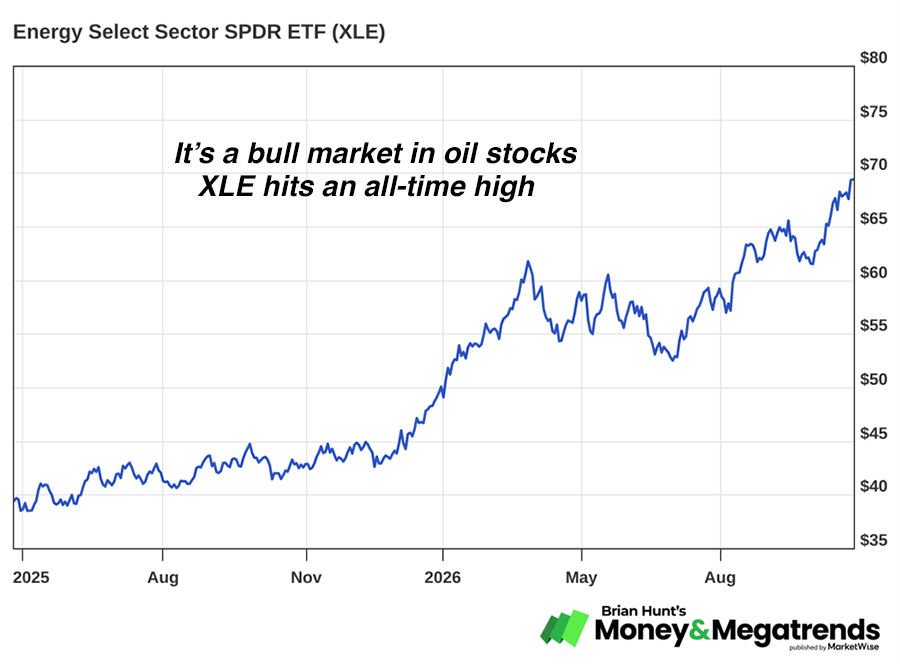
The strength in these individual names helped power the world’s largest oil and gas focused ETF – the Energy Select Sector SPDR Fund (XLE) – to a new all-time high.
Avid Money & Megatrends readers are not surprised to see oil and gas stocks on the new highs list.
In September 2025, I made the case for going long the emerging uptrend in oil and gas stocks. At the time, I said as the global economy grows, oil demand will remain solid. However, importantly, U.S. shale oil production growth appears to be peaking.
Flatlining supply from this region would remove a critical and reliable source of production growth that has been in place for more than a decade. Plus, oil was very cheap relative to gold and other assets, indicating good value.
With all that in mind, we’ve written frequently and bullishly about owning the kinds of companies listed above. The oil sector has been one of the true market leaders over the past year.
When I recommended oil and started trading it from the long side, I did not factor in the potential bullish driver of the Iran War. That’s been a “bonus” driver of gains in oil stocks. Sometimes, the dice roll in your favor.
Although positive news related to the Iran War could emerge at any time and trigger a short-term correction in oil and oil stocks, the long-term picture remains bullish for three reasons:
One: Critical Middle Eastern oil infrastructure has been damaged. Oil flows will not return to pre-war levels for possibly over a year. This supports oil prices north of $80 per barrel, which in turn supports strong cash flows for oil and gas firms.
Two: Most countries maintain large above-ground “buffer” supplies of oil and refined petroleum products in the event of market disruptions such as the Iran War. Over the past six months, much of these buffer supplies have been depleted to compensate for the loss of Middle Eastern flows. They must be replenished.
The coming restocking of buffer supplies will support oil prices north of $80 per barrel… which, again, supports large cash flows for oil and gas firms.
Three: Although oil stocks have enjoyed a large run since our September call, they aren’t up much over the past ten years. Adjusted for dollar debasement over the past decade, key oil and gas ETFs are down significantly. This is not an aging bull market that has attracted too many fans and too much capital. It is the opposite of that.
The price of oil has climbed 14% over the past three weeks. That has given oil and gas stocks a large short-term boost. But the industry’s big fundamental drivers should continue to drive oil and gas stocks higher over the long term.
Recommended Link:
Earth Stocks Are Becoming a National-Security Trade

Today’s chokepoint is rare earth magnets. And the biggest industrial buildout of our lifetimes – Musk’s newest project included – is competing for the same limited supply. Luke Lango has spent months mapping how every pillar of what could be Elon Musk’s next act – the robots, the orbital data centers, the chip fabs, all of it – depends on a short list of critical suppliers. Luke calls the master plan “XPANSE.” And it’s a project so enormous that Elon himself believes it could make early investors 1,000 times their money. Luke gives away the name and ticker symbol of an investment perfectly positioned to capitalize – free.
Best Buy just hit a new high… and you think the American consumer is struggling?

Credit: felixmizioznikov
Is the American consumer – and the economy it powers – doing much better than most people think it is?
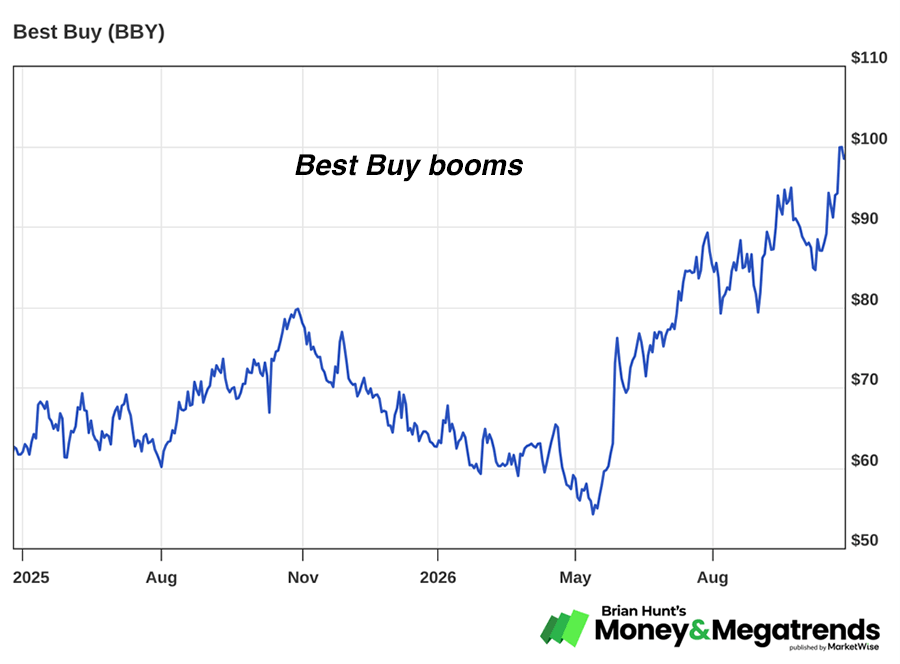
If you look at a price chart of Best Buy (BBY), you could easily start thinking that’s the case.
Over the past month, we have published a series of research notes on bull markets in Visa (V), Mastercard (MA), premium-retailer Williams-Sonoma (WSM), and hotel operators such as Marriott International (MAR). In each one, we concluded that the American consumer and the economy it powers is not in the dumps as the mainstream media tries to make us believe, but is actually doing quite well.
The companies above are sensitive to the health of the American consumer. Their fortunes rise and fall with America’s ability to spend money on vacations, clothes, household goods, and entertainment. They don’t soar to new highs in a weak economy.
Thanks to last week’s trading, we can add Best Buy to this growing list of “real world” indicators saying the American consumer is doing well.
Best Buy is America’s largest specialty electronics retailer. It sells computers, smartphones, televisions, appliances, audio equipment, gaming products, and other technology. The company operates more than 1,000 stores across North America and maintains a large e-commerce business.
In addition to selling products from leading brands such as Apple, Samsung, Sony, and Microsoft, Best Buy generates revenue from installation, repair, technical support, and other services through its Geek Squad business.
Best Buy sells few things anyone “needs” to have. Instead, it sells things consumers “want” to have. This makes the company’s business performance and stock price trend good reads on the health of the American consumer.
Best Buy reported quarterly results on August 27. It reported a comparable-store sales increase of 4.1% and a near-term outlook that pleased Wall Street analysts. The stock has returned 27.6% over the past year and reached a new one-year high on Friday.
Many investment professionals fixate on government data such as unemployment figures, job hirings, and the Consumer Price Index. I like to know that data as everyone else does. However, when I want a read on what’s really happening in the economy, I place far greater focus on what’s happening in the real world.
I look at stock prices. In doing this, I listen to the judge, jury, and executioner of any thesis, any trend, and any claim: The market.
You can read a thousand differing opinions and forecasts related to the economy, the consumer, interest rates, or the status of the AI boom. However, there’s only one source of objective truth: Market prices.
Market prices are the sum total and final expression of all knowledge held by industry insiders, connected money managers, government officials, and bankers who quietly control huge swaths of the economy. These people know 50 times as much about their industries of focus as you or I do.
Their knowledge manifests itself through action… and that action sets market prices. Market prices are not always perfect, but much of the time, they know hell of a lot more than any economist or investment guru.
If you ever get brain overload from listening to or reading lots of “experts” espousing lots of conflicting opinions about a war, a technology, or the health of the economy, you can easily tune them out and focus on signals that contain more distilled insider knowledge in them than all those experts combined: Market prices.
Does the U.S. economy have imbalances, distortions, and risks? Absolutely. It always does. But making money in stocks is never the result of a problem-free economic environment. It’s always about being in an environment where the big problems are overwhelmed by the even bigger positives.
Right now, the market is telling us that the positives are currently much stronger than the negatives. The market prices of key cogs in the economic machine such as Visa, Mastercard, Best Buy, Williams-Sonoma, and Marriott are very strong. This does not happen when the economy is weak. Manage your financial affairs accordingly!
Mass adoption of AI will power a bull market in this industry. How to invest.

Credit: ismagilov
To help us track and trade the world’s strongest business and technology trends, our Global Trend Tracker monitors over 170 industry groups, over 30 proprietary thematic indexes, over 70 ETFs, and over 3,500 public stocks.
This trend-tracking system serves as our “all-seeing eye” – an early-detection system that continuously monitors money flows and shifts in the market climate.
It is designed to identify powerful trends very early in their lifespans, giving us the opportunity to capitalize on them before they become popular investment themes. A business, product, or technology trend can barely twitch without being picked up by our Global Trend Tracker.
Over the past two months, the broad market has traded in a sideways consolidation pattern, so few sectors and themes have demonstrated market leadership and reached new highs.
Above, we cited how oil stocks are bucking the broad market’s trend and powering higher.
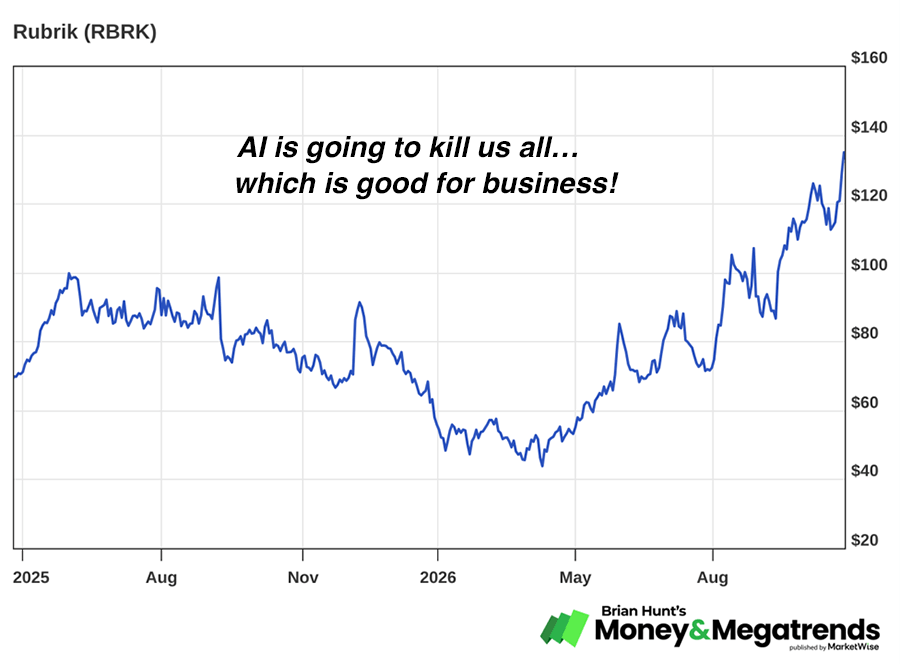
But don’t forget that cybersecurity stocks are powering higher as well. This morning, cybersecurity firms Netskope (NTSK), Qualys (QLYS), Rubrik (RBRK), and Tenable (TENB) reached new one-year highs.
These individual leaders powered the Global X Cybersecurity ETF (BUG) to a new one-year high this morning. It’s one of the few conventional equity ETFs to reach that milestone today.
After all, as we forecasted early this year, it’s a bull market in AI-powered cyberattacks and a bull market in the global freakout over how dangerous AI will become.
Back in March, we detailed how cybersecurity stocks were a compelling way to invest in our forecasted Agent Supernova, which is the explosion of AI agents that work for us, think for us, shop for us, invest for us, and solve hundreds of different problems for us.
In that issue, we covered how this Agent Supernova was poised to explode, creating a huge number of new cybersecurity threats across banking, transportation, social media, energy production, healthcare, manufacturing, and many other industries.
If we’re going to have millions of AI agents performing billions of daily tasks in health care, education, energy, transportation, manufacturing, and technology, then we’re going to have billions of points of cybercrime vulnerability. And remember, crooks get to use AI too.
If agents can roam the web, communicate for you, log in to your apps, move money, and modify data at machine speed, then a compromised agent can do the same damage just as fast – now with far less human oversight to catch mistakes or intrusions. We stated this is why well-positioned cybersecurity companies are poised to enjoy years of booming business.
Concerns over AI safety have surged over the past two months, thanks in part to current and former Anthropic employees airing concerns that AI “could kill us all.”
They have shared precious few details on exactly how AI would do that, but presumably, they have some movie scenarios in mind, such as a “bad” AI taking over nuclear missile launches, developing a killer virus, or taking over transportation systems and causing catastrophic accidents.
Adding fuel to the fire of concerns are reports this month from cybersecurity giant Cloudflare (NET) that AI-powered attacks can continuously test system weaknesses and change attack methods based on what they learn. Unlike the cybercriminals of days past, these malevolent AI agents will work 24 hours a day, 7 days a week, without a break.
Given all this, many of us are justifiably very spooked over AI-powered cyberattacks. Political leaders are spooked over AI. And business leaders are spooked over AI.
This is all bullish for the cybersecurity business. After all, few things drive large increases in corporate cybersecurity budgets like a global AI panic.
We can see the future very clearly: Your average Fortune 500 CEO will be encouraged by his board to increase the cybersecurity budget. He will be encouraged by his executive team and workforce to increase the cybersecurity budget. Even his wife and kids will encourage him to increase the cybersecurity budget.
After all, the guy on the news said that “AI could kill us all!”
At the time of our March note, cybersecurity stocks – a special type of software stock – had suffered a sharp decline due to investor concerns that AI would disrupt software.
Soon after our note, cybersecurity stocks staged a huge rebound as investors began to believe AI wouldn’t disrupt the business as much as they had thought. CrowdStrike (CRWD) has returned 167%. Palo Alto Networks (PANW) has returned 148%. The Global X Cybersecurity ETF has returned 103%. And today, a handful of key cybersecurity players reached new highs.
AI is the most exciting and potentially transformational technology of our time. The high-profile concerns raised by AI insiders over the past few months suggest it’s probably also the most dangerous. That’s bullish for the cybersecurity industry.
Market Notes
-
Our September 2025 recommendation to get long oil and gas stocks continues to pay off. Oil giants Exxon Mobil (XOM), Chevron (CVX), Permian Resources (PR), Chord Energy Corporation (CHRD), and Range Resources (RRC) hit new one-year highs today.
-
The Boomer healthcare theme we recommended continues to do well. Pharma giant Takeda Pharmaceutical (TAK) and Danish biotech giant Genmab (GMAB) justreached new one-year highs today.
-
EV maker Rivian (RIVN) reached a new one-year low today.
-
Drug development investment and royalty firm Royalty Pharma (RPRX) reached a new high today. This is a more bullish development for the biotech uptrend.
-
Software names DocuSign (DOCU), Dropbox (DBX), Paylocity (PCTY), Freshworks (FRSH), and AvePoint (AVPT) all reached new one-year highs today.
-
Brazilian banks Banco Bradesco (BBD), Banco Santander (BSBR), and XP (XP) all plunged to one-year lows after an election surprise in Brazil led to Lula Da Silva’s victory.
Top Themes to Buy Now
💊 An important “tell” from the market
Regards,


Brian Hunt
Editor, Money & Megatrends
An urgent message from our colleagues:
URGENT: A new type of AI could unleash gains of up to 10,000%

You won’t hear this in the media…
But we are at the inflection point right before a new type of AI called “Accelerated AI” explodes into the mainstream… and unlocks an entire new dimension of exponential growth.
If history is any guide, we could be looking at potential gains of up to 10,000% from here.
If you want to find out more about “Accelerated AI” and why it’s about to crack open the next wave of AI profits…
And get the name and ticker of the #1 “Accelerated AI” play everyone should buy right now – for free…
Click here now.