
Listen to the audio version of this article (generated by AI).
Today’s issue in preview:
-
This off-the-radar bull market is minting millionaires. Are you profiting yet?
-
The rich get richer in this market-leading industry
-
If you’re bearish on America after seeing this chart, please consult a brain specialist
-
Learn our Top Themes to buy now
This off-the-radar bull market is minting millionaires. Are you profiting yet?

Credit: BlackJack3D
Turn on CNBC or open The Wall Street Journal, and you’ll hear plenty about artificial intelligence, politics, and Jensen Huang’s big problem.
What you probably won’t hear much about is the quiet bull market in biotechnology that is minting fortunes virtually every month.
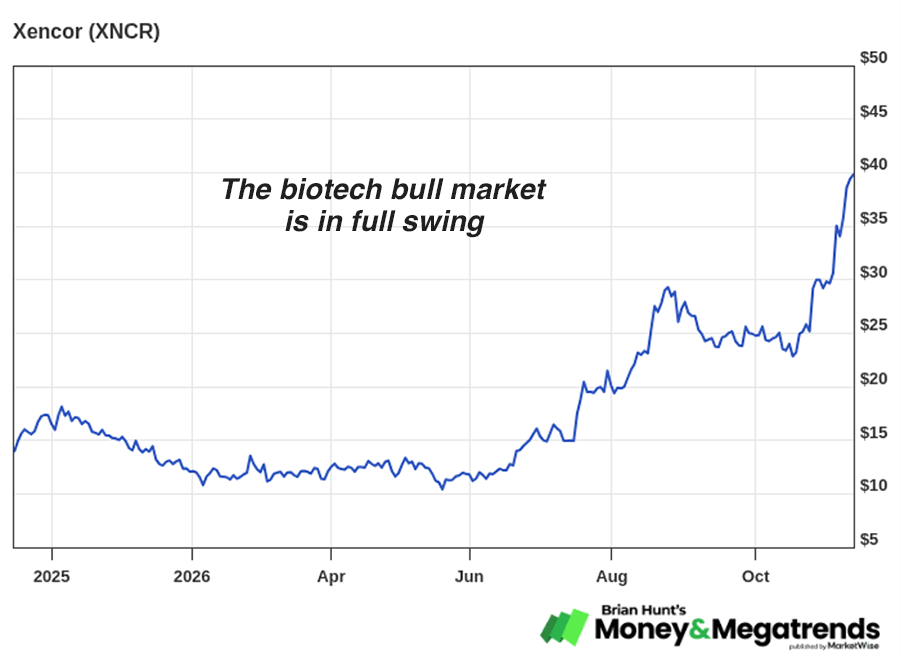
This week, the market sent biotech firms TG Therapeutics (TGTX), Kymera Therapeutics (KYMR), Kodiak Sciences (KOD), Replimune (REPL), Xencor (XNCR), Zymeworks (ZYME), and Septerna (SEPN) to new one-year highs.
Plus, biotech industry giants Amgen (AMGN) and Gilead Sciences (GILD) are both up more than 40% over the past year and are trading near their all-time highs.
These individual stock trends are further confirmation that the biotech bull market is in full swing and is full of opportunities. They also make our recommendation to invest in this theme a very large winner.
On Aug. 18, 2025, I sent a research note to colleagues outlining my bullish view of the biotech sector’s price action. Since then, I’ve written more than a dozen updates on the biotech bull market, as the S&P Biotech ETF (XBI) has returned 71%, far outpacing the S&P 500’s 17.7% return.
The biotechnology sector occupies a unique spot in the healthcare industry. It is home to companies developing cures and treatments for hundreds of diseases. When investors grow interested in this industry, the returns can be incredible. During the last biotech bull market, the sector soared 300% over four years.
Because biotech performed poorly from 2021 to mid-2025, most investors are indifferent to it. But this industry is one of the clear market leaders of the past year, and its momentum will continue.
In the future, the convergence of AI and biology will create dozens of large investment opportunities. Armed with increasingly powerful AI systems, researchers will be able to run millions of digital simulations, identify promising drug candidates, predict how treatments will interact with the human body, and accelerate the discovery process.
Drug development could shift into overdrive. Breakthroughs that once took decades could arrive in years. Diseases once considered untreatable could become manageable or even curable. And as this revolution unfolds, I expect it to generate many compelling stock market narratives, breakthrough companies, and large winners.
Companies that leverage AI to “crack the code” for various diseases, treatments, and drugs will enjoy 100%… 500%… even 1,000%+ stock rallies. In many cases, these rallies will happen thanks to stories and potential… rather than a company generating revenue or earnings.
Biotechnology stocks currently have one of the stock market’s most powerful setups working in their favor … yet the investment public remains largely indifferent. It’s an “Unpopular Uptrend.”
CNBC is not running long segments devoted to the biotech bull market. Biotech newsletters are not flying off the shelves. Biotech CEOs are not popular as podcast guests. If I were to bring up biotech investing at an investment conference, I’d get blank stares in return.
This “state of indifference” is very bullish for biotech stocks.
I often say that I could profitably trade stocks for the rest of my life by going long established market trends that the public is either indifferent to or hostile towards. It’s literally all I need to generate substantial returns.
This strategy is so effective and so broadly applicable across all asset markets that it is the Swiss Army Knife of trading. It works in every market for several reasons…
One, market trends tend to persist, and winners tend to keep on winning. This is one of the “Iron Laws” of business, markets, and life.
It takes an enormous amount of time, energy, and investment to get a big trend up and running. This goes for technological, business, and macroeconomic trends. Once trends achieve critical mass and develop momentum, they often become like snowballs rolling down a hill… gathering mass and speed in self-reinforcing cycles that last for years.
Second, an ignored market is usually relatively cheap… and often offers high upside potential.
When the public is indifferent towards a theme or asset class, that market will not be bid up to expensive levels. This means the trend could run higher for years. It has plenty of “valuation room” to grow into. Plus, some of the money on the sidelines could eventually pile into the market and drive prices higher.
In other words, “A strong industry uptrend + public indifference towards that industry” is one of the greatest moneymaking equations in all of finance.
The biotech industry has tremendous price momentum working in its favor… plus the investment public is largely indifferent to its success. This is a powerful combination that makes more new highs a high-probability bet.
Recommended Link:
Log into our new $5,000 AI Signals Trading system

It shows you the most profitable trades, 90 minutes before they occur, every morning. In 2026, we’ve officially booked gains of 7.6% in 24 hours on (TER)… 8.5% in 48 hours on (RDDT)… 14.4% in 48 hours on (MTSI) and more. Try it on 2,467 stocks now (no purchase required).
The rich get richer in this market-leading industry

Credit: janiecbros
The business of creating and selling drugs isn’t the only facet of the Boomer healthcare megatrend rewarding shareholders this year (see above).
The businesses that support the businesses creating and selling drugs are booming as well.
This is what the market leadership of the Pharmaceutical Infrastructure industry group is telling us right now. This week, members of this group leading the market and reaching new one-year highs include:
Thermo Fisher Scientific (TMO), a $267 billion leader in laboratory instruments, diagnostic equipment, research services, and life sciences supplies. Its products and services help pharmaceutical companies develop new drugs, laboratories conduct sophisticated testing, and scientists perform cutting-edge research.
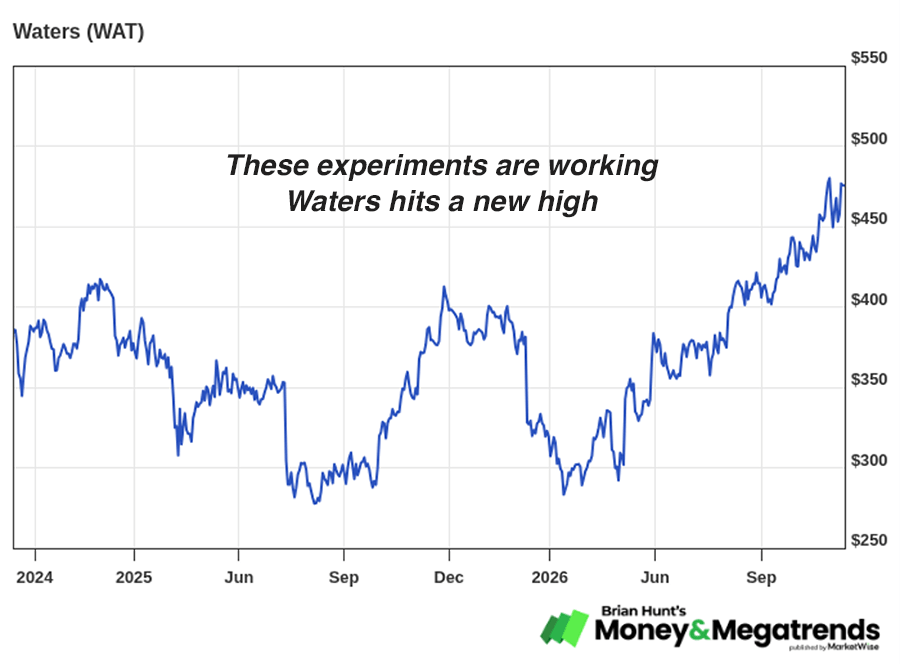
Waters (WAT), a $47 billion leader in analytical instruments used in pharmaceutical development, chemical analysis, and scientific research. Its chromatography and mass spectrometry systems help researchers identify and measure chemical compounds, test drug purity, and ensure product quality.
Azenta (AZTA), a $2.1 billion provider of biological sample storage, laboratory automation, and sample management services for pharmaceutical and biotechnology companies. Its systems help researchers safely preserve, organize, and retrieve millions of biological samples used in drug discovery and scientific research.
Cryoport (CYRX), a $1.1 billion provider of specialized temperature-controlled logistics and storage services for cell therapies, gene therapies, and biological materials. Its technology helps ensure that highly sensitive, often irreplaceable biological products remain viable during transportation and storage worldwide.
IQVIA Holdings (IQV), a $46 billion leader in clinical research services, healthcare data, and analytics. The company helps pharmaceutical and biotechnology firms develop new drugs, conduct clinical trials, analyze healthcare data, and bring new treatments to market.
The Pharmaceutical Infrastructure industry group supplies the essential tools, technologies, equipment, and services that drug companies need to discover, test, and manufacture new medicines.
These businesses produce everything from sophisticated laboratory instruments and diagnostic systems to drug-testing equipment, specialized chemicals, and advanced manufacturing equipment.
Back in September, we highlighted this group’s emerging uptrend and bright long-term outlook… which is being powered by the larger Boomer healthcare megatrend.
The fortunes of the Pharmaceutical Infrastructure group above are closely tied to the R&D and capital spending cycles of drug firms such as Pfizer (PFE), Eli Lilly (LLY), and Gilead Sciences (GILD).
When drugmakers expand laboratory research, genomic analysis, testing programs, and manufacturing capacity, they require more analytical instruments, services, consumables, and bioprocessing equipment – the “picks and shovels” supplied by companies like Waters and Azenta.
We believe the new highs reached by the likes of these firms are harbingers of a healthcare megatrend that will generate large returns over the coming years: That thanks to advanced genomic sequencing, AI-powered data analytics, and other bleeding-edge innovations, the healthcare industry will move away from blunt “one-size-fits-all” treatments and move to more “personalized” treatments that are tailored to an individual’s genetic makeup.
This megatrend will drive strong drugmaker R&D spending and strong revenue growth for well-positioned “picks and shovels” firms above.
Also, consider that U.S. healthcare leaders and the U.S. government are very keen on increasing domestic drug manufacturing to reduce our reliance on foreign manufacturing.
The FDA says more than half of pharmaceuticals distributed in the U.S. are manufactured overseas, and only about 11% of active pharmaceutical ingredient (API) manufacturers are U.S.-based.
Since 2025, pharmaceutical companies have announced hundreds of billions of dollars of U.S. manufacturing and R&D investment. Commercial real estate investment firm CBRE tracked approximately $350 billion in announcements, although it estimates that roughly half of these were projects already planned or underway – an important caveat when interpreting the headline.
Combine these two trends – the personalized treatment revolution and the domestic drug manufacturing boom – and you get serious fundamental tailwinds that should drive the bull market in many areas of healthcare, especially the “picks and shovels” providers of drug development and manufacturing. This new stock trend has further to run.
If you’re bearish on America after seeing this chart, please consult a brain specialist

Credit: Serjio74
The railroad business isn’t as exciting as Elon Musk launching rockets or the latest AI agent, but it’s a huge, “mission-critical” part of the U.S. economy.
And most people don’t realize it, but this mission-critical industry is sending us a powerful bullish signal about the state of the U.S. economy.
Over the past month, I’ve written over a dozen research notes analyzing the soaring share prices of highly economically sensitive industry groups, including regional banks, manufacturing stocks, steelmakers, credit card firms, and hotel chains.
At the end of each note, I said their strong business performances and soaring stock prices are evidence that the U.S. economy is doing much better than most people think.
These economically sensitive firms are important “real world” indicators.
They almost always do a better job of telling us what is happening in the economy than any media outlet or economist. And their uptrends are moving in a bullish upward direction for the U.S.A.
The railroad business is a key member of this group… and its booming.
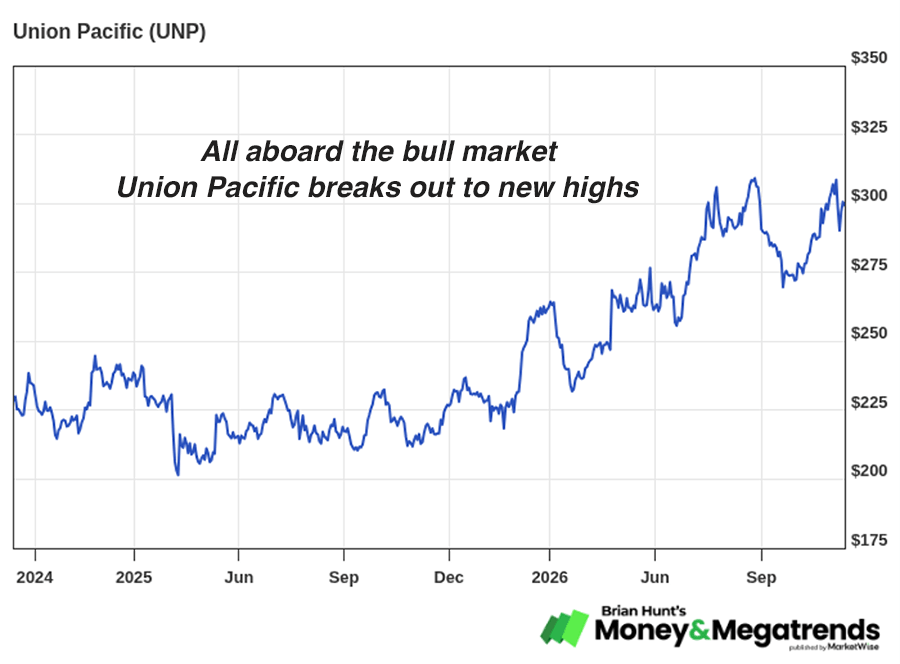
Over the past year, railroad giants Union Pacific (UNP), CSX Corp. (CSX), Canadian Pacific Kansas City (CP), and Norfolk Southern (NSC) have quietly generated excellent business performance and bull markets in their stock prices.
Each stock is in a clear uptrend and is currently trading near a one-year high.
Here’s why this “off the radar” bull market is important for you…
Railroads are among the most important arteries of the American economy. They move huge quantities of grain, coal, chemicals, automobiles, construction materials, and consumer goods across the country, connecting farms, factories, mines, ports, and distribution centers.
Railroads are particularly important for transporting heavy, bulky commodities over long distances, where they are generally much more fuel-efficient and economical than trucks. They also play a critical role in international trade, moving shipping containers between major ports and inland markets. For example, around 75% of new cars sold in the U.S. spend time on a train.
This means the stocks of railroad companies such as Union Pacific are highly economically sensitive and powerful financial indicators. These stocks do well when America is making things, buying things, building things, and transporting things.
The bull market in America’s largest railroad operators flies in the face of all the negative and alarming economic stories the mainstream media likes to run.
But remember, market prices are the total and final expression of all knowledge held by industry insiders, connected money managers, government officials, and bankers who quietly control huge swaths of the economy. These people know much more about their industries of focus than you or I do. Their knowledge manifests itself through action… and that action sets market prices.
Market prices are not always perfect, but much of the time, they know a hell of a lot more than any economist or investment guru.
If you ever get brain overload from listening to or reading lots of “experts” espousing lots of conflicting opinions about a war, a technology, or the health of the economy, you can easily tune them out and focus on signals that contain more distilled insider knowledge in them than all those experts combined: Market prices.
Right now, market prices are telling us that railroads – a key part of the U.S. economy – are in a bull market.
Does the U.S. economy have imbalances, distortions, and risks? Absolutely. It always does. But making money in stocks is never the result of a problem-free economic environment. It’s always about being in an environment where the big problems are overwhelmed by the even bigger positives.
Right now, the market is telling us that the positives are currently much stronger than the negatives. The market prices of key cogs in the economic machine are very strong. This does not happen when the economy is weak. Manage your financial affairs accordingly!
Market Notes
-
Our Jan. 28 recommendation to own the AI application layer is paying off. Zeta Global Holdings (ZETA) just hit a new yearly high. It is up 94% since our initial recommendation.
-
Our March 27 recommendation to own cybersecurity stocks is still paying off. Government security specialist Telos (TLS) reached a new one-year high today.
-
The Boomer health care megatrend is alive and well. Senior housing and medical property owner American Healthcare REIT (AHR) and eye health giant Bausch & Lomb (BLCO) reached new one-year highs today.
-
The consumer continues to spend with enthusiasm. Formula One owner Liberty Media (FWONK), outdoor gear maker Clarus (CLAR), and watchmaker Fossil Group (FOSL) reached new one-year highs today. These are more bullish economic signals.
-
EV charging network ChargePoint (CHPT) reached a new one-year high today.
Top Themes to Buy Now
⛏️ Here’s why silver could resume its explosive uptrend
Regards,


Brian Hunt
Editor, Money & Megatrends
An urgent message from our colleagues:
Bigger than Nvidia? Louis Navellier thinks so.

In 2016, Louis Navellier recommended Nvidia at $2.51 — split-adjusted. It went up 44,000%. He also called Apple before a 36,000% rise and Microsoft before a 60,800% climb. Now he says a new AI device coming online in Tennessee is the setup for the biggest call of his career.
He’s agreed to reveal the stock at the center of it — down to the ticker — for free.