
Listen to the audio version of this article (generated by AI).
Today’s issue in preview:
-
This blue-chip stock is poised to get a big AI boost
-
The biggest industry gold rush you’re probably missing
-
The stock market is flashing a powerful economic signal… yet almost no one is talking about it
-
Learn our Top Themes to buy now
The stock market is flashing a powerful economic signal… yet almost no one is talking about it

Credit: alfexe
AI gets most of the headlines these days, but one of America’s oldest, most boring industries is quietly enjoying a big bull market.
And that’s great for your 401(k)!
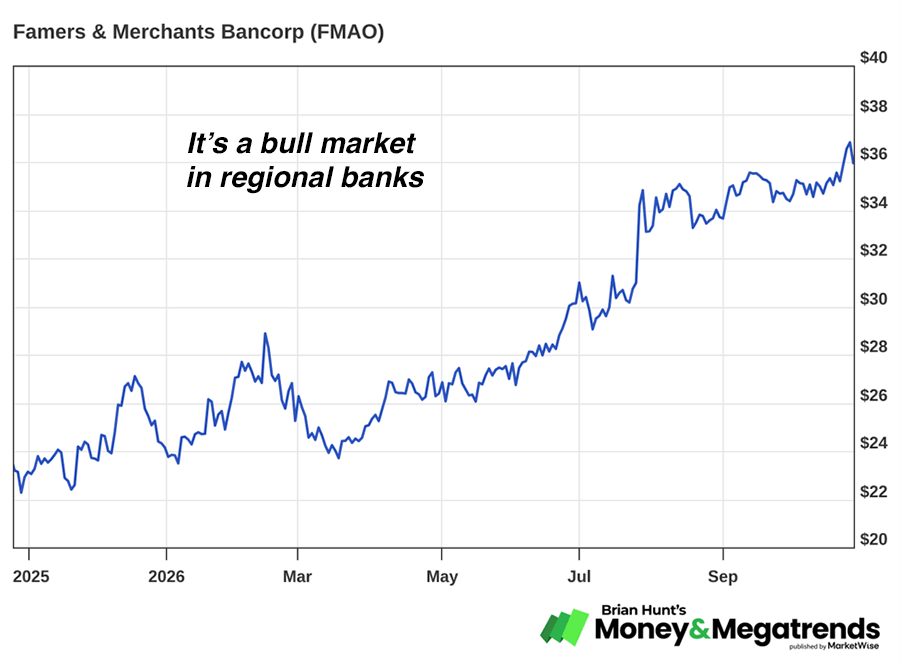
This week, the list of stocks marking new one-year highs is full of America’s regional banks.
Regional bank firms surging to new highs this week include:
United Community Banks (UCB), Customers Bancorp (CUBI), Dime Community Bancshares (DCOM), Tompkins Financial (TMP), HBT Financial (HBT), Eagle Bancorp (EGBN), Orrstown Financial (ORRF), Capital Bancorp (CBNK), Bank7 (BSVN), Sierra Bancorp (BSRR), West Bancorporation (WTBA), Farmers & Merchants Bancorp (FMAO), Northeast Community Bancorp (NECB), First Bancorp (FNLC), Princeton Bancorp (BPRN), Citizens Financial Services (CZFS), and First United (FUNC).
These regional banks are much smaller firms than giants like Bank of America (BAC) and Wells Fargo (WFC).
For example, BofA’s market cap is $350 billion. Most regional banks have market caps under $5 billion, or less than 2% of BofA’s.
Regional banks derive a greater share of their profits from “plain vanilla” banking activities, such as business loans, real estate development loans, and mortgage lending, than some “mega banks” do.
This makes your average regional bank highly sensitive to the economic health of its region. Its profits and market value will rise and fall with the area’s ability to create new businesses, operate existing ones, and pay back home loans. A regional bank is something of a “catch basin” into which the economic health (good or bad) of its surrounding community flows.
Right now, enough regional economies across America are doing so well that over 20 regional bank stocks reached new one-year highs this week. This is one of the most important economic signals the mainstream media won’t tell you about.
Over the past month, we have published a series of research notes on bull markets in Visa (V), Mastercard (MA), premium retailer Williams-Sonoma (WSM), electronics retailer Best Buy (BBY), and hotel operators such as Marriott International (MAR).
In each one, we concluded that American consumers and the economy they power are not in the dumps as the mainstream media tries to make us believe, but are actually doing quite well.
Today, let’s add regional banks to this large and growing list of “real-world” economic indicators that reflect a strong U.S. economy.
Does the U.S. economy have imbalances, distortions, and risks? Absolutely. It always does. But making money in stocks is never the result of a problem-free economic environment. It’s always about being in an environment where the big problems are overwhelmed by the even bigger positives.
Right now, the market is telling us, via bull markets in Visa, Mastercard, Best Buy, Williams-Sonoma, hotel operators, and regional banks, that the positives are much stronger than the negatives. Who knew having “Bancorp” in your company’s name would be almost as powerful as “AI” here in 2026?
Recommended Link:
Elon Musk: This Could be 180 Times Bigger than SpaceX IPO

Elon Musk is on record predicting this new opportunity is set to be 180 times bigger than the SpaceX IPO. That IPO minted 4,400 millionaires overnight. If this is 180 times bigger… Just imagine how many more Americans will become millionaires. Will you be one of them? Click here now.
The biggest industry gold rush you’re probably missing

Credit: OpenAI
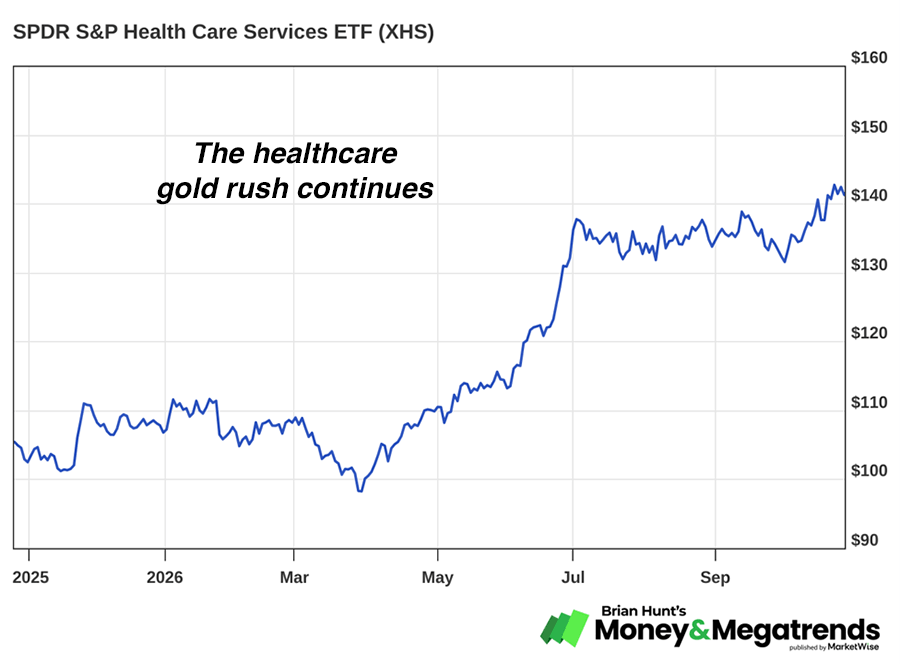
Day after day, week after week, month after month, healthcare stocks are proving one of the market’s oldest truths: Trends tend to persist and winners tend to keep winning.
On Monday, the sector posted another round of new highs, making shareholders richer.
The list of healthcare industry leaders reaching new one-year highs includes:
LTC Properties (LTC), a $2.4 billion real estate investment trust focused on senior housing and healthcare properties. Its portfolio includes assisted living, memory care, and skilled nursing facilities serving America’s aging population.
The Pennant Group (PNTG), a $1.5 billion healthcare services company operating home health, hospice, and senior living businesses. Pennant benefits from growing demand for home-based medical care and services for America’s aging population.
AtriCure (ATRC), a $3.1 billion medical device company specializing in treatments for atrial fibrillation, a common heart rhythm disorder. Its technologies help physicians correct abnormal heart rhythms and reduce the associated risk of stroke.
West Pharmaceutical Services (WST), a $27.8 billion manufacturer of specialized packaging and drug-delivery components for injectable medicines. Its products include rubber stoppers, seals, syringe components, and injection systems used by pharmaceutical manufacturers.
Exelixis (EXEL), a $16.1 billion biotechnology company focused on cancer treatments. Its flagship drug, Cabometyx, treats several cancers, including kidney and liver cancers. Exelixis is developing additional therapies to expand its oncology portfolio.
Halozyme Therapeutics (HALO), a $14.5 billion biotechnology company specializing in drug-delivery technologies. Its ENHANZE platform allows certain intravenous medications to be administered through faster, more convenient injections, generating licensing fees and royalties.
Charles River Laboratories (CRL), a $17.1 billion provider of research and laboratory services to pharmaceutical and biotechnology companies. Charles River supports drug discovery, preclinical testing, and manufacturing, helping developers bring new medicines to market.
Certara (CERT), a $1.6 billion healthcare technology company providing software and consulting services to drug developers. Its biosimulation technology uses computer models to predict drug behavior, optimize clinical trials, and accelerate development.
Penumbra (PEN), a $12.8 billion medical technology company specializing in devices that remove dangerous blood clots. Its minimally invasive technologies help physicians treat strokes, pulmonary embolisms, and other serious vascular conditions.
In addition to these individual firms, the SPDR S&P Health Care Services ETF (XHS) powered to a new all-time high on Monday. It is one of the few conventional equity ETFs to do so.
For more than three years, I’ve made “Boomer healthcare” one of my highest conviction long-term investment themes. We don’t know of another investment research publication that has written more bullishly, more often about this booming industry than we have.
Over the past year, we have published more than two dozen pieces on opportunities in drug development, biotechnology, senior living facilities, genomics, cardiology, diagnostics, and more.
Our bullish stance has produced a parade of home runs, with the healthcare industry dominating the stock market’s list of new highs over the past year.
Healthcare stocks are generating extraordinary returns because they are benefiting from several megatrends simultaneously. One is the enormous Baby Boom generation entering the phase of life when healthcare spending skyrockets.
And two: extraordinary innovation in the healthcare sector. Thanks to advances in genomic sequencing, AI-powered analytics, imaging technology, and preventive treatments, healthcare is becoming much better and more personalized. This is driving strong demand for all kinds of new tests, tools, and treatments.
After all, when a useful and important service you buy gets much better, you typically buy more of it.
Each time I highlight the modern-day gold rush taking place in healthcare, I worry some readers are tired of reading about it. We’ve devoted so much attention to healthcare because it has paid off well for us. This is where the money is. It is the stock market version of what the famed bank robber Willie Sutton said. When asked why he robbed banks, Sutton said, “Because that’s where the money is.”
We’ve been publishing a lot on healthcare because that’s where the money has been for the past year. It’s a trend that is paying us.
One of the “Iron Laws” of business and investing is that trends tend to persist and winners tend to keep on winning. This isn’t always the case, but the odds heavily favor such a bet.
It takes an enormous amount of time, energy, and investment to get a big trend up and running. This goes for technological, business, and demographic trends. Once trends achieve critical mass and develop momentum, they often become like snowballs rolling down a hill… gathering mass and speed in self-reinforcing cycles that last for years.
Given the very large, long-term nature of the Boomer healthcare megatrend, we expect solid returns to continue.
This blue-chip stock is poised to get a big AI boost

Credit: Bruce Peter Morin
Over the past month, we have published a special research series on stocks with significant upside potential driven by the coming boom in the “AI Applications Layer.”
The AI Applications Layer consists not of companies involved in the financing and building of “hard” AI infrastructure such as semiconductor chips, AI data center buildings, electrical wiring, fiber-optic cables, power plants, and cooling systems. Instead, it consists of companies that will leverage all that very expensive (over $1 trillion and counting) infrastructure to create new businesses or augment existing ones.
We expect to see dozens of businesses follow in the footsteps of legendary winners such as Amazon, YouTube, Facebook, and Netflix.
These winners didn’t build the physical network of fiber optic lines, routers, servers, and switches that made up the internet. Instead, they built the wonderful businesses on top of that revolutionary infrastructure.
They were the “applications” layer of the internet.
It’s important to understand the applications layer concept because we’re on the cusp of a historic boom in companies that don’t build critical AI hard infrastructure but instead build wonderful businesses on top of that infrastructure… just like Apple, Amazon, and Google did with the internet.
I’m talking about AI-centric businesses that revolutionize how we invest, how we develop medicines, how we educate, how we entertain ourselves, how we manufacture, how we shop, how we transfer money, and much more. Or big changes at existing businesses that leverage AI to increase revenue and decrease costs.
The internet changed every industry and created many new ones. AI will do the same.
Investors who follow the Internet applications layer playbook into big AI applications layer winners stand to make giant returns.
Recently, we highlighted how AI-centric data analytics firm Palantir (PLTR) is a powerful example of this strategy. The business is booming, and its stock is up more than 1,000% since Jan. 1, 2024.
In our Oct. 13 issue, we detailed how the market is sending us a message that Apple (AAPL) is emerging as another winner in this trend. For more than 145 million Americans and more than 1 billion people globally, Apple devices are the primary gateway to the internet and, increasingly, to AI applications.
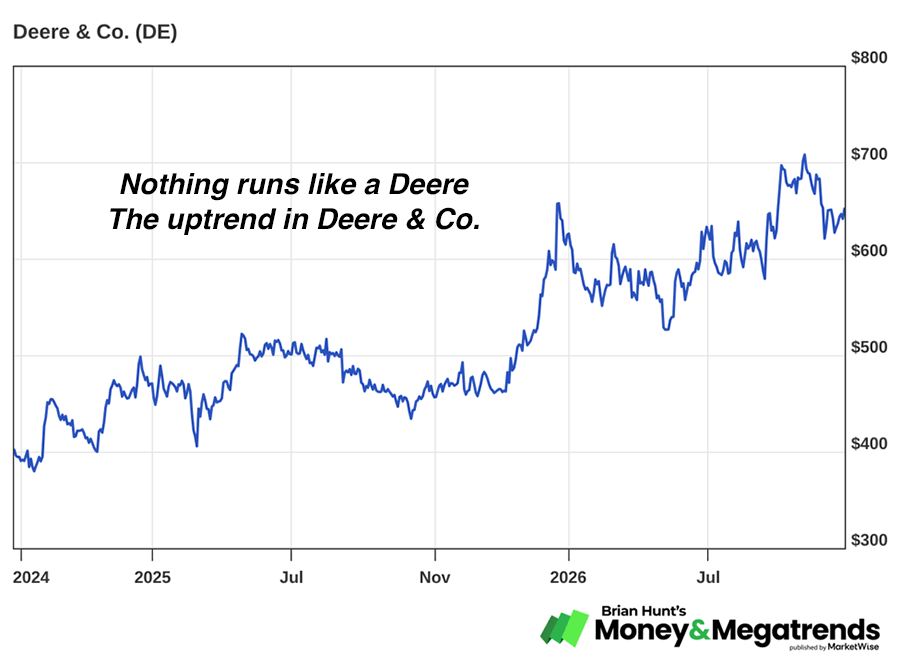
Today, we highlight how Deere & Co. (DE) is poised to benefit from the proliferation and advancement of AI.
John Deere is America’s largest manufacturer of agricultural tractors and farm machinery. The company’s unique shade of green is a common sight in fields and farms across the country.
John Deere isn’t your typical 189-year-old stodgy manufacturing company, however. Bulls on the stock say it’s an AI company dressed as a tractor company.
Deere is often cited as one of the best ways to play the boom in big data analytics and AI because it has invested heavily in building its “precision farming” expertise and product suite.
This includes data analytics and machine sensory technology that allow farmers to precisely place seeds, apply fertilizer, and spray crops with pesticides… all of which help reduce farming costs and improve crop yields.
Deere is also rolling out AI-driven autonomous operating features that essentially turn tractors into farm robots.
Deere’s investment in technology and its massive manufacturing capacity give it a significant competitive advantage over its competitors.
Importantly, Deere employs a powerful business model we call the “Money Machine” model.
Businesses that produce expensive, complex, and specialized machines like tractors, locomotives, surgical robots, and jet engines make money not only on initial product sales, but they also enjoy recurring, high-margin revenue for years afterward by selling maintenance services, replacement parts, and consumable materials the machines constantly use up, burn up, and wear down.
Owning such firms gets even better: After a customer buys an expensive, specialized machine, he is usually “locked in” or “married” to its manufacturer. You want to stick with the original manufacturer’s specialized parts and service plans.
After all, if you buy a $4 million locomotive or a $500,000 tractor, you want to make sure it has quality replacement parts and expert ongoing maintenance. You don’t want to risk switching to a different firm in pursuit of saving a few bucks. So, for better or worse, you’re married to the manufacturer… often for 7+ years.
The positives above have helped Deere’s stock appreciate by 63% over the past two years. As you can see in the chart below, the stock is enjoying an uptrend and is close to a new all-time high.
Massive tech firms such as Amazon (AMZN), SpaceX (SPCX), Microsoft (MSFT), OpenAI, and Anthropic have spent over $1 trillion on physical AI infrastructure. They are poised to spend at least $4 trillion more over the next five years. Whether those investments produce solid ROI has become one of the biggest, most intense debates in the investment world.
But what is not up for debate is that many companies will enjoy the fruits of that investment and leverage that costly infrastructure to create new businesses or augment existing ones. We bet Deere will prove to be one of the “AI Applications Layer” winners.
Market Notes
-
Online travel giant Booking Holdings (BKNG) reached a new one-year low today.
-
The bull market in cybersecurity continues: Cybersecurity firm Rubrik (RBRK) reached a new one-year high today.
-
Financial data and services giant S&P Global (SPGI) reached a new six-month high today.
-
Drug development investment and royalty firm Royalty Pharma (RPRX) reached a new high today.
Top Themes to Buy Now
💊 An important “tell” from the market
Regards,


Brian Hunt
Editor, Money & Megatrends
An urgent message from our colleagues:
AI Pioneer: Make This Move Before October 31

Most investors are piling into the same overpriced AI stocks, and AI pioneer Keith Kaplan says that’s a mistake. His firm’s AI-powered system — built with $17 million in research and a team that includes a former NSA codebreaker — has identified a small group of stocks positioned to surge before November. Keith is sharing one critical move to make before October 31st in his free briefing.
Click here to watch the full presentation now.