
A few days ago, Wall Street veteran Whitney Tilson started sounding an alarm.
He calls it America’s “ripping point.” And if you haven’t heard the term yet, you soon will.
Whitney is the man who CNBC once dubbed “The Prophet” for his string of eerily accurate market calls. And now, he says the country is entering a stretch of upheaval unlike anything he has seen during his career.
It’s all due to artificial intelligence (“AI”)… and it’s beginning to tear the economic fabric of the nation apart.
AI will create massive new fortunes for a small group of people, while ripping away the livelihoods and security of millions of others. Already, white-collar workers like lawyers, analysts, consultants, managers, and software engineers are watching AI creep into their jobs… and wondering for how much longer they’ll still have a job.
But Whitney’s message is not all bad news.
He insists this turmoil also carries huge opportunity. And he’s coming forward in an exclusive interview with a step-by-step plan to help everyday Americans use AI in their own investing.
Table of Contents
Three Core Ideas Behind Whitney’s Prediction
I’ve rarely, if ever, heard Whitney this worried.
Here’s what he wrote just days ago:
I’m concerned that our whole way of life is being swept away in front of our eyes…
Hundreds of thousands of people are losing their jobs. Violent swings are battering the stock market. Entire industries are collapsing around us.
I’m not only worried for older folks like me. I have three beautiful daughters. And it feels like their future gets more unstable with every passing day.
It’s not just because of the extreme political division or violent protests that seem to be a regular part of our lives now. I mean the deeper change that we can all feel.
We’re living through a permanent reset in our economy. It’s making the world – the one our children are going to inherit – deeply unstable.
Whitney’s “ripping point” prediction will affect every American with a 401(k) or retirement account. And it comes down to three core ideas.
First, America has hit a societal and economic breaking point.
One group of Americans is using AI to race toward new wealth – or simply to grow their current wealth. But another group is sliding into financial insecurity. And the gap between them is growing fast.
A key measure of wealth concentration called the Gini coefficient sits at 60-year highs according to a report from U.S. Bank, and terms like the “K-shaped economy” are now commonplace.
“This is not a cyclical or temporary phenomena,” said Mark Zandi, chief economist at Moody’s Analytics. “This is a structural, fundamental issue.”
Federal Reserve data shows that the top 1% in America now control nearly one-third of the nation’s wealth. The bottom half of the U.S. population, on the other hand, controls less than 3%. And white-collar employment has fallen for 17 straight months, according to the Bureau of Labor Statistics.
Social unrest is growing. Debt is ballooning. Political extremism is spreading.
For a wide swath of the population, the American dream is getting harder to even imagine, much less attain.
Second, Whitney believes the AI revolution is the primary force behind this American fracture.
AI adoption is advancing much faster than most people expected.
So, even as traditional white-collar roles and entire business models are getting gutted, new fortunes are also being built at a speed we have never seen before.
For example, the poster child for the AI revolution is chipmaking giant Nvidia (NVDA). Its stock has soared in recent years, and Nvidia was the first-ever public company to cross $4 trillion in market capitalization.
But what you might not know is that Stansberry Research, the publishing firm where Whitney hangs his hat, actually initiated coverage of Nvidia back in 2004 at a split-adjusted price of about $0.12 per share, listing it as their No. 1 buy.
Nvidia is up more than 140,000% from that initial coverage. And subscribers had multiple opportunities to buy in along the way, including right before it went on its recent tear.
The opportunities Whitney is spotting today could be just as powerful for your portfolio.
That’s why the final part of Whitney’s prediction is so important.
There is a way forward for everyday Americans, using AI in their investing instead of being afraid of it. He has helped build an AI-powered investing system specifically designed as a financial life raft for those folks willing to grab hold.
It’s called the N.E.W. System… short for “New Engine of Wealth.”
The system uses AI to crunch financial data on thousands of publicly traded companies and identify the stocks most likely to outperform. In back testing, the approach beat the S&P 500 Index, bonds, gold, and even Warren Buffett’s Berkshire Hathaway (BRK.B) over recent years.
We’ll examine each of these three ideas here today. But if you read nothing else, you should at least know Whitney’s core recommendation: Stop fearing AI, and start using it.
The American Ripping Point: A Tale of Two Economies
Whitney believes the United States has split into “Two Americas.” And this divide is reaching a “ripping point.”
By that, he means the gap between those who are thriving and those who are struggling has gotten so wide that it no longer feels like a gap. It feels like a tear.
On one side are people riding booming asset prices, cashing in on new technology, and watching their portfolios grow. On the other side are people dealing with stagnant wages, climbing costs, and a gnawing sense that they are falling behind for good.
Economists have a name for this pattern: The “K-shaped economy.”
Picture the letter K on a chart. One arm shoots upward. That is the segment of the population doing well – rising incomes, growing net worth, and expanding opportunity. The other arm falls downward. Those are the folks losing ground.
In fact, Moody’s Analytics found that the top 10% of the wealthiest Americans now account for roughly half of all consumer spending. And as the Fortune article went on to note, this is a big deal:
Morgan Stanley Wealth Management’s Lisa Shalett has increasingly been sounding the alarm from her perch as chief investment officer. She told Fortune in an October 2025 interview, “The income inequality stuff is really getting like completely wackadoo,” specifically citing Zandi’s research: “That means 90% of the country is only half the consumption, I mean holy cannoli.”
Now, in early 2026, Whitney says the K-shaped economy has started to rip. And one of the clearest signs is white-collar job losses.
We’ve been following the layoffs across white-collar industries for months now. Good jobs are already starting to disappear, and we are only at the very beginning of the layoff cycle. As we noted last month, if you’re one of several million folks employed by a Big Tech company, your job is absolutely at risk.
We went on to add:
Of course, people are clever. We’ll create other interesting, human jobs in new industries. But it’s going to take time.
In [our previous] doom-loop article, we gave the example of the 50-year period during the early Industrial Revolution when GDP growth exploded, but workers’ wages stagnated for half a century. All the gains went to capital owners.
That could absolutely happen again today.
And if it does, it will be devastating for American workers, especially for anyone who currently sits at a desk.
Using data from the Bureau of Labor Statistics, Axios reports that core white-collar employment – sectors like finance, insurance, information, and professional services – has fallen for three straight years.
For context, from 2010 to 2019, these sectors added an average of 569,000 jobs a year. In the last three years, they’ve lost an average of 191,000 jobs a year.
These sectors account for more than 40% of U.S. GDP and 20% of U.S. employment.
When the economy is expanding, these jobs have historically grown in size. These were the “safe” jobs. The desk jobs parents told their kids to get. The ones that were supposed to be recession-proof. Today, they’re disappearing.
And much of the reason has to do with AI. As we wrote last fall, the AI layoffs will continue until morale improves:
Goldman Sachs says that AI can already replace 2.5% of the American workforce – that’s more than 4 million employees. And looking ahead, it expects as much as 14% of the current U.S. workforce could ultimately be at risk within the next five years.
That would be roughly 22 million Americans, suddenly out of work…
Already, social tensions are boiling over in America. What do you think will happen when millions more Americans find themselves jobless, thanks in large part to AI?
America is living through a foundational shift. We stand at the beginning of a new era. But for that era to begin, the old era must end. And a huge portion of the population risks being left behind.
Whitney compares this moment to earlier transformative periods, like the advent of railroads or the arrival of electricity. These were times that reshaped society in a generation, exactly as AI is doing today.
The AI Revolution’s Winners and Losers
If Whitney’s ripping-point prediction describes what is happening to America today, then AI explains why it is happening so fast.
Whitney calls AI the most destructive and creative economic force of our lifetimes. And it certainly looks that way.
For some companies, AI has been a disaster.
In his interview, Whitney points to the example of Gartner (IT):
For 45 years, it has been one of the biggest consulting firms in the world and has thousands of staff worldwide. It’s the whitest of white-collar firms.
And yet, it took just months to wipe out HALF of its market value, including a 31% one-day plunge in February.
Companies that were once pillars of finance, analytics, and consulting have all gotten hit as investors realize AI can replicate some or much of what these firms do.
In finance and law, the early signs are already showing up. Junior analysts and attorneys face replacement by AI that drafts reports or contracts in seconds.
For example, Goldman Sachs’ CEO David Solomon noted last year that AI can now draft 95% of an IPO prospectus in minutes. That task once took a six-person team working on it for two weeks. In other words, some 480 hours of highly compensated human effort can now be done in maybe 20 minutes by AI.
Today, Goldman employs some 11,000 engineers, largely to push forward on AI initiatives.
Or take language-learning app Duolingo (DUOL). Whitney continues,
The language-learning app was once a darling of the AI world. In fact, its CEO publicly pushed an “AI-first” strategy.
But now?
It turns out any off-the-shelf AI system can do what Duolingo’s software does.
The stock collapsed 75% in less than a year.
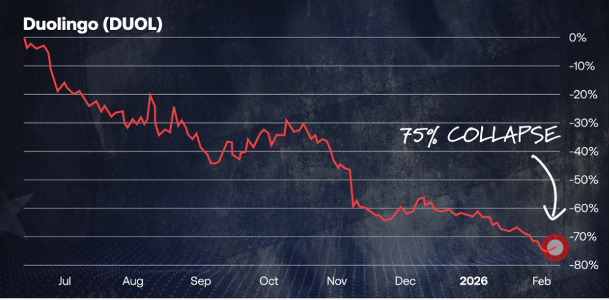
Why pay a premium for a company whose competitive advantage just evaporated?
This goes far beyond a handful of companies.
If a business depends on information brokerage, routine data analysis, content creation, or any repeatable cognitive task, it is in trouble.
And if your job depends on something similar, that, too, is in trouble.
Amazon CEO Andy Jassy warned employees last summer that AI would reduce the corporate workforce “in the coming years.” Sure enough, a few months later, Amazon announced plans to fire some 30,000 white-collar office workers in two waves.
Amazon’s corporate layoff is an early sign of what’s coming to other large tech companies. Back in 2022, Amazon was also the first mover – laying off 27,000 over several months. It was quickly followed by dozens of other well-known tech companies, shedding tens of thousands of their own employees. Expect to see plenty more folks purged in the months ahead as tech companies refocus their spending from salaries to AI compute.
AI will ultimately replace millions of jobs. The current layoffs are only the beginning.
And when it starts happening in earnest, it won’t be a gradual change. It will be sudden.
After all, companies have already been cutting jobs despite solid economic growth to increase efficiencies and squeeze more output from fewer workers. The latest AI capabilities are just accelerating a trend already in motion.
Dario Amodei, CEO of AI leader Anthropic, has warned that business leaders may see the cost savings of AI and replace humans almost overnight.
Now flip the coin.
The same wave that is crushing some companies is sending other businesses into orbit.
Semiconductor firms that supply the chips and equipment AI runs on, like Micron Technology (MU) and Lam Research (LRCX), have seen their stocks soar.
And then there is Nvidia. Long before the stock was on most of Wall Street’s radar, Stansberry Research subscribers were tipped off to the role Nvidia would soon play in artificial intelligence.
When machines begin learning for themselves, it will be a watershed moment in human history. And these “artificial brains” will bring huge profits to early investors.
And although Nvidia is a well-known tech company, nobody on Wall Street is betting on artificial brains as a business segment.
Sure enough, Nvidia shares have soared in the years since.
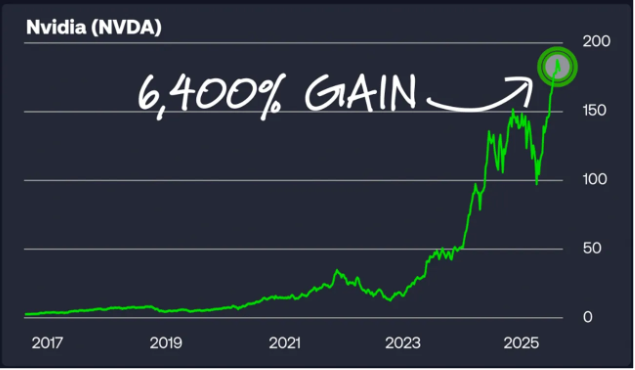
What is happening in the market right now is a massive rotation of capital. Money is flowing out of firms threatened by AI, and into firms building or powering AI.
Whitney cites Massachusetts Institute of Technology research, noting that going back over 100 years of data, wealth has never been created at this size and speed. Think about that. Not during the dot-com boom. Not during the post-war industrial expansion. Not during the Roaring ’20s.
Yet most Americans are missing out.
Many investors never owned these stocks. Or they bailed out early when things got volatile. And the workers losing their jobs? They are probably not sharing in the stock market’s gains.
This feeds directly back into the K-shape economy we talked about earlier. The upper arm accelerates because of AI. The lower arm falls faster because of AI.
Same force, opposite outcomes.
Whitney puts it plainly in his interview, which you can watch for free by clicking here:
Imagine the progress of the entire 20th century compressed into a single decade. That’s what insiders say is happening now.
That kind of growth is almost impossible for the human brain to comprehend.
But think about it like this…
The world economy grew 19-fold in the 20th century.
If the economy grew at that pace in the next century, it would create hundreds of trillions of dollars in new wealth every year.
And it’s beginning, right now. You can feel it. The pace of change is picking up. The next six months will define everything.
That stark divide sets up Whitney’s third idea. How can regular investors get themselves on the right side and use AI for their own investing?
Harnessing AI for Investors With the New Engine of Wealth System
At the center of Whitney’s plan for regular investors is his firm’s AI-powered investing system: The N.E.W. System, short for “New Engine of Wealth.”
The core question it tries to answer: How can everyday investors come out ahead in an era dominated by AI and rapid disruption?
Here is how it works.
The N.E.W. System is an AI-driven, fully allocated model investment portfolio.
It’s the end product of more than a decade of research and development, involving dozens of coders, developers, and research staff – and costing millions of dollars.
It uses artificial intelligence to analyze financial data on more than 5,000 publicly traded companies. Then it identifies a mix of investments with the highest chance of delivering strong returns, while dodging the big losers.
Think of it as a “best of the best” portfolio assembled with more computing power and analytical rigor than most individual investors could manage alone.
Whitney’s team built it by feeding an AI vast amounts of data and running simulations. Trillions of possible outcomes. Different market conditions. Bull markets, crashes, sideways grinds. The AI searched for patterns and combinations of stocks that held up across all of them.
The result is a model investment portfolio that gets updated quarterly. And Whitney’s team vets every pick before it goes out to subscribers.
That last part matters. This is not a robot on autopilot. Whitney and a committee of human analysts review each recommendation – checking for statistical flukes, real-world factors the algorithm might miss, and anything that does not pass the common-sense test. Investors aren’t blindly following a computer.
Now, what about results?
Whitney shares a few examples of stocks the system flagged early. Nutex Health (NUTX) returned 1,100% in under a year. Robinhood Markets (HOOD) rallied 340%. AppLovin (APP) surged 2,500%.
Those are obviously cherry-picked winners. Nobody can guarantee future returns will look anything like that. But the back-tested track record is striking.
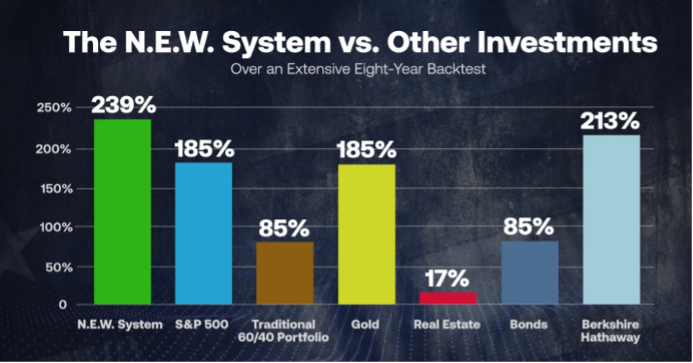
The strategy would have beaten the S&P 500, long-term Treasury bonds, gold, and even Berkshire Hathaway over recent years. And with lower volatility than chasing hot AI stocks on your own.
Today, AI is leveling the playing field for individual investors.
For decades, big Wall Street firms had enormous teams and expensive data tools that gave them a structural edge that regular folks simply couldn’t replicate. Whitney cites Renaissance Technologies’ Medallion Fund, widely considered the most successful hedge fund ever. It generated roughly 66% annual returns over decades. Their secret? Better data and better models than everyone else.
But today, advances in AI make serious analytical firepower accessible to smaller investors. That is the whole idea behind the N.E.W. System – packaging an elite-level analytical engine in a form regular people can use.
Subscribers also get access to a few key tools.
- The Stansberry Score is an AI-driven rating for thousands of stocks, showing how each one ranks against the system’s criteria. You can look up any stock and instantly see where it stands.
- StansberryGPT is a financial chatbot that answers plain-English questions from market data. It is like having a 24/7 analyst at your fingertips, minus the $20,000 Bloomberg terminal bill.
- And a year of access to the N.E.W. System, with Whitney’s latest recommendations of the strongest-rated companies to buy right now for the highest potential gains. Should you choose to invest, all you’ll need to do is type in your portfolio size, and his calculator will spit out exactly how many shares of each company to buy.
Today, you can use the same technology that is shaking everything up to invest smarter, avoid being blindsided by big market declines, and even find the next big winners before everyone else catches on.
Whitney puts it like this:
In short, we’ve taught our AI to find you the unique combination of stocks that is most likely to double or triple your money, with a level of confidence that has never been possible before.
And keep in mind, the N.E.W. System updates its model portfolio roughly four times a year, or as needed, based on market conditions. That means regular updates on what stocks to add, which to trim or sell, and the latest highest-potential new recommendations to add.
This frequency is intentional. It’s not a day-trading system that will bombard you with constant trades, but it’s also not a “set-and-forget for years” approach.
In short, the N.E.W. System offers a radically different, high-tech approach to stock investing – one that tilts the odds in your favor by using vast data and computing power.
What Is Stansberry Research?
Stansberry Research is one of the largest and most respected independent financial research firms in the world.
Founded in 1999, the firm made its name by giving individual investors access to the kind of in-depth research and contrarian ideas often reserved for Wall Street insiders. Today, Stansberry Research is a cornerstone of the financial publishing industry.
The firm has subscribers all around the globe. And its publications are read by hundreds of thousands of folks.
A key differentiator is that, unlike big banks or brokers, Stansberry doesn’t manage money or earn commissions on trades. They strictly publish research and investment recommendations. And they are known for sometimes taking bold, unpopular stances that later proved prescient.
For example, Stansberry Research analysts warned about the housing bubble and the impending collapse of Fannie Mae and Freddie Mac before the 2008 crisis, saving attentive subscribers from huge losses. They were early in predicting the rebound of oil and natural gas in the mid-2010s. And they even covered burgeoning trends like bitcoin as far back as 2017.
Over the years, Stansberry’s various services have logged dozens of triple-digit winners and a handful of 1,000%-plus gainers.
Of course, no firm gets every call right. That’s why Stansberry Research analysts also regularly acknowledge their mistakes – including in an annual “Report Card” where the publisher grades each publication, no holds barred. Their mission is to put the kind of research and tools that used to be reserved for Wall Street insiders into the hands of regular investors. The company employs experts on macroeconomics, commodities, biotech, insurance stocks, and much more… and now, an AI system is working for you, too.
Who Is Whitney Tilson?
Whitney Tilson is a familiar name in investing circles… and beyond. His career spans hedge funds, research publishing, philanthropy, and even a run at New York City politics. Understanding his background helps explain why people take his “ripping point” warning seriously.
The short version…
Whitney graduated from Harvard College and Harvard Business School, where he finished in the top 5% of his class and was named a Baker Scholar. In 1999, he co-founded what became Kase Capital Management. He started with $1 million and ran the whole thing from a folding Ikea desk in the corner of his bedroom. Over the next dozen or so years, he grew his fund to more than $200 million in assets and nearly tripled his investors’ money.
That stretch included the dot-com crash, the 2008 financial crisis, and a flat-to-brutal market for long stretches. Steering a fund through all of that and coming out well ahead was no small feat.
He also earned a reputation for calling big turns in the market.
- During the depths of the financial crisis, he went on 60 Minutes and argued it was a once-in-a-lifetime buying opportunity for stocks. At the time, fear was rampant. But he was right – it marked the bottom… And the ensuing bull market became the longest in history.
- In 2015, he again appeared on 60 Minutes to expose fraud at a company named Lumber Liquidators, which was found to be selling toxic Chinese-made laminate flooring. Following that, the stock plummeted 80%, and the CEO resigned. Whitney’s actions potentially saved consumers and investors from a disastrous situation.
- He predicted the exact market bottom in March 2020 during the COVID-19 crash. Anyone who listened would have caught the huge rebound that followed.
These and other calls earned him that “Prophet” nickname from CNBC.
Over his career, Whitney rubbed elbows with some of the greats – even baking cookies for the legendary investor Warren Buffett every Christmas. Whitney also counts hedge-fund legends like Bill Ackman, Joel Greenblatt, David Einhorn, and Seth Klarman among his circle.
After leaving the hedge fund world, Whitney moved into investment research and education and now heads up a team of analysts at Stansberry Research. He brings a rare combination to the table: proven investment skill, connections with legendary investors, and a down-to-earth teaching mentality.
Whitney has published four books, including The Art of Value Investing. He has traveled to Ukraine multiple times during the war to deliver aid. He helped launch the nonprofit Teach For America as a founding member. He even ran for mayor of New York City.
You can probably tell that Whitney isn’t a doom-and-gloom kind of guy. So when he turns urgent, as he has with his “ripping point” warning in his latest documentary, it’s worth paying attention.
Frequently Asked Questions
Question: What does Whitney mean by “ripping point”?
Answer: “Ripping point” is Whitney’s term for when America’s economic and social fabric tears apart under extreme pressure from technology and wealth inequality.
Think of it as a more violent version of a tipping point – a rapid, visible split between those getting richer and those getting left behind. This gap is now showing up in political polarization, consumer debt, career anxiety… You name it. And in Whitney’s view, AI is speeding this up from a slow divergence into something much more abrupt.
Question: Why is Whitney’s ripping-point prediction causing panic among white-collar workers?
Answer: White-collar professionals have historically been largely shielded from automation. A college degree and an office job meant stability, but AI is changing that assumption.
For example, as we wrote about Elon Musk’s “Macrohard” AI system last month:
Soon, you may have an “always-on” AI at your desk, watching what you do, and learning to do it without you.
That sounds dystopian… or maybe just far-fetched.
But it has happened before with American workers training their offshore replacements in the late 1990s… That trend sped up following the dot-com crash in the early 2000s as companies faced intense pressure to survive by cutting costs. This time, instead of being replaced with a cheaper worker in a foreign country, it’s an AI in the cloud
As AI costs go up and AI gets smarter, human headcounts come down. And if you’re one of the millions of folks employed in a white-collar office setting, your job is likely more at risk than you would have ever expected.
Question: Haven’t we faced disruptions from technology before?
Answer: We absolutely have. Mechanization gutted farming jobs early in the 20th century. Robots changed manufacturing late in the 20th century. Each time, new job categories eventually appeared.
Two things stand out about AI, though:
- First, the scope. AI can hit many industries and many types of cognitive work at once – legal research, marketing copy, financial analysis, and software code. It’s not limited to one sector.
- Second is the speed. AI models improve on a timeline of months, not decades. And the newest tools are accelerating a trend already in motion.
So, whether Whitney’s comparison of compressing 100 years into a single decade holds up perfectly, the pace is genuinely unlike anything in recent memory.
Question: How does the N.E.W. System work?
Answer: The New Engine of Wealth (N.E.W.) System uses machine learning to comb through years of market data – stock prices, financial statements, and economic indicators. It looks for patterns that predict strong performance.
It runs trillions of simulations to find combinations of stocks that hold up well across different conditions. From that analysis, it builds a model portfolio of 10 to 20 stocks, updated quarterly.
Of course, Whitney and his analyst team review every pick before sending it to subscribers. So there is a human check on the algorithm’s output. Subscribers also get access to the Stansberry Score, which rates thousands of stocks on demand, and StansberryGPT, a financial chatbot that answers plain-English questions from market data.
The idea is to give regular investors the kind of analytical firepower that used to live behind locked doors on Wall Street. You can learn more about the N.E.W. System by watching Whitney’s full interview here.
Question: If the system works so well, why share it?
Answer: Fair question. Whitney has addressed it directly. Part of his answer is personal. He has already run a hedge fund and made his money on Wall Street. At this point in his career, he says he is more motivated by teaching and helping individual investors.
In addition, Stansberry Research is in the business of selling research, not managing money. By creating a product like the N.E.W. System, they can attract subscribers willing to pay for high-quality insights. In a sense, scaling it to thousands of subscribers is more lucrative for them than trying to quietly run a small fund with it.
Finally, both Whitney and Stansberry Research have built a reputation on delivering big ideas to readers. This is, in a way, their next big idea to retain and grow that audience.
Question: Is the system all tech stocks?
Answer: Nope. The recommendations look diverse, based on what Whitney has shared publicly. His examples include a health care small-cap. A fintech firm. An ad-tech company. An industrial manufacturer. A biotech. A gold-related firm. A defense-parts maker.
The AI searches across every sector for the best risk-reward opportunities. That could mean a boring industrial stock sitting right next to a high-growth tech name. The system also steers users away from popular-but-overpriced names if the data does not support additional upside.
Question: Can an average investor use Whitney’s N.E.W. System?
Answer: Absolutely. It was designed with everyday investors in mind. The system outputs a model portfolio with ticker symbols and allocation percentages. It even has an online calculator. Enter how much you want to invest, and it computes how many dollars to put in each stock. You would make trades a few times a year to rotate into new picks or adjust your positions. No advanced tech skills required.
If you can read a report and place a trade in your brokerage account, you can follow it. Whitney’s team also provides a Quick Start Guide, monthly updates, and customer support. You can find more details on the order form. (This link does not go to a long video.)
How an Investor Can Profit From Whitney’s Ripping-Point Prediction
We could soon be blindsided by a permanent change in our economy…
America’s “ripping point” will be far more wide-reaching than a stock market crash or banking collapse. It has the potential to split our entire financial system in two.
But buried in that chaos is an opportunity to do incredible things with your money.
That’s why Whitney has gone public with his warning today.
Whether you choose to watch Whitney’s documentary on the N.E.W. System, the takeaway is clear: AI is transforming investing. It’s showing us ways to beat stocks, gold, bonds, real estate – and even potentially outperform the great Warren Buffett.
And keep in mind: AI is only going to get stronger (and smarter) from here.
So, even if you don’t see a threat from AI right now, that doesn’t mean it won’t be here tomorrow.
As Whitney predicts:
Today’s AI is the dumbest it’ll ever be. It’s getting smarter at an exponential rate. In fact, AI’s capability has doubled roughly every seven months for the past six years.
It gets smarter and more powerful with every passing day.
You can’t fight it.
None of us can.
But you can use it to grow wealthy – by making sure AI works for you, not against.
And of course, Whitney is offering a full 30-day money-back guarantee for all new subscribers. So you can give his research a try without worrying about a long-term commitment today.
If you’re ready to subscribe, you can go straight to the order form without watching a long video by clicking here.