
The gold market closes Fridays at 5 p.m. Eastern time and reopens Sundays at 6 p.m. That’s a 49-hour gap in trading – at least on paper.
But in reality, gold trading doesn’t stop.
A new class of investors is trading tokenized gold markets over the weekend, setting the terms for Monday before traditional exchanges reopen.
They’re the ultra-early allocators. I call them “homesteaders.”
As I’ll explain, these aren’t speculative crypto experimenters. Homesteaders are the investors who move in early but stay longer than the famous “bleeding edge” crowd.
And the infrastructure they’re using just went institutional…
Those 49 Hours Aren’t Empty
Here’s what the textbook says…
COMEX – the world’s leading market for trading gold and silver futures – closes Friday at 5 p.m. Eastern time. The London Bullion Market Association is dark. Asia stops trading. Interdealer liquidity dries up. Gold sleeps until Sunday at 6 p.m.
Here’s what’s actually happening…
That trading volume doesn’t stop at 5 p.m. on Friday. It continues all weekend.
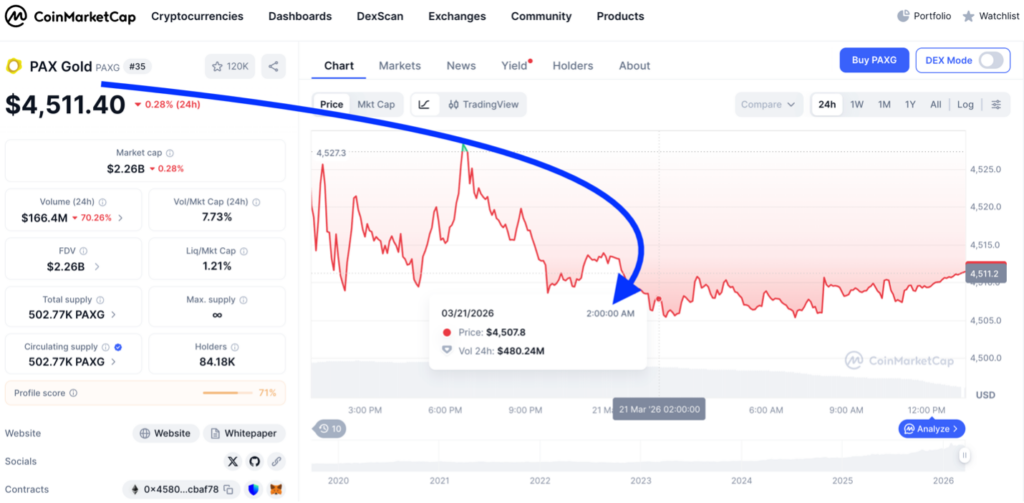
Just take a look at this snip of PAX Gold activity last Saturday. Homesteaders were trading the gold-backed token at 2 a.m…
Source: CoinMarketCap.com
When geopolitical events hit on weekends – and they often do – exchange platforms like Binance, OKX, and Hyperliquid become the only active markets pricing gold in real time.
The futures pit is empty. The London dealers are offline. But anyone watching on-chain data can see exactly where gold is going before COMEX opens Sunday night.
The market for tokenized gold (i.e., physical gold that has been turned into a digital token on a blockchain) has grown from roughly $1.8 billion to more than $5.9 billion in a year.
Tokenized gold reached a trading volume of $178 billion in 2025. And about $126 billion of that was in the fourth quarter alone, surpassing every U.S.-listed gold exchange-traded fund (“ETF”) except one… the SPDR Gold Shares (GLD) – one of the largest and most liquid gold ETFs in the world.
The CEX.io research team put it plainly: “If tokenized gold were an ETF, it would already rank as the second largest by trading volume.”
We got a live case study about a month ago. Following military strikes in Iran on February 28, tokenized gold approached $5,450 per ounce while traditional markets sat frozen.
That wasn’t noise – it was early price discovery.
By the time markets reopened Sunday night, the signal to buy gold had already been set.
Why Gold Prices ‘Gap’ on Sunday Open
One of the most common questions about commodities trading is why gold gaps up or down at the open on Sunday. (By “gap” I mean a significant move between normal trading hours.)
The answer: Because 49 hours of news gets priced in all at once.
Sunday’s 6 p.m. open is the single most volatile moment of gold’s weekly schedule.
During the weekend, markets absorb central-bank announcements, geopolitical shocks, currency dislocations, and other macroeconomic surprises.
The moment COMEX opens, that backlog converts into a price – creating the well-known “Sunday gap.”
Institutional Adoption: Tokenized Gold Is Now a 24/7 Market
This isn’t a fringe trend anymore.
Big institutions now offer the infrastructure that makes tokenized gold tradeable with precision.
That means professionals who read the weekend tokenized data are already positioned when it happens. Everyone else is reacting late.
Flow Traders, one of the largest exchange-traded product (“ETP”) market-makers in the world, just launched a 24/7 over-the-counter (“OTC”) liquidity service for tokenized assets, including gold.
Marc Jansen, co-chief trading officer at Flow Traders, said:
The demand mainly comes from institutions that want the ability to manage exposure outside traditional market hours…
All weekend long, with these markets getting pretty close to the traditional market open price as a result of that weekend price discovery. OTC liquidity helps support that activity, particularly for larger trades where public venue liquidity is still developing.
Read that carefully.
A firm that trades billions in traditional ETPs is now providing institutional-grade OTC liquidity for tokenized gold on Saturday afternoon.
The weekend is no longer dead air. It’s a trading session that just got a market maker.
Central Banks Were the Original ‘Off-Hours’ Gold Buyers
Before tokenized gold existed, central banks were already trading gold outside market hours.
The central banks of Uzbekistan and Kazakhstan have standing programs to purchase gold directly from domestic mine production.
China likely acquires two to three times its officially disclosed gold through domestic production purchases and offshore transactions. (Its central bank once went six months without reporting a single purchase before suddenly disclosing 44 tonnes.)
The World Gold Council noted that central-bank reported purchases in 2024 accounted for only a third of its estimated total official-sector demand.
The rest move in bilateral deals with zero regard for exchange hours. In 2025, reported net central-bank purchases came in at 863 tonnes… but that’s only what they told us about.
The World Gold Council described this accumulation plainly:
Sustained activity from emerging-market central banks – supported by the findings from our annual survey – strongly suggests that these purchases are strategic rather than opportunistic, reinforcing gold’s importance amid persistent macroeconomic uncertainty.
Central banks don’t wait for COMEX to open. They never did.
Now, homesteaders using tokenized gold are just applying the same logic at retail scale – buy when you have conviction, not when the exchange tells you the window is open.
Risks of Trading Gold on the Weekend
The homesteader strategy isn’t without risk.
For one, weekend tokenized gold liquidity is thin relative to the $32 trillion physical gold market. Wide spreads punish retail traders who over-trade the signal.
For another, weekend prices can show a premium or discount to the London Bullion Market Association’s open on Monday, and reading too much into that gap has burned people.
On top of that, the regulatory landscape for tokenized assets remains fragmented. Rules vary significantly across jurisdictions – which creates many cross-border challenges.
These are real constraints.
But constraints define the opportunity. Thin weekend liquidity is exactly why those homesteaders who read it correctly get there first. The friction is the filter.
What This Means for Gold Investors in 2026
Gold climbed 76% from the end of 2024 into early 2026.
In a move that large, the marginal buyer matters. Right now, the marginal buyer over the weekend is a trader using on-chain infrastructure that didn’t exist two years ago.
The institutional adoption of tokenized gold for weekend price discovery is not a future development.
Flow Traders is using this infrastructure now. The volume is real. The Sunday gap is already being shaped by people who understand that the 49-hour blackout is, for anyone paying attention, 49 hours of uncontested signal before Monday’s crowd arrives.
The question isn’t whether gold trades on the weekends. It does.
The question is, are you watching the signal or reacting after the fact?
Good investing,
Eric Wade
Editor’s Note: What should you invest in right now?
A renowned former hedge fund founder and his research team have found what they believe is the next big tech trend that could make investors rich.
It’s a breakthrough they’re calling “Helios” – and if you haven’t yet heard of it, you soon will.
Over the next few years, it could impact the food you eat… the water you drink… the places you live and work… and even the prices you pay for airfare, gas, electricity, and household goods.
“Helios” is going to cause a lot of people to lose money, too. Dozens of well-known businesses could go bankrupt.
But if you own a stake in this new tech, the positive effects will far outweigh the negatives. Get the facts for yourself. Make sure you’re not on the wrong side of this trend. Click here to see this new analysis…