

Bitcoin (BTC) has rebounded to around $70,000, following weeks of intense volatility that saw it plunge from more than $90,000.
In this latest round of selling, the original cryptocurrency recently fell as low as $60,033… its lowest level since October 2024… before rebounding to the $70,000 level.
After that steep, quick bounce, the question for many crypto traders is: Where now?
This has plenty of traders wondering whether this drop is just a flash crash or a more extended crypto winter. Crypto had its last hard winter in 2022… along with other risk assets.
Bitcoin’s plunge happened just as gold and silver were plummeting from all-time highs, too…
As you can see in the chart below, bitcoin experienced what traders call a “dead cat bounce”… As the name suggests, it’s a rebound that’s due mainly to the sharp drop that preceded it.
That is, traders are buying just because it looks oversold for the moment.
But that rebound looks like cold comfort for traders who have held on since October, when bitcoin was north of $120,000 for a bit…
Bitcoin’s drop should give traders in other frothy markets – gold and silver both fell hard at the end of January after epic runs – a wake-up call that more volatility may be on the way.
Yes, volatility is the name of the game at bitcoin, but this latest round feels like more than the usual turbulence.
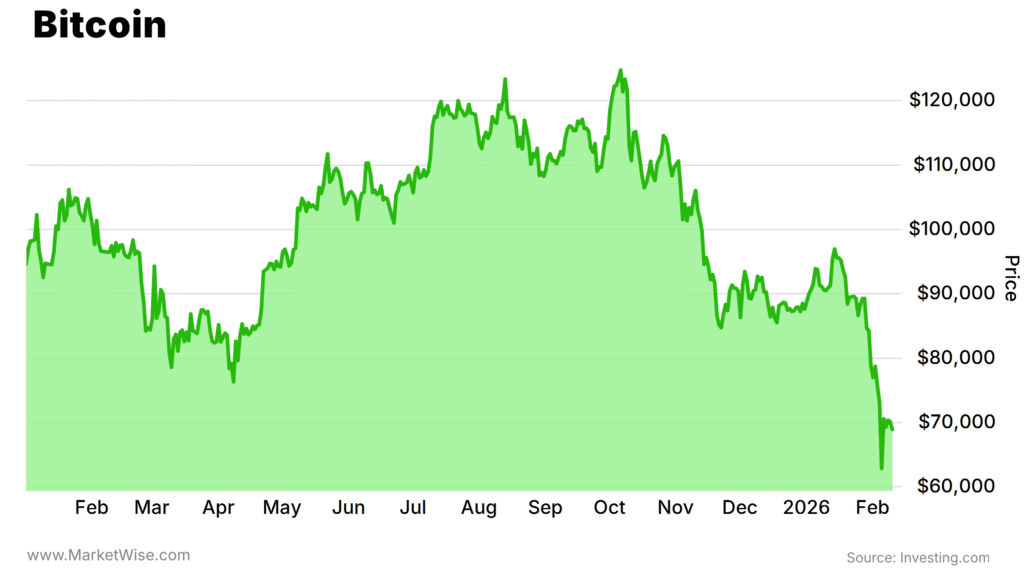
Bitcoin came within a hair’s breadth of sinking under the $60,000 level after its recent fall. Notably, this decline pushed the crypto coin’s price back to levels of 16 months ago, before the crypto-friendly administration of President Donald Trump was appointed into office.
But this $60,000 level also sits below the last cycle’s high in November 2021, when bitcoin briefly surpassed $68,000. Then it soon plunged into the crypto winter of 2022.
In last year’s run, prices on bitcoin and other cryptocurrencies, as well as crypto exchanges and coin issuers, saw strong momentum for much of the year.
For example, both Coinbase Global (COIN) and Robinhood (HOOD) had bullish runs after the market cleared through some of the tariff-related doldrums in March and April 2025.
But shares of both these companies have followed crypto pricing lower since October or so.
Circle Internet (CRCL), the company behind the USDC stablecoin, had a strong IPO and burst out of the gate in June… only to have its gains fade away throughout the second half of the year and into 2026.
Bitcoin may be the most well-known and closely followed cryptocurrency, but many other coins have been hit by lower prices in the past few months. Ethereum (ETH), the second-largest coin by market cap, saw prices top out in late summer. They melted through the rest of 2025, too.
Even specialty crypto plays such as digital asset treasuries – companies that hold crypto as an investment – have been stung hard. The largest is Strategy (MSTR) (formerly known as MicroStrategy), and its stock has been pummeled, falling much faster than bitcoin itself.
Bitcoin’s impact is being felt across the industry.
Bitcoin Often Trades Like a High-Risk Stock
Early bitcoin proponents touted the cryptocurrency as the “anti-financial” financial system… the banker to the unbanked… the money that cannot be debased.
For all that, bitcoin and other cryptocurrencies trade like high-risk stocks, especially as they have enjoyed wider acceptance. Bitcoin responds to the “risk on” trade. It’s not really surprising why…
- Bitcoin perks up in response to declining interest rates, such as during 2020-2021, similar to high-risk investments such as stocks.
- Bitcoin generates no cash flow… much like risky, early-stage companies.
- Bitcoin has no claim on the assets or cash flow of an underlying entity (the way a stock does), so you might think of it as a gauge of pure sentiment.
In fact, the correlation with stocks has tended to be strong for more than a decade. Last year was the first in a decade that bitcoin didn’t rise when the S&P 500 Index rose. (It needed to finish 2025 at $93,429, but ended around $87,508.)
Because of these elements, bitcoin may be a good indicator for investors looking for the direction of the stock market. A kind of canary in the coal mine…
How Can You Trade a Bitcoin Rebound?
If you think bitcoin is poised to rise – that’s been a good long-term bet, though with a lot of volatility – you have a variety of ways to play it:
- Buy bitcoins directly: If you want to own bitcoins directly, you can purchase them through a cryptocurrency exchange. You’ll need to safeguard them yourself, such as holding them in a crypto wallet. Your performance will look exactly like bitcoin’s, minus any transaction fees for the exchange.
- Buy bitcoins via an exchange-traded fund (“ETF”): A spot bitcoin ETF lets you own the crypto and leave the safekeeping to someone else. The return of this investment looks just like bitcoin’s, less the fund’s management fee, which is low anyway. You can buy ETFs from any broker and don’t need a specialized account to do so.
- Buy bitcoins via a high-leverage play: This last alternative has the potential to increase your returns for any given rise in bitcoin’s price. The downside is that you’ll need to take on more risk. These alternatives include buying a company such as Strategy that owns hundreds of thousands of bitcoins or using options on bitcoin ETFs.
If you’re interested in the high-reward, high-risk plays, this article walks through the pros and cons of each of them.
When deciding which choice might work best for you, carefully consider how each investment makes sense for your risk tolerance and return expectations.
For example, buying bitcoins directly or in an ETF means you can hold them indefinitely, as long as you think there’s upside. In contrast, some of the high-leverage plays (such as options) may expire with a set, relatively short period.
So, you want to understand the risks and potential rewards of each investment thoroughly.
Of course, as legendary investor Warren Buffett astutely informs us: “There are no called strikes in investing.” In other words, you should wait for the risk-reward setup that works best for you.
Regards,
James Royal
Editor’s Note: What should you invest in right now?
A renowned former hedge fund founder and his research team have found what they believe is the next big tech trend that could make investors rich.
It’s a breakthrough they’re calling “Helios” – and if you haven’t yet heard of it, you soon will.
Over the next few years, it could impact the food you eat… the water you drink… the places you live and work… and even the prices you pay for airfare, gas, electricity, and household goods.
“Helios” is going to cause a lot of people to lose money, too. Dozens of well-known businesses could go bankrupt.
But if you own a stake in this new tech, the positive effects will far outweigh the negatives. Get the facts for yourself. Make sure you’re not on the wrong side of this trend. Click here to see this new analysis…