To catch a killer, Clarice Starling consulted one.
In the 1991 American horror thriller The Silence of the Lambs, the FBI is hunting a serial killer known as “Buffalo Bill.”
To find the murderer, young FBI trainee Starling seeks the help of another predator… cannibal psychiatrist Dr. Hannibal Lecter.
The logic is unsettling, but compelling: If you want to understand how something hunts, you have to understand how it thinks.
I recently applied this same approach to the AI panic sweeping software stocks.
Rather than speculate which companies AI might disrupt, I simply asked it which software businesses it thought were defensible in an AI-driven world.
We’ll get to the results in a moment. But first, let’s start at the beginning…
The AI Shock Hitting Software Stocks
The sell-off in software stocks kicked off at the end of January after Anthropic announced new features for its Claude Cowork tool.
The AI agent previously allowed users to read, manage, and edit documents on their computers. It was designed as a collaborator, but required manual oversight.
The new upgrades are a massive step-up. Claude Cowork became an autonomous employee that can create, edit, and manage files… execute multistep projects… and work seamlessly between different apps.
Its application programming interface (“API”) upgrades allow for deeper, more automated collaboration across office apps like Google Workspace, Docusign, WordPress, Excel, and PowerPoint.
(Think of an API as a secure digital handshake. It lets one piece of software tap directly into another – pulling data, updating files, triggering actions – without a human clicking back and forth between screens.)
Claude can now automate tasks in marketing, customer support, data analysis, and legal workflows.
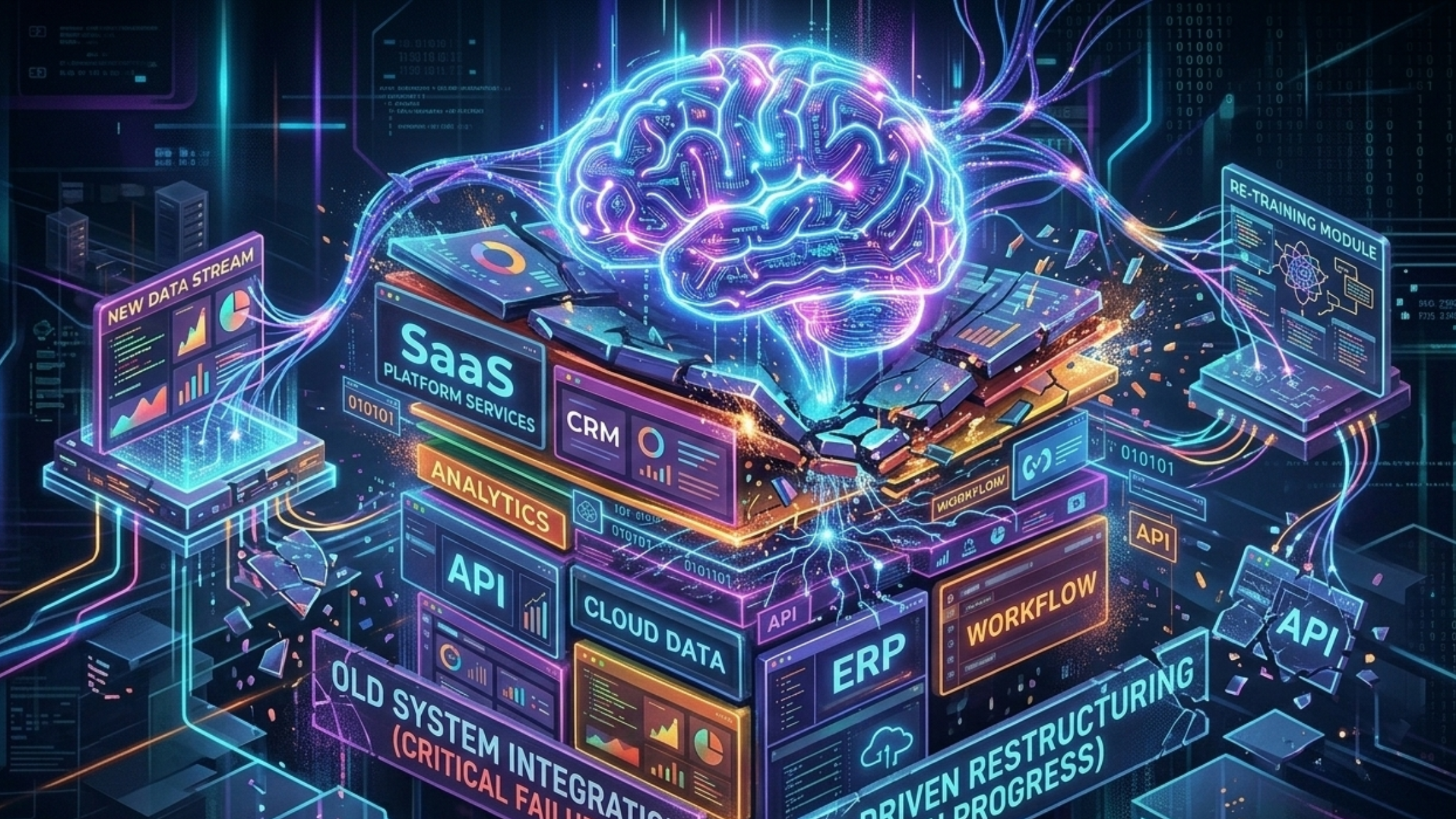
The market responded forcefully… Investors began fearing certain IT and Software as a Service (“SaaS”) business models would become obsolete.
Roughly $1 trillion in global software market value was erased in a single week in early February as the S&P 500 Software & Services Index fell nearly 13%.
People started calling it the “SaaSpocalypse.”
Investors were clearly betting that AI would replace parts of the software stack entirely.
But when markets move this fast, nuance disappears…
Two Extreme Narratives About AI and SaaS
A couple narratives hardened almost instantly following the sell-off in software stocks.
On the one hand, you have the software doomsayers – the ones saying AI will compress entire layers of software into AI prompts. These are the investors leading the SaaSpocalypse.
On the other, you have the optimists – the ones like Nvidia (NVDA) CEO Jensen Huang who think the idea that AI will replace software is laughable.
Let’s look at both…
Extreme No. 1: ‘SaaS Is Dead’
Some investors argue AI tools will replace software services entirely.
One tech CEO recently told Business Insider…
[There] are many SaaS vendors we would have likely previously used that are no longer relevant.
The industry is waking up to the fact that AI is becoming extremely good at creating software autonomously. This brings questions around what “moats” exist for incumbent companies that are not themselves frontier AI labs.
In other words, if AI can generate tools internally, automate workflows, and integrate systems directly… why pay SaaS vendor fees?
The implication is that advances in AI will hurt SaaS pricing power, lower switching costs, and commoditize application-layer software.
Extreme No. 2: ‘AI Just Supercharges Software’
Others argue the opposite.
AI doesn’t destroy SaaS – it enhances it. Software platforms can integrate AI features, increase productivity, and strengthen their moats.
Dan Ives, global head of tech research at brokerage firm Wedbush, says investors are making a huge mistake dumping software stocks. He believes AI “will complement existing software models rather than displace them.”
Both views are emotionally satisfying.
Both are incomplete.
Software isn’t a monolith. It’s thousands of distinct business models. And AI won’t impact them evenly.
That begs the question…
What specific traits make a software business hard – or easy – for AI to disrupt?
Why the Usual ‘Moat Talk’ Fails in the AI Era
When disruption fears arise, investors fall back on familiar buzzwords.
Switching costs… Stickiness… Vertical specialization… Data moat.
These factors matter, but they aren’t enough.
For instance, having data is meaningless without asking:
- Is the data proprietary?
- Is it compounding?
- Is it structurally difficult for AI to replicate?
- Does it live inside validated workflows?
Likewise, switching costs have always mattered. You want your customers to stay with you. You want it to be harder for them to take their money elsewhere. That’s not new insight.
To evaluate AI disruption risk properly, we need to look at things most investors don’t consider. We need a more rigorous framework – one that focuses on:
- Technological substitution
- Platform economics
- Network effects
- Modularity
- Vertical integration
- Labor intensity
- Ecosystem centrality
So I built one…
The AI Disruption Scorecard: A Research-Backed Framework
I asked ChatGPT to synthesize decades of academic literature on technological disruption and competitive strategy.
Not Twitter takes.
Not venture-capital slogans.
I asked for decades of peer-reviewed research by people who’ve made their careers out of disrupting the tech industry.
From that body of work, ChatGPT identified 12 factors that determine resilience when new technologies emerge. (I won’t give all 12 factors today, but we will focus on one of the most important.)
Next, I fed the rubric to two separate AI models and had them score more than 200 publicly traded U.S. software companies from 1 to 10.
1 = Highly vulnerable
10 = Structurally resistant
The results were, for the most part, consistent across both models.
Some companies looked deeply embedded in the software industry.
Others looked surprisingly fragile.
One factor stood out…
The Overlooked Importance of APIs and Ecosystem Centrality
In an AI-driven world, software isn’t just a destination for users. It’s infrastructure for other software.
Human users navigate dashboards and click through menus. AI models don’t. They connect directly through APIs – the behind-the-scenes access points that allow one system to interact with another. That’s how AI retrieves data, updates records, initiates payments, and opens support tickets.
In other words, AI agents don’t “use” software the way we do. They plug into it. And that shift changes which companies sit at the center of the ecosystem – and which ones risk being bypassed.
That means we need to look for signs of ecosystem centrality. We need to figure out whether a software product is really a replaceable app… or foundational infrastructure.
For software to be the latter, it needs to…
- Have robust, widely used APIs
- Support deep third-party integrations
- Enable partners to build revenue-generating products on top of it
- Have downstream systems that are dependent on it
When other companies build on top of a platform – and design their own products around it – it becomes embedded in the broader software stack.
Over time, it turns into connective tissue.
Billing engines, identity providers, payment rails, cloud platforms, data warehouses… these all sit underneath the visible layer of software – the dashboards and tools human users actually see.
They power workflows quietly but continuously. AI models don’t replace these systems. They depend on them.
In other words, software that’s more like an app can be swapped out. Infrastructure is harder to dislodge.
Case Study: Veeva vs. Cognizant – Two Different AI Futures
I picked two companies to look at under my AI disruption framework… two that the casual observers might put in the same bucket: Veeva Systems (VEEV) and Cognizant Technology Solutions (CTSH).
Both companies are tech businesses. Both operate in enterprise environments. Both are roughly similar in size.
And during the sharp AI-driven sell-off, both companies dropped roughly 10%.
The market treated them similarly. But structurally, they’re very different.
And that difference is the reason why Veeva ranks in the very top of my disruption scorecard… while Cognizant ranks in the bottom.
Veeva Is Structurally Resilient
Veeva is a vertical SaaS company serving the life-sciences industry.
It operates inside one of the most heavily regulated sectors in the world, serving more than 1,500 pharma and biotech companies across:
- Drug development
- Clinical trials
- Quality management
- Compliance documentation
- Regulatory workflows
In this industry, errors are not minor inconveniences. They can trigger regulatory action, hefty fines, product delays, and litigation. These are matters where AI can prove beneficial.
Generative AI excels at flexible knowledge tasks, though it’s less suited to replace the validated, compliance-bound systems that have become standard in the life-sciences industry.
(“Validated” means the software has been tested and documented to prove it performs consistently within regulatory standards. Once in place, changes require review, documentation, and often revalidation.)
That’s why Veeva is integrating AI directly into its workflows – not allowing external agents to sit between users and its platform.
The company is rolling out AI agents to help with customer-service and digital-asset management, as well as with research and development.
This strengthens ecosystem centrality. And it makes Veeva look less like a generic SaaS app… and more like regulated infrastructure.
That’s why Veeva ranks near the top of my results for AI resilience.
Cognizant Is Exposed
Cognizant isn’t primarily a software company like Veeva.
It’s a services business. When companies decide to overhaul their IT systems, move to the cloud, or implement new enterprise software… Cognizant provides the people who make it happen. In other words, its product is skilled labor.
Cognizant earns money by supplying companies with engineers and consultants who write code, configure systems, test integrations, and manage technology projects.
These are precisely the workflows that AI agents are rapidly improving at.
Moreover, IT services firms like Cognizant scale their business by growing their staff. If demand rises, they hire more engineers, more consultants, and more project managers. Revenue grows alongside headcount.
Software platforms scale differently. Once the core product is built, growth comes from adding users, partners, and integrations to an existing system. Revenue can expand without a proportional increase in labor.
This difference is crucial.
When your product is human labor, automation directly pressures your margins.
But when your product is a platform that other software connects to, AI doesn’t replace you – it depends on you. That’s why Veeva is more likely to survive (and even thrive) in the AI era.
Stop Arguing About AI. Start Grading Exposure.
The AI debate is loud.
There’s a lot of chatter about the SaaSpocalypse. There’s a lot of talk about what will change… and what won’t.
That means you need a disciplined way to evaluate the noise.
As I’ve noted, software isn’t a monolith. It’s thousands of distinct business models.
Some are embedded in regulated systems like life sciences. Others depend on labor-intensive execution. Some sit at the core of enterprise stacks. Others operate at the edges.
AI won’t impact them all equally.
That’s why I built a framework rooted in research on technological disruption – one that considers switching costs, ecosystem centrality, process rigidity, network effects, modularity, and labor intensity.
Some companies are structurally insulated, while others are exposed. Many sit somewhere in between.
Of course, this rubric doesn’t guarantee which company is a “buy” today… or which is likely to become obsolete in the years ahead. But it does bring a little bit of insight into which companies look the most and least like AI’s next victim.
Good investing,
John Robertson
Editor’s Note: A strange change is coming to the stock market – and it’s about to have dramatic consequences for anyone over the age of 50.
“If you own popular AI stocks like Nvidia, you’re in for a big shock,” says Whitney Tilson, who predicted the 2000 Tech Wreck and founded a $200 million hedge fund firm.
He isn’t the only leading figure warning investors to tread carefully.
Michael Burry, who made hundreds of millions shorting banking stocks before 2008, just placed a $1 billion bet against AI stocks – he’s short both Nvidia and Palantir.
And if Whitney is correct, what’s coming to AI stocks next won’t be a crash or mass rush for the exits…
It’s something far more dangerous – a permanent change that could leave millions behind.
That’s why he’s stepping forward today, to reveal the one place you can move your money today, which could outperform stocks, bonds and gold in the near future.