
Listen to the audio version of this article (generated by AI).
Today’s issue in preview:
-
An exciting new AI trade is emerging. Here are the stocks to play it.
-
One of America’s biggest megatrends just flashed another bullish signal
-
How to trade AI infrastructure stocks from here
-
Learn our Top Themes to buy now
A new kind of AI trade is emerging. Here are the stocks to play it.

Credit: AndreyPopov
Since ChatGPT burst onto the scene in late 2022, the world’s largest technology companies have poured huge sums into building AI infrastructure.
According to Goldman Sachs, cumulative global AI investment is on track to reach approximately $1.8 trillion by the end of 2026. It’s one of the largest collective industry investments in history… and trillions more are set to follow.
After all this investment and years of progress, leading AI models such as OpenAI’s ChatGPT-6 Astra have become far more than just great search engines compared with those of 18 months ago.
These models have extraordinary capabilities. They can analyze complex information, solve difficult problems, make decisions, and automate a wide range of tasks and business functions. They can generate useful “agents” that do lots of work for us.
So how in the heck do we leverage this new, awesome power inside our business?
That’s the question thousands of executives, corporate boards, and entrepreneurs are asking themselves today. It’s one of the hottest topics in the business world… one that will create huge opportunities for you as an investor.
After all, a company that successfully uses AI to increase efficiency, reduce costs, and generate more revenue could gain an enormous advantage over its competitors.
And a company that fails to embrace and master AI could find itself falling hopelessly behind.
That’s why many business leaders – especially those in knowledge industries such as law, software, consulting, research, marketing, and media – view mastering AI as one of their defining challenges of 2026 and beyond. Failure to do so poses an existential risk.
And when something is an existential risk that could result in a business leader getting fired, losing a big executive salary, and seeing her stock grants lose 75% of their value, that business leader is going to go to great lengths to prevent that potential risk from becoming real.
This means spending lots of money on enterprise software and data analytics firms that help companies integrate and leverage AI.
Enterprise software refers to applications and technology platforms that help businesses manage operations, organize and analyze data, automate tasks, and improve productivity. These systems support functions such as finance, sales, R&D, human resources, and supply chain management. Increasingly, enterprise software incorporates AI to help companies make better decisions and operate more efficiently.
In fact, to capitalize on the “mad dash” of businesses trying to incorporate AI, a smart enterprise software company will sell itself as an “enterprise AI” company.
Approximately $283 billion was spent on AI software in 2025, and that number rose to approximately $453 billion in 2026, according to consulting giant Gartner.
Enterprise software has such strong AI-related growth prospects because converting old, legacy databases and software platforms into lean, mean, AI-centric systems is a messy, complicated business.
This cannot be done by purchasing a ChatGPT subscription and having two run-of-the-mill employees work on it. Transitioning a large company’s disparate tech systems into a safe, reliable package of AI-powered systems is a huge task whose bill can run into the many millions of dollars.
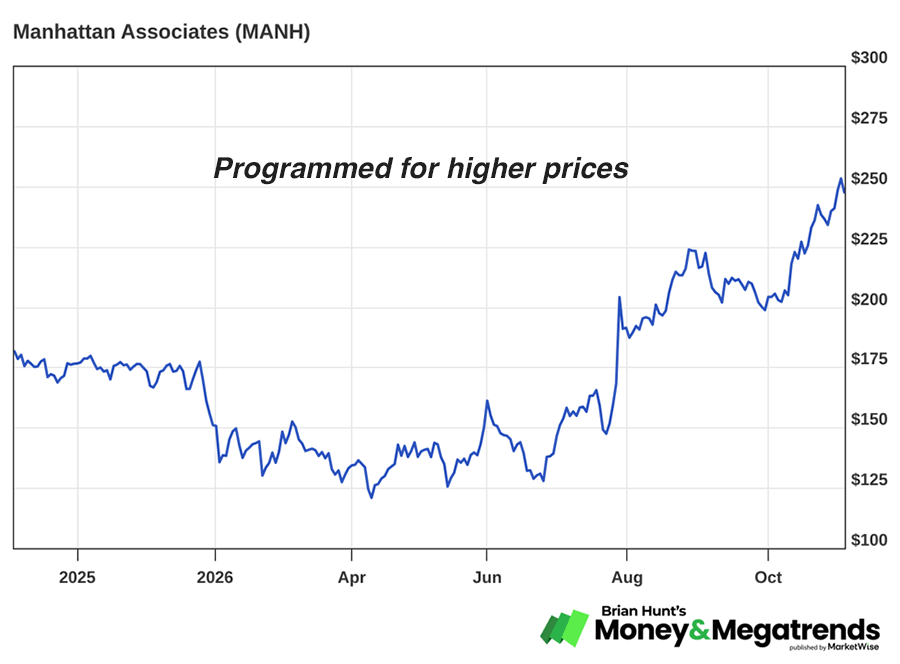
This situation is proving to be so beneficial and powerful that the following enterprise software and technology service firms reached new six-month highs this week:
Tyler Technologies (TYL), a $16 billion software company that provides essential systems for local governments, including courts, public administration, financial management, and schools.
Manhattan Associates (MANH), a $14.7 billion enterprise software developer that helps major retailers, manufacturers, and distributors manage warehouses, inventory, transportation, and supply chains.
Bentley Systems (BSY), a $12.7 billion engineering software company whose products help customers design, construct, and maintain roads, bridges, factories, and other infrastructure.
EPAM Systems (EPAM), a $7.1 billion technology engineering firm that develops enterprise software, modernizes digital platforms, and helps large corporations implement AI.
Grid Dynamics (GDYN), a $1.1 billion technology services company specializing in enterprise AI, digital engineering, and software modernization for major corporations.
Globant (GLOB), a $2 billion digital engineering and consulting company that helps businesses build software, adopt AI, and modernize customer experiences.
BlackLine (BL), a $2 billion enterprise software company whose cloud platform automates corporate accounting, financial reconciliations, and financial close processes.
Vertex, Inc. (VERX), a $2.5 billion enterprise software company that automates sales tax calculations, tax compliance, and reporting for large corporations.
Q2 Holdings (QTWO), a $4.1 billion financial technology company providing digital banking, lending, and fraud prevention software to banks and credit
These companies operate in different industries, but they share a key business objective: helping their customers harness the power of AI. Some build and implement AI systems directly. Others incorporate AI into software that businesses and government agencies already rely on. Either way, they are helping customers put AI to practical, profitable use.
This under-the-radar tech trend is one of the strongest themes in the market right now.
The AI boom is entering a powerful new phase. After spending more than a trillion dollars building AI infrastructure, the business world is now racing to put that technology to work. For large corporations, integrating AI into existing systems is a complex, expensive, and increasingly urgent undertaking.
That creates an enormous opportunity for enterprise software and data analytics companies. As businesses scramble to harness AI’s capabilities, or risk falling behind, the companies helping them make that transition are generating strong revenue growth and stock returns.
Do we need to update these figures, or just talk about them in the past tense?
Recommended Link:
Every Bubble of His Life Was Caused by the Fed. This One Is Different.

Savings-and-loan. Dot-com. Housing. Dr. Ron Paul watched the Federal Reserve inflate every bubble of the modern era. But this one is different, he’s warning. Because for the first time, the federal government is directly sponsoring it. And what we’re seeing now, he says, is just a foreshadowing of an even greater crisis. Get the full story — and the #1 step to prepare — here.
How to trade AI infrastructure stocks from here

Credit: KanawatTH
Just when you think AI infrastructure spending figures are getting truly crazy, America’s largest tech firms up the intensity and scale…
Last week, Amazon reaffirmed plans to spend approximately $220 billion on capital expenditures in 2026, much of it supporting its AI and cloud businesses.
Meanwhile, Google parent Alphabet reported $51.4 billion in third-quarter capital spending, more than double the year-earlier figure. Alphabet now expects approximately $205 billion in capital expenditures this year. Combined, these two giants are on track to spend roughly $425 billion in 2026 alone, much of it building the data centers, computing systems, and other infrastructure needed to power the AI revolution.
However, none of this news is dislodging “the world’s most important trend” from the sideways consolidation pattern we highlighted on October 16.
Here’s what it means for your portfolio…
Over the past three months, we’ve published a special series of research notes analyzing the AI infrastructure boom… which we’ve called “the world’s most important trend.”
The status of this critical trend has become one of the great sagas of the business and investment world… a source of intense disagreement among industry bulls and bears. It’s a trend whose outcome could have large effects on your portfolio.
Given AI’s enormous promise, large tech firms such as Alphabet (GOOG) and Microsoft (MSFT) have invested over $1 trillion in AI infrastructure. They are on pace to invest over $700 billion this year alone and more than $3 trillion after that.
Both the scale and the velocity of this investment boom are unprecedented. It is the largest collective investment effort in history.
Big Tech’s historic investment boom has made the entire “AI infrastructure” trend responsible for a large share of America’s GDP growth and stock market returns over the past two years. It has also drawn the skeptical scrutiny of many widely followed investment analysts who claim the trend is a bubble… one that will soon explode and cause tremendous damage to stock prices and the global economy.
If this hugely consequential trend isn’t the most important trend in the stock market, then it is certainly in the top three.
I believe the AI infrastructure trend has years to run. I believe the world’s smartest, most connected tech insiders who know the true state of bleeding-edge AI development and have real-time stats on AI investment ROI, such as Elon Musk, Jensen Huang (Nvidia), Satya Nadella (Microsoft) and Andy Jassy (Amazon), perhaps maybe… just might… know far more about AI and their businesses than outsiders know about it.
As much press as AI gets, let’s remember that less than 1% of the global population pays for top-tier AI programs. And I estimate less than 10% of large companies believe AI has made a meaningful impact on their businesses.
This revolutionary technology hasn’t yet proliferated, achieved mass adoption, or had mass impact. However, the Agent Supernova is coming.
I like to know the bull and the bear case for any trend. But regular readers know I care a lot more about what the market thinks of any stock, trend or theme than what any one person thinks of it, including me. You can be bullish or bearish on a trend all you like, but if that trend is moving strongly against you, then your idea isn’t worth a hell of a lot in my book.
One of the best ways to gauge what the market thinks of AI infrastructure is analyzing the VanEck Semiconductor ETF (SMH).
This fund is full of key semiconductor firms whose fortunes rise and fall with AI infrastructure spending trends. Major holdings include Nvidia (NVDA), Taiwan Semiconductor (TSM), AMD (AMD), Texas Instruments (TXN), ASML Holding (ASML) and Micron (MU).
As you can see in the two-year chart below, SMH enjoyed a gigantic run from June 2025 to June 2026. The fund gained 176%. Since June 2026, however, the fund has corrected and moved in a volatile, sideways pattern. The fund attempted a breakout in late Sept./early Oct., but huge selling pressure over the past month has sent it deeply back into its sideways base. Back to a trendless state… and to its lowest point since July.
The AI infrastructure trade is at an important crossroads. Neither bulls nor bears have the upper hand right now. I’ll keep you updated on the world’s most important trend. It won’t be long before we get meaningful price action that provides more direction for trading the semis and AI infrastructure.

One of America’s biggest megatrends just flashed another bullish signal

Credit: Maudib
Day by day… week by week… the Made in America megatrend is making investors richer.
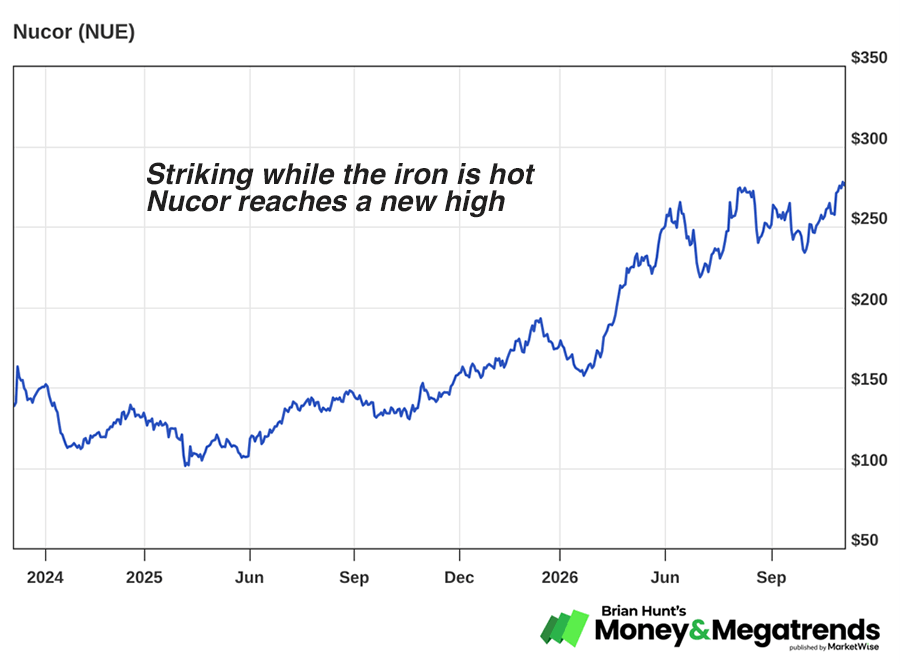
Today, the banner carrier for this lucrative megatrend is Nucor (NUE).
The stock just reached a new all-time high. And if you have the faintest idea of how things are built in America, you’ll realize this is a huge deal.
Nucor is America’s largest steelmaker by production and revenue. It produces the structural steel used in our office buildings, data centers, electric grids, hospitals, automobiles, factories, and skyscrapers.
In today’s high-tech world of iPhones, ChatGPT, video streaming, and Instagram, it’s easy to forget our world is built on a low-tech foundation of steel, concrete, and lumber.
Steel is a major component of bridges, cars, trucks, electric grids, ships, pipes, factories, construction equipment, and skyscrapers. This makes the steel industry highly sensitive to the economy’s ups and downs. When the economy booms, the steel industry booms with it. When the economy busts, so does the steel business.
Right now, the steel business is booming.
On October 26, Nucor reported strong third-quarter earnings, with revenue surging 32% to $11.25 billion and earnings per share more than doubling to $5.80. The company benefited from a 19% increase in average steel selling prices and an 11% increase in shipments, while management expects profits to remain strong in the fourth quarter.
These strong results and the prospect of more soon have propelled Nucor stock to an 87% return over the past year.
Like Johnson Controls (JCI) and Emerson Electric (EMR) – is well positioned to benefit from a multi-year boom in U.S. manufacturing capacity expansion… which we call the Made in America megatrend.
Back in January, I made the case for investing in companies that supply critical equipment and services for building and operating today’s high-tech factories.
The bull case here is simple…
President Donald Trump – along with many business and military leaders – believes that the U.S. has outsourced far too much of its industrial capacity to China over the past 25 years. We outsourced significant portions of our semiconductor, appliance, medicine, weapons, and machinery production.
We outsourced the capacity to produce and process critical resources, such as rare earth elements.
The COVID –19 pandemic showed that depending on other countries for critical economic inputs makes the U.S. economy less safe and secure. To put it bluntly, it is very stupid not to produce products critical to national security, like AI semiconductors, within our own borders… especially when we are in an economic and geopolitical “great powers” contest with China.
Trump has staked his legacy and reputation on greatly expanding our industrial base… and he’s working with business leaders to invest trillions to pursue this goal.
Collectively, major American companies such as Apple (AAPL), Nvidia (NVDA), Micron (MU), IBM (IBM), and Eli Lilly (LLY) have announced more than $1.5 trillion in planned U.S. investments spanning advanced manufacturing, new factories, research facilities, and domestic supply chains.
In Money & Megatrends, we’ve capitalized on this “Made in America” megatrend with strong returns in robotics, factory automation, and machine component makers such as Cognex (CGNX), Ouster (OUST), and RBC Bearings (RBC).
The Made in America megatrend involves building huge amounts of new AI data centers, high-tech factories, and electrical infrastructure. Nucor’s s strong business performance and surging stock price indicate this trend is in full swing.
Market Notes
-
The Boomer healthcare theme we recommended continues to reward shareholders. Pharma giants Pfizer (PFE) and Teva Pharmaceutical (TEVA) reached one-year highs today. PFE is now up 30% since July.
-
Our October 2025 recommendation to go long biotech is doing well. Replimune Group (REPL) and Opko Health (OPK) reached new highs today.
-
Life science tools and diagnostics giant Revvity (RVTY) reached a new high today. It’s now up 81% over the last year.
-
Insurance giants Everest Group (EG) and Selective Insurance (SIGI) reached new highs today.
Top Themes to Buy Now
🦅 How to invest with President Trump as your biggest ally
Regards,


Brian Hunt
Editor, Money & Megatrends
An urgent message from our colleagues:
Elon Musk’s Fourth Wealth Window Set to Open by November 30

This Cybercab you see in this image is taking me to Elon Musk’s new project… Which he called “the most epic AI project in history.” This is so big that I believe it will open a brand-new “generational wealth window…” And whenever Elon opens one of those windows, people get rich.
Click here now.