Today’s issue in preview:
-
A “high upside, low downside” trade in a booming industry
-
How AI could erase a huge portion of your 401(k)
-
One of the world’s greatest investors bets big on a unique oil stock
-
Our extraordinary track record gets better: Our thematic trades in Oil, Semiconductor Equipment, and Longevity run to new highs.
A “high upside, low downside” trade in a booming industry
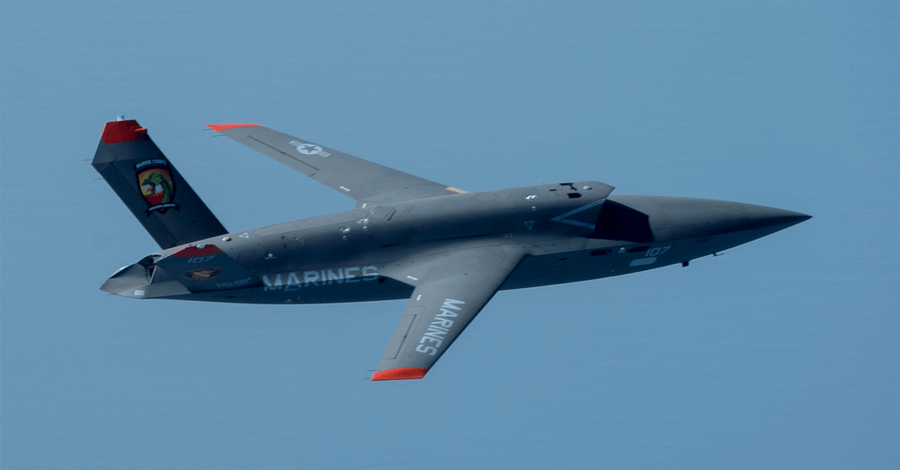
Source: Kratos Defense & Security Solutions
Some aspects of stock trading involve many moving parts and are therefore complicated.
Financial statements are complicated.
Industry trends and a company’s place inside them are complicated.
The products a company sells – such as semiconductors, airplanes, oil rigs, software, or smartphones – can be complex.
However, the foundational, critically-important aspect of trading – what really determines your success or failure as a trader or investor – is quite simple: As much as possible, you want to make a lot more money on your winning trades versus how much you lose on your losing trades.
You want what I call a “golden ratio” constantly working in your favor… where the difference between a trade’s potential upside and its potential downside is large, in the upside’s favor.
The higher this ratio is, the more you can win versus what you can lose, the better. Most of the market’s consistently successful traders look for trades that can give them at least $4 of upside for every $1 of downside.
Successful trading – the kind that can make you serious money – isn’t about being right all the time. An obsession with a high win rate is a loser’s mentality. Instead, successful trading is about finding and structuring trades that offer golden ratios, executing such trades, and then repeating the process as many times as possible. Doing all this allows simple math to make you lots of money.
I bring this up because a trade with a good “golden ratio” is setting up right now in one of the world’s strongest megatrends: The drone megatrend.
In late 2024, I urged colleagues to invest in drone stocks for one simple reason: After years of progress and innovation, military and surveillance drone makers can now produce a large number of effective drones at low cost. Many drone applications now have very high “cost-to-damage inflicted” ratios. Plus, they allow militaries to conduct strikes and surveillance without risking human lives.
This is why drones have played a significant role in the Russia/Ukraine war and the Iran war… and why I’ve reiterated my bullish call a handful of times in M&M.
The now pervasive use of drones in warfare means we are in what military experts call a “Revolution in Military Affairs.”
A Revolution in Military Affairs is a fundamental change in how wars are fought, typically driven by technological innovation. For example, the introduction of mechanized warfare in the form of tanks, battleships, and airplanes drastically changed the battlefield. Airplanes, in particular, introduced a whole new dimension to war.
I’m anti-war and anti-surveillance, so I’d rather see drones used just for peaceful activities like delivering pizza and Amazon packages. However, I don’t make the rules. Governments around the world are buying drones like crazy. Drone maker revenue is soaring. We have an investment megatrend on our hands.
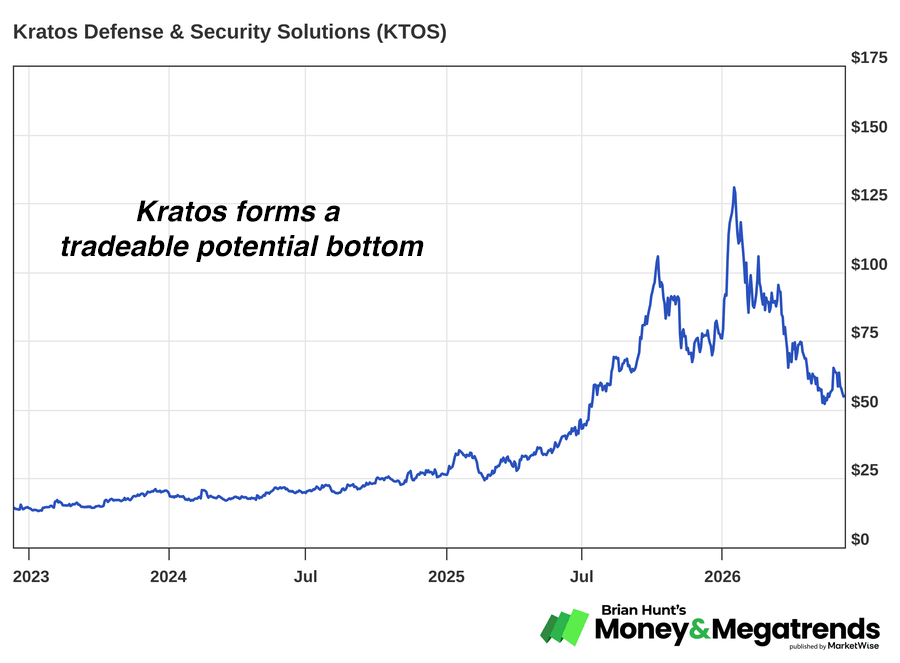
Soon after my 2024 note, leading drone maker and satellite defense firm Kratos Defense (KTOS) took off like a rocket. It advanced 380% in just over a year. However, the stock has suffered a 57% decline from its 2026 highs, largely due to running too far, too fast and becoming overvalued.
Kratos’ giant selloff (sell below) is a common occurrence with small, rapidly growing companies. Small companies in hypergrowth mode tend to generate tremendous investor interest and enthusiasm. Too much enthusiasm leads investors to bid up shares to absurdly high valuations. When a small hypergrowth firm trading at a high valuation encounters a business problem or sees its growth rate slow from “blistering” to merely “exceptional,” it can experience a big stock price decline.
These selloffs are often great times to invest in the stock. Almost every big growth stock winner of the past 20 years went through at least one of these cycles. No big winner goes up every month in a straight line.
Kratos has heavy exposure to the booming drone trend. Sales of its XQ-58 Valkyrie military drone are strong and growing. Plus, Kratos benefits from the space economy boom. A big part of its business is building and operating land-based facilities that protect U.S. government satellite hardware and communications. This is another megatrend with large growth potential.
In other words, the stock is a bet on not one, but two megatrends with very bright futures. Traders can buy KTOS shares near the recent lows, set a stop near those lows, structure a “high upside, low downside” trade, and get the golden ratio working in their favor.
Recommended Link:
Satellite Confirms: Elon Musk Activating Strange ‘Dark Energy’ Across U.S. South

Confirmed by satellites 300 miles above the Earth’s surface… Elon Musk is rolling out a breakthrough technology that could replace our need for foreign oil and ignite a $10 trillion boom a small group of stocks. Click here to learn how you can invest in this before it becomes mainstream.
How AI could erase a huge portion of your 401(k)

Credit: Chat GPT
This week, the market sent us another reminder… that, for investors, there’s both a bright side and a dark side to AI.
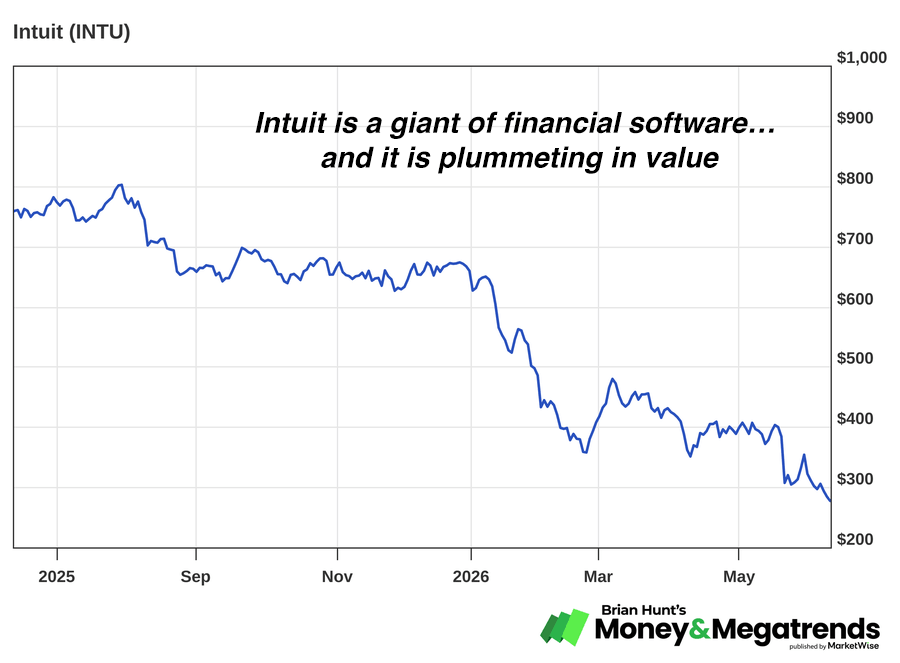
The message is being delivered via the plunging market values of leading software, online services, and data analytics firms Intuit (INTU), Trade Desk (TTD), Zillow (Z), Adobe Systems (ADBE), Fidelity National Information Systems (FIS), GoDaddy (GDDY), and Procore (PCOR).
When Elon Musk talks about the fast-moving, world-shaping effects of AI, he often calls the technology a “supersonic tsunami.” AI is the fastest developing technology in history… and it promises to reshape the world in massive ways. Plus, its progress is being fueled by the largest collective investment effort of all time.
This week, the supersonic tsunami created another round of losers in the “K-shaped stock market” I’ve been writing about for months.
-
Shares of tax software giant Intuit (INTU) just reached a new one-year low. They are down 63% over the past year.
-
Shares of software firm Trade Desk (TTD) just reached a new one-year low. They are down 73% over the past year.
-
Shares of real estate information firm Zillow (Z) just reached a new one-year low. They are down 53% over the past year.
-
Shares of graphic design firm Adobe (ADBE) just reached a new one-year low. They are down 46% over the past year.
-
Shares of financial data and software firm Fidelity National Information Services (FIS) just reached a new one-year low. They are down 51% over the past year.
-
Shares of web domain firm GoDaddy (GDDY) just reached a new one-year low. They are down 56% over the past year.
-
Shares of construction project software firm Procore Technologies (PCOR) just reached a new one-year low. They are down 35% over the past year.
These firms are not weak players in small industries. They are among the largest and strongest players in major industries. And they are suffering huge market declines.
Over the past year, we’ve detailed many ways to leverage the supersonic tsunami’s effects to make a lot of money quickly. Our recommendations in optical networking stocks, space stocks, E&C stocks, Power Grid Upgrade stocks, robotics stocks, and semiconductor stocks have generated large returns over short time periods. They’ve served as a “live fire demonstration” that right now, you can make money in stocks faster than ever.
But there’s a dark side to the supersonic tsunami. Due to blazing technological change, you can not only make money faster than ever in stocks… You can also lose money in stocks faster than ever.
Over the past three months, we’ve detailed how stocks in the KIDS category are the most vulnerable to the supersonic tsunami. KIDS is my acronym for Knowledge work, Information collection and analysis, Data collection and analysis, and Software.
Generally, these businesses sell digital products and services. We’re talking consulting firms. Credit rating agencies. Financial data providers. Software firms. You can’t stub your toe on what they sell.
These companies sell products and services that AI programs could produce for a very low cost soon. If someone using AI can code a product or service into existence, then any business related to it is in danger.
AI will put some of these KIDS work companies out of business. But keep in mind, it doesn’t have to put them out of business to make them stock market losers. AI only needs to lower the cost of producing what they produce over the long run. This will enable hordes of AI-centric competitors to throw a heavy wet blanket over their growth rates, profit margins, and P/E multiples.
Concerns over this trend have manifested in the steep market-value declines of the companies listed above.
Technological disruption isn’t producing just a “K-Shaped economy.” It’s also creating a “K-Shaped stock market” full of big winners and big losers. This week’s declines in the companies above are a serious reminder: Much of your investment success over the next decade will depend on whether you are positioned to greatly benefit or be seriously harmed by the supersonic tsunami that is AI.
One of the world’s greatest investors bets big on a unique oil stock

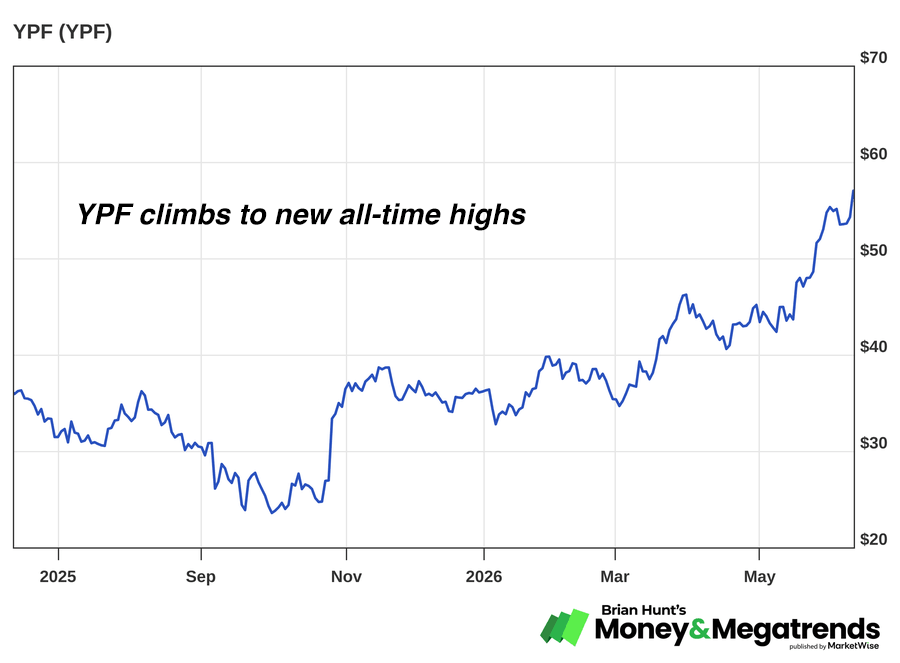
On May 18, I highlighted Stan Druckenmiller’s accumulation of Argentine oil producer YPF (YPF) shares and suggested it was a compelling way to invest in the world’s growing desire to develop “non Middle Eastern” energy supplies.
To this thesis, the market is saying, “So far, so good.”
Today, YPF surged 5% to reach a new all-time high. Shares are up 20% since our recommendation less than one month ago.
Stan Druckenmiller is one of the world’s greatest investors. He’s on my “Mt. Rushmore” of investors and traders. It’s been reported that “Druck” achieved 30% annual returns for 30 years with no down year. That earns him his own wing in the Wall Street Hall of Fame.
Druckenmiller is a world-class practitioner of “global macro” trading. This means he looks for big impending shifts in industries, technologies, currencies, interest rates, and commodities… and then bets on those shifts taking place.
Big investors like Druckenmiller must report their public-market positions to government regulators via “13F filings.” Those filings are made every quarter and are public. 13F filings essentially allow you to look over the shoulder of investors like Druckenmiller, which is often useful for spotting trends and good stock ideas.
In May, Druckenmiller revealed that he recently purchased over 2.5 million shares of Argentine oil and gas producer YPF. The purchases increased a YPF position that Stan held the previous quarter. The stock is now one of his largest positions.
YPF is the largest oil and gas company in Argentina. It is the dominant operator in Argentina’s enormous Vaca Muerta (dead cow) shale basin. The Vaca Muerta is one of the world’s most promising oil fields. Its potential for big discoveries and increased production is enormous… and its “not in the Middle East” location is a major positive.
However, since Argentina has spent most of the past 50 years as an economic basket case, many investors avoid investing there.
Making a bet on Argentina getting “less bad” looks like a good idea, however. In 2023, the country elected Javier Milei as president – an advocate of sensible, small government. He’s scored a string of successes that could make Argentina a good place to do business… and to discover large new oil reserves. This makes the Vaca Muerta one of the world’s most-watched oil fields among industry experts.
Stan doesn’t run his investment ideas by me, so I can’t know exactly what he is thinking. But I bet he’d mention the world’s burning desire to develop non-Middle Eastern oil and gas supplies as a big factor in his decision to load up on YPF.
YPF isn’t the only vehicle an investor can use to bet on a potentially huge win via Argentina’s oil and gas development. Another operator in the Vaca Muerta is Vista Energy (VIST), with a market cap of around $7 billion. Vista is another company that could enjoy a large increase in market value if it has exploration success and an improving business climate.
The world’s most powerful governments and businesses are very keen on discovering, developing, and securing safe supplies of critical resources like oil and gas. Argentina has them. One of the world’s best investors is betting that this situation will deliver big returns for the likes of YPF and VIST. So far, the market is enthusiastically agreeing with the idea.
Market Notes
-
Our recommendation to own drug giant Eli Lilly (LLY) as a way to invest in the health & longevity megatrend is off to a good start. The stock jumped 2.3% this morning, reaching an all-time high.
-
Our recommendation to own the semiconductor equipment stock group continues to generate gains. Applied Materials (AMAT), KLA (KLAC) and Lam Research (LRCX) each soared more than 7% this morning to reach new all-time highs. The group is up 49% since our recommendation in March.
-
Hotel & hospitality REITs Ryman Hospitality Properties (RHP), DiamondRock Hospitality (DRH), Park Hotels & Resorts (PK), RLJ Lodging Trust (RLJ), Pebblebrook Hotel Trust (PEB), and Apple Hospitality REIT (APLE) reached new all-time highs today. These are bullish economic signals.
-
Shopping mall giant Simon Property Group (SPG) reached a new all-time high today. The American consumer continues to spend with enthusiasm.
Top Themes to Buy Now
🧬 An ignored market theme with huge upside quietly hits new highs
💊 These under-the-radar AI stocks are soaring… and have room to run higher
🤖 The robotics megatrend is powering key players to new highs. Are you positioned to benefit?
Regards,


Brian Hunt
Editor, Money & Megatrends
An urgent message from our colleagues:
Louis Navellier: “This Could Be Bigger Than Nvidia”

Popular Fox News guest Louis Navellier sat down for a tell-all interview on Elon Musk’s little-known AI project in Tennessee. He reveals why competitors are flying spy planes overhead… and details three little-known stocks (not Tesla) he believes will soar from this $7 trillion shift.