
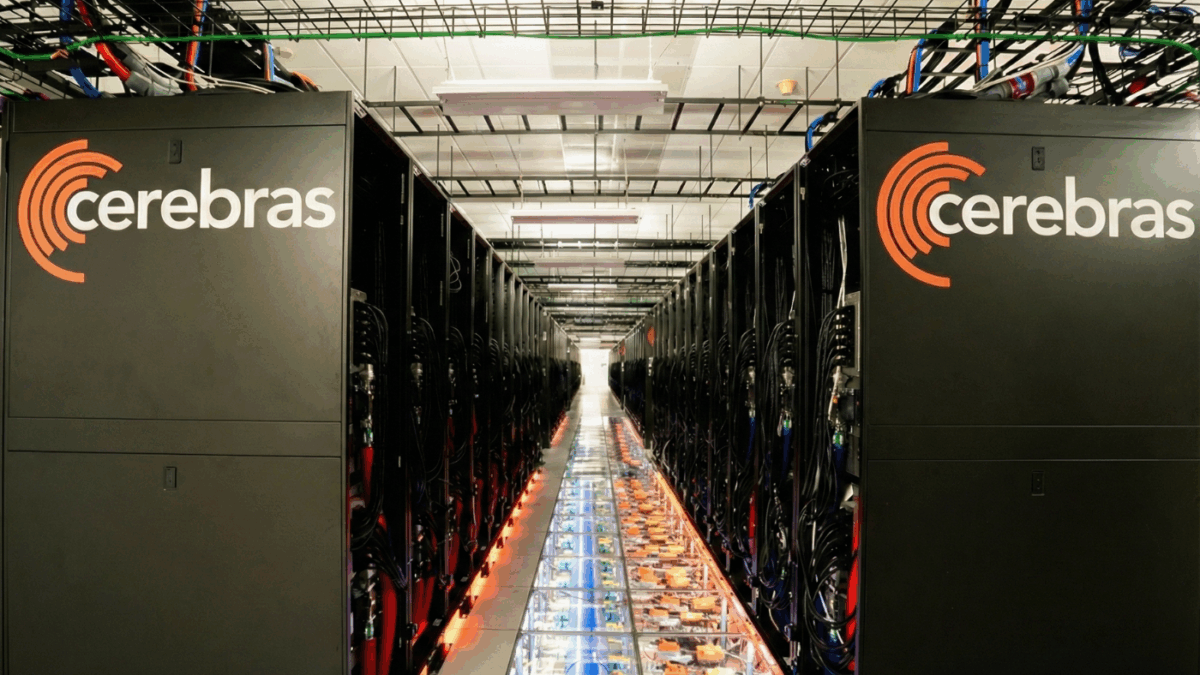
Image Credit: Cerebras
One of 2026’s hottest IPOs is reportedly just around the corner.
The AI chipmaker Cerebras Systems is in talks to go public. It would make its debut in a market that’s hungry for all things AI… And the pitch is compelling.
Management says its platform is faster and cheaper than those of market leader Nvidia (NVDA) – news that should make investors sit up and take notice.
Cerebras uses what it calls the Wafer-Scale Engine (“WSE”). It’s the world’s largest single chip – a single integrated circuit on an entire silicon wafer the size of a dinner plate.
According to Cerebras, its wafer-scale chips can process the inference workloads on key AI models up to 20 times faster than Nvidia’s graphics processing units.
This inference outperformance may be particularly important now. You see, training is the data-intensive process that loads AI models with the information they need. Inference is the next step – when the trained AI learns to draw conclusions on its own, from all-new data.
Right now, AI workloads are shifting from training to inference. More AI models are now moving from the training stage to the deployment stage.
In fact, Deloitte estimates that inference will account for about two-thirds of all AI computation in 2026 – up from around 50% in 2025. That figure has risen from 20% just a few years ago. And it could rise to as much as 80% by 2027, according to McKinsey.
This gives companies focused on inference, such as Cerebras, a huge tailwind. And that’s one key reason that the valuation on Cerebras’ pre-IPO stock has soared in recent months.
Here’s why Cerebras could be one of the hottest IPOs of 2026.
Cerebras Touts Advantages Over Nvidia
Cerebras takes a different approach from Nvidia. The wafer-scale chip is massive compared with most chips you’ll find on the market today… But it packs in tons of processing power – the kind that AI apps need.
For example, the WSE-3 chip from Cerebras features some four trillion transistors separated into 900,000 cores with 44 gigabytes of memory. The large supply of memory means the chip can run AI models right on the chip instead of the slower process of moving the data off-chip.
The big benefit, says Cerebras, is increasing the inference speed of AI. This higher speed makes AI more usable for an audience that wants answers immediately rather than waiting around for the AI to process.
Using the Llama 3.1 8B AI model from Meta Platforms (META), Nvidia can only process 90 or so “tokens” (the pieces of data processed by AI models) per second. But Cerebras can process 1,800 tokens per second.
That’s 20 times the speed. And Cerebras’ systems are reportedly more cost-effective than Nvidia’s, when you factor in the costs of both hardware and operation.
The WSE-3 chip is sold as part of an accelerator (a type of AI processor) called the CS-3. The CS-3 also incorporates a cooling system and other related hardware for use in data centers.
Cerebras is deploying the CS-3 in its own inference data centers, where it’s renting out capacity to other companies on a per-use basis. It’s also selling its CS-3 units for those who want them in-house.
And now, Cerebras is building out its data centers even more, after a funding round in late 2025. This includes six new data centers that will house thousands of CS-3 units.
Customer Concentration at Cerebras
Cerebras has only just begun ramping up its client list. So its customer base is still very concentrated.
In its 2024 IPO filing, Cerebras reported that the Emirates-based AI company G42 provided 87% of its revenue in the first half of the year.
That level of concentration might sound scary at first. But it’s largely because Cerebras’ sales are still small. Look at the scale here… The company’s sales soared from $6 million in the second quarter of 2023 to nearly $70 million in the same quarter of 2024.
And since then, sales have grown rapidly as Cerebras works to expand its customer base. It now offers remote computing services to International Business Machines (IBM), Meta , and Mistral AI, among others.
Cerebras also scored a big win with leading player OpenAI. In January, Cerebras agreed to provide 750 megawatts of computing power to OpenAI through 2028 for an estimated deal of more than $10 billion. The companies have touted it as “the largest high-speed AI inference deployment in the world.”
We’ll see a revised IPO filing in the lead-up to the stock’s debut, which will provide more concrete financial details on revenue growth, customers, and risks.
Will Cerebras Finally Have Its IPO in 2026?
Cerebras initially filed publicly for an offering in September 2024, but then pulled it in October 2025.
The delay was related to a foreign investor in the company. Now, though, the issue has been resolved, clearing the way for this year’s offering (expected in the second quarter). Here’s what happened…
At the time, one of Cerebras’ minority investors was G42 – the Emirates-based company that made up a huge portion of Cerebras’ revenue last year. U.S. officials flagged the 2024 IPO filing as a result.
The Committee on Foreign Investment in the United States (“CFIUS”) was scrutinizing G42’s stake in Cerebras. The agency was concerned about whether Middle Eastern companies might act as indirect conduits to move American AI technology to China.
CFIUS later gave clearance to the IPO. But in October, Cerebras pulled its planned IPO anyway, saying that its now financials looked much different from when it had first filed them in the third quarter of 2024.
Despite the pulled IPO, investors remained confident enough to put up big money to fund the chipmaker. They invested $1.1 billion in a September 2025 funding round at an $8.1 billion valuation… And they’re expected to fund another $1 billion in early 2026.
In short, the delay likely means that Cerebras will debut with an even higher valuation when it does go public. Anything AI-related remains white-hot today, making it a great time to conduct an IPO.
So, with its new plan in place, 2026 could be the year Cerebras goes public.
Cerebras’ Pre-IPO Valuation Keeps Soaring
The AI chipmaker has a strong history of rising valuations. This shows that venture investors continue to buy in at ever-higher prices:
- In November 2021, the company raised $250 million at a $4 billion valuation.
- In September 2025, Cerebras raised $1.1 billion at an $8.1 billion valuation.
- In early 2026, Cerebras is poised to raise another $1 billion at a $22 billion valuation.
The galloping valuation in the past few months – an eye-popping rise of 175% – is a testament to how powerful the AI trend is right now.
And of course, investors will be attracted to anything that might be able to move in on Nvidia’s turf and capture some of the margins of the leading chipmaker.
Cerebras reported $136.4 million in revenue in the first half of 2024. And late in 2025, the company was on pace for record annual revenue. But even breakneck growth rates between then and the IPO date would still leave the stock at a breathtaking valuation.
Investors should expect the IPO to price at an even higher valuation than the figures listed above… And first-day trading will likely push that even higher.
But those who witnessed Nvidia’s rapid ascent in the last few years shouldn’t forget how quickly that stock skyrocketed. That’s why it’s worth keeping an eye on this IPO out of the gate.
Good investing,
James Royal
Editor’s Note: A strange change is coming to the stock market – and it’s about to have dramatic consequences for anyone older than 50.
“If you own popular AI stocks like Nvidia, you’re in for a big shock,” says Whitney Tilson, who predicted the 2000 Tech Wreck and founded a $200 million hedge-fund firm.
He isn’t the only leading figure warning investors to tread carefully.
Michael Burry, who made hundreds of millions shorting banking stocks before 2008, just placed a $1 billion bet against AI stocks – he’s short both Nvidia and Palantir Technologies (PLTR).
And if Whitney is correct, what’s coming to AI stocks next won’t be a crash or mass rush for the exits…
It’s something far more dangerous – a permanent change that could leave millions behind.
That’s why he’s stepping forward to reveal the one place you can move your money today, which could outperform stocks, bonds, and gold in the near future.