

Every investor who has lived through a pullback knows the feeling. The market drops 5%, 10%, maybe more, and suddenly the stocks you were most confident about look like the ones doing the most damage. You freeze, you sell, or if you’ve been around long enough, you start looking for opportunities.
MarketWise surveyed 1,050 American retail investors to find out what they actually do when markets pull back, whether they stick with the stocks that led the rally, and how their instincts stack up against historical patterns where leadership stocks have tended to reassert themselves after market corrections.
Key Takeaways
- Nearly 7 in 10 American investors (69%) have bought the dip in the past year, but only 22% actually added to holdings during the March pullback.
- 1 in 3 American investors say gut instinct is their top influence on pullback decisions, outranking predetermined plans, financial news, and analytics tools.
- Investors who follow a predetermined plan report positive dip-buying results 75% of the time, compared to 58% of those who rely on gut instinct.
- Only 13% of American investors are very confident that current market leaders will continue to outperform after the pullback.
- Fewer than half (49%) of American investors believe the same market-leading stocks will come back and win again.
The Dip Playbook
Ask most investors whether they buy the dip, and the answer is a confident yes. Ask them what they did during the March pullback, and the story gets more complicated.
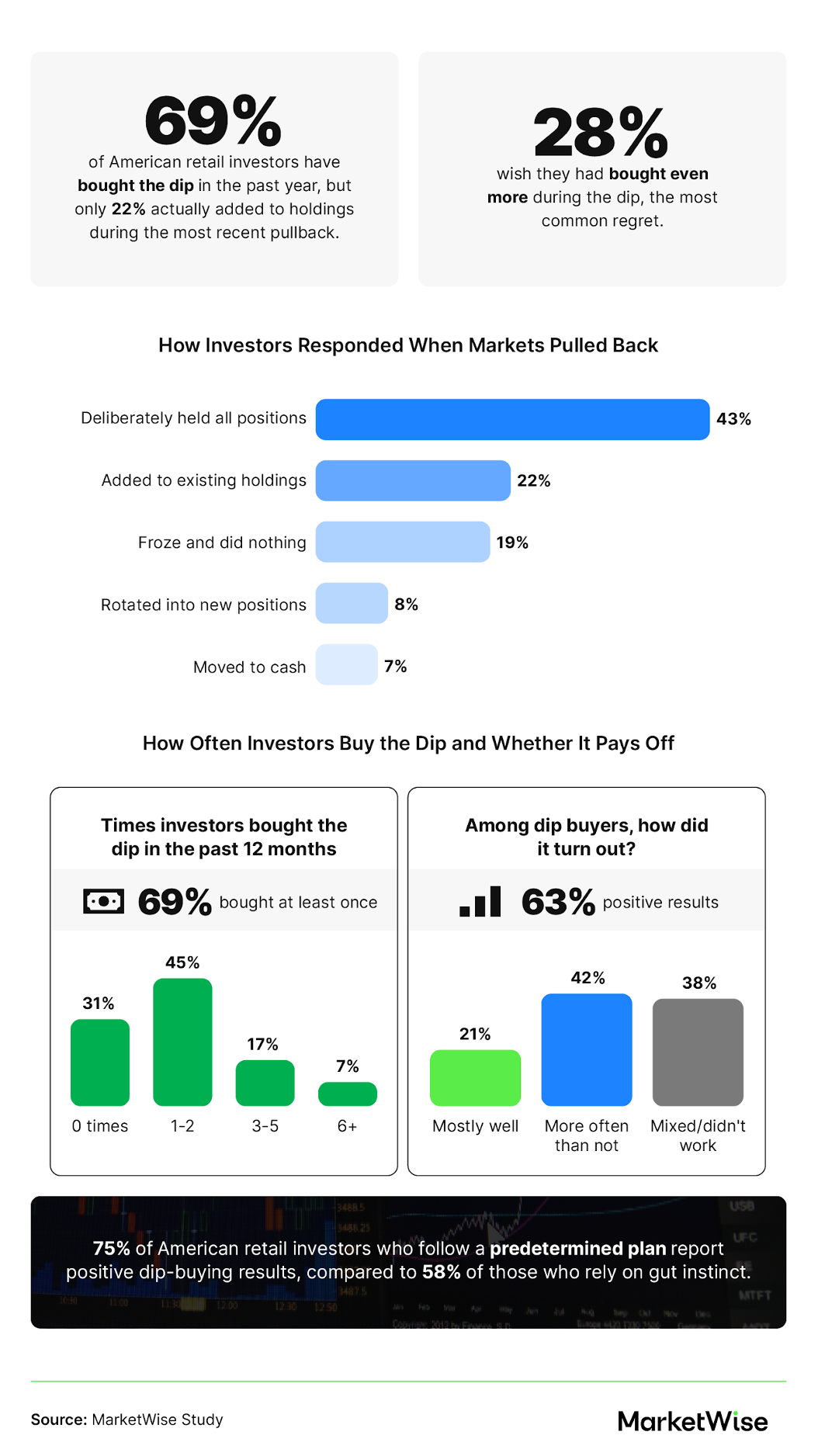
Nearly 7 in 10 American investors (69%) said they bought the dip at least once in the past year, though frequency varied. Among dip buyers, 45% had done it once or twice, 17% 3 to 5 times, and 7% 6 times or more.
The remaining 31% hadn’t bought a single dip. When we asked specifically about the March pullback, the picture shifted:
- Deliberately held all positions: 43%
- Added to existing holdings: 22%
- Froze and did nothing: 19%
- Rotated into new positions: 8%
- Moved to cash: 7%
Among those who did buy the dip in the past year, 63% reported positive results overall:
- Mostly well: 21%
- More often than not: 42%
- Mixed or didn’t work out: 38%
The gap between “I buy dips” and “I bought this dip” is worth paying attention to. Twenty-eight percent of investors said their biggest regret was not buying more during the pullback, making it the most common regret overall. The willingness was clearly there, but the follow-through less so.
Experience level made a dramatic difference in how investors handled the moment. Nearly half of self-identified beginner investors (48%) froze and did nothing during the most recent pullback, compared to just 4% of self-identified advanced investors.
Gender differences also emerged. Over 1 in 4 male investors (28%) added to holdings during the pullback, compared to about 1 in 6 female investors (16%). Nearly 3 in 10 female investors (29%) froze, compared to just 12% of men. The reasons behind the gap are harder to pin down, but the behavioral divide was unmistakable.
Headlines play a different role depending on who you ask. Over 1 in 5 Gen Z investors (21%) cited recession fears as the top headline that influenced their pullback behavior. Baby boomers were far less reactive, with nearly half (46%) saying no headline affected their behavior at all.
What actually works when markets sell off? Having a plan mattered more than having good instincts.
Among investors who followed a predetermined plan during the dip, 75% reported positive results. Among those who relied on gut instinct, that number dropped to 58%.
The gap widened further when it came to positions performing well in hindsight. Over 1 in 3 plan-followers (36%) said their positions performed well, compared to fewer than 1 in 5 gut-followers (17%).
Investors who bought the dip more frequently also fared better. Among those who bought 3 or more times in the past year, 70% reported positive outcomes, compared to 63% overall.
Beginners were especially vulnerable to going in without a framework. Over half of beginner investors (53%) said they bought opportunistically with no set threshold, compared to just 25% of advanced investors. When you have no line in the sand, every pullback feels equally scary and equally tempting, which often means doing nothing.
The Leadership Loyalty Gap
Historical data from prior bull markets, including the 1990s dot-com era, suggests that stocks leading the rally before a correction tend to lead again after it. Retail investor behavior doesn’t always reflect that pattern.
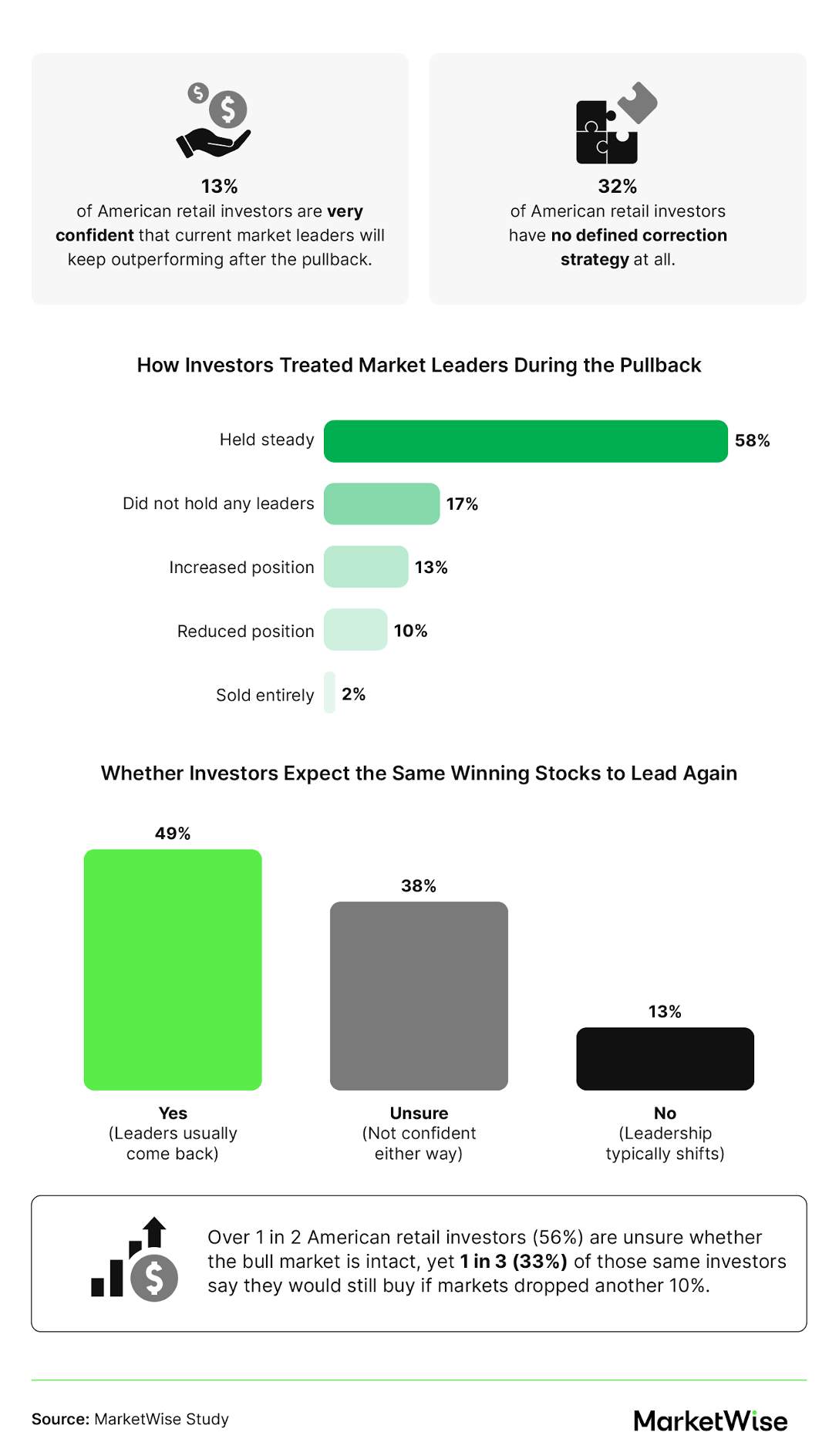
During the March pullback, investors handled their market-leading positions in very different ways:
- Held steady: 58%
- Did not hold any leaders: 17%
- Increased position: 13%
- Reduced position: 10%
- Sold entirely: 2%
That 12% who reduced or sold ran against the historical tendency for leaders to bounce back. Nearly 1 in 6 Gen Z investors (16%) reduced or sold their positions in market leaders, more than triple the rate of
Only 13% of American investors said they were very confident that current market leaders would continue to outperform after the pullback. When asked whether the same winning stocks would lead again, investors were split:
- Yes, leaders usually come back: 49%
- Unsure, not confident either way: 38%
- No, leadership typically shifts: 13%
That uncertainty deepened among less experienced investors. Nearly 3 in 4 beginner investors (73%) were unsure whether the current pullback was a temporary reset, compared to about 1 in 3 advanced investors (35%). On the flip side, 43% of advanced investors believed the bull market was still intact, versus just 15% of beginners.
One of the more telling findings: over half of American retail investors (56%) were unsure whether the bull market was intact at all, yet 33% of those same uncertain investors said they would still buy if markets dropped another 10%. That’s a striking mix of doubt and appetite, and it says a lot about how conflicted investors actually are during pullbacks.
Whether investors had a correction strategy at all turned out to be one of the strongest predictors of how they behaved and how things turned out. (A correction strategy is simply a plan you set ahead of time for what you’ll do if the market drops.) Among investors without a defined correction strategy, 40% froze during the pullback, compared to fewer than 1 in 10 of investors who had one (9%). The strategic investors were also twice as likely to report positive outcomes (27% vs. 14%).
About 1 in 3 American investors (32%) had no defined correction strategy at all. That rate was worst among beginners, where 57% had no strategy, compared to 21% of advanced investors.
What Pullback Behavior Tells Us About Investor Preparation
The pattern across nearly every data point was the same: preparation beat reaction. Investors with a predetermined plan acted more decisively, reported better outcomes, and carried fewer regrets. Those without one froze, sold at the wrong time, or sat on the sidelines. For self-directed investors navigating volatile markets, the real edge probably isn’t picking the right stock to buy on the dip but having a framework that lets you act at all when the moment arrives.
Methodology
For this study, we surveyed 1,050 American retail investors about their behavior during market pullbacks, their confidence in market-leading stocks, and their correction strategies. Among them, 56% identified as male, 43% identified as female, and 1% identified as non-binary. Generationally, 8% reported as baby boomers, 20% as Gen X, 52% as millennials, and 20% as Gen Z. The survey was conducted on Connect Cloud Research from April 6–9, 2026.
About MarketWise
MarketWise is a leading financial research and education platform serving self-directed investors. Through a network of independent brands, including Stansberry Research, Altimetry, Chaikin Analytics, TradeSmith, InvestorPlace, Brownstone Research, and Wide Moat Research, MarketWise delivers independent insights, tools, and software to help individuals navigate complex markets with confidence. Whether you’re exploring emerging opportunities or seeking stability, MarketWise supports every investor with credible research and actionable strategies.
Fair Use Statement
We welcome the use of this study for noncommercial purposes. If you share or reference any part of this content, please include a link back to this page to credit MarketWise appropriately.