
Day trading has never been more accessible, more hyped, or more misunderstood. To find out who’s actually doing it, what’s pulling them in, and what it’s costing them, MarketWise surveyed 1,000 U.S. investors about their day trading behaviors, motivations, and the financial and emotional consequences of their experience. The findings show that social media is reshaping how people approach the markets, and not always for the better. If you’re managing your own money, this data might change how you think about your next trade.
Key Takeaways
- Over 1 in 10 investors (11%) are planning to start day trading in the near future; Gen Z is most likely to do so, at 13%.
- 15% of day traders believe they could realistically quit their job and day trade full-time within two years.
- 56% of day traders have made at least one trade based solely on a social media post or online recommendation, with Gen Z being the most likely (68%).
- Reddit is the top single platform for trading ideas among engaged traders (26%), followed by YouTube (22%) and financial news sites (19%).
Who Is Day Trading and Who Wants to Start
A new generation of investors is entering the market faster, trading more frequently, and spending serious time doing it.
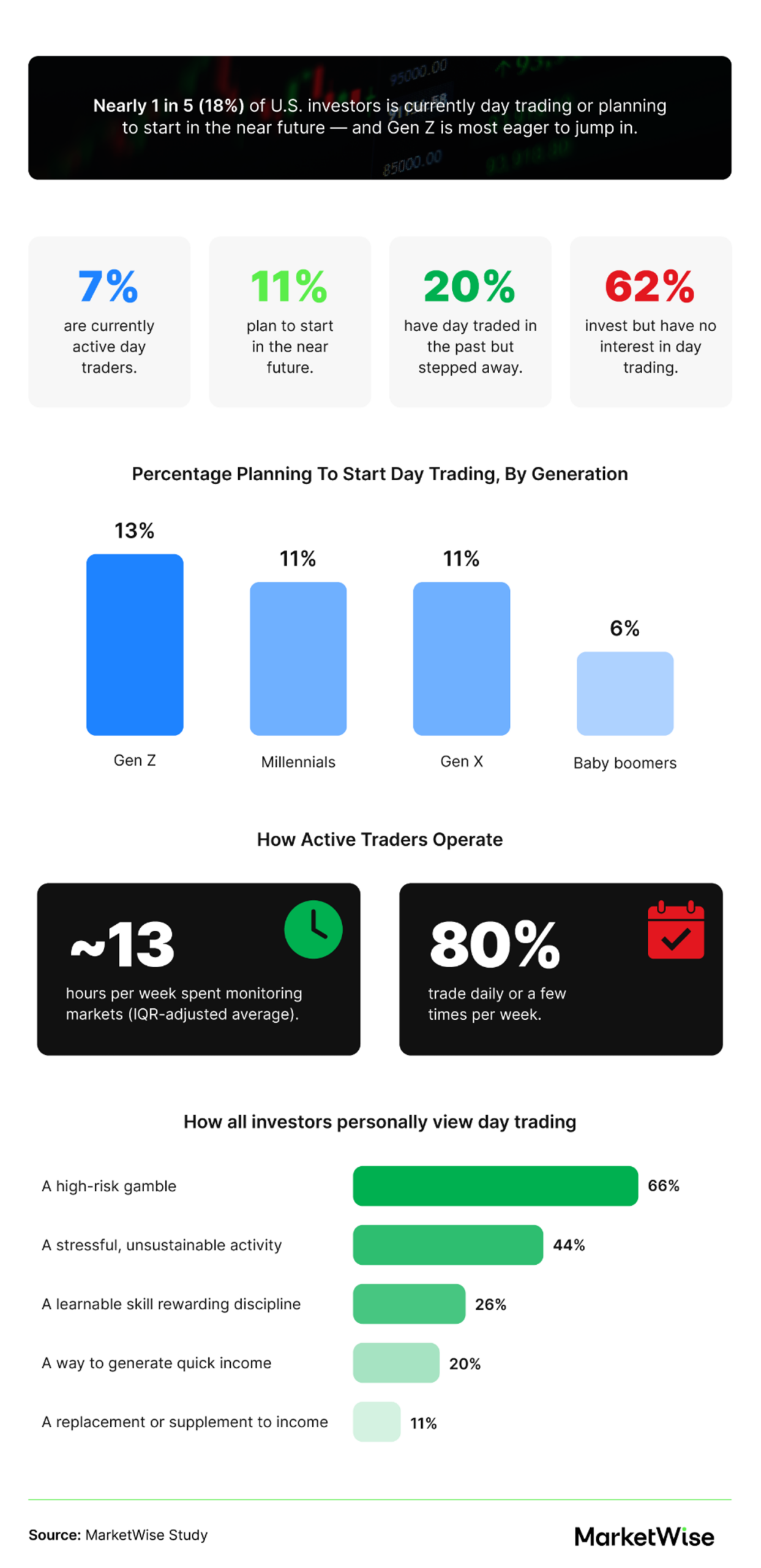
Nearly 1 in 5 American investors (18%) are currently day trading or planning to start in the near future; 7% are active today, and another 11% plan to begin soon. Gen Z was the most eager generation to get started, with 13% planning to start in the near future, the highest of any generation. Another 10% of Gen Z investors were already active traders, bringing their combined rate to 23%.
The pace at which active traders operate may surprise even seasoned market watchers. Active day traders reported spending an average of 13 hours per week monitoring markets, tracking alerts, or researching potential trades; the equivalent of a part-time job, minus the steady paycheck. And 80% traded daily or a few times per week, making this anything but a casual side interest.
Perhaps most striking is how the broader investing public views the practice. Two-thirds of all investors (66%) described day trading as a high-risk gamble, and 44% called it a stressful and unsustainable activity. Yet plenty pursued it anyway, a reminder that knowing something is risky and acting accordingly are two very different things.
What’s Fueling the Day-Trading Surge
The motivations behind day trading reveal something important: for most people, this isn’t about thrill-seeking. It’s about financial frustration, social influence, and the seductive promise of a faster path to independence.
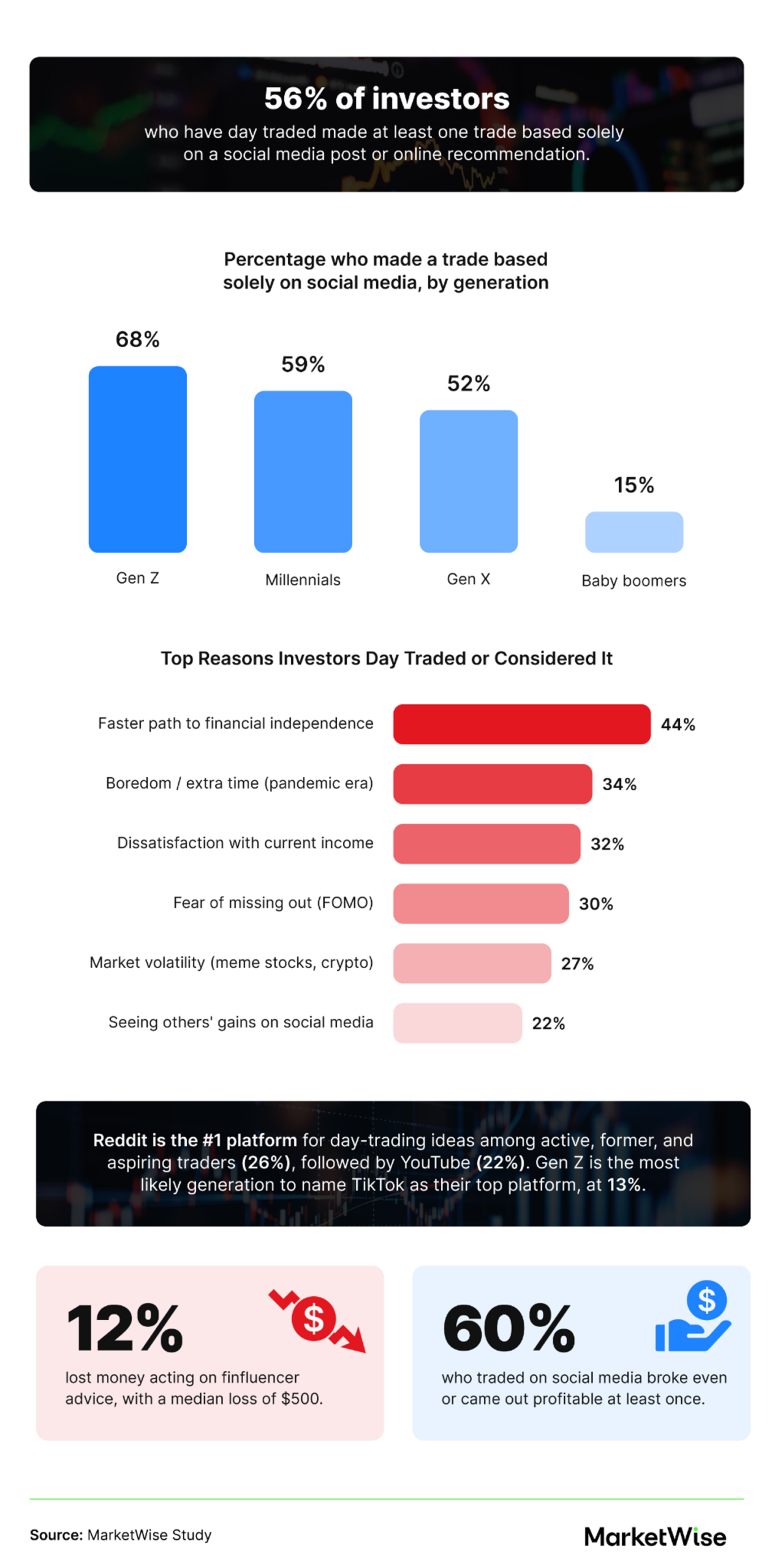
Day traders cited a mix of financial pressure, lifestyle shifts, and social influence as their top motivators. Here’s what drove them to start trading:
- Wanting faster financial independence (44%)
- Boredom or extra time (34%)
- Dissatisfaction with current income (32%)
- Fear of missing out (FOMO) (30%)
- Market volatility (27%)
- Seeing others’ gains on social media (22%)
Social media’s influence on actual trading behavior is even more direct. More than half of day traders (56%) reported making at least one trade based solely on a social media post or online recommendation. Gen Z was the most likely group to do so at 68%, followed by millennials at 59%.
When it comes to where traders turn for ideas, Reddit ranked first among active, former, and aspiring traders at 26%, followed by YouTube at 22% and financial news sites at 19%. Gen Z stood out as the most likely generation to name TikTok as their top platform, at 13%. The finfluencer pipeline has real consequences: 12% of traders reported losing money acting on a finfluencer’s advice, with a median self-reported loss of $500.
The Real Costs of Day Trading
The financial risks of day trading are well-documented, but the emotional and behavioral toll rarely gets the same attention. The data reveals a pattern of stress, regret, and hidden consequences that extends well beyond a losing trade.
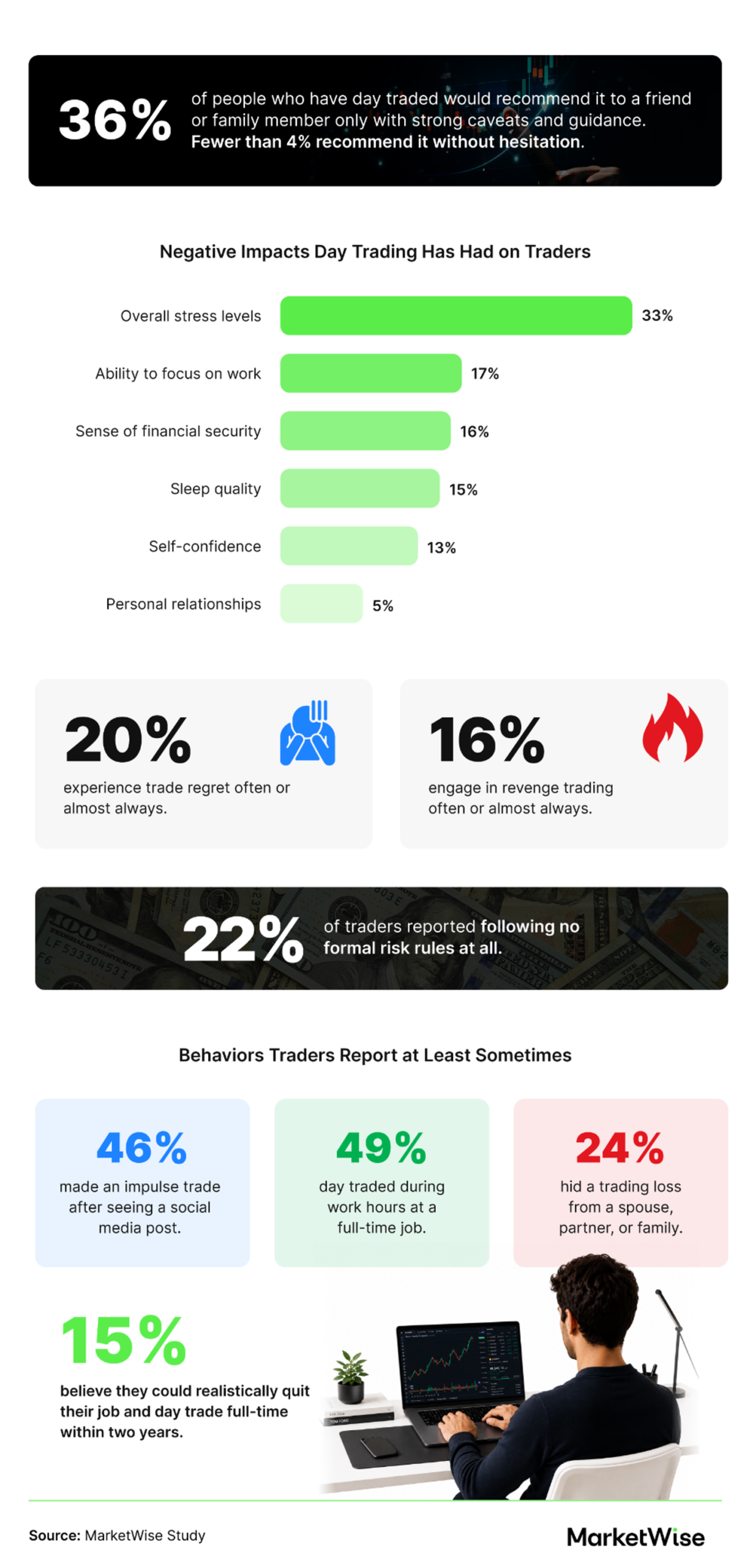
Day trading took a toll in more ways than one. Here’s where traders felt it most:
- Stress levels (33%)
- Work focus (17%)
- Financial security (16%)
- Sleep quality (15%)
Gen Z reported the highest stress impact at 42%. The emotional weight of active trading is real, and for younger investors especially, it is proving hard to shake.
The behavioral patterns that emerge under pressure are equally telling. One in five traders (20%) said they experience regret about a trade decision often or almost always, and 16% reported engaging in revenge trading at that same frequency, making additional trades specifically to try to recover losses. More than 1 in 5 traders (22%) reported following no formal risk rules at all. The most common risk management practice that did exist was setting stop-loss limits, used by 25%.
The hidden behaviors paint an even more candid picture of how day trading bleeds into daily life. Nearly half of traders (49%) reported day trading during work hours at a full-time job at least sometimes, 46% made impulse trades after seeing a social media post, and 24% admitted to hiding a trading loss from a spouse, partner, or family member. Despite those consequences, 15% of day traders said they believe they could realistically quit their job and day trade full-time within two years.
When asked whether they would recommend day trading to a friend or family member, 36% said they would, but only with strong caveats and guidance. Fewer than 4% recommended it without hesitation, and 50% would caution against or actively discourage a friend or family member from starting.
The Bottom Line on Day Trading
Day trading can be compelling, but the data suggests the costs are easy to underestimate and hard to recover from. The traders who fared best shared one thing in common: they approached the markets with structure, discipline, and a clear-eyed view of the risks involved. If you’re thinking about getting into active trading, this data is worth a second look, not as a reason to avoid it, but as a reminder that strategy beats impulse every time.
Methodology
To explore the prevalence, motivations, and consequences of day trading among American investors, we surveyed 1,000 U.S. adults who currently hold investments or savings. Respondents were asked about their relationship with day trading, their trading behaviors and information sources, and the financial and emotional impacts of their experience.
For the purposes of this study, “traders” refers to those who are currently active day traders, have day traded in the past, or are planning to start in the near future (n=377). Generations are defined as follows: Gen Z (13%), millennials (53%), Gen X (26%), and baby boomers (8%). The survey was conducted in 2025. Some questions allowed respondents to select multiple answers; percentages for those questions reflect the share of respondents who selected each option and may not sum to 100%. All other percentages may not sum to 100% due to rounding.
About MarketWise
MarketWise is a leading financial research and education platform serving self-directed investors. Through a network of independent brands, including Stansberry Research, Altimetry, Chaikin Analytics, TradeSmith, InvestorPlace, Brownstone Research, and Wide Moat Research, MarketWise delivers independent insights, tools, and software to help individuals navigate complex markets with confidence. Whether you’re exploring emerging opportunities or seeking stability, MarketWise supports every investor with credible research and actionable strategies.
Fair Use Statement
We welcome the use of this study for noncommercial purposes. If you share or reference any part of this content, please include a link back to this page to credit MarketWise appropriately.