
Listen to the audio version of this article (generated by AI).
Key Points
- 79% of Americans who invest say they are worried the next geopolitical headline could erase the market’s recent gains, while 72% say positive news feels too fragile to act on.
- 42% of Americans who invest say they do not trust the recent market calm following the U.S.-Iran de-escalation, and 25% expect the rally to reverse quickly.
- 6% of Americans who invest say they have taken on more risk as U.S.-Iran tensions eased, while 28% have moved toward safer assets or cash.
- 25% of Americans who invest say inflation staying higher than expected is their biggest investing worry, while 14% name another geopolitical headline reversing the rally and 8% the Federal Reserve keeping rates higher for longer.
- 53% of Americans who invest believe the Pentagon timed its Iran strike announcement to limit the market impact, and 43% consider it manipulative.
- 67% of Gen Z Americans who invest say they would invest more if they believed the calm would last, the most of any generation and well above the 44% of baby boomers who say the same.
- 53% of Americans who invest are holding their positions, and 51% have not moved a single dollar in response to the recent geopolitical headlines in the past 30 days.
- 31% of Americans who invest say nothing right now would make them confident enough to invest more aggressively.
When the U.S. and Iran stepped back from the brink in June 2026, the markets calmed almost overnight. Retail investors did not. MarketWise surveyed 1,006 U.S. retail investors to see how they were processing the whiplash, and the mood that came back was less relief than suspicion.
Most weren’t buying the rebound, at least not yet. We asked how the ceasefire changed the way they feel, whether they’d moved any money, and what it would take to trust the calm. The answers point to a market that has moved on in price but not in confidence.
Why Retail Investors Still Don’t Trust the Calm
When the U.S. and Iran stepped back, the market exhaled, but most retail investors are still holding their breath.
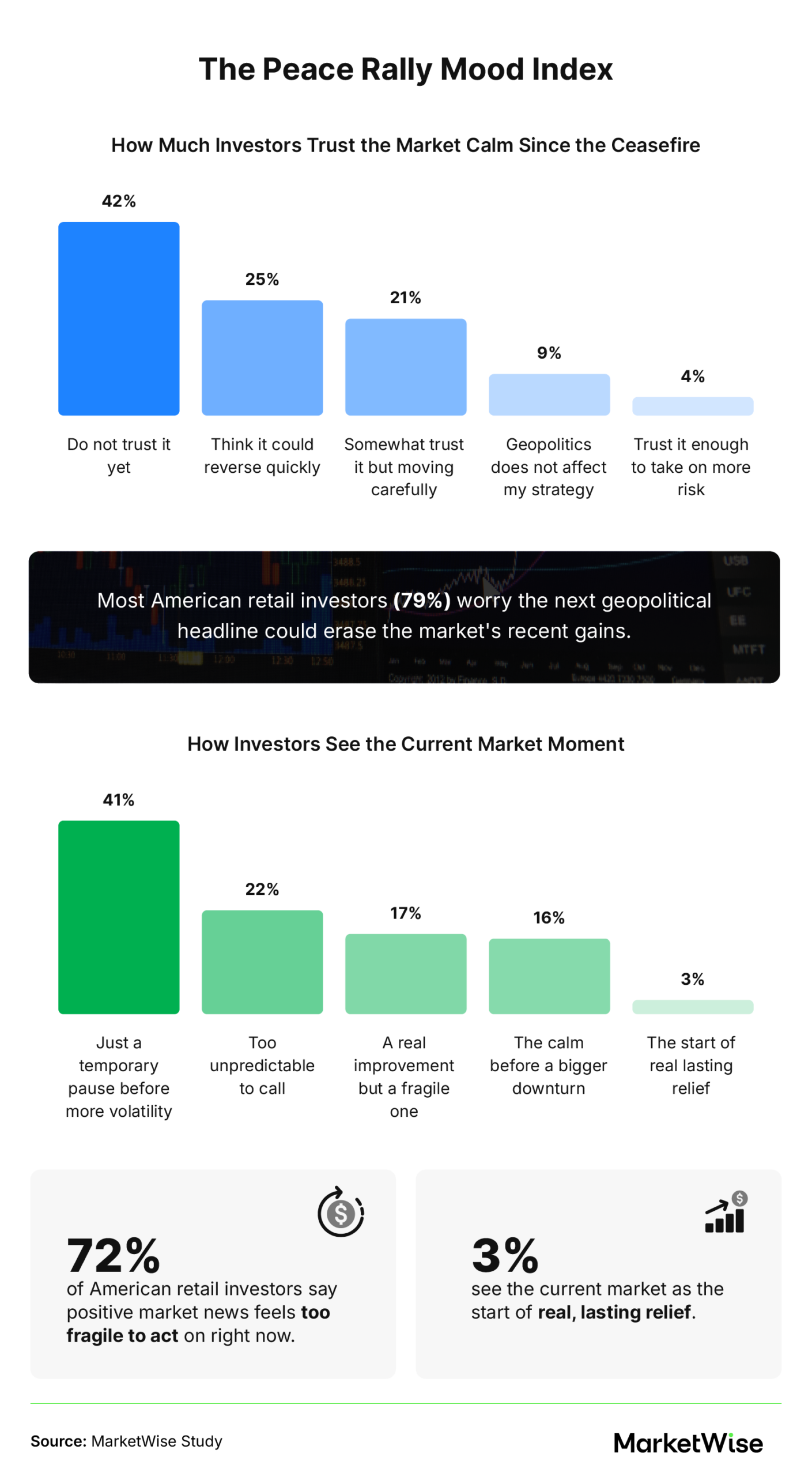
For retail investors, the mood is less about relief than about doubt:
- Nearly four in five worry the next geopolitical headline could erase the market’s recent gains (79%).
- A similar share say positive news feels too fragile to act on (72%).
- Distrust is widespread, with 42% saying they don’t trust the market calm following the U.S.-Iran de-escalation and 25% expecting the rally to reverse quickly.
Asked how the ceasefire and de-escalation made them feel about the markets, investors split several ways:
- 41% were skeptical it would hold.
- 24% felt relieved but cautious.
- 16% felt anxious about more volatility.
- 13% were indifferent.
- 7% were excited to buy.
Their reaction to good news right now is just as guarded:
- 34% want to believe it but don’t fully trust it.
- 21% assume the next geopolitical headline could undo it.
- 18% mostly ignore short-term news.
- 18% wait for confirmation.
- 7% are unsure.
- 3% believe it and act quickly.
There’s broad agreement on what’s driving the mood:
- 76% feel the market is driven more by headlines than fundamentals.
- 59% say it’s swinging too fast for them to react to.
- 57% would invest more if they believed the calm would last.
Investors’ willingness to get back in the market tracked closely with age:
- Gen Z was the most ready to re-engage, with 67% saying they’d invest more if the calm held, compared with 59% of millennials, 50% of Gen X, and 44% of baby boomers.
- Skepticism that the de-escalation would hold rose with age, at 33% of Gen Z, 42% of millennials, 42% of Gen X, and 46% of baby boomers.
- Distrust of the calm was highest among millennials and Gen X, at 45% and 44% saying they don’t trust it yet, compared with 38% of Gen Z and 25% of baby boomers.
- Expecting the rally to reverse quickly was most common among baby boomers at 38%, versus 23% of Gen Z, 25% of millennials and 24% of Gen X.
Why Most Investors Haven’t Moved a Dollar
For all the headline whiplash, the most common response among retail investors has been to do nothing at all.
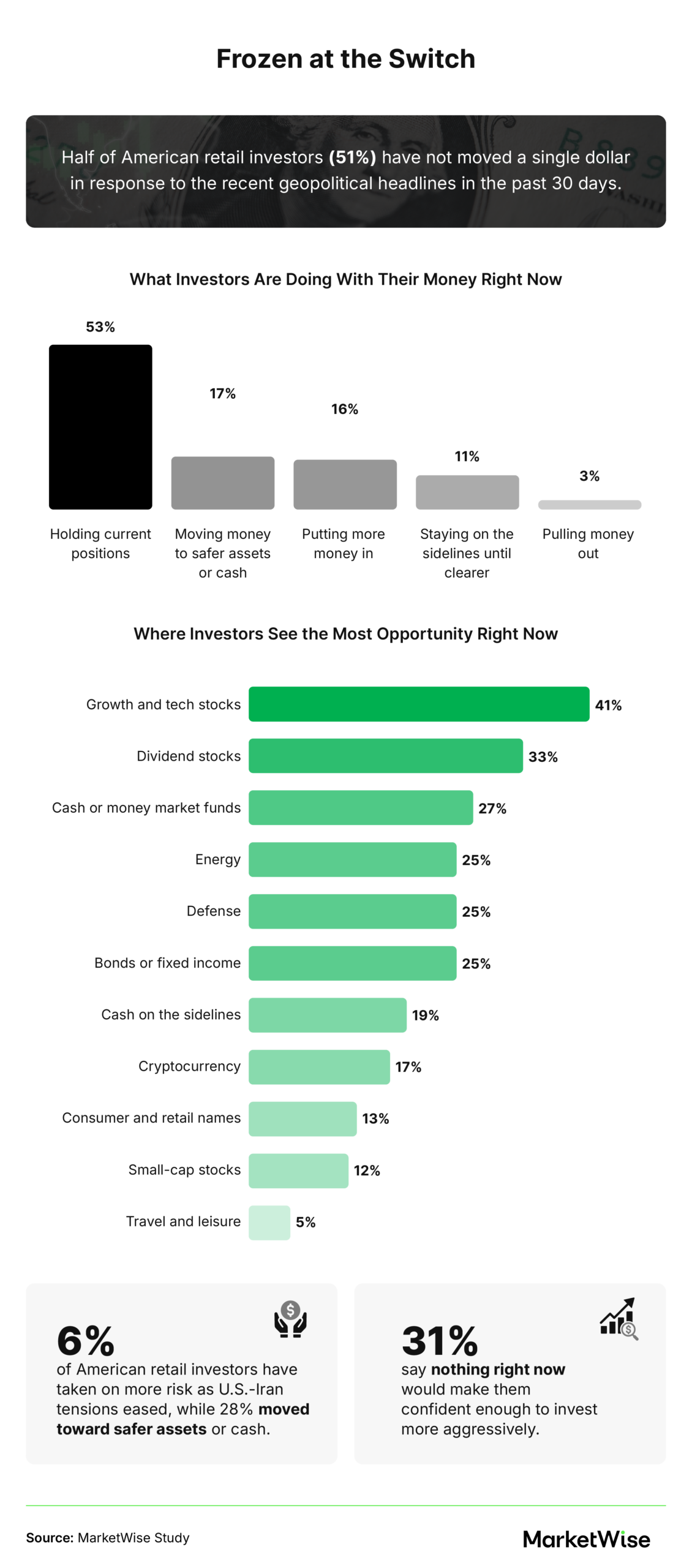
Most portfolios haven’t budged:
- More than half are holding their current positions (53%), and 51% haven’t moved a single dollar in the past 30 days.
- Just 6% have taken on more risk as tensions eased, while 28% have shifted toward safer assets or cash.
The back-and-forth between the U.S. and Iran left most investors standing still:
- 33% say it hasn’t changed how they invest.
- 32% are waiting for a clear resolution before acting.
- 16% have started tuning out the headlines.
- 12% feel more cautious than the news justifies.
- 7% have tried to act on buying opportunities.
Nearly half of investors moved money over the past 30 days, and the moves were small:
- 18% moved 5% to 10% of their assets.
- 16% moved less than 5%.
- 11% moved 11% to 25%.
- 3% moved 26% to 50%.
- 2% moved more than half.
What would actually get them to invest more aggressively varied widely:
- 27% want clear signs inflation is falling.
- 14% want lower energy prices.
- 11% want a lasting ceasefire.
- 9% want a Federal Reserve signal on rate cuts.
- 7% want a sustained rally.
- 31% say nothing right now would make them confident enough to invest more aggressively.
The generational patterns tell the rest of the story:
- Beyond those moving to safety, 44% are watching closely without changing course and 22% say their strategy isn’t driven by geopolitics.
- Entrenchment was highest among baby boomers, with 46% saying nothing would make them more aggressive, compared with 25% of Gen Z, 30% of millennials and 32% of Gen X.
- Appetite for growth and tech stocks was highest among Gen Z at 46%, versus 41% of millennials, 40% of Gen X, and 39% of baby boomers.
- Reluctance to move tracked with age, with 46% of Gen Z, 50% of millennials, 54% of Gen X and 55% of baby boomers having moved nothing in the past 30 days.
Suspicion About the Strike, Doubts About Relief
Many investors aren’t just cautious about the market, they’re skeptical about the story behind the headlines.
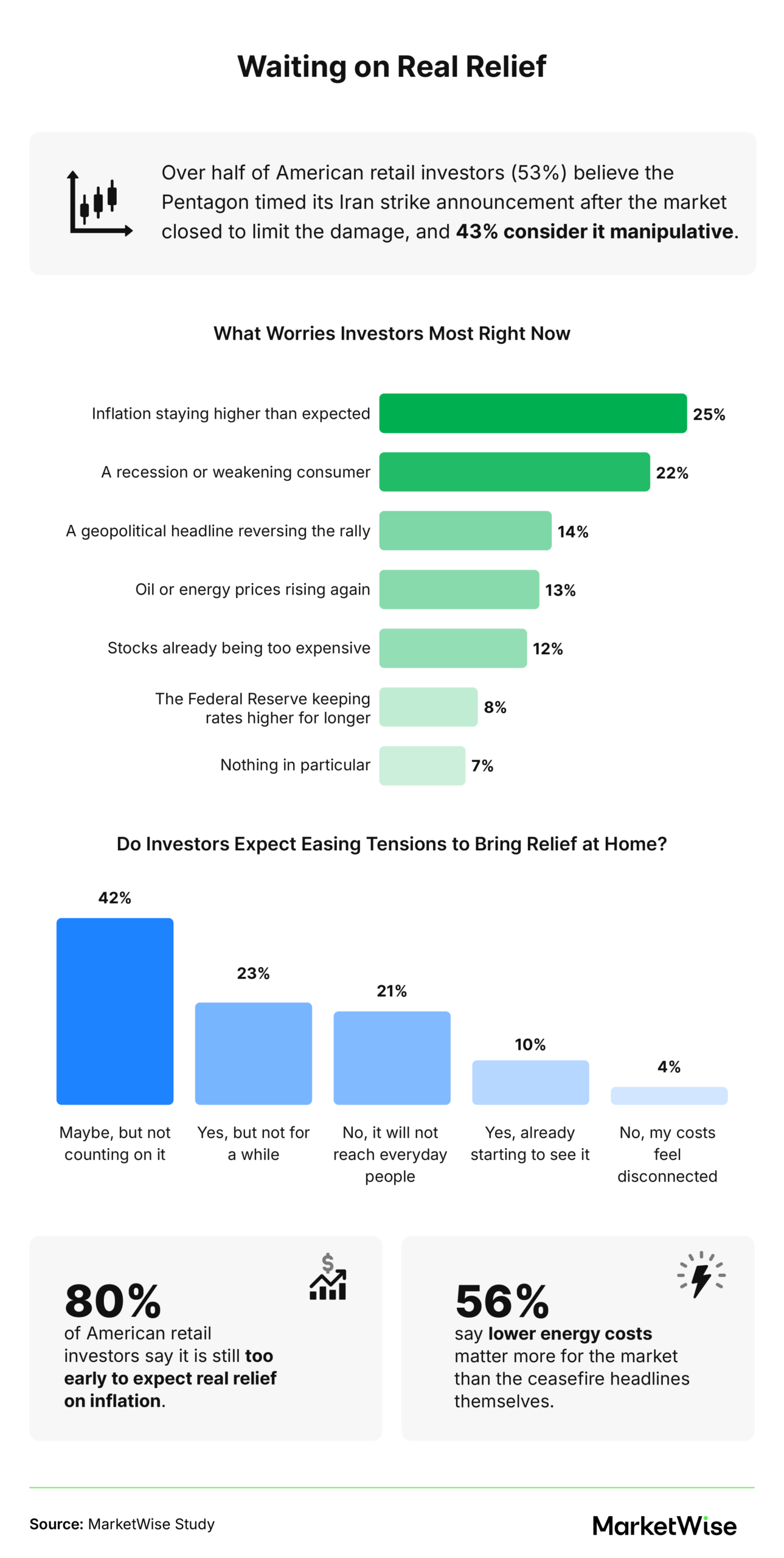
The survey’s sharpest split was over the strike announcement itself:
- More than half believe the Pentagon timed its Iran strike announcement to limit the market impact (53%), and 43% consider it manipulative.
The full breakdown of views on the report that the Pentagon timed its Iran strike announcement to limit market impact:
- 33% are unsure but wouldn’t be surprised.
- 10% believe it happened and call it smart.
- 9% hadn’t heard the report.
- 6% doubt it’s true.
Skepticism of that claim was highest among baby boomers, with 14% doubting it, compared with 4% of Gen Z, 5% of millennials and 5% of Gen X.
Inflation topped the list of worries:
- Inflation is the top concern, named by 25% as their biggest investing worry, while 14% point to another geopolitical headline reversing the rally and 8% to the Federal Reserve keeping rates higher for longer.
- Worry about inflation was lowest among Gen Z at 18%, compared with 26% of millennials, 28% of Gen X and 26% of baby boomers.
There’s cautious hope that relief could reach the broader economy:
- 46% say falling oil prices will help bring inflation down, and 36% say easing tensions make the second half of the year more investable.
Optimism that easing U.S.-Iran tensions would bring relief skewed young:
- Optimism that easing tensions makes the second half more investable was highest among Gen Z at 49%, versus 33% of millennials, 35% of Gen X, and 32% of baby boomers.
- Expecting relief to reach their finances eventually was most common among Gen Z, with 32% saying “yes, but not for a while,” compared with 19% of millennials, 23% of Gen X and 25% of baby boomers.
Methodology
We surveyed 1,006 U.S. retail investors about the market calm following the U.S.-Iran de-escalation, what worries them most about investing right now, whether they expect real relief from easing U.S.-Iran tensions and how they have adjusted their positioning in response to the headlines. Respondents represented a mix of generations, income levels and genders. The generational breakdown was 50% millennials, 24% Gen X, 18% Gen Z and 9% baby boomers. Data was collected in June 2026. Percentages may not total to 100% due to rounding.
About MarketWise
MarketWise is a leading financial research and education platform serving self-directed investors. Through a network of independent brands, including Stansberry Research, Altimetry, Chaikin Analytics, TradeSmith, InvestorPlace, Brownstone Research, and Wide Moat Research, MarketWise delivers independent insights, tools, and software to help individuals navigate complex markets with confidence. Whether you’re exploring emerging opportunities or seeking stability, MarketWise supports every investor with credible research and actionable strategies.
Fair Use Statement
We welcome the use of this study for noncommercial purposes. If you share or reference any part of this content, please include a link back to this page to credit MarketWise appropriately.