
Listen to the audio version of this article (generated by AI).
Today’s issue in preview:
-
The big money is quietly flowing into this explosive sector
-
A key barometer of American prosperity is flashing green
-
AI infrastructure stocks suffer a huge blow: How to trade this key sector from here
-
Learn our Top Themes to buy now
The big money is quietly flowing into this explosive sector

Credit: TanyaJoy
Over the past week, we have published a series of research notes analyzing stocks and themes displaying outstanding “relative strength.”
This means their share prices have declined much less than the broad market averages during the recent market decline.
Some have even produced positive returns, which might not sound like much, but is very impressive, given the severity of declines in many sectors. For example, the widely followed and traded VanEck Semiconductor ETF (SMH) fell 29% over a recent 35-day period.
Yesterday, we detailed how the Pharmaceutical Infrastructure group – led by the likes of Thermo Fisher (TMO), Agilent Technologies (A), Waters (WAT), Cytek Biosciences (CYTK), and Revvity (RVTY) – is displaying outstanding relative strength.
Unlike the broad market averages – which are trading below their 200-day moving averages – many Pharma Infrastructure stocks are in strong uptrends, trading above their 200-day moving averages, and are close to their one-year highs.
Plus, industry leader Agilent reached a new all-time high yesterday after reporting strong earnings. It is one of the few large-cap stocks to do so, which is impressive given how weak the broad market currently is.
During stock market corrections, it’s a good idea to review what stocks are holding up better than the overall market. As I mentioned yesterday:
When a company’s stock price holds steady during a broad market decline, it’s a sign that the company likely has very strong fundamentals, a reasonable valuation, and thus strong buying support from large money managers.
For example, if the market drops 10%, you want to see what drops just 2%. Or even rises 2%. If the market drops 5%, you want to see what climbs 5%. That sort of thing.
This is often called “relative strength.” It allows you to spot the safer, sturdier stocks and megatrends for investment. These stocks often are outstanding performers when the broad market environment improves.
It’s like looking at a beachfront neighborhood after a hurricane. Some homes lost their roofs, and some homes were blown away. But some homes were unbothered by the storm. Those are safe, well-built homes.
Pharma Infrastructure isn’t the only industry group trading strongly in a weak market. Its industry cousin – Biotechnology – is doing so as well.
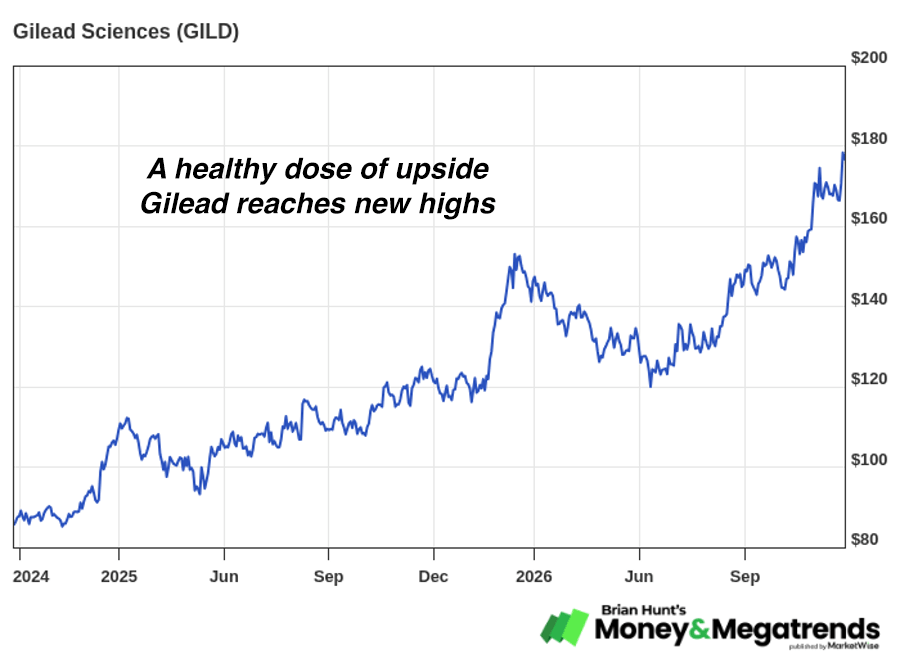
This week, leading biotech drug giants Gilead Sciences (GILD), Roivant Sciences (ROIV), and Biogen (BIIB) reached new all-time highs.
Fellow industry leader Amgen (AMGN) has surged this week to trade within pennies of its all-time high.
Many smaller biotech firms, including Xeris Biopharma (XERS), Kymera Therapeutics (KYMR), and Kiniksa Pharmaceuticals (KNSA) reached new all-time highs.
This unusual and powerful “relative strength” from the biotechnology sector is further confirmation that the biotech bull market is in full swing and is full of opportunities. This also makes our recommendation to invest in this theme a very large winner.
On Aug. 18, 2025, I sent a research note to colleagues outlining my bullish view of the biotech sector’s price action. Since then, I’ve written more than a dozen updates on the biotech bull market, as the SPDR S&P Biotech ETF (XBI) has returned 73%, far outpacing the S&P 500’s 13.2% return.
The biotechnology sector occupies a unique spot in the healthcare industry. It is home to companies developing cures and treatments for hundreds of diseases. When investors grow interested in this industry, the returns can be incredible. During the last biotech bull market, the sector soared 300% over four years.
Because biotech performed poorly from 2021 to mid-2025, most investors are indifferent to it. But this industry is one of the clear market leaders of the past year, and its momentum will continue.
In the future, the convergence of AI and biology will create dozens of large investment opportunities. Armed with increasingly powerful AI systems, researchers will be able to run millions of digital simulations, identify promising drug candidates, predict how treatments will interact with the human body, and accelerate the discovery process.
Drug development could shift into overdrive. Breakthroughs that once took decades could arrive in years. Diseases once considered untreatable could become manageable or even curable. And as this revolution unfolds, I expect it to generate many compelling stock market narratives, breakthrough companies, and large winners.
Companies that leverage AI to “crack the code” for various diseases, treatments, and drugs will enjoy 100%… 500%… even 1,000%+ stock rallies. In many cases, these rallies will happen thanks to stories and potential… rather than a company generating revenue or earnings.
Biotechnology stocks currently have one of the stock market’s most powerful setups working in their favor … yet the investment public remains largely indifferent. It’s an “Unpopular Uptrend.”
CNBC is not running long segments devoted to the biotech bull market. Biotech newsletters are not flying off the shelves. Biotech CEOs are not popular as podcast guests. If I were to bring up biotech investing at an investment conference, I’d get blank stares in return.
This “state of indifference” is very bullish for biotech stocks.
I often say that I could profitably trade stocks for the rest of my life by going long established market trends that the public is either indifferent to or hostile towards. It’s literally all I need to generate substantial returns.
This strategy is so effective and so broadly applicable across all asset markets that it is the Swiss Army Knife of trading. It works in every market for several reasons…
One, market trends tend to persist, and winners tend to keep on winning. This is one of the “Iron Laws” of business, markets, and life.
It takes an enormous amount of time, energy, and investment to create a powerful trend. This goes for technological, business, and macroeconomic trends. Once trends achieve critical mass and develop momentum, they often become like snowballs rolling down a hill… gathering mass and speed in self-reinforcing cycles that last for years.
Second, an ignored market is usually relatively cheap… and often offers high upside potential.
When the public is indifferent towards a theme or asset class, that market will not be bid up to expensive levels. This means the trend could run higher for years. It has plenty of “valuation room” to grow into. Plus, some of the money on the sidelines could eventually pile into the market and drive prices higher.
In other words, “A strong industry uptrend + public indifference towards that industry” is one of the greatest moneymaking equations in all of finance.
The biotech industry has tremendous price momentum working in its favor… plus the investment public is largely indifferent to its success. This is a powerful combination that bodes well for biotech in the future.
Recommended Link:
AI Pioneer: Make This Move Before November 30

Most investors are piling into the same overpriced AI stocks, and AI pioneer Keith Kaplan says that’s a mistake. His firm’s AI-powered system — built with $17 million in research and a team that includes a former NSA codebreaker — has identified a small group of stocks positioned to surge before December. Keith is sharing one critical move to make before November 30th in his free briefing. Click here to watch the full presentation now.
A key barometer of American prosperity is flashing green

Credit: jetcityimage
Everyone knows the U.S. economy has significant imbalances and problems. Wealth inequality. Government debt. Housing affordability. High healthcare costs as a result of a deeply flawed system.
But right now, those big negatives are being overwhelmed by even bigger positives.
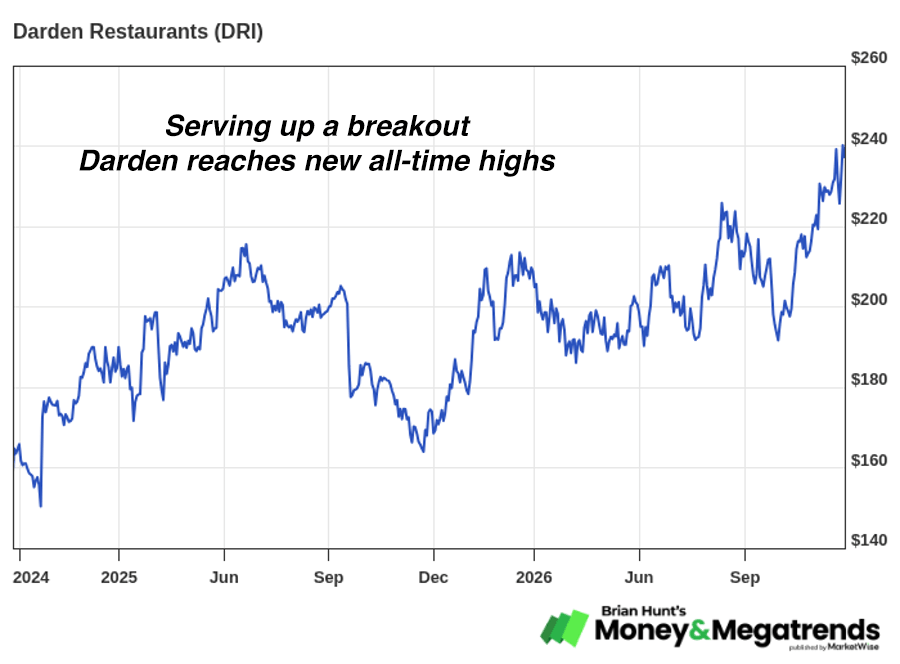
That’s the message the market is sending us this week… in the form of Darden Restaurants (DRI) reaching a new all-time high.
You may not know the name Darden, but you know what it owns.
Darden is the large holding company that owns and operates Olive Garden, LongHorn Steakhouse, Ruth’s Chris, The Capital Grille, Yard House, and Seasons 52.
It is America’s largest Full-Service Restaurant (FSR) operator.
Over the past six months, we have regularly checked in on the bull market in FSR stocks such as The Cheesecake Factory (CAKE), Brinker International (EAT, owner of Chili’s), Texas Roadhouse (TXRH), and Darden.
These uptrends are important because they give us an informed, real-time analysis of American consumer health.
A full-service restaurant is one where you’re seated by a host, talk to a server, have your food brought to you, and hopefully leave a nice tip. This experience is different from a fast-food restaurant such as McDonald’s or Chick-fil-A.
It is also more expensive.
The typical family of four going to a full-service restaurant knows it will be spending considerably more there than at a fast-food joint.
Because FSR bills are on the higher end of the dining cost spectrum, the earnings and stock prices of these chains are excellent “real world” indicators that signal a lot about the financial health of the American consumer.
After all, dropping $150 on dinner is not something most people do when they are broke. It is something people are much more likely to do when they are gainfully employed, making money, and optimistic about tomorrow.
Driven by strong business performance, American FSR stocks are in a clear uptrend. And Darden – the industry’s undisputed leader – just reached a new all-time high. Its contemporary – Cracker Barrel Old Country Store (CBRL) – also reached a new one-year high this week.
Over the past two months, I’ve written over a dozen research notes analyzing the soaring share prices of highly economically sensitive industry groups, including railroad stocks, Best Buy (BBY), Williams-Sonoma (WSM), and hotel chains.
At the end of each note, I pointed to their soaring stock prices and told readers that the U.S. economy is doing much better than most people think.
These economically sensitive firms are important “real world” indicators. They almost always do a better job of telling us what is happening in the economy than any media outlet or economist. And their uptrends are moving in a bullish upward direction for the U.S.A.
Does the U.S. economy have imbalances, distortions, and risks?
Absolutely. It always does.
But those big problems are currently being overwhelmed by the even bigger positives.
AI infrastructure stocks suffer a huge blow: How to trade this key sector from here

Credit: BlackJack3D
In Monday’s issue, we detailed how the return of Nvidia (NVDA) founder Jensen Huang to his role as CEO of Nvidia was a step in the right direction to advance the health of the struggling AI infrastructure trade… but that the trend had plenty of work to do before we could say it was healthy again.
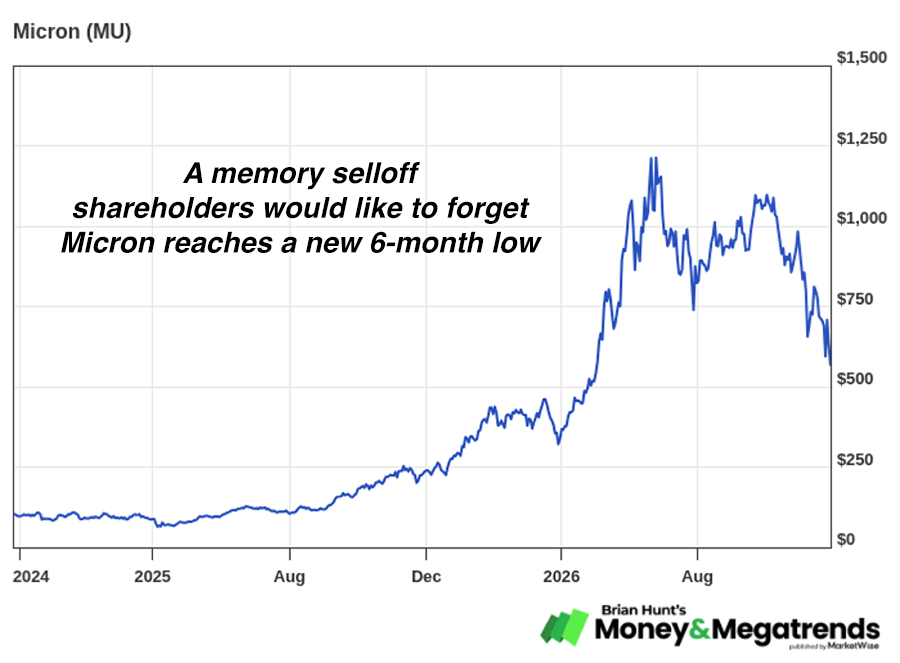
This week, that bit of positive momentum was stopped in its tracks. In a negative development in this story, leading memory semiconductor chip maker Micron (MU) – which is one of the “poster children” of the AI infrastructure trade – declined 10.7% this morning and reached its lowest low in over six months.
This is an important development for AI infrastructure, which we’ve called “the world’s most important trend.”
Before we get into the particulars of Micron, a quick refresher on this situation of enormous consequence…
Over the past three months, we’ve published a special series of research notes analyzing the AI infrastructure boom… which we’ve called “the world’s most important trend.”
The status of this critical trend has become one of the great sagas of the business and investment world… a source of intense disagreement among industry bulls and bears. It’s a trend whose outcome could have large effects on your portfolio.
Given AI’s enormous promise, large tech firms such as Alphabet (GOOG) and Microsoft (MSFT) have collectively invested over $1 trillion in AI infrastructure.. They are on pace to invest over $700 billion this year alone and more than $4 trillion after that.
Both the scale and the velocity of this investment boom are unprecedented. It is the largest collective investment effort in history.
Big Tech’s historic investment boom has made the entire “AI infrastructure” trend responsible for a large share of America’s GDP growth and stock market returns over the past two years. It has also drawn the skeptical scrutiny of many widely followed investment analysts who claim the trend is a bubble… one that will soon explode and cause tremendous damage to stock prices and the global economy.
If this hugely consequential trend isn’t the most important trend in the stock market, then it is certainly in the top three.
I believe the AI infrastructure trend has years to run. I believe the world’s smartest, most connected tech insiders who know the true state of bleeding-edge AI development and have real-time stats on AI investment ROI, such as Elon Musk, Satya Nadella (Microsoft) and Andy Jassy (Amazon), could possibly… perhaps maybe… just might… know far more about AI and their businesses than outsiders know about it.
As much press as AI gets, let’s remember that less than 1% of the global population pays for top-tier AI programs. And I estimate less than 10% of large companies believe AI has made a meaningful impact on their businesses.
This revolutionary technology hasn’t yet proliferated, achieved mass adoption, or had mass impact.
Over the past few months, we have analyzed price action in critical areas of the AI infrastructure trade – including the VanEck Semiconductor ETF (SMH) and optical networking stocks such as Lumentum (LITE) – to guide our trading. The trend in computer memory stocks such as Micron is another key aspect of AI infrastructure we must analyze.
Memory chips are a critical part of AI data centers because AI systems constantly require large amounts of data to perform their tasks. Think of memory as the information sitting within easy reach of an AI chip. The faster the memory, the faster powerful AI chips can get the data they need. As AI models get bigger and smarter, they need more and faster memory to keep up.
Micron is America’s largest memory chip maker. Along with South Korea’s Samsung and SK Hynix, it is one of the “big three” global memory chip makers. The state of Micron is essentially the state of the memory business.
The massive AI infrastructure buildout has been a boon to Micron’s business. Micron revenue grew 49% in fiscal 2025, and the stock soared over 950% from June 1, 2025, to June 1, 2026.
Since reaching a high in June, Micron stock traded in a sideways consolidation pattern. Over the past six weeks, however, enormous selling pressure crippled Micron’s long-term trend health and sent the stock to new multi-month lows.
Along with many other AI infrastructure stocks, Micron enjoyed a large “pop” higher on Monday after the Jensen Huang news hit the wires. But this morning, Micron plummeted 10.7% and reached its lowest low in over six months.
Many other high-profile AI infrastructure stocks such as Bloom Energy (BE), Lumentum (LITE), and Vertiv (VRT) look much the same.
This is terrible price action on top of terrible price action.
My guidance and personal trading plan here remain the same as I laid out on November 20: Although I believe this trend will eventually move higher, I can’t know that for sure. Nobody can. I could be wrong. And I’m not putting one dollar into it until it can prove to me it has healthy buying support.
All trends – including this one – are guilty until proven innocent in my book. They can prove their innocence by attracting significant money flows and moving with an upside purpose. The AI infrastructure stock trend isn’t doing any of that right now. We will continue to provide frequent analysis and guidance on the “world’s most important trend” as it unfolds.
Market Notes
-
The Boomer healthcare megatrend helped send senior living firm American Healthcare REIT (AHR) to a new high today.
-
Tech supergiant Alphabet (GOOG) reached a new one-year low today. Investors are concerned AI applications such as ChatGPT could eat into its “golden goose” search engine business.
-
Financial services giant Goldman Sachs (GS) reached a new one-year low today.
-
Cryptocurrency brokerage and blockchain infrastructure giant Coinbase (COIN) reached a new one-year low today. The stock is down an incredible 51% in the last two months.
-
High-profile Bitcoin play Strategy (MSTR) reached a new one-year low today.
-
Software and AI infrastructure leader Oracle (ORCL) reached a new one-year low today.
-
Blue-chip uranium miner Cameco (CCJ) reached a new one-year low today.
-
High-profile “neocloud” firm CoreWeave (CRWV) reached a new one-year low today.
Top Themes to Buy Now
🦾 Amazon’s stock is doing something extraordinary
⚒️ These stocks are the best inflation hedges you don’t know about
📈 Quality dividend payers are delivering stability in a volatile market
Regards,


Brian Hunt
Editor, Money & Megatrends
An urgent message from our colleagues:
This Tech Could Be Bigger Than Apple, Amazon, and Microsoft Combined

A breakthrough tech backed by Elon Musk, Sam Altman, and Former Nvidia CEO Jensen Huang could soon be worth more than the stocks of Apple, Microsoft, and Amazon—combined. It’s likely the only answer to a $33 trillion problem… but most people don’t yet know it exists. A man who has consulted for the Pentagon and FBI just flew into a heavily secured site to get the full story and discover the stocks involved.
Click here to see this tech with your own eyes — and learn how you could invest in the companies that own it.