Listen to the audio version of this article (generated by AI).
Today’s issue in preview:
-
How to trade the world’s hottest market of 2026: An update in our series
-
This growing list of stocks says you should be bullish on America
-
How to own America’s most valuable property in one investment
-
Learn our Top Themes to buy now
How to trade the world’s hottest market of 2026: An update in our series

Credit: KanawatTH
As you read this, thousands of investors, big and small, are trying to decide what to do about semiconductors.
The status of this critical industry has become one of the great sagas of the business and investment world… a source of intense disagreement among industry bulls and bears.
Is this consequential industry group a buy, a sell, or something else?
Today, we update you on this industry’s “trend health” and offer guidance on how to think about and trade this sector.
The semiconductor industry has always been a critical part of our high-tech economy. Semiconductors are the “tiny engines” that power our computers. However, the proliferation of AI has turbocharged the industry’s revenues and stock prices. It has also made industry leader Nvidia (NVDA) a $4.7 trillion colossus. The stock is up 1,242% since January 1, 2023.
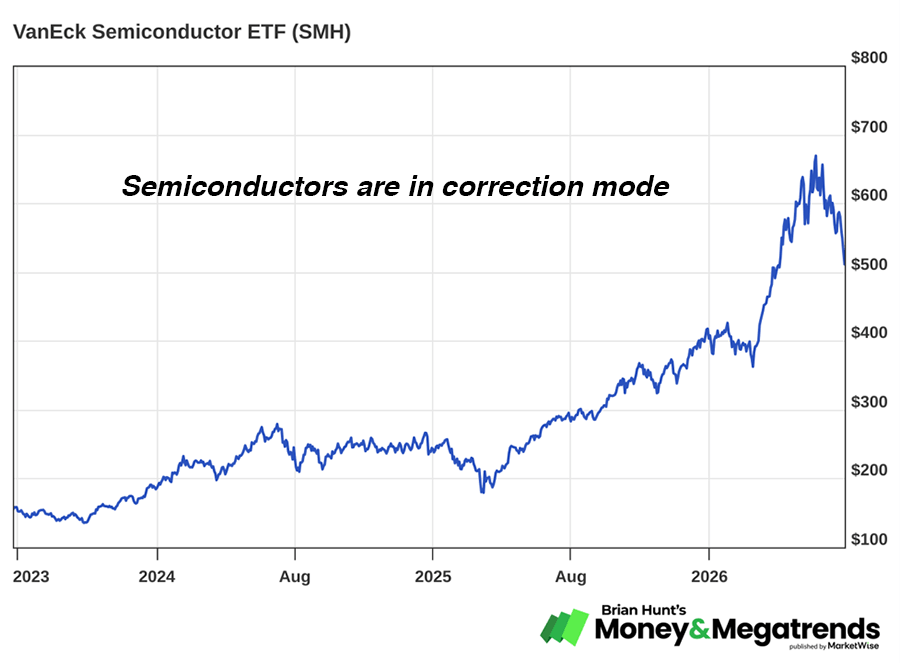
In June 2025, semiconductor stocks broke out of a sideways consolidation pattern and began a rally for the ages. During this rally, the world’s largest semiconductor ETF – the VanEck Semiconductor ETF (SMH) gained 147% in just under a year.
Individual semiconductor leaders AMD (AMD), Marvell Technology (MRVL), and Lattice Semiconductor (LSCC) gained more than 200% during that time. Stock gains of 25% in a month became commonplace.
When a sector gains 50% in a year, that’s considered incredible. What semis returned was “triple incredible.”
Avid Money & Megatrends readers know what drove those giant returns. Given AI’s enormous promise, large tech firms such as Google (GOOG), Amazon (AMZN), and Microsoft (MSFT) have invested over $1 trillion in AI infrastructure. They are on pace to invest over $700 billion this year alone and more than $3 trillion after that.
Both the scale and the velocity of this investment boom are unprecedented. It is the largest collective investment effort in history.
A lot of this money was used to purchase semiconductors. Semiconductor industry revenue totaled $793 billion in 2025, an increase of 21% year-over-year, according to Gartner, Inc.
Given its AI drivers and big returns, it’s no wonder semis became the world’s “hottest trade.” And when any theme becomes the world’s hottest trade, it becomes a leading candidate to experience a significant correction or something worse.
That’s just how the stock market works. When a bull market grows very popular and attracts a lot of speculation, it likes to “buck off” market participants by going through a sharp correction or something worse.
That’s what has happened to the semiconductor trade over the past month or so. After soaring from June 2025 to June 2026, SMH has declined 21%. This week, it reached its lowest point in two months.
So, what is next for the “world’s hottest” trade?
Let’s size up this trend and make some “trend health” conclusions.
As you can see in the two-year chart below, the SMH share price has declined from the mid-$600s to the mid-$500s. This decline has taken the high-flying SMH to levels last seen in May.
If long-term AI bulls are proven right by the market, SMH will likely “digest” its recent losses by trading in a sideways consolidation pattern for 3-6 months… and then recover and trade back to the mid-$600 area and beyond.
If the AI bears are right, SMH won’t see that mid-$600-per-share level for years… and we are much better off focusing on other trends.
I’m watching SMH with all this in mind. I lean towards thinking SMH’s decline will prove to be a short-term correction inside a long-term bull market.
However, I place much more weight on what the market thinks about this trend (and every other trend) than on what anyone thinks about it, including me.
With all this in mind, traders looking to ride clear, healthy uptrends should see the semiconductor trend as damaged goods… a trend worth watching but not to be entered. Long-term bulls, of course, can ignore these short-term moves and stay long.
This same analysis applies to every other meaningful part of the AI infrastructure trade, such as memory, neoclouds, and optical networking. These three industries are highly correlated with semiconductors. The four groups move in near tandem together.
I’ll keep you updated on the former “world’s hottest” trade. It won’t be long before we get meaningful price action that provides more direction for trading the semis.
Recommended Link:
Guess which tech stock is about to crash next?

No one believed Whitney Tilson when he predicted the collapse of Bear Stearns and Lehman Brothers. Or when he went on 60 Minutes exposing a company of poisoning its own customers. (The stock fell nearly 80%.) Now he has a new warning about what’s REALLY around the corner for America’s most beloved tech companies. Watch for free here.
This growing list of stocks says you should be bullish on America
Credit: ElsvanderGun
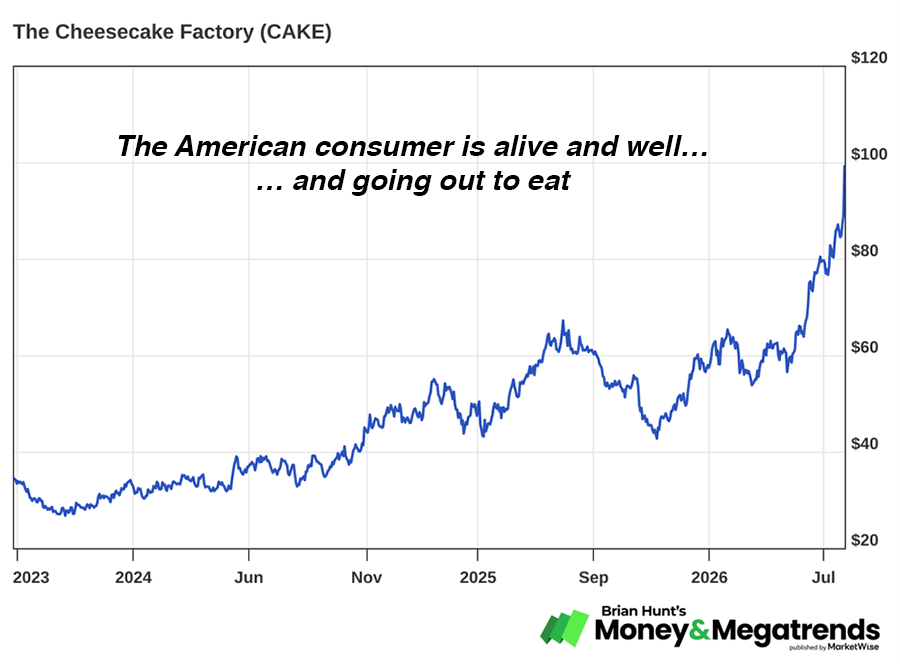
This morning, shares of leading full-service restaurant chain The Cheesecake Factory (CAKE) surged 9% to reach a new all-time high.
CAKE’s big jump was driven by the company reporting strong second-quarter results and raising its revenue outlook.
This is another sign that the bull market in full-service restaurant chains is alive and well, a byproduct of a strong American economy. It’s also the best financial news you won’t hear much in the mainstream media.
On July 21, I highlighted the emerging uptrend in full-service restaurant (FSR) stocks, including Darden Restaurants (DRI, Olive Garden, LongHorn, Yard House), Texas Roadhouse (TXRH), Brinker International (EAT, Chili’s), and The Cheesecake Factory (CAKE).
These uptrends are important because they give us an informed, real-time analysis of American consumer health.
A full-service restaurant is one where you’re seated by a host, talk to a server, have your food brought to you, and hopefully leave a nice tip. This experience is different from a fast-food restaurant such as McDonald’s or Chick-fil-A.
It is also more expensive. The typical family of four going to a full-service restaurant knows it will be spending considerably more there than at a fast-food joint.
Because FSR bills are on the higher end of the dining cost spectrum, the earnings and stock prices of leading these chains are excellent “real world’ indicators that have a lot to say about the financial health of the American consumer. After all, dropping $150 on dinner is not something most people do when they are broke. It is something people are more likely to do when they are gainfully employed, making money, and optimistic about tomorrow.
Driven by strong results like CAKE’s, FSR stocks are in a clear uptrend, and some have broken out to new all-time highs. FSR giants Texas Roadhouse and Brinker International, for example, also reached new all-time highs today.
Over the past eight months, I’ve written over a dozen research notes analyzing the soaring share prices of highly economically sensitive industry groups, including trucking stocks, railroad stocks, regional banks, manufacturing stocks, steelmakers, shopping mall operators, and hotel chains.
At the end of each note, I pointed to their soaring stock prices and told readers that the U.S. economy is doing much better than most people think.
These economically sensitive firms are important “real world” indicators. They almost always do a better job of telling us what is happening in the economy than any media outlet or economist. And their uptrends are moving in a bullish upward direction for the U.S.A. Soaring FSR stocks are key members of this growing list of positives.
How to own America’s most valuable property in one investment

Credit: Boris_Zec
One consequence of a strong U.S. economy (see above) is a strong real estate market.
This is because all the good times… all the bad times… every industry boom and every industry bust…
… all eventually affect real estate prices.
They all end up making landlords a lot richer… or a lot poorer.
Identifying and profiting from giant technology and business trends is our stock in trade here at Money & Megatrends. When this is how you earn a living, real estate prices are a key part of your analytical “toolbox.”
Real estate investment vehicles – whether publicly or privately traded – can be excellent ways to trade big industry and technology trends. The ripple effects of every boom and every bust eventually make their way into real estate prices.
For example, when oil is in a bull market, prime real estate in Houston, the oil industry hub, does well. When corn and soybeans are in bull markets, land in Iowa soars in value. The value of prime properties in Silicon Valley and San Francisco rises and falls with the valuations of big tech companies. The massive expansion of the Chinese steel-exporting industry in the late 1990s and 2000s was terrible for real estate prices in Pittsburgh, the U.S. steelmaking capital.
The list of such “cause and effect” examples goes on for miles.
Yes, real estate is essentially a “catch basin” where money flows in or out, depending on a region or industry’s economic health and prospects.
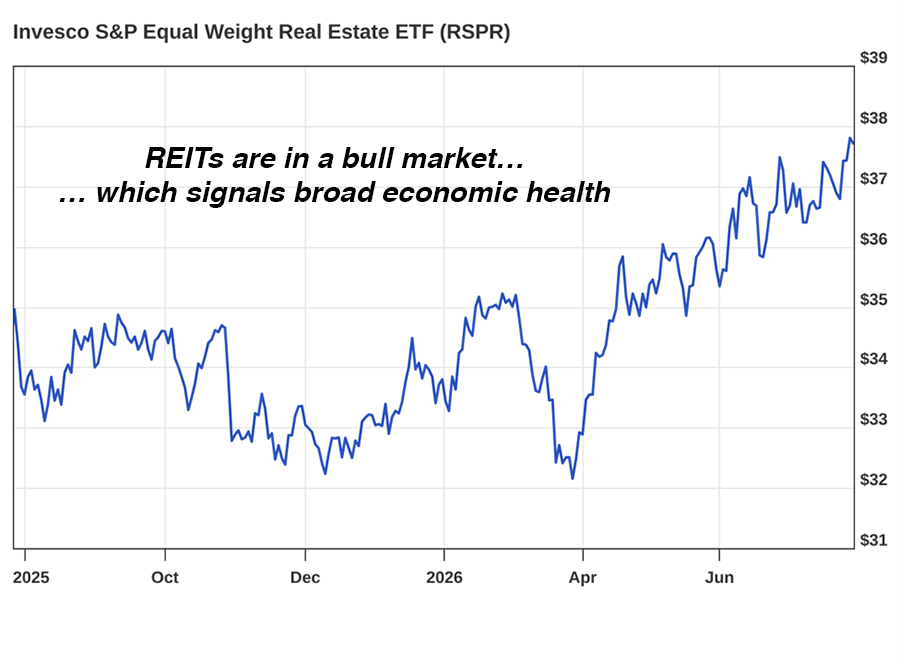
With this in mind, it’s worth noting that the Invesco S&P 500 Equal Weight Real Estate ETF (RSPR) has returned a robust 14.4% this year and just reached a new all-time high.
RSPR is an ETF that holds about 30 of America’s largest REITs. A REIT is a bundle of real estate assets that trade as a single security. REITs own, operate, or finance income-producing real estate – such as apartments, office buildings, shopping centers, warehouses, or data centers – and allow investors to buy shares in those real estate portfolios.
RSPR’s constituents are the “who’s who” of big U.S. real estate firms. They own and manage a wide range of real estate across the country. Apartment buildings. Office buildings. Hotels. Health care facilities. Shopping malls. Warehouses. Public storage facilities. Timberland. Communication infrastructure. Laboratories and research facilities.
This broad diversification means the fund rises and falls with overall American economic health.
As you can see in the one-year chart below, American economic health is solid. Obviously, there are some things going right for the owners of apartments, offices, hotels, and the like.
Are there big problems and imbalances in the U.S. economy? Absolutely. There are always big problems and imbalances in the U.S. economy.
Economic growth and rising asset prices are never the result of being in problem-free economic climates. They’re about being in economic climates where the big negatives are overwhelmed by the even bigger positives.
The rising values of leading real estate firms indicate this is the case in America. Conduct your financial affairs accordingly!
Market Notes
-
Consumer technology giant Apple (AAPL) reached a new all-time high today.
-
Beverage giant Coca-Cola (KO) reached a new all-time high today after reporting strong second-quarter business results.
-
Property rental marketplace Airbnb (ABNB) reached a new one-year high today.
-
The Boomer health care trend continues to generate stock market winners. Dialysis and kidney health giant DaVita (DVA) reached a new all-time high today.
-
Office property giant Cousins Properties (CUZ) reached a new all-time high today.
-
The American consumer is traveling. Hospitality property firms DiamondRock (DRH), Park Hotels & Resorts (PK), Xenia Hotels & Resorts (XHR), and Ryman Hospitality Properties (RHP) reached new all-time highs today
Top Themes to Buy Now
⚡ Five stocks to profit from America’s soaring electric power needs
📺 Hedge funds are about to pile into this stock. You can get in before them
🏫 These unique stocks can earn you big returns over the next four years
Regards,


Brian Hunt
Editor, Money & Megatrends
An urgent message from our colleagues:
Hidden AI Crisis Could Bring Crash ‘62 Times Worse Than the Great Depression’

A critical flaw in the AI industry could soon wipe out $33 trillion from the U.S. stock market and cause a potential crash 62 times worse than the Great Depression – if it isn’t fixed fast. One small group of companies holds the answer… a breakthrough technology backed by Sam Altman, Elon Musk, Jensen Huang, the White House, and more.
Click here to see how you could invest in the tech saving America from a $33 trillion crisis.