
Listen to the audio version of this article (generated by AI).
Today’s issue in preview:
-
AI is headed for your house, office, factory, and hospital. Three stocks to profit.
-
Don’t let the media talk you into doing something stupid. Focus on this instead.
-
How to invest with Donald Trump massively on your side
-
Our extraordinary track record gets better: Thematic trades in Biotech, Machine Sensory Perception, AI Semiconductors, and Smart Factories run to new highs.
-
Learn our Top Themes to buy now
AI is headed for your house, office, factory, and hospital. Three stocks to profit.

Credit: da-kuk
As I’ve been predicting, the world is rushing to invest in robotics.
The venture capital firm a16z recently reported that global venture capital investments in robotics totaled approximately $16 billion in the first quarter of 2026. The figure is easily a record for the robotics industry.
In 2024, I named the Robotics Revolution as one of my top long-term investment themes… an industry where investors get to enjoy a gale-force tailwind at their backs.
The Robotics Revolution is a giant, multifaceted megatrend poised to change our world in thousands of ways. Decades of progress in this field are now yielding autonomous cars, automated factories, surgical robots, military drones, delivery drones, and humanoid robots. Last year, Amazon announced it uses more than one million robots across its business. This figure will soon exceed the company’s number of human employees.
Investing in this trend has allowed us to score large wins in Vishay Precision Group (VPG), Allient (ALNT), Ouster (OUST), and Cognex (CGNX). These firms produce various precision-engineered “body parts” for the robotics industry.
But don’t forget about our “chain reaction” way to profit from the robotics boom. One of the big ripple effects of a massive increase in robotics is a concurrent rise in the use of high-tech batteries.
Thanks to soaring demand for EVs, smart devices, robots, and more, demand for high-tech batteries will be extraordinary over the next decade.
As AI enhances the functionality of cars, robots, devices, and a thousand other things, they will become increasingly autonomous. These devices won’t be worth much if they must be plugged into the wall all the time. They must be mobile… and they must have high-tech batteries that can run power-hungry AI applications.
Device makers of all kinds have a permanent, urgent need for batteries to become cheaper, smaller, and more powerful. The better their batteries are, the more attractive their products are to consumers.
In the case of robots, each robot deployed across a warehouse, a factory floor, a battlefield, or a hospital must have its own power source. Power-hungry AI applications will push battery functionality to its limits.
According to Grand View Research, the global battery market was estimated at $134.6 billion in 2024 and is projected to reach $330 billion by 2030.
Today’s lithium-ion batteries are unlikely to meet the needs of many battery users.
They use a flammable liquid electrolyte, lose capacity with every charge cycle, and can’t pack in enough density to power an autonomous machine all day. This is a huge barrier to the robotics buildout.
Two breakthroughs are poised to be the way forward for battery tech. Solid state batteries replace today’s flammable liquid electrolyte with a solid material, improving safety, energy density, and charge speed in what’s widely considered the biggest leap in battery technology in decades.
Silicon-anode batteries store far more energy than the graphite anodes used in conventional lithium-ion cells, enabling smaller, lighter, and faster-charging batteries.
These are two separate, parallel paths to the same outcome: batteries that can keep up with the autonomous world we’ll live in.
With all this in mind, here are three Battery Tech firms poised to benefit from the trends detailed above:
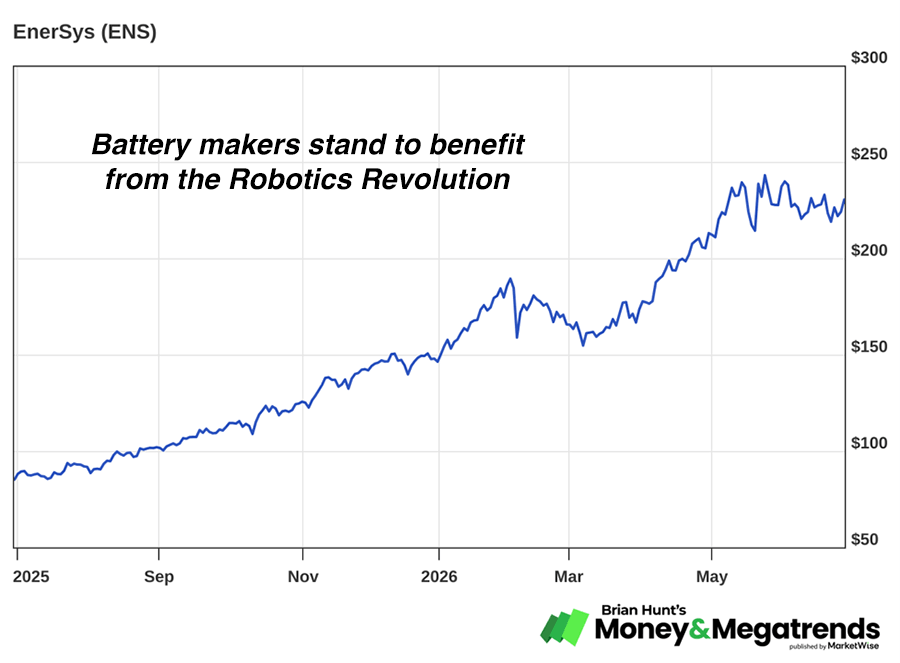
EnerSys (ENS) is an $8 billion giant, and the “blue-chip” of this group. ENS manufactures industrial stored-energy solutions like lithium batteries. Aerospace revenue grew 25% year over year, while data center revenue grew 36% year over year. Despite these higher growth segments, the overall revenue growth is much slower, about 5% per year, which makes it a safer bet on the trend, but not a high growth disruptive play like AMPX below.
Amprius Technologies (AMPX) is a $2 billion name, and perhaps the group’s highest risk today post a short-seller report alleging management misconduct. AMPX makes high-energy density silicon-anode lithium-ion batteries for drones, defense systems, satellites, and robotics. Revenue in Q1 was up 153% year over year. Demand is driven by defense spending, as key AMPX customers have landed deals totaling more than $270 million from the U.S. Army and the Air Force. AMPX’s CEO estimates that a battery takes up approximately 5-15% of a drone’s bill of materials, so the downstream effects of these contract wins are large for AMPX as well.
Solid Power (SLDP) is the smallest in this group at a $500 million market cap, but it’s taking a more conservative approach. Rather than manufacturing full battery cells, SLDP is supplying the critical electrolyte material that enables solid-state batteries to operate. It’s already partnered with BMW and Samsung. The risk is that meaningful revenue is unlikely to arrive until 2028 or later, making SLDP a very catalyst-driven trade until then.
As AI leaves the data center and enters warehouses, homes, hospitals, and battlefields, the demand for smaller, lighter, and more powerful batteries will rise for years. The companies above stand to benefit.
Recommended Link:
The Billionaire Who Saved SpaceX Just Made a New Bet

He once rescued SpaceX from bankruptcy. He also helped launch Facebook, Airbnb, YouTube, and Spotify. And now he’s making a new bet – he’s just sold every single share of the Mag 7 companies in his portfolio. And he’s using that money to buy a shocking new kind of company instead. You should mirror his moves. And now you can, for as little as $50 a share. Click here for details.
Don’t let the media talk you into doing something stupid. Focus on this instead.
Credit: Traimak_Ivan
It’s too bad our biology makes us fixate on alarming news, scandals, wars, fights, murders, and disasters.
If that wasn’t the case, more people would know America’s industrial base is booming… and that’s a great thing for our economy.
Lots of people like to blame the mainstream media for fanning the flames of political divides, culture wars, and other conflicts. But don’t blame the media. The people working there have kids and mortgages and cars to pay for, like the rest of us. They are chasing profits, bonuses, and dividends like the rest of us.
And they know their customers (you and me) like to click on and watch news about wars, crises, murders, political fights, and the like. This desire is seared into our DNA.
Fixating on potential dangers and sources of conflict is a useful survival instinct. A million years ago, it’s how our ancestors survived. Back then, an unusual noise coming from behind a bush could mean a tiger was about to attack.
These days, we don’t need to worry about tiger attacks, but our old survival instincts still dictate our actions. We still fixate on potential dangers. That’s why we are compelled to click on headlines that promise information about war, murder, fights, crises, natural disasters, recessions, and bear markets.
Again, you can blame the media. But it’s just responding to consumer demand.
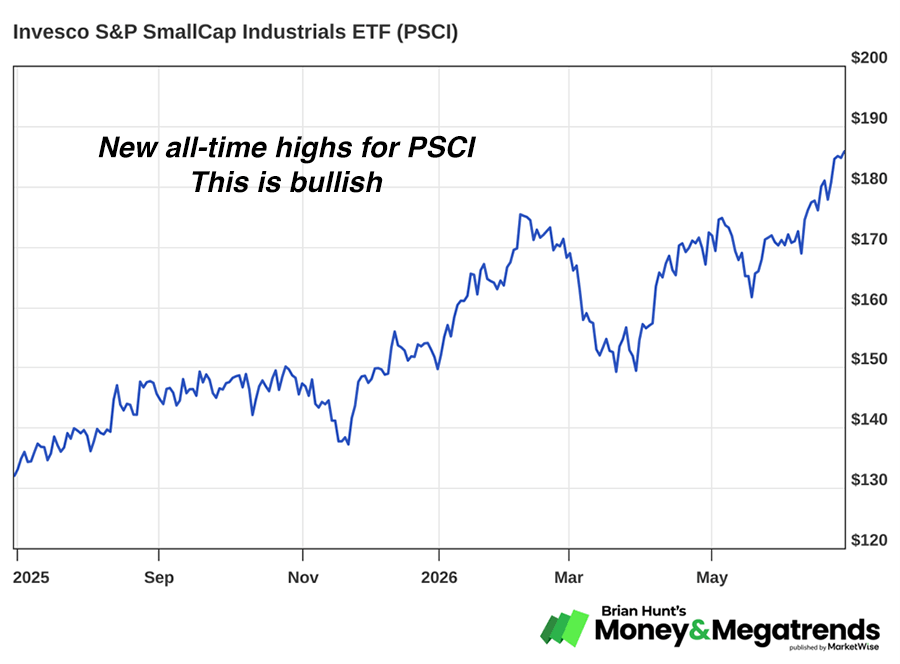
If this weren’t the case, more people would know about extremely positive developments like the Invesco S&P SmallCap Industrials ETF (PSCI) reaching a new all-time high today.
PSCI is one of the most important ETFs you’re probably not following. It holds a diversified basket of smaller, lesser-known U.S. manufacturing firms. These companies typically don’t make the front page. There are no “rock star” CEOs like Elon Musk.
These firms operate with little fanfare, providing critical equipment and services the U.S. economy cannot function without. You may not know them, but you most certainly encounter their products when you walk into an office, turn on your car, or flip on the lights.
Our factories, vehicles, homes, and cities cannot function without their specialized pumps, motors, filters, fans, valves, fasteners, tools, gaskets, wiring, bearings, and switches. These businesses are the backbone of the American economy. And they are doing great.
In late 2025 and early 2026, I frequently highlighted how many critical, yet unrecognized U.S. manufacturers were reporting excellent business results and enjoying rising stock prices. At the time, PSCI was regularly registering new all-time highs.
However, PSCI suffered an Epic Fury-induced selloff alongside the broader market. Shares dropped 14% in six weeks. Since then, PSCI has soared to new all-time highs. As you can see in the chart below, the fund is in a beautiful three-year uptrend.
This exceptional price strength means the economy is doing very well. We are making and buying lots of trucks, tractors, concrete, steel, engines, HVAC systems, data centers, power plants, transmission lines, and communication networks.
The stock market is one of the world’s greatest forecasting mechanisms. It tends to look ahead 6-12 months. When an industry is in a recession, its stock prices will rise before the news media says it is recovering. When an industry seems to be doing well, its stock prices will decline before the news covers its downturn. This is often called “discounting the future.”
The new highs for PSCI are bullish for America’s future. They tell us to expect to see reports of strong economic activity about six months from now. Please manage your financial affairs accordingly!
How to invest with Donald Trump massively on your side
Credit: SweetBunFactory
So far today, we’ve discussed powerful megatrends in robotics and U.S. manufacturing.
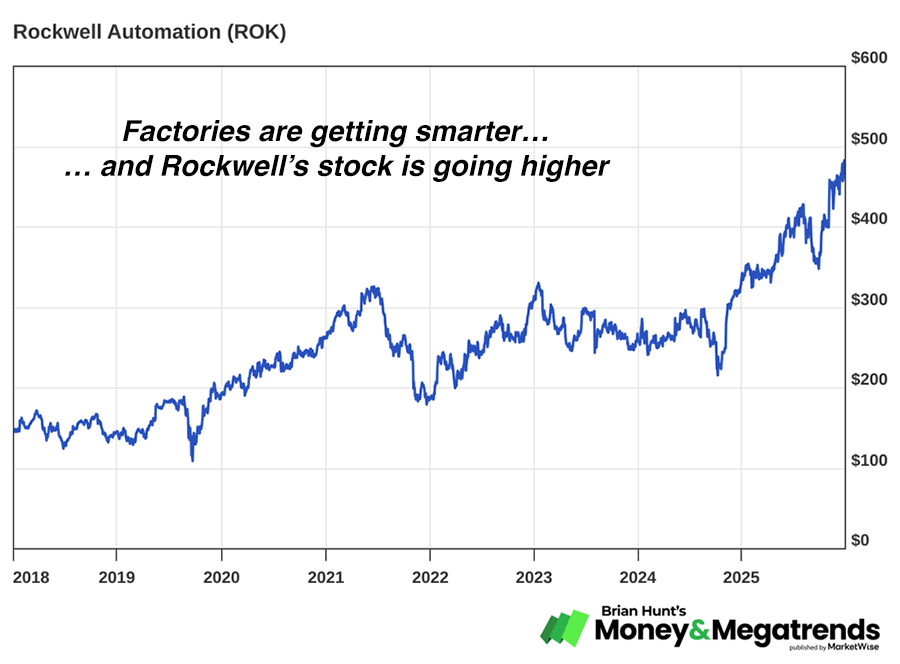
Given how strong these two themes are, it’s no wonder companies at the intersection of them are booming. As evidence, we present the new all-time high in market value reached today by factory automation leader Rockwell Automation (ROK).
Back in January, I made the case for investing in companies that supply critical equipment and services for building and operating high-tech, highly automated “smart factories.” The bull case here is simple…
President Donald Trump – along with many business and military leaders – believes that the U.S. has outsourced far too much of its industrial capacity to China over the past 25 years. We outsourced significant portions of our semiconductor, appliance, medicine, weapons, and machinery production. We outsourced the capacity to produce and process critical resources, such as rare earth elements.
The COVID-19 pandemic showed that depending on other countries for critical economic inputs makes the U.S. economy less safe and secure.
Trump has staked his legacy and reputation on expanding our industrial base… and he’s working with business leaders to invest trillions to pursue this goal. Apple (AAPL), for example, has committed to invest $600 billion in U.S.-based manufacturing over the next four years. Nvidia (NVDA) says it will invest $500 billion in U.S.-based manufacturing over the next four years.
These kinds of efforts are bullish for the “smart factory” megatrend.
Any factory competing in today’s economy must be highly automated. This means a large increase in U.S. manufacturing capacity must be matched by a large increase in the use of robotics, specialized semiconductors, AI programs, and machine sensory perception equipment.
This situation has made our recommendation of “smart factory stocks” like those inside the ProShares S&P Kensho Smart Factories ETF (MAKX) a big winner so far.
MAKX is based on an index that tracks companies that provide the equipment and services required to build and operate smart factories. Major holdings include machine sensory leaders such as Ouster (OUST) and Cognex (CGNX). (We’ve scored big wins with both stocks.)
MAKX also has a large weighting in Rockwell Automation. Rockwell is one of the world’s largest factory automation firms. It is about as close to a “one-stop shop” as it gets for building and operating a high-tech factory. Rockwell makes physical hardware, sensory components, and software. It also provides post-installation services and maintenance. Powered by growing demand for factory automation, Rockwell recently reported an 11.9% increase in year over year quarterly revenue.
Business is booming for smart factory equipment and service providers. MAKX is up 45% this year and is close to new all-time highs. Rockwell is up 27% and just reached a new all-time high.
The push to make the American economy safer and more secure by greatly expanding our manufacturing base is no “flash in the pan” trend. It will most likely be a decade-long megatrend that directs enormous capital flows into well-positioned leaders. I remain bullish on the Smart Factory trend.
Market Notes
-
Our March 20th recommendation to own semiconductor equipment stocks is paying off. Lam Research (LRCX) and KLA Corp (KLAC) just hit one-year highs. KLAC is now up 92% since our recommendation. Smaller-cap semiconductor names like Onto Innovation (ONTO), ACM Research (ACMR), and MKS (MKSI) hit new highs as well.
-
Our longstanding recommendation to own Boomer health care stocks continues to pay off. Drug giants Johnson & Johnson (JNJ) and Moderna (MRNA) just hit new all-time highs. JNJ is now up 68% in the last year.
-
Our October 30th recommendation to own biotech has paid off well so far. Revolution Medicines (RVMD), Palvella Therapeutics (PVLA) and Lexicon Pharmaceuticals (LXRX) all hit new highs today.
-
Our December 18th recommendation to own LiDAR giant Ouster (OUST) is soaring to new highs. It’s now up 44% in the last 5 days and up 94% since we recommended it.
-
Our 5th February recommendation to own the humanoid sensor player, Vishay Precision Group (VPG), just hit a new high. It’s now up 191% since our February recommendation.
Top Themes to Buy Now
🧬 These stocks will get you into the next big AI trade
🦾 The machine sensory perception theme is quietly booming. Are you profiting?
⚡ This bet on AI power consumption is poised to run higher. Are you on board?
Regards,


Brian Hunt
Editor, Money & Megatrends
An urgent message from our colleagues:
Are You Still Holding This Stock? Louis Navellier Says Get Out.

In 2001, Louis Navellier got his readers out of Enron before it collapsed… without knowing anything about the accounting scandal. He didn’t need to. His system uses a different signal — one that often tells you where a stock is heading long before the headlines. And now, his system is issuing a similar signal about one of the most widely held stocks in America. Louis recently put on a presentation revealing the ticker symbol of this stock completely free — along with his #1 stock to buy before July 23rd.
Click here to find out if you’re holding it.