
Today’s issue in preview:
-
How to invest with Donald Trump massively on your side
-
Visa and Mastercard just trampled the stock market bears. That’s important for your 401(k)
-
Should you be selling stocks because of “weak breadth?” This chart has the answer
-
Learn our Top Themes to buy now
Visa and Mastercard just trampled the stock market bears. That’s important for your 401(k)

Credit: VioletaStoimenova
This week, shares of credit card giants Visa (V) and Mastercard (MA) reached new all-time highs.
We can take several insights away from their strength, but the most important one is this:
If two of America’s most important consumer spending companies are enjoying strong growth and soaring stock prices, then the economy isn’t struggling as many bearish investment professionals claim… it’s actually “humming along nicely.”
Visa and MasterCard are the world’s largest credit card companies. Their payment networks connect billions of consumers, merchants, and banks.
Rather than lending money, they earn fees by facilitating credit and debit card transactions. The two firms are effectively a duopoly in U.S. credit card payments. Together, they account for roughly 85% of U.S. general-purpose credit card purchase volume, with American Express and Discover accounting for most of the remainder.
Visa and Mastercard have leveraged their entrenched positions and massive networks to generate market-leading long-term growth and large profit margins. Business quality aficionados consider their financial metrics a thing of beauty.
Visa and Mastercard’s positions also make them good “real world” economic indicators.
Many investors fixate on government data such as unemployment figures, job hirings, and the Consumer Price Index. I like to know that data as everyone else does.
However, when I want a read on what’s really happening in the economy, I place far greater focus on what’s happening in the real world. I look at stock prices. In doing this, I listen to the judge, jury, and executioner of any thesis, any trend, and any claim: The market.
Visa and Mastercard are sensitive to the health of the American consumer. Last quarter, both firms reported double-digit revenue growth, healthy transaction volumes, and resilient consumer spending. That business strength – plus expectations of more in the future – has propelled both stocks to new all-time highs.
Does the U.S. economy have imbalances, distortions, and risks? Absolutely. It always does. But making money in stocks is never the result of a problem-free economic environment. It’s always about being in an environment where the big problems are overwhelmed by the even bigger positives.
Right now, the market is telling us that the positives are currently much stronger than the negatives. Manage your financial affairs accordingly!

Recommended Link:
Up 26% in a Month — And Navellier Says It’s Just Getting Started

This AI stock just posted record orders. Some of its biggest customers are signing multi-year deals without even knowing the final price. Louis Navellier — who’s recommended over 675 stocks that went on to gain 100% or more — says its biggest move is still ahead. Don’t wait. Get the name and ticker now.
How to invest with Donald Trump massively on your side

Credit: halbergman
Want to know if America’s manufacturing renaissance is real?
Don’t listen to the mainstream news or politicians.
Instead, listen to the market.
It’s far smarter and far more honest than the sources above. And it’s saying the “Made in America” megatrend is gathering steam.
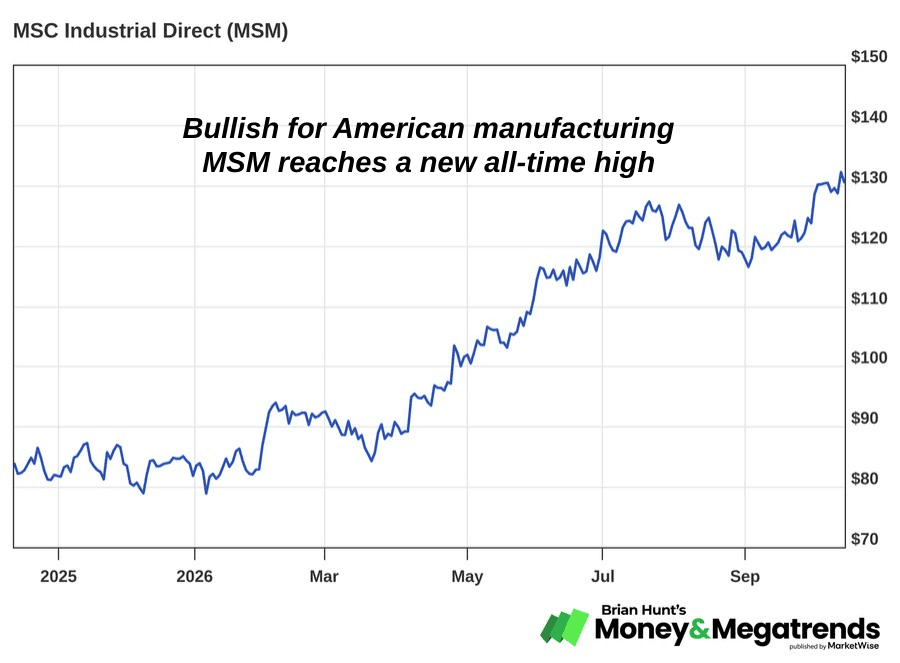
As evidence, we cite the bull market in industrial supply distributors Fastenal (FAST), W.W. Grainger (GWW), and MSC Industrial Direct (MSM).
Fastenal, Grainger, and MSC Industrial Direct are three of America’s leading industrial supply distributors. They provide manufacturers, construction companies, and industrial facilities with essential products such as fasteners, cutting tools, safety equipment, replacement parts, and maintenance supplies.
Fastenal specializes in fasteners and on-site inventory management. Grainger offers a vast catalog of industrial and maintenance products. MSC focuses heavily on metalworking and manufacturing supplies. All three benefit from increased U.S. manufacturing activity and industrial investment.
This means their stock price trends tell us a lot about the Made in America megatrend.
Back in January, I made the case for going long the Made in America megatrend… for investing in companies that supply critical equipment and services for building and operating today’s high-tech factories.
The bull case here is simple…
President Donald Trump – along with many business and military leaders – believes that the U.S. has outsourced far too much of its industrial capacity to China over the past 25 years.
We outsourced significant portions of our semiconductor, appliance, medicine, weapons, and machinery production. We outsourced the capacity to produce and process critical resources, such as rare earth elements.
The COVID-19 pandemic showed that depending on other countries for critical economic inputs makes the U.S. economy less safe and secure. To put it bluntly, it is very stupid to not make products critical to national security like AI semiconductors within our own borders.
Trump has staked his legacy and reputation on expanding our industrial base… and he’s working with business leaders to invest trillions to pursue this goal. Apple (AAPL), for example, has committed to invest $600 billion in U.S.-based manufacturing over the next four years. Nvidia (NVDA) says it will invest $500 billion in U.S.-based manufacturing over the next four years.
Drug giant Eli Lilly (LLY) said it has committed more than $50 billion in domestic manufacturing commitments since 2020, including four additional U.S. plants announced in 2025. Lilly says it will be the largest domestic drug manufacturing investment in U.S. history.
In Money & Megatrends, we’ve capitalized on this “Made in America” megatrend with strong returns in robotics, factory automation, and machine component makers such as Cognex (CGNX), Ouster (OUST), and RBC Bearings (RBC).
The stock price trends of FAST, GWW, and MSM suggest the Made in America megatrend is gaining momentum. Over the past 12 months, their shares have surged 21.5%, 41.6%, and 54%, respectively. This week, MSM reached a new all-time high. All three companies are reporting year-over-year quarterly revenue growth exceeding 7.5%.
These impressive business results and stock market performances send a powerful message: American manufacturers and industrial companies are spending heavily on the equipment, supplies, and materials they need to expand and maintain their operations. We recommend staying long the Made in America megatrend.
Should you be selling stocks because of “weak breadth?” This chart has the answer

Credit: roman_slavik
No matter how strong corporate earnings are… or how strong broad market averages like the S&P 500 are, two or three “Big Worries” are always circulating around the investment community.
There are always potential risks and concerns held by investment professionals that keep them light on stocks or out of them completely.
This fall, one of the Big Worries is “weak market breadth.”
“Breadth” is Wall Street’s preferred term for how widely a stock market’s gains or losses are spread across individual stocks.
Rather than focusing solely on the movement of a major index like the S&P 500, breadth reveals how many stocks are participating in the trend. The general idea is that if you’re bullish, you want to see strong breadth, which shows many stocks are in uptrends.
Common breadth indicators include the percentage of stocks above their 50- or 200-day moving averages, the percentage of advancing versus declining stocks, and the percentage of new highs versus new lows.
Strong breadth suggests widespread participation, while weak breadth indicates that relatively few stocks are driving the market.
Over the past two months, stock market breadth has grown weak. Rising interest rates and several smaller market forces have hammered many key market sectors, including real estate, utilities, defense, financials, and consumer spending-related stocks.
Meanwhile, the strength in technology stocks we’ve been covering has supported the broad market averages. The S&P 500 is less than 2% off its all-time high.
Many investment professionals look at select weak breadth indicator readings and say it’s bearish. They say it means “time to sell.”
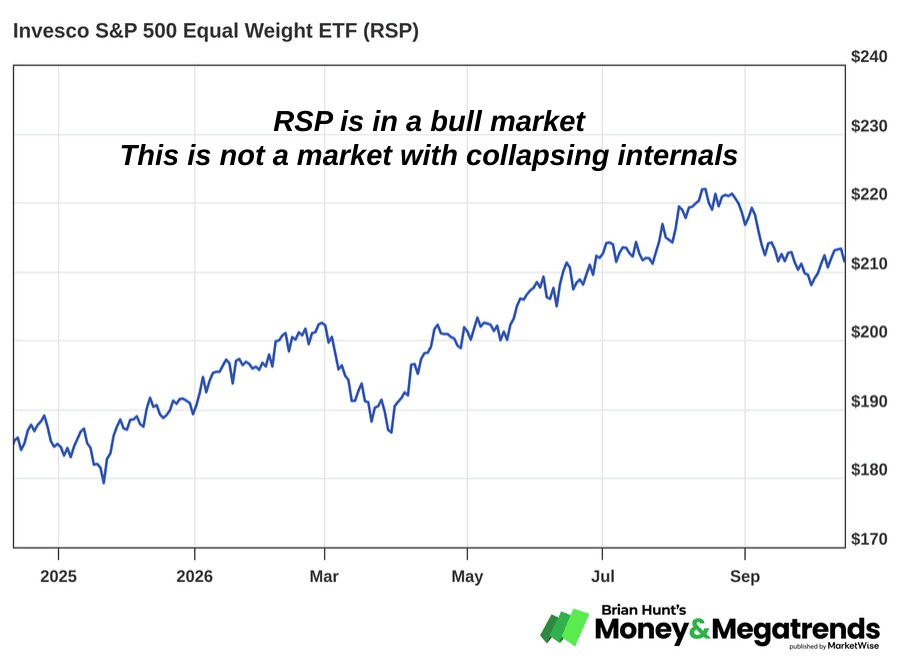
But before you do that, have a look at the Invesco S&P 500 Equal Weight ETF (RSP).
The popular S&P 500 Index is a “market-cap weighted” index. This means the biggest companies, such as Nvidia (NVDA) and Apple (AAPL), have a greater impact on the index’s value than smaller companies. A big rally in a $5 trillion giant like Apple can overwhelm losses in 30 smaller companies.
An “equal weight” index nullifies market-value-related impacts – assigning equal weight to each stock in the index regardless of company size. With an equal-weight index, a massive 100% annual gain in a giant like Nvidia cannot mask or overwhelm weakness in hundreds of smaller stocks.
An equal-weight index does a much better job of showing how the market is doing broadly than how the 10 largest companies are doing.
RSP is by far the largest ETF that tracks the S&P 500 Equal Weight Index. As you can see in the one-year chart below, this fund is comfortably within the confines of an uptrend. And while it isn’t trading near its all-time high, it’s not far from it (less than 5%).
RSP’s uptrend shows that all the hype and hoopla over “weak market breadth” and the supposed horrible market conditions it reflects is ignorant and misplaced. This is not a market with a small handful of leaders and a collapsing interior.
Having said this, keep an eye on RSP’s September low of $209 per share. If we hold above this line, I’m not worried at all about weak breadth. But a break below $209 is cause for concern. We will keep you updated on this Big Worry that is getting so much attention.
Market Notes
-
Our recommendation to get long oil and gas stocks continues to pay off. Oil giants Chevron (CVX), Shell (SHEL), Canadian Natural Resources (CNQ), EOG Resources (EOG), Suncor Energy (SU), and Petroleo Brasileiro (PBR) hit new one-year highs today.
-
The Iran War and its constriction of oil and refined products continue to benefit U.S. refiners. Refining giants Valero Energy (VLO), Phillips 66 (PSX), HF Sinclair (DINO), and Marathon Petroleum (MPC) reached new one-year highs today.
-
The Iran War and its constriction of oil and refined product supplies continue to work in favor of oil shipping firms. Industry leaders International Seaways (INSW) and Tsakos Navigation (TEN) reached new one-year highs this week.
-
Leading financial technology company SoFi Technologies (SOFI) reached a new one-year low today.
-
Space economy leader AST SpaceMobile (ASTS) reached a new one-year low today.
-
Large homebuilders DR Horton (DHI), KB Home (KBH), PulteGroup (PHM), and Lennar (LEN) reached new one-year lows today.
-
Leading air taxi firm Joby Aviation (JOBY) reached a new one-year low today.
Top Themes to Buy Now
🇧🇷 One of the world’s best investors bets on Brazil. Why it’s poised to head higher
📈 How to make 1,000%+ returns from the next wave of AI winners
Regards,


Brian Hunt
Editor, Money & Megatrends
An urgent message from our colleagues:
“Do NOT buy high flying tech stocks like Nvidia, SpaceX”

One of America’s leading AI pioneers is stepping forward today with this urgent warning… and to reveal exactly where to move your money for a chance at 1,000%+ returns before October 31st.