
Today’s issue in preview:
-
Big Tech’s $700 billion spending spree is poised to send this niche tech trade higher
-
This unique trade is like owning gold, only far more entertaining
-
A stock market debate with hundreds of billions of dollars on the line. Which side are you on?
-
The AI “supersonic tsunami” sends a fresh group of industry leaders plummeting to new lows.
Big Tech’s $700 billion spending spree is poised to send this niche tech trade higher

Credit: Henrik5000
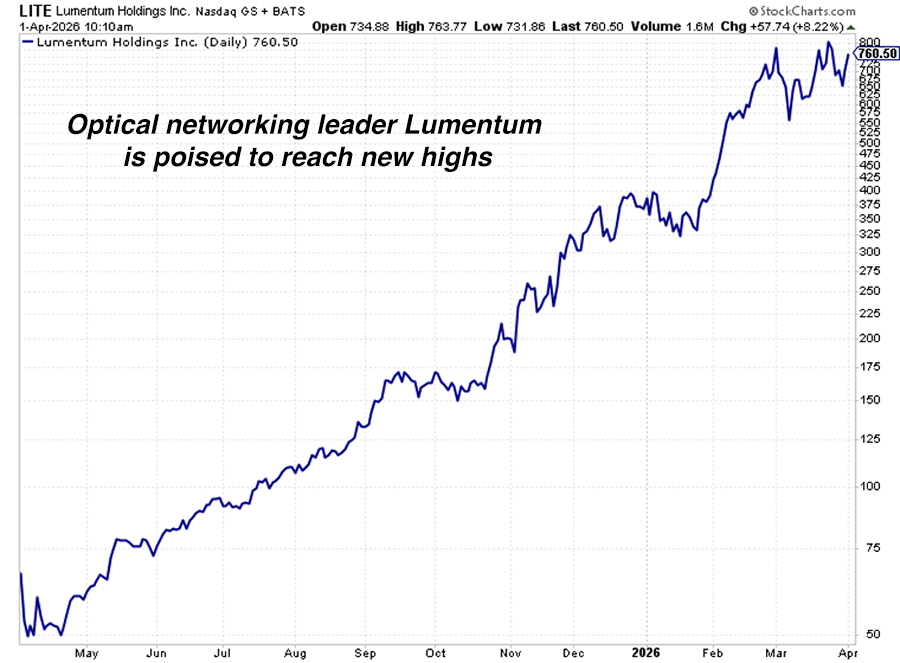
In today’s trading, leading AI infrastructure stocks Lumentum (LITE), Coherent (COHR), and Ciena (CIEN) each gained more than 6% and traded near their all-time highs.
It’s evidence that the “optical networking” bull market is very close to breaking out and running higher.
Over the past month, we’ve highlighted how “AI demand shocks” are taking industries by surprise and generating extraordinary stock market winners.
AI “demand shocks” are very different from their more commonly known “supply shock” counterparts, in which a war or pandemic abruptly cuts off the supply of a resource like oil.
Instead, demand shocks are where demand for a specific resource or manufactured product suddenly skyrockets… and sends its price hundreds of percent higher. This creates boom times for the companies involved, as their unit sales and per-unit prices skyrocket simultaneously.
Twenty years ago, demand shocks for manufactured goods and natural resources were relatively rare. Businesses had time to anticipate new sources of demand and plan accordingly. For many industries, those days are over.
AI – the fastest-evolving technology in history and the focus of the largest-ever capex cycle – has changed the rules.
AI’s power, adoption rates, and capacity are exploding… from just one quarter to the next.
AI is advancing at such a rapid pace… and large tech firms such as Google, Microsoft, and Amazon are spending such huge, unprecedented amounts of money on it (over $600 billion in 2026 alone) that AI-driven demand shocks are now happening every year… and creating the biggest, fastest stock market moves we’ve ever seen.
One industry experiencing a demand shock is optical networking. Optical networking equipment is a critical ingredient of the AI infrastructure boom. This equipment allows data to be transferred quickly and efficiently between parts of AI computing chains. Think of optical networking as a critical part of the “AI data traffic highway system.”
As a result of Big Tech’s enormous AI infrastructure spending, optical network equipment makers Lumentum, Coherent, and Ciena have enjoyed soaring revenues, and their stocks have returned hundreds of percent over the past 18 months.
However, the Operation Epic Fury-induced broad market correction hit these “highflyers” very hard. They fell 10%-22% from their highs.
Now that the worst of Epic Fury-induced chaos may be past, optical networking stocks are back to running. Ciena gained 6% this morning and traded near its all-time high. Lumentum gained 8% and traded near its all-time high. Ciena gained 6% this morning and traded near its all-time high.
The big bull market in optical networking is poised to run higher. It’s good to be on the receiving end of the largest capex program in all recorded history.
Recommended Link:
The #1 AI Stock You’ve Never Heard Of

AI fears have triggered a bloodbath in tech stocks. Yet, in the midst of the carnage… One under-the-radar AI stock is still quietly going straight UP. A 50-year Wall Street legend explains why, right here.
A stock market debate with hundreds of billions of dollars on the line. Which side are you on?

Credit: style-photography
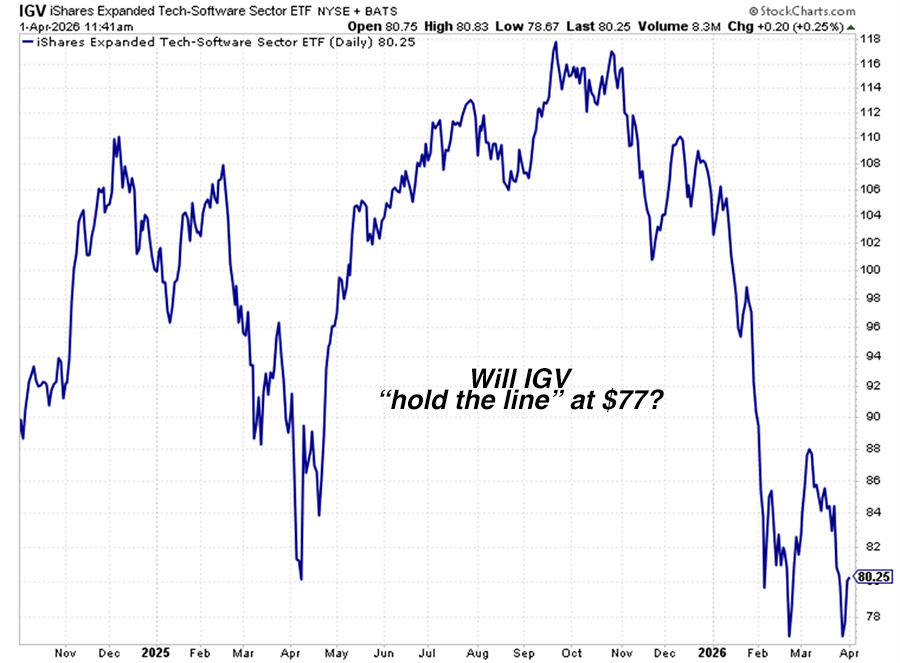
Keep an eye on the IGV ticker and the share price of $77.
It’s one of the most important ticker/share price combinations in all of technology right now.
IGV is the ticker of the world’s largest and most widely followed software stock ETF: the iShares Expanded Tech-Software Sector ETF. The fund’s big holdings are a “who’s who” of software: Microsoft (MSFT), Oracle (ORCL), Palantir (PLTR), Salesforce (CRM), Adobe Systems (ADBE), and ServiceNow (NOW).
When Elon Musk talks about the rapid, world-shaping effects of AI, he often calls the technology a “supersonic tsunami.” AI is the fastest developing technology in history… and it promises to reshape the world in massive ways.
Few industries have been hit harder by the supersonic tsunami than those in IGV.
From 2010 to 2024, the software industry was a wonderful place to invest. It gave life to many huge stock market winners. It became a favorite of institutional investors. A great software business sported high profit margins, big returns on capital invested, and excellent growth rates.
But over the past 18 months, investors have dumped software stocks by the truckload, worried that advanced AI will allow hundreds of new “AI native” companies to create and sell software for very low cost.
The software bears among us say that in the future, a single person using AI will be able to create specialized software programs that currently require teams of expensive programmers. HR software, graphic design software, accounting software, you name it, producing it is going to get a lot cheaper.
AI will put some software companies out of business. But keep in mind, it doesn’t have to put them out of business to make them stock market losers. AI only needs to lower the cost of producing what they produce over the long run. This will enable hordes of AI-centric competitors, which will throw a wet blanket on their growth rates, profit margins, and P/E multiples.
Over the past year, these worries have sent graphic design software giant Adobe Systems(ADBE) down 38%, business software firm ServiceNow(NOW) down 36%, HR software firm Workday (WDAY) down 47%, advertising software firm Trade Desk (TTD) down 60%, business software firm Atlassian (TEAM) down 69%, business software firm HubSpot (HUBS) down 58%, payroll software firm Paycom (PAYC) down 45%, and the list goes on.
The relentless selling produced a spectacular decline in IGV. From November 1, 2025, through February 23, 2026, the fund plunged 33%. It’s one of the largest, fastest declines in ETF history.
This drop has spurred a huge debate in the investment world… one with hundreds of billions of dollars on the line: Time to buy software… or not?
Software bulls say the recent massacre has created an incredible opportunity to buy top-shelf software firms such as ServiceNow and Adobe at low prices. Bears say the sector is due for a long, grinding bear market… where AI enables brutal competition.
As you can see in the 1.5-year chart below, IGV recently staged a rally off its February lows in the $ 77-per-share area… only to fall right back to that level in late March. Bulls need to see IGV “hold the line” at $77 and rally. If it gives, we can say the software sector is still in a bear market.
This unique trade is like owning gold, only far more entertaining

Credit: littleny
This week, the National Football League approved a plan by Las Vegas Raiders controlling owner Mark Davis to sell a small portion to Egon Durban, the co-CEO of investment firm Silver Lake. The sale is expected to value the Raiders at $11 billion, a huge increase over the $6.5 billion valuation the Raiders received in a 2024 transaction.
This transaction serves as confirmation that sports teams are one of the leading “debasement” bets in the market today.
The “debasement trade” is the popular term for buying assets to get out of a depreciating U.S. dollar and into scarce, in-demand assets that will hold their value over the long term.
Regular readers are familiar with the bullish drivers of this trade, which I’ve described many times when discussing gold.
The governments of most wealthy Western nations have promised far too many things to far too many people.
The related debts and obligations governments have taken on cannot be paid back with sound money. They can only be paid back with debased, devalued money… much of which is created out of thin air. This is driving inflation and significant currency debasement. Prices are going up because the value of our money is going down.
It’s important to note that the prices of scarce resources are going up. Things that cannot be easily produced or replicated. Things you can’t print. Gold. Copper. Silver. Natural gas pipelines. Beachfront homes. These are proving to be sound “debasement” hedges.
And this might sound odd to you, but I include professional sports teams in this group. Like gold and beachfront homes, professional sports teams are valuable, in-demand, scarce resources that cannot be printed or easily produced.
Every year, we hear new superlatives for how the values of professional football, basketball, and baseball teams are rising. CNBC reports that the average NFL franchise is worth $7.65 billion. That figure marks an 18% jump from the year before. CBS reports that Major League Baseball generated a record $12.1 billion in revenue in 2024, and franchise valuations increased 8%. The New York Yankees recently achieved a valuation of $8.2 billion.
Professional sports contests are one of the few television products people still reliably watch. In a world where our attention is pulled away from television, sports become incredibly valuable to big advertisers. Plus, it’s reasonable to expect that people will be ever more likely to want to watch something “real” and “live” in a world of AI video proliferation.
Plus, sports team valuations are benefiting from the K-shaped economy and soaring asset values. The ultra-rich love buying and owning sports teams. Even the hapless Raiders franchise, with its 94 – 151 record over the past 15 years, is soaring in value.
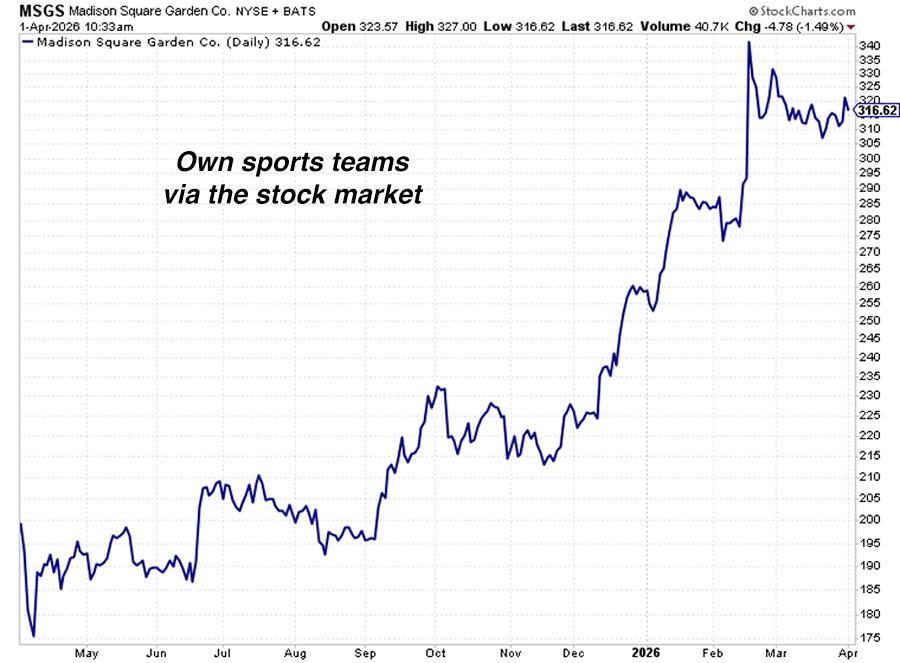
This backstory comes to mind when I hear that famed money manager Mario Gabelli recommends owning some of the few ways to own sports franchises via the stock market. Gabelli is bullish on Atlanta Braves Holdings (BATRA), which owns MLB’s Atlanta Braves, and Madison Square Garden Sports (MSGS), which owns the NBA’s New York Knicks and NHL’s New York Rangers.
Gabelli believes both stocks are undervalued and poised to go higher as the professional sports franchise megatrend runs higher. This is an unusual “debasement” trade you can literally cheer for. It’s no surprise MSGS is in a bull market and trading near all-time highs.
Market Notes
-
Our 2024 recommendation to invest in the Engineering & Construction theme continues to pay off. Giant contractor MasTec (MTZ)‚ reached a new all-time high today. The stock is up 183% over the past year.
-
The Boomer health care theme continues to generate winners. Pharma giant Pfizer (PFE) reached a new one-year high today.
-
Clothing and shoe giant Nike (NKE) reached a new one-year low today. The stock is down 49% over the past two years.
-
The AI “supersonic tsunami” continues to slam into vulnerable companies in the “KIDS category.” Big real estate data firm CoStar Group (CSGP) reached a new one-year low today. Software giant Fidelity National Information Services (FIS) reached a new one-year low today. Real estate firm Zillow (Z) reached a new one-year low today.
Regards,


Brian Hunt
Editor, Money & Megatrends
An urgent message from our colleagues:
Mark Your Calendar for April 7 at 10 a.m. Eastern Time

For the first time ever, one of the most sought-after voices in finance – who TURNED DOWN opportunities with George Soros and Steve Cohen – is going public with an elite financial road map for the weeks ahead. He predicted the rise of the iPhone and Bitcoin. And now, with the world in chaos and tremors hitting the market, he’s stepping forward with his most critical market warning yet.
Learn more and reserve your free spot now.