
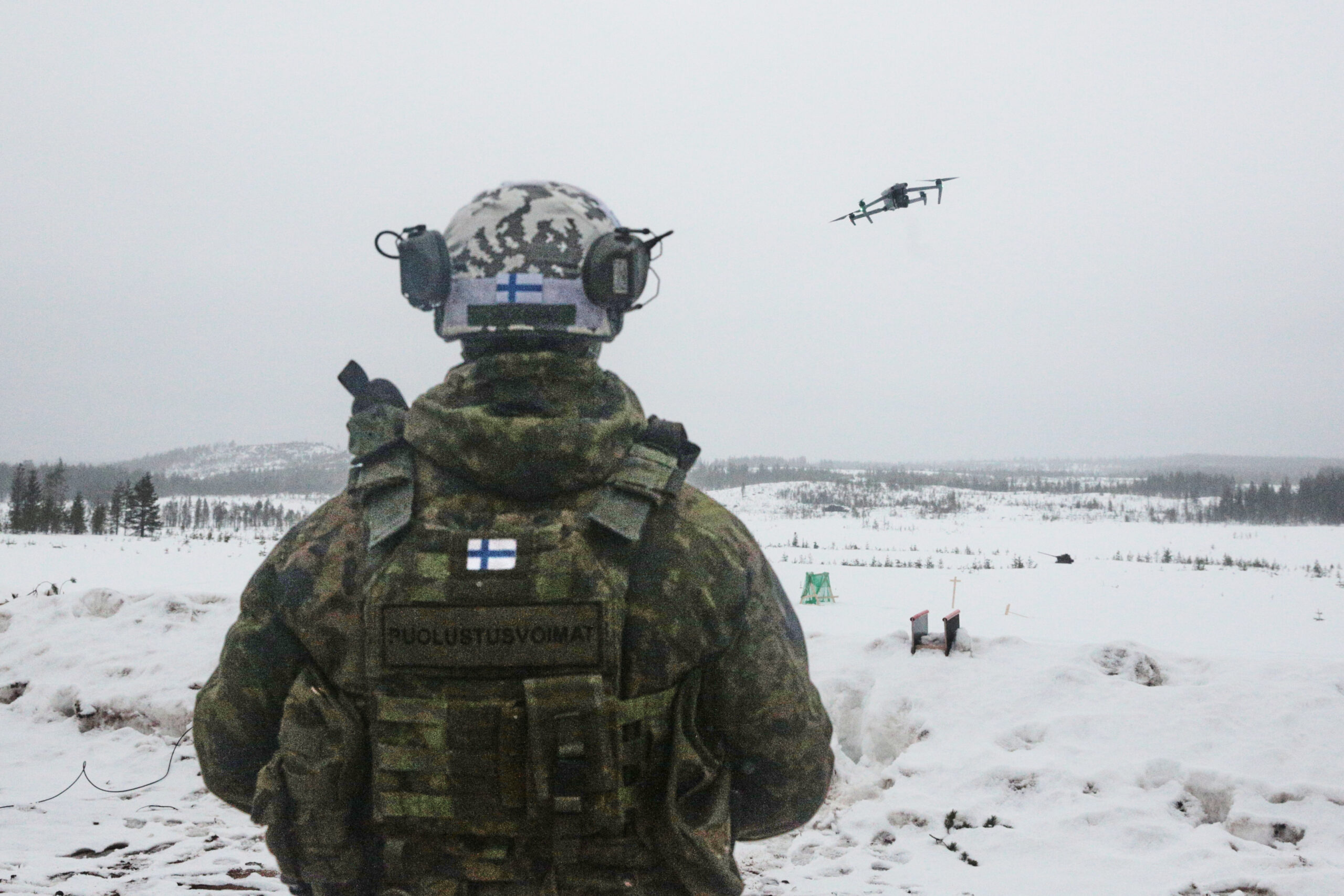
Since the United States and Israel attacked Iran as part of Operation Epic Fury in early March, drone warfare has played a major role in the daily battles taking place in the Middle East.
Going back just a few months, 2026 began with literal fireworks when, on January 3, the U.S. conducted a military strike on Venezuela and seized President Nicolás Maduro and his wife. A key component of that strike? Military drones.
We’re barely into spring, and military drones – also known as unmanned (or uncrewed) aerial vehicles (“UAVs”) – have already played a prominent role in two major global conflicts.
Military drones are now the primary weapons for several countries… most prominently, the U.S., Ukraine, and Iran.
And that puts military drone stocks in the spotlight as the fighting continues.
The Prominent Role of Military Drones in the Middle East and Venezuela
Drones have been the Iran’s primary method of attack, especially as Operation Epic Fury commenced in early March.
But they’re not using high-cost, AI-equipped drones.
Instead, Iran is deploying Shahed-136 loitering munition systems (also known as “kamikaze” drones) that measure roughly 12 feet long and eight feet wide and can reach speeds of 115 miles per hour. Once airborne, the Shahed drone can travel up to 1,500 miles. And it uses GPS to locate its target.
The interesting thing about these drones? They’re about as basic as drones get.
They can be fired off the back of a truck. And they cost around $35,000 to make.
For comparison, the cheapest drone made by American defense titan Lockheed Martin (LMT) – the “Speed Racer” drone – costs somewhere between $1 million and $2 million each.
Iran is certainly making plenty of these Shahed-136 models. As of late March, more than 70% of Iran’s recorded retaliatory strikes have come from drones.
They’ve been used as primary weaponry to target U.S. military bases and neighboring Gulf States like the United Arab Emirates, Bahrain, Qatar, and Kuwait. Sadly, a Shahed drone attack is what killed six American service members in Kuwait on March 1.
Even as the U.S. targets drone-manufacturing facilities, Iran is expected to continue building the Shahed drones because they’re generally made with off-the-shelf parts and 3D-printed materials. That means they can be constructed pretty much anywhere.
Somewhat ironically, the United States mimicked the design of the Shahed kamikaze drone to create its own mass-produced, cheap weapons. They’re called Low-cost Uncrewed Combat Attack Systems… better known as LUCAS. So, the U.S. is now essentially using Iranian-designed weapons to fight Iran.
As for the military operation in Venezuela in early January, the U.S. took a much different approach.
The Pentagon never officially confirmed which types of UAVs were used in Operation Absolute Resolve. But those familiar with the technology believe that military drones such as the MQ-9 Reaper, the RQ-4 Global Hawk, or the super-secretive RQ-170 and RQ-180 stealth drones were deployed for this mission.
Rough cost per unit:
- General Atomics MQ-9 Reaper: $64 million
- Northrop Grumman (NOC) RQ-4 Global Hawk: $131 million
- Lockheed Martin RQ-170 Sentinel: $6 million
- Northrop Grumman RQ-180: Not disclosed, but rumored to cost at least $100 million
As proven by the war in Iran and the military operation in Venezuela, the use of military drones is no fad. It’s a long-term strategy shift.
As is the use of artificial intelligence (“AI”) in drones. And that shift to AI is just in its beginning stages.
A Look at the AI-in-Drone Market
According to ResearchAndMarkets.com, the global AI-in-drone market should reach around $47.1 billion by 2033. That’s a huge increase from just less than $12 billion in 2024. It also projects an impressive 16.4% compound annual growth rate (“CAGR”) between 2025 and 2033.

And the U.S. will be the primary driver of this growth. The One Big Beautiful Bill Act, signed into law in July 2025, allocated $33 billion for direct spending on drones and AI for the Department of Defense (“DoD”).
Of course, not all drones are used for military purposes. And not all military drones in use today are equipped with AI… the Shahed kamikaze drones, for example.
But you can bet that most new drones will include AI technology. At this point, it’s necessary to fight and win today’s wars.
And that means the AI-in-drone market is one that will soon encompass most military and non-military drones.
That’s great news for the drone industry… and investors.
Recent Military Strikes Illustrate a Massive Shift Toward Drones and AI
Though the Shahed-136 drones being used in the Iran war aren’t equipped with AI, plenty of other military drones are.
For example, the U.S. Army has deployed thousands of AI-powered Merops drones to find and destroy incoming Iranian Shahed drones.
And Israel is using new AI drone swarms for recon and even electronic warfare in Iranian airspace. Its military is also using large UAVs to release swarms of smaller AI-controlled drones.
The use of military drones has also been prevalent throughout the conflict between Russia and Ukraine. In fact, drone technology has quickly evolved since the start of the nearly four-year war.
For example, AI-equipped drones can now hit their targets even through the dense fog of interference that has sent many a non-AI-equipped Russian and Ukrainian drone from the sky to the ground.
Thanks to AI, these drones can lock onto the image of a target viewed through their onboard camera. The drone can then continue along its path autonomously, even after the drone pilot loses contact with the vehicle.
This autonomous technology improves accuracy while mitigating human risk.
With nearly 50% of military AI systems used in UAV and vehicle navigation systems, it’s clear that AI is driving the latest developments in military strategy, defense, and weaponry.
So clear that Pete Hegseth stated that the U.S. military “will become an ‘AI-first’ warfighting force across all domains.”
And AI drones are now critically important on the front lines of the modern battlefield.
As Secretary of the United States Army Dan Driscoll noted, “If small arms defined the 20th century, drones will define the 21st.”
And that’s a compelling statement for investors seeking military drone stocks with steady growth potential.
Military drone stocks are still a strong, long-term growth bet. But those stocks also matter right now, as the U.S. military increases defense spending and deploys its own drones to attack its enemies as well as defend itself.
Key Signals Investors Should Watch
Here’s what you should be watching if you’re thinking of investing in military drone stocks.
- Escalation in Iran and the Middle East: As long as this conflict continues, you can expect more money to be spent. And at over $1 billion a day, defense stocks will continue to reap the benefits.
- Defense budget increases: Even having spent several billions on the war in Iran since the end of February, the Pentagon is asking for another $200 billion in extra funds. If this request is approved by Congress, it will likely be spent quickly.
- New drone contract announcements: New drone contracts equal several millions of dollars for drone manufacturers. On March 20, the U.S. Army announced two contracts, totaling $134 million, to AeroVironment (AVAV) for uncrewed long-range reconnaissance systems and one-way attack drones. And on March 22, the U.S. Army paid $52 million to Skydio for 2,500 small quadcopter drones. As the conflict continues, expect more drone contracts to be awarded.
- Continued AI/autonomous warfare adoption: We’ve seen increased autonomous and drone warfare from both Russia and Ukraine. Now we’re seeing it from Iran, the U.S, and Israel. China and Turkey are also known to have established AI and drone warfare programs. And countries like South Korea, the United Kingdom, and Australia are developing their own autonomous, AI-driven weapons and defense systems. You can bet that many more countries will be doing the same quite soon… if they aren’t already.
- The growth of counter-drone systems: As more militaries are engaging in drone offensive attacks, more militaries are prioritizing counter-drone defense systems. In mid-March, for example, the U.S. Army awarded a massive $20 billion contract to Anduril Industries to strengthen its counter-drone capabilities. The fast-growing global counter-drone market is projected to reach around $20.3 billion by 2030 (it was roughly $6.6 billion in 2025), at a compound annual growth rate of 25.1%.
Now, let’s look at the military drone stocks you should be watching.
The Best Military Drone Stocks to Add to Your Watch List
Lockheed Martin (LMT)
A contracting partner of the U.S. military for more than 75 years, Lockheed Martin (LMT) is a relatively low-risk play for investors looking for a military drone-related stock.
The global aerospace and defense titan is on the cutting edge of drone and UAV technology, as well as AI-enabled targeting systems. For example, the company’s well-known yet hyper-secretive Skunk Works division (formally known as Lockheed Advanced Development Programs) recently demonstrated how AI can take over a UAV if unmanned missions run into unexpected problems.
Couple the company’s AI and drone innovation with its massive defense backlog (a record $194 billion at the end of 2025) and long history of Pentagon relationships, and it’s clear why LMT is so successful.
Lockheed’s Stansberry Score, which measures the long-term investment quality of a stock, backs that up with a strong overall “A” grade.
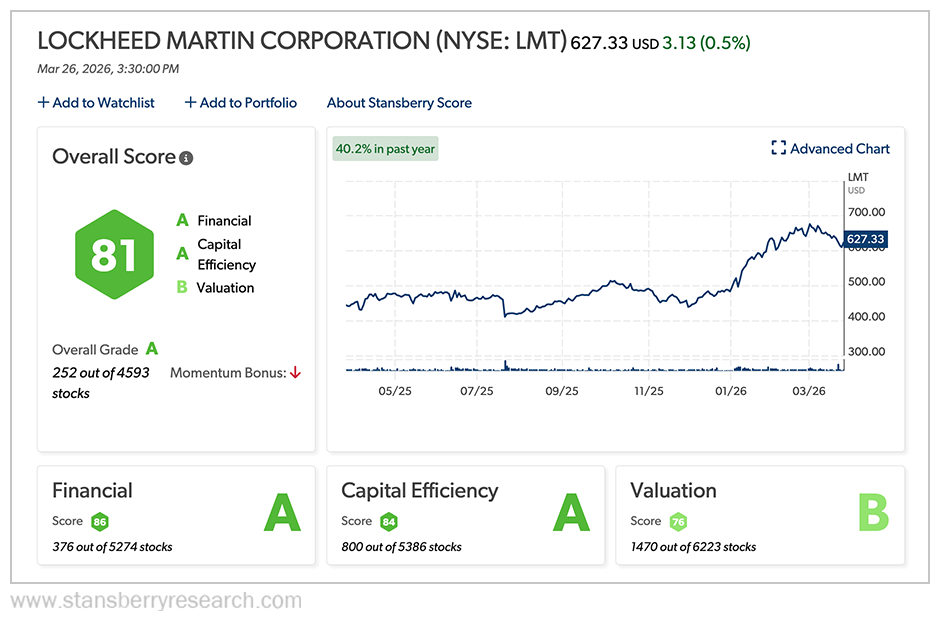
LMT scores high marks with an “A” in Financials (its substantial backlog and 2025 full-year revenue of just over $75 billion are key drivers), an “A” in Capital Efficiency.
As battlefield technology evolves, and as the U.S. military continues spending on UAVs, AI, and autonomous systems, LMT is positioned to benefit from rising global tensions. And that sets Lockheed up for continued, long-term success.
L3Harris Technologies (LHX)
Another high performer in the defense space is L3Harris Technologies. The Florida-based business provides a wide range of mission-critical solutions to global government and commercial customers through its Space & Mission Systems (“SMS”), Missile Solutions (“MS”), and Communications & Spectrum Dominance (“CSD”) segments.
(L3Harris recently sold about a 60% controlling stake in its Space Propulsion and Power Systems business, previously a part of Aerojet Rocketdyne, for $845 million.)
The U.S. government is one of those customers, with contracts covering advanced defense and intelligence technology, avionics, and command/control systems for the DoD, Army, and Air Force, among others.
And, like Lockheed Martin, L3Harris Technologies is an innovator, particularly in the autonomous systems and counter-UAV technology space. A few prominent examples include:
- AMORPHOUS™: Artificial intelligence/machine learning (AI/ML) software that enables the simultaneous command and control of thousands of autonomous assets through one user interface.
- Uncrewed Surface Vehicles (“USVs”) and Autonomous Underwater Vehicles (“AUVs”): The company’s Iver4 AUVs and C-Worker/C-Target USVs are routinely used for maritime missions in a similar way that drones are used for air missions.
- VAMPIRE™ (Vehicle-Agnostic Modular Palletized ISR Rocket Equipment): A portable system that can be mounted on various vehicles, VAMPIRE uses an advanced sensor and a weapons station to fire rockets to take down opposing drones.
- Drone Guardian: This technology offers drone detection, tracking, identification, and defeat capabilities.
- CORVUS-RAVEN: This portable electronic warfare solution provides fast detection and jamming of drone threats.
- Widow®: This mission-management software assists operators in quickly identifying and engaging targets through an integrated view of the battlespace.
L3Harris Technologies is laser-focused on next-generation defense technologies equipped with AI, including counter-drone systems. Its partnerships with Palantir Technologies (PLTR) for its TITAN Army intelligence ground station that improves situational awareness, and Shield AI to integrate their Hivemind autonomy software into unmanned systems (which will improve surveillance and targeting capabilities), demonstrate as much.
L3Harris Technologies enjoyed a very strong 2025, reporting $21.9 billion in revenue, a 3% year-over-year increase. The company also earned $3.1 billion in cash from operations.
Just as importantly, L3Harris finished 2025 with a $38 billion backlog, proof of the demands for its products. Roughly half of that backlog is expected to convert to revenue within the next year. That promises near-term stability not just to the company, but to investors as well.
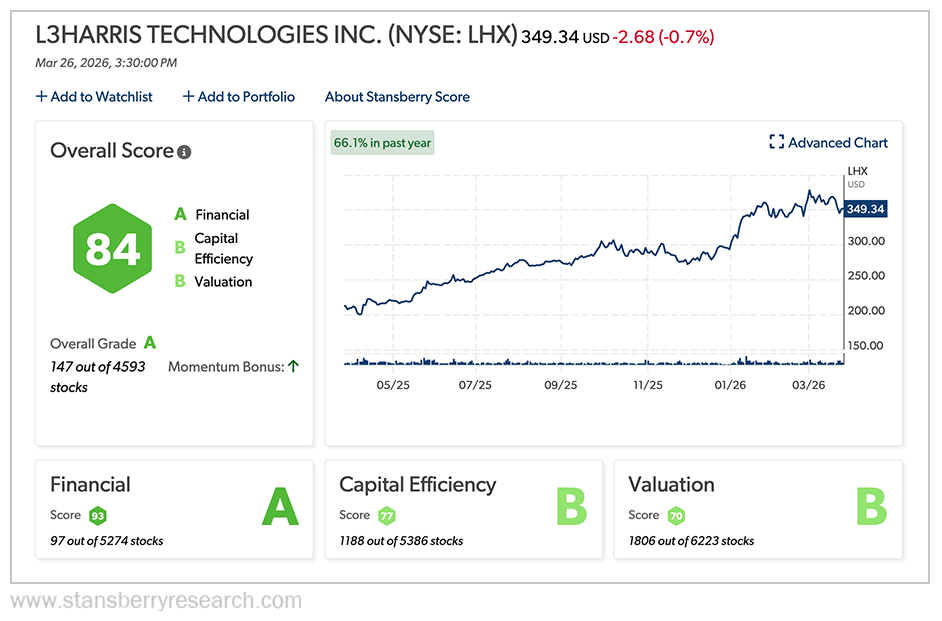
LHX’s Stansberry Score shows plenty for investors to like. And the market agrees, as LHX hit its 52-week high of $379.23 on March 2… just as Operation Epic Fury was unfolding.
LHX, with an overall “A” score, cracks the top 150 stocks out of nearly 4,600, fueled by strong Financials (“A”… and among the top 100 out of nearly 5,300 stocks ranked in that category), Capital Efficiency (“B”), and Valuation (“B”).
AeroVironment (AVAV)
Known for its Switchblade kamikaze drones and Puma UAVs, AeroVironment is a pure-play business that has fully embraced AI and integrated it into many of its systems and technologies.
AVAV saw its stock rise, literally and figuratively, when the conflict in Ukraine began in 2022. As a significant military drone supplier to Ukrainian forces, AeroVironment’s revenue has increased roughly 222% since the start of the Ukraine war.
And with Secretary Driscoll announcing late in 2025 that the Army plans to buy another million drones, there’s plenty of reason to be optimistic about AVAV’s prospects, especially given the company’s direct exposure to battlefield drone demand.
There’s also plenty of reasons for caution if you’re considering AVAV stock. Its Stansberry Score ranks well below the middle of the pack with an overall “C” grade.
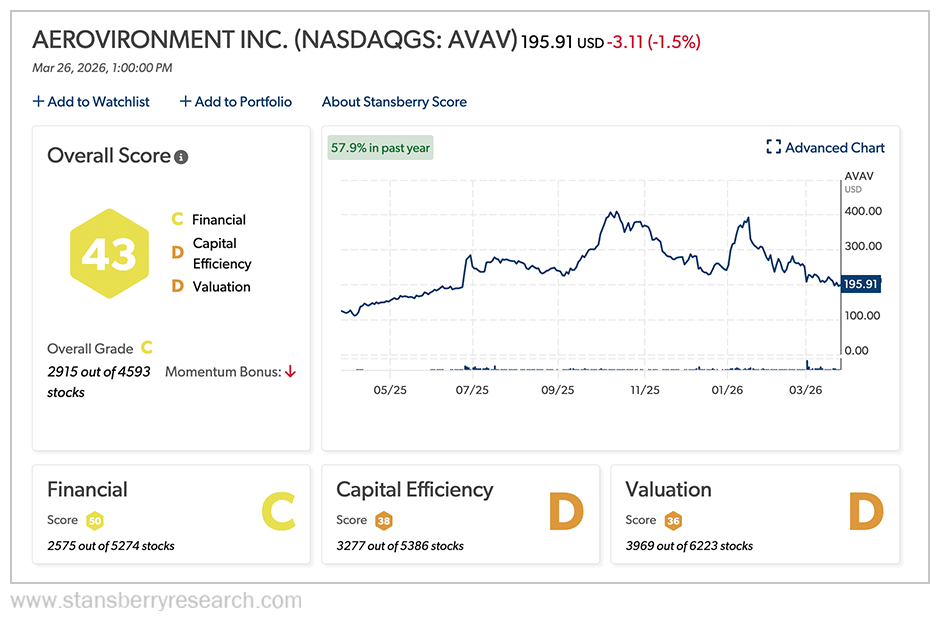
Its Financials are decent (“C”) but improving, highlighted by a solid $408 million in fiscal third-quarter 2026 revenue – a 143% year-over-year increase – and $1.3 billion in revenue for the first three quarters of fiscal 2026.
AeroVironment also has bookings of $2.1 billion and a book-to-bill ratio of 1.6 for the first nine months of fiscal 2026, plus a record funded backlog of $1.1 billion.
But the company is not profitable right now.
It reported a net loss of $156.6 million in Q3 2026, compared to $1.8 million net loss in the prior-year period. AVAV was also hit with a $179 million operating loss.
AVAV is also burning through lots of cash. The company has recorded negative free cash flow since 2022. And its free cash flow margin has decreased by 6.3 percentage points over the past five years.
That all contributes to its “D” grade for Valuation.
AVAV shows strong future growth potential – especially after its 2025 acquisition of defense technology company Blue Halo, which will expand the business beyond UAVs. AeroVironment’s backlog is significant, and its foray into broader autonomous systems should open the door for even more substantial contracts.
But AVAV is a risky, highly speculative play right now. It’s certainly worth watching, but there are safer bets out there.
Draganfly
If AeroVironment is considered risky, Draganfly (DPRO) is an even dicier play. This microcap doesn’t operate on the same scale as Lockheed or L3Harris, but its laser focus on building the world’s most advanced UAVs has helped the company gain traction in the military and government space.
Draganfly designs and manufactures custom airframes, payloads, and robotic systems, while offering management services for complex flight operations. Two of its more prominent contracts involve supplying its Flex FPV drone systems to the U.S. Army and providing the DoD with its Commander 3XL drones.
Like AeroVironment, Draganfly saw a nice bump in both 2025 revenue and product sales, growing 17.8% and 28% year over year, respectively. Those positive developments were offset, however, by a comprehensive loss of nearly $23 million, almost $10 million more than in 2024.
Draganfly, like AeroVironment, is not yet a profitable company. While it’s striving to scale its sales with military and government contracts, the consistent net losses and negative operating income prevent the company from profitability.
It’s worth noting, however, that Draganfly finished 2025 with a strong cash balance of just over CA$90 million.
This is all reflected in our Stansberry Score, which grades DPRO a “D”. This is mainly due to its poor Capital Efficiency (“F”), which ranks near the bottom of the nearly 5,400 stocks tracked in this category. DPRO’s Valuation isn’t much better, with a “D” grade that suggests the stock is overvalued.
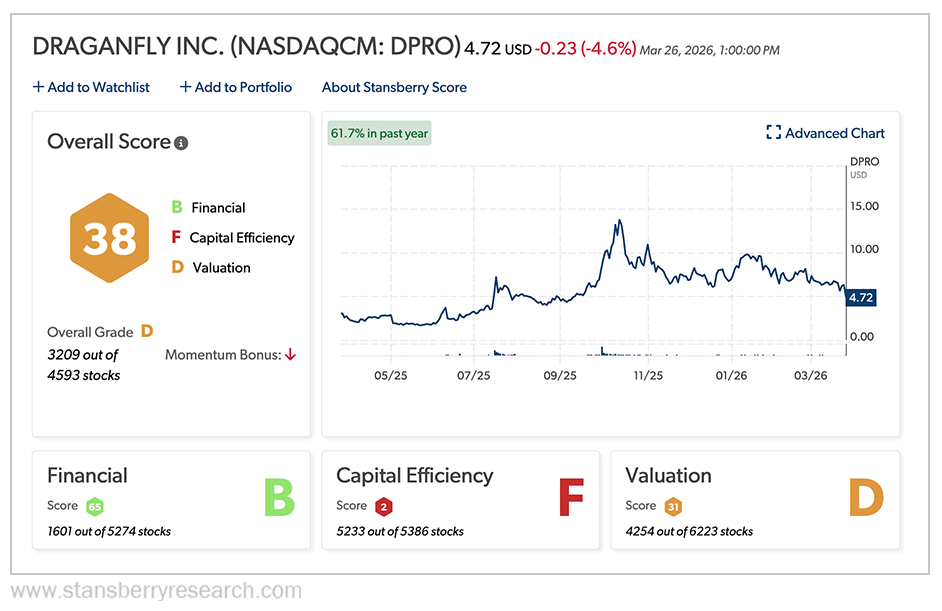
DPRO is also highly volatile, with a five-year beta average of 3.55. That means DPRO stock is at least 3.5 times more volatile than the overall market.
All that said, Draganfly still offers some upside thanks to its military and government contracts and UAV innovation. And despite some of its numbers, DPRO is considered by many analysts to be a solid buy for risk-tolerant investors.
If you’re considering investing in DPRO, weigh the growth potential as well as the elevated risk level involved with investing in a small, growing, volatile company that still loses money.
Keep Draganfly on your watch list as a potential long-term growth play.
Why Autonomous UAVs Are Reshaping Defense Tech
Autonomous UAVs are changing the way battles are fought and wars are won right before our eyes. Drones are a key component of 21st-century warfare because they’re more cost-effective, safer, faster, and far more scalable than traditional manned aircraft like jets and helicopters.
Also, with the integration of AI into UAVs, all it takes is one drone operator to control multiple UAVs. This saves on manpower and increases tactical flexibility.
More importantly, today’s UAVs are built smart. Many are designed to deliver real-time intelligence, surveillance, and reconnaissance. Their AI, machine vision, and autonomous targeting technologies deliver greater strike precision while keeping human pilots mostly out of harm’s way.
And it’s not just drones. Companies like the ones we highlighted are creating counter-UAV systems, battlefield sensors, and AI mission technology that have forever changed the battlefield landscape.
Ukraine, a massive underdog in its war against Russia, has managed to keep fighting its battle for nearly four years now… in large part because of the skillful, tactical use of military drones, UAVs, and smart technology.
As we’ve seen throughout the war in Ukraine, as we witnessed with the U.S. military operation in Venezuela, and as we’re seeing now in Iran and the Middle East, global conflict is, unfortunately, a persistent concern.
And the militaries that autonomize their operations and invest in drones, AI, and UAVs will be most prepared.
Why Military Drone Stocks Are Gaining Urgency in Today’s Geopolitical Climate
Military drones are here to stay. Their cost-effectiveness and tactical success ensure that governments and military organizations will continue investing in this technology. So does the overall global climate.
The world has taken notice of how successful drone warfare can reshape the battle narrative. A few recent examples of the accelerating demand for drones:
- The U.S. is spending more than $1 billion per day during the war in Iran, with much of that dedicated to drone warfare.
- Germany is spending nearly $12 billion on drones for defense.
- The U.S. is buying a million more drones.
- Taiwan is purchasing around 50,000 commercial-grade military drones for defense.
AI, robotics, satellite communications (Ukraine’s use of Starlink for essential battlefield connectivity is a great example)… we’ve written about these technologies in this space before.
They’re all game changers.
And they all overlap in the design and production of military drones and UAVs, which makes them an intriguing addition to investors’ portfolios.
Why These Military-Drone Stocks Are the Ones to Watch
The four military-drone stocks we examined here touch both ends of the risk spectrum for defense stocks. There are the lower-risk giants (Lockheed Martin and L3Harris Technologies). And there are the volatile, high-risk businesses (AeroVironment and Draganfly).
If you’re seeking steady but modest gains with a lower investment risk, LMT and LHX are worth considering.
These are reliably strong, established companies with long track records of success, plenty of government contracts, and products and solutions that fill essential needs. So, there probably won’t be much rapid growth here. But there likely won’t be a risk of rapid decline either.
For investors willing to take a considerable amount of risk with the potential for significant growth, AVAV and DPRO should be on your watch list. They both offer solid revenue growth and are riding the AI and drone tailwinds.
However, both military drone stocks have proved to be extremely volatile. Many analysts see them as overvalued, and neither company is profitable yet.
If you’re willing to wait out the turbulence, investment in AVAV and DPRO may eventually pay off. But both companies need to start consistently making money and addressing operational challenges for that to come to fruition.
Let’s be honest… we all want to see global conflict end. Unfortunately, war is a reality. It has been for ages, and it will continue to be. And when there’s war, there’s a need for battlefield technology. So, it’s smart to consider investing in companies that are at the forefront of modern warfare. Especially those that are driven by both AI innovation and rising geopolitical turmoil.
Regards,
David Engle
Editor’s note: Speaking of AI, we know that it’s devouring energy at an unprecedented rate… straining America’s already vulnerable power grid.
All the big players are searching for new ways to meet AI’s power-hungry daily demands, pouring billions of dollars into alternative energy sources.
You can still get in on this tech, too – but time is running out.
Because Amazon (AMZN) may have cracked the code.
This breakthrough technology is being hailed as “the Holy Grail of Power,” and Amazon went all-in on it…
Get the details right here, including how to prepare and what to buy.