
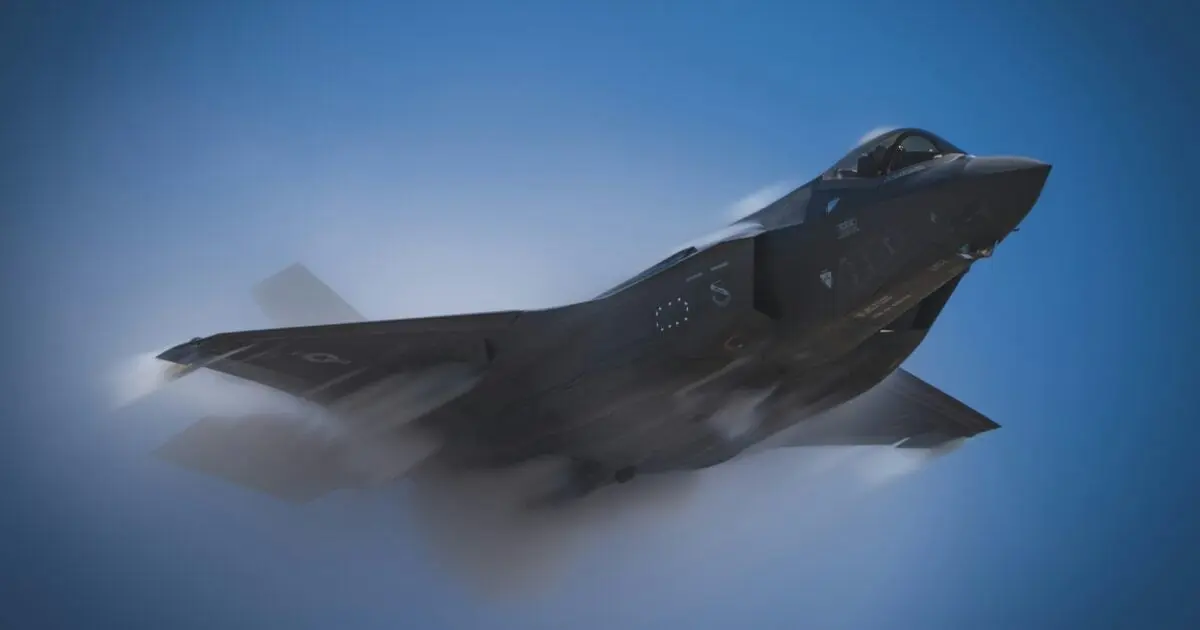
Defense stocks typically benefit from times of war and conflict. We’ve seen it time and time again.
In early January, after the U.S. government invaded Venezuela and captured President Nicolás Maduro and his wife, global defense stocks surged.
On Monday, January 5, U.S. defense titans Lockheed Martin (LMT) and Northrop Grumman (NOC) gained more than 2% and 4%, respectively. And the iShares U.S. Aerospace & Defense Fund (ITA) hit a new intraday record when it increased 2%.
Just two months later, tensions escalated into war between the U.S., Israel, and Iran.
On Monday, March 2:
- Northrop Grumman jumped to $768.02, a roughly 6% gain from Friday, February 27.
- RTX Corporation (RTX), formerly Raytheon, surged roughly 4.7%.
- Lockheed Martin saw a roughly 2.8% bump.
- The iShares U.S. Aerospace & Defense Fund increased another 2.8%.
Since then, however, defense stocks have leveled out. Some have even dropped significantly despite the ongoing war in the Middle East.
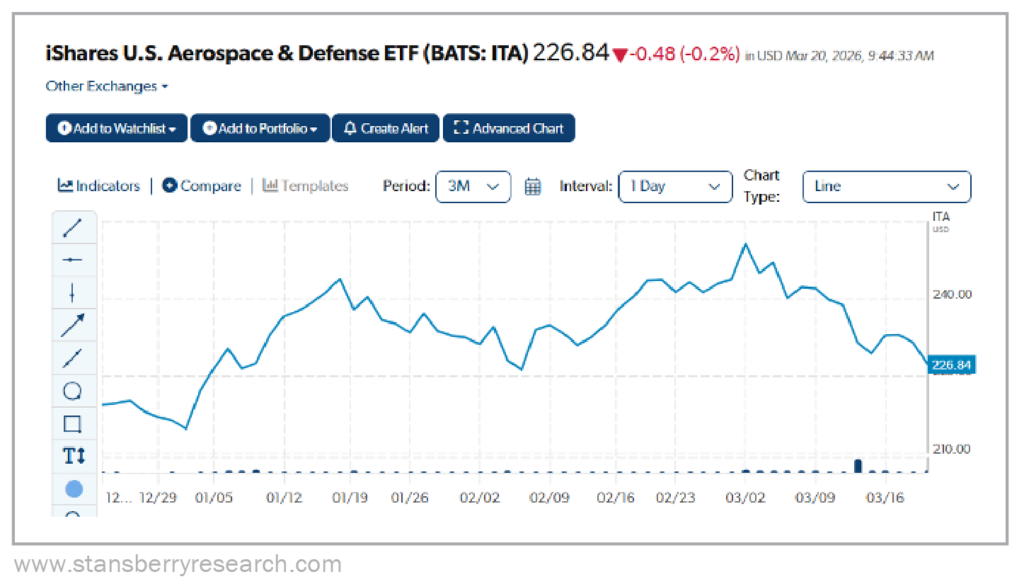
In fact, since its March 2 peak of roughly $250, the ITA ETF’s shares have plummeted around 9.8% to roughly $227 in less than three weeks.
And Northrop Grumman, a big gainer at the start of the war, has seen its stock price drop by around 7.25% in the same timeframe.
But there is some context to consider.
While many defense stock prices have dipped since their apex on March 2, they’re still generally up overall since the start of the new year. Using Northrop as an example again, its share price is up roughly 16.6% since January 5.
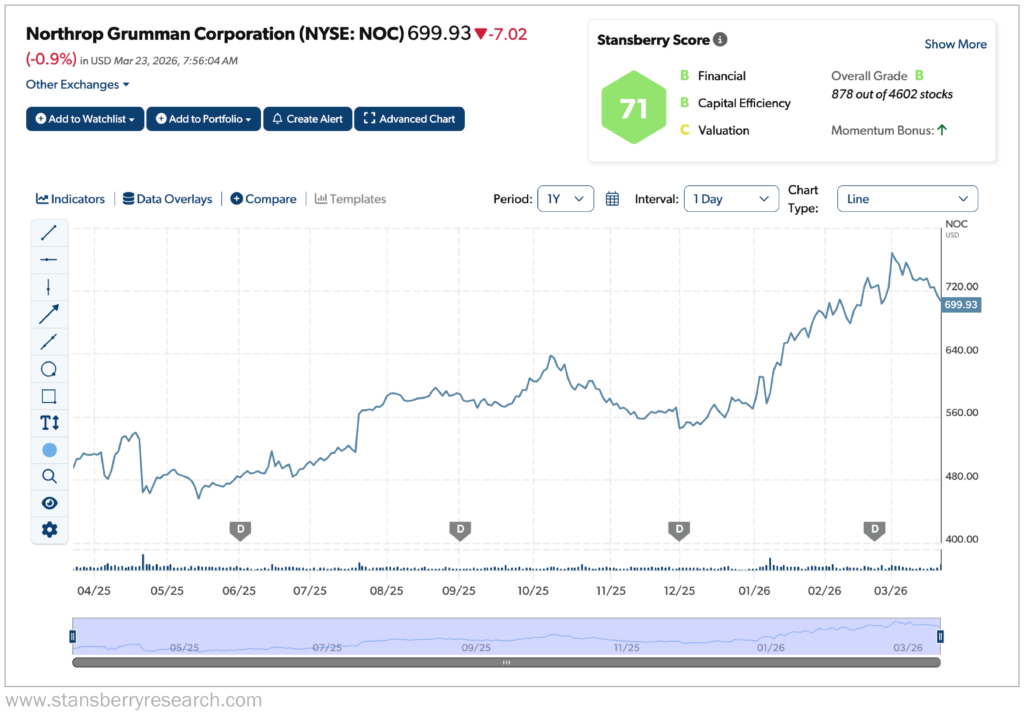
Defense stocks spike upon the first real evidence of war or conflict. Then they tend to dip shortly after the start of the war before leveling off at a lower price than the initial spike. From there, defense stocks then appear to maintain a higher overall price than pre-conflict levels as the war goes on.
Wartime leads to much market uncertainty. Just look at gas and oil prices since this war led Iran to close the Strait of Hormuz, a shipping lane critical to the world’s supply of both.
Defense companies, as we’ve seen, generally benefit from times of war. So do those who invest in the right defense stocks. The key word being “right.”
Because not all defense stocks are winners, even during wartime.
Why Geopolitical Risk Pushes Investors Toward Defense Stocks
Defense companies don’t rely on traditional consumer spending to make money. Their revenue is driven by government-backed demand.
The logic is simple. When the geopolitical climate is more fragile (or downright hostile) than usual – as it is now – governments pour more cash into military readiness. They raise their defense spending to prepare for worst-case scenarios.
And that drives defense companies’ stocks higher.
Even when the broader market experiences volatility, defense stocks are often considered a relatively safe play for investors.
And it’s not just because they thrive on uncertainty… it’s also because they’re typically backed by government funding and long-term contracts. That creates a lot of stability. So, investors turn to defense stocks for steady returns, regardless of how other industries are performing.
We’ve seen this play out many times. It happened with:
- Boeing (BA) and General Electric during the Cold War
- The entire defense industry during the wars in Iraq and Afghanistan
- Lockheed, Northrop Grumman, and General Dynamics (GD) at the start of the Israel-Hamas conflict
- The global defense industry again, when Russia invaded Ukraine
After the U.S. military operation in Venezuela and Operation Epic Fury in Iran, investors have followed this same pattern.
But it’s not just the traditional weapons makers and defense contractors that are benefiting today. Modern warfare businesses are carving out space in the market as newer technologies like drones, AI, space defense, and cybersecurity are increasingly central to today’s wars.
Along with the Lockheeds, Boeings, and Northrops, companies specializing in those technologies – such as AeroVironment (AVAV), Rocket Lab (RKLB), Kratos Defense & Security Solutions (KTOS), Palantir (PLTR), and Axon Enterprise (AXON) – have also become major players in the defense industry.
How Iran Is Shaping Market Sentiment
The January 3 overthrow of Maduro was months in the making. This event demonstrated that the U.S. was willing to use force in taking down government leaders the Trump administration views as unfit.
Not surprisingly, this aggressive move caught the attention of Iran… a country with a historically complicated relationship with the U.S. This mutual wariness has been primarily rooted in Iran’s stockpile of enriched uranium (a violation of international agreements) and the potential to develop nuclear weapons.
President Trump, Pete Hegseth, and company grew impatient with Iran’s refusal to abandon its uranium enrichment. And, fearing a potential Iranian attack on U.S. forces and their allies, the decision was made to strike Iran first.
The strike put other countries on high alert… which is enough to make the market respond. Because it’s not only actual military events that move the needle. It’s also the possibility of escalation that sends investors scurrying toward defense stocks.
And as Operation Epic Fury continues and expands to include neighboring countries like Lebanon, Qatar, and the United Arab Emirates, global defense spending continues.
And that means the defense industry – including AI, cybersecurity, and drone warfare – should keep benefiting.
Top U.S. Defense Stocks Positioned to Benefit
Lockheed Martin (LMT)
Long considered the defense-industry bellwether, Lockheed Martin is the world’s largest defense company by sales.
Analysts watch this firm closely during earnings season. Lockheed is so successful and well respected that its stock performance usually reflects the geopolitical climate.
And it’s easy to see why. Lockheed, a core supplier of fighter jets, air defense systems, missiles, and more, is incredibly reliable. Nearly 74% of Lockheed’s sales are long-term government contracts… specifically with the U.S. Department of Defense (“DoD”).
New hostilities have erupted between Israel and Iran. And most recently, at a summit last week, NATO made a landmark agreement to raise military spending. Most European countries said their defense spending would rise to 5% of national income over the next 10 years.
So, if you’re an investor, you might be looking for the best war stocks to buy during these uncertain times. And Lockheed Martin consistently rises to the top of the list.
From iconic stealth aircraft to cutting-edge missile systems, Lockheed has not only shaped modern warfare… It has also built a fortress of profitability, thanks to its unrivaled relationship with the U.S. government.
And in a world where geopolitical risk is rising, Lockheed stands as one of the most reliable military stocks to buy.
Tyler obviously wrote this well ahead of the Iran war. But he was spot on. Since that article was published, Lockheed’s stock price has increased by more than 49%.
Which makes sense considering the company’s impact on this war. Lockheed Martin provides the U.S. and its allies with critical offensive and defensive systems. Its F-35 jets are conducting strikes, and its PAC-3/THAAD systems are defending American bases.
Lockheed’s Stansberry Score, which gauges the long-term investment quality of a stock based on multiple factors, reflects the company’s importance in this war. Out of nearly 4,600 stocks that are tracked, LMT ranks within the top 375, with a stellar overall “A” grade.
Lockheed hits outstanding marks in all areas. It earns a “A” in Financials, thanks to its $194 billion backlog entering 2026 and a projected $77.5 billion to $80 billion in revenue. It also gets an “A” in Capital Efficiency and a “B” in Valuation.
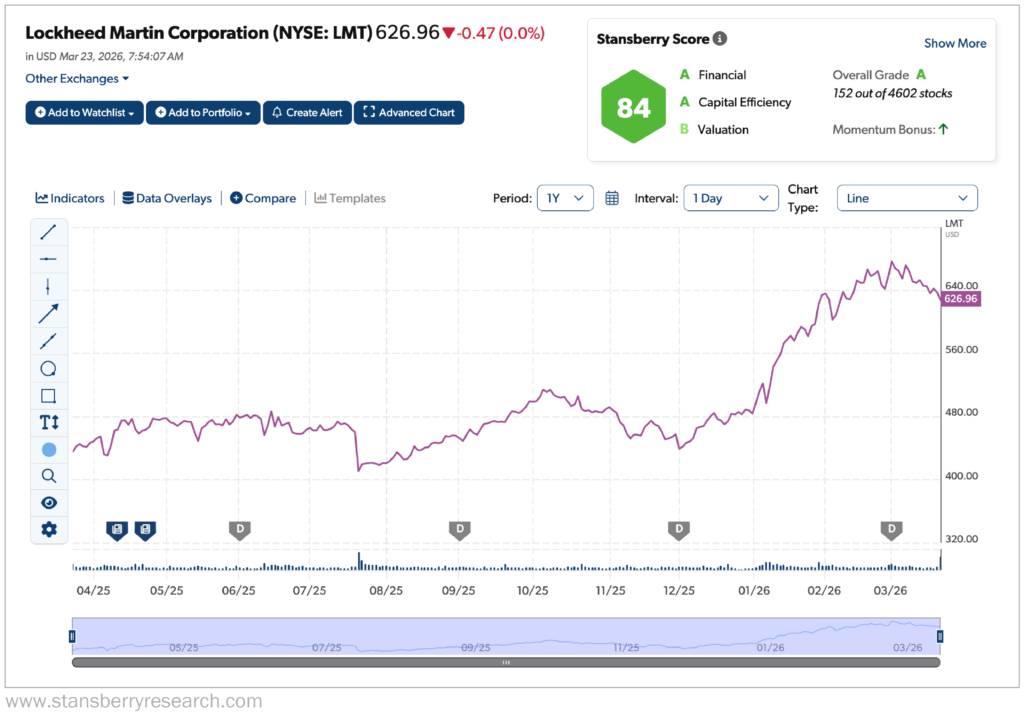
For investors, Lockheed Martin is probably as close to a sure thing in the defense sector. But even a stock as strong as LMT is not immune to volatility, especially during times of war.
General Dynamics (GD)
General Dynamics is a company with a long history. It has been a continuous contractor with the American government and/or military for 125 years.
General Dynamics designs and builds nuclear-powered submarines, surface combatants, and auxiliary ships for the U.S. Navy. It also manufactures land combat vehicles, weapons systems, munitions, tactical vehicles, battle tanks, and armored vehicles for the military.
Along with warfighting equipment, General Dynamics also provides technology and mission support services, including intelligence, surveillance, and reconnaissance (“ISR”) solutions to intelligence agencies and the military.
As of 2024, 69% of the company’s revenue came from the U.S. government, a number that rivals Lockheed Martin.
Bolstered by its government contracts, General Dynamics posted strong financials in 2025:
- Full-year net earnings of $4.2 billion on $52.6 billion in revenue
- A record $118 billion backlog
- Diluted EPS of $15.45
- $5.1 billion cash from operating activities, up $1 billion from 2024
General Dynamics earns an overall “B” Stansberry Score. Its Capital Efficiency and Valuation both get solid “B” grades. But its Financials, as noted above, are outstanding. Not only does General Dynamics get an “A”, but it ranks well within the top 200 tracked stocks in that category.
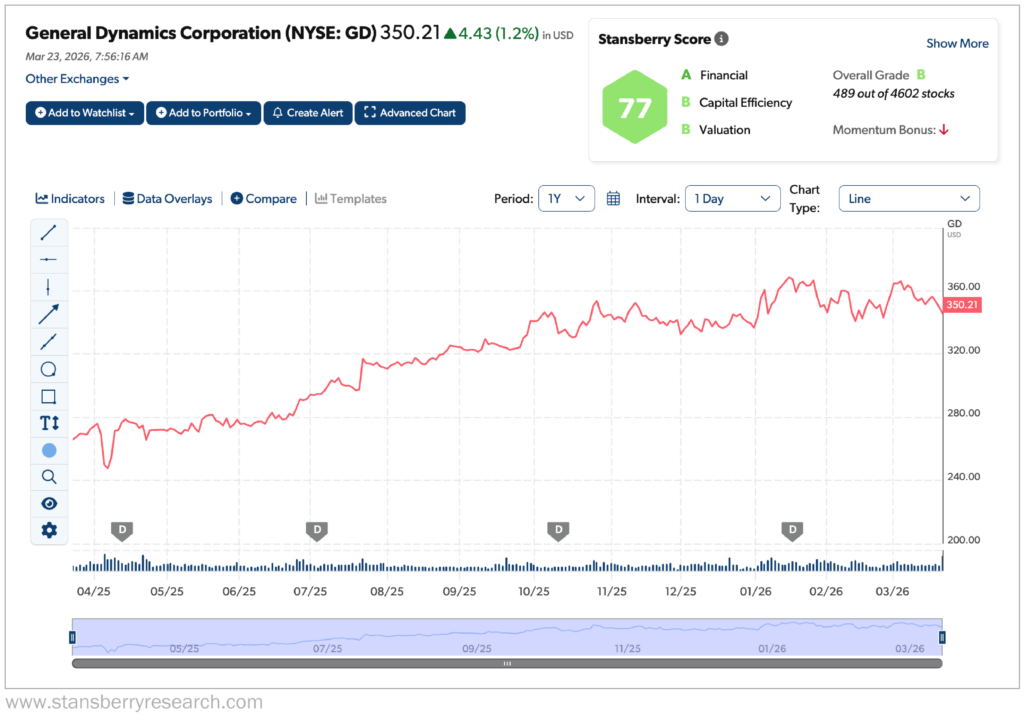
And, as Operation Epic Fury continues in the Middle East, General Dynamics’ weapons and military equipment remain critical to American efforts.
Northrop Grumman (NOC)
Northrop Grumman is probably best known for its advanced aircraft… particularly the B-2 Spirit stealth bomber, the E-2 Hawkeye, and the F-14 Tomcat.
But Northrop Grumman also produces defense electronics, such as missile defense, which is in high demand given the war in Iran.
In fact, the company’s international sales increased by 20% thanks to 20 countries requesting Northrop’s Integrated Battle Command Systems (“IBCS”). IBCS is the network-centric command-and-control system used by the U.S. Army, designed to unify air and missile defense sensors and weapon systems across all military domains (land, sea, air, space, and cyber).
While not quite as strong overall as Lockheed or General Dynamics, Northrop’s stock is a solid performer. As you can see from its Stansberry Score, NOC earns an overall “B” grade.
Northrop’s Financials earn a strong “B” grade “A” grade. In 2025, the company increased year-over-year total sales by 2% to $42 billion. It also earned $4.2 billion in net revenue, with a diluted EPS of $29.08.
Northrop also finished the year with a record $95.7 billion backlog.
NOC’s Valuation grades out as middle of the pack with a “C”. But its Capital Efficiency scores a solid “B,” thanks largely to an impressive uptick in free cash flow (“FCF”). Its 2025 FCF jumped to $3.3 billion, up 26% from 2024.
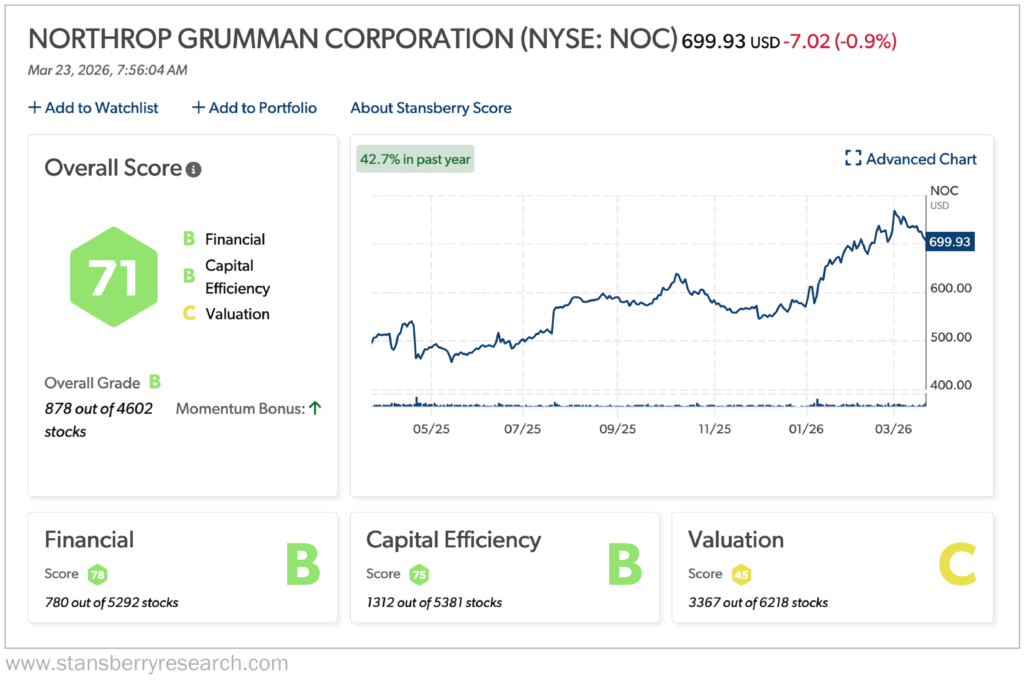
But it takes more than steady free cash flow to be a capital-efficient company.
Northrop checks plenty of boxes by focusing its strategy on high-margin defense and aerospace programs. And it takes care of its shareholders through share buybacks, helping elevate its EPS while delivering value to its investors.
How Modern Warfare Is Impacting Operation Epic Fury
The U.S. is still employing plenty of traditional methods of warfare in Iran. Stealth and precision bombers are wreaking havoc on Iran’s nuclear facilities and other targets by air.
Cruisers and destroyers are actively targeting Iranian naval ships in the Persian Gulf with the aim of reopening the Strait of Hormuz.
And both precision long-range and Hellfire missiles are being launched at land and sea targets.
But the war in Iran has also seen a shift toward more modern warfare.
For example, the U.S. is now using:
- LUCAS (Low-cost Uncrewed Combat Attack System) one-way kamikaze drones, developed in 2025 and used in combat for the first time in Iran
- ODIN (Optical Dazzling Interdictor, Navy) lasers to destroy drones from U.S. Navy warships
- Merops anti-drone systems to counter Iranian low-tech drones
- Various types of AI, including Anthropic’s Claude, to analyze intelligence, improve surveillance, accelerate the “kill chain” by identifying potential targets, and support operations planning
It’s a new era of war, one driven by AI and emerging defense technology. And while the tried-and-true warfare methods have stood the test of time, and will likely continue to do so, there’s now plenty of room at the table for modern approaches to war.
Companies like Lockheed, Northrop, and General Dynamics will always thrive during times of war. But the businesses delivering modern technology – like Palantir (PLTR), Nvidia (NVDA), Anthropic, Ondas (ONDS), and CrowdStrike – also stand to benefit as they become major players in military operations.
The Benefits and Risks of Buying Defense Stocks
As with any kind of investing, buying defense stocks has both benefits and potential drawbacks. Let’s look at some…
Benefits
- Predictable revenue: Most defense companies, especially the ones we examined today, enjoy long-term government contracts that deliver predictable revenue for several years.
- Long-term reliability: Because of those contracts and steady revenue, defense stocks can often withstand volatile markets.
- Geopolitical climate: Defense stocks reliably benefit from tension across the globe. As countries increase their defense spending, these companies’ revenues increase.
- Limited competition: Due to the highly specialized and regulated nature of defense products and technologies, it can be challenging for new businesses to break into the industry. This limits the competition to a handful of established companies.
- Innovation: Defense companies employ brilliant minds who are consistently on the cutting edge. This often results in new products and technologies that appeal to their customers.
Risks
- Over-reliance on contracts: Defense companies benefit from long-term contracts. But what happens if a contract is canceled… or the government slashes the defense budget? Those overwhelming sources of revenue can take a major hit if something goes wrong.
- Government involvement: The government is unpredictable. And any announcements can immediately impact defense-stock prices. President Trump’s social media tirades are prime examples.
- Overvaluation potential: Defense-stock prices spiked when news of the Venezuela operation surfaced. It happened again when U.S. forces attacked Iran. Those types of events often artificially inflate share prices. And when geopolitical sentiment inevitably shifts again, defense stocks tend to fall sharply.
While defense stocks are in good position today, it only takes one social media post, an act of hostility, or a peace accord to dramatically alter the landscape. This is something to keep in mind when investing.
Defense Stocks Often Shine During Global Uncertainty
Back in 2023, at the start of the Israel-Hamas war, Brett Eversole – editor and lead analyst of our True Wealth, True Wealth Systems, and DailyWealth newsletters – captured the complicated dynamic of war and the market…
War is always tragic. That’s by far the most important concern. It affects all of us as human beings. But from an investment standpoint, war also raises other fears and doubts.
What will be the downstream effects? Will this war spiral into a larger global conflict? Will the geopolitical world – and, thus, the economic world – change as a result?
We can’t know the answers for certain. But you should know one thing as an investor… The market doesn’t always work the way we expect. And that matters when it comes to these financial worries.
As Brett went on to explain, wars usually don’t lead to a market crash. History shows that stocks have rallied even in geopolitical crises.
With the U.S. takeover of Venezuela and the ongoing war in Iran, the world is in a state of uncertainty today. Markets have been volatile and supply chains – especially natural gas and oil – have been choked.
But that doesn’t mean investors should run for the exits. The overall market will likely weather the storm just fine.
Plus, the defense sector is set up for success as governments invest in the military. The U.S. government is certainly doing so… to the tune of over $1 billion per day for Operation Epic Fury.
And the government just requested another $200 billion. If that passes before September 30, the federal government will have spent $1.2 trillion on defense during fiscal year 2026.
Like it or not, defense contractor stocks feed off not just war itself, but also the potential for war. And there’s always potential for war.
Does that guarantee all defense stocks will make money for investors? Of course not.
It simply means that careful analysis and selectivity are important when deciding how to invest in the defense industry.
U.S. defense stocks are typically reliable and resilient. There are just more options to consider today, as modern warfare technology and companies join forces with the “old guard” for Operation Epic Fury and any potential future conflicts.
Regards,
David Engle
Editor’s Note: Forbes calls $1 billion fund manager Louis Navellier “the king of quants.” Today, he’s stepping forward to reveal why he’s investing $358 million of his own firm’s money in the next stage of Artificial Intelligence… a technological sea-change that could erase millions of jobs, solve humanity’s biggest mysteries, and spark a wave of moneymaking opportunities — both in and outside the stock market. Click here for the details…