Elon Musk is designing a chip factory unlike anything on Earth – one he says is a prerequisite for building a “galactic civilization.”
In front of a crowd at the Seaholm Power Plant in Austin, Texas last Saturday, Musk announced a new $20 billion to $25 billion compound dedicated to building semiconductors.
The plant, called “Terafab,” would bring the fragmented semiconductor supply chain together under one roof… from design all the way to fabrication.
By Musk’s projections, Terafab will be the largest chip-building facility on the planet. But what’s even more ambitious is his plan for the computing power Terafab will generate…
As Musk told investors during Saturday’s Terafab announcement:
We want to be a civilization that expands to the galaxy with spaceships that anyone can go anywhere they want at any time. That would be epic. And have a city on the moon, cities on Mars, populate the solar system, and send spaceships to other star systems… So to do that, we need to harness the power of the sun.
This sounds like the stuff of science fiction. But as we’ve discussed before, Musk is putting his money where his mouth is. His space-exploration company, SpaceX, is slated for one of the largest initial public offerings (“IPOs”) in history later this year.
That said, in order for Musk to realize his vision, he will need computing power – enough to dwarf the current global supply by orders of magnitude.
As Musk put it to investors…
We’re very grateful to our existing supply chain – to Samsung, [Taiwan Semiconductor Manufacturing Company (“TSMC”)], Micron, and others. And we would like them to expand as quickly as they can. And we will buy all of their chips. I have said these exact words to them.
But there’s a maximum rate at which they’re comfortable expanding. But that rate is much less than we would like.
With Terafab, Musk will attack the AI-induced semiconductor shortage while playing to his strengths: owning the entire supply chain.
As I’ll explain, his past approach to electric-vehicle manufacturing shows just how his strategy might come to fruition.
With Tesla (TSLA), SpaceX, and his AI company, xAI, Musk is taking the first steps in his grand plan to expand civilization into space. It’s an inflection point for Musk’s businesses – and maybe even our place in the solar system.
Let’s dive into what investors need to know…
Terafab Is Do-or-Die for SpaceX and Tesla
Today, the semiconductor industry is highly fragmented.
Different parts of the globe have specialized in different parts of chipmaking.
For example, Dutch company ASML (ASML) builds the lithography machines that make chip design possible. But TSMC runs the foundries that actually produce most chips. Unless we’re talking about memory chips… Those are mostly made in South Korea.
In short, the semiconductor supply chain is far-flung and full of chokepoints. It could easily be knocked out in the chess game of geopolitics. And that’s a problem, especially for Musk.
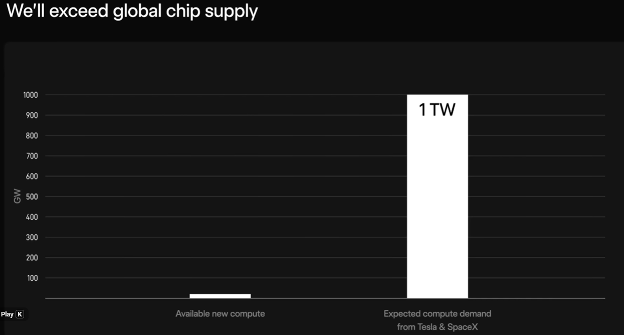
During the Terafab announcement, Musk showed the total annual production of computing power next to the projected demand from just Tesla and SpaceX…
Source: Musk’s Terafab Presentation at Seaholm Power Plant in Texas
Musk estimates that the world produces about 20 gigawatts (“GW”) of AI computing power a year. But Tesla and SpaceX’s projected annual demand is 1 terawatt (“TW”) – 50 times as much as the current global supply.
Musk’s companies alone stand to swamp the world’s current chipmaking capacity. So the CEO says he has little choice but to build Terafab.
As Musk put it during Saturday’s announcement, “We either build the Terafab, or we don’t have the chips. And we need the chips. So we’re going to build the Terafab.”
Musk’s giant chip factory aims to bring the semiconductor supply chain to a single location in Texas. This will massively enhance efficiency in the semiconductor supply chain. And it will domesticate America’s semiconductor supply, removing it from the geopolitical chess game entirely.
Yes, Terafab is a massive undertaking. But Musk has already secured the full backing of the state of Texas, with Governor Greg Abbott among the attendees cheering it along.
Musk’s Galactic Vision
Terafab would be a monumental leap in global computing. But it’s just the first step in Musk’s blueprint for a galactic civilization…
The next step is iteration. Once semiconductor logistics are under a single roof, it will become much easier for the technology to evolve. Musk describes a “recursive loop” of chip improvement where design and execution tweaks can be made very rapidly – much faster than the current industry status quo.
The factory will produce chips of two different varieties…
First are edge-inference chips. These chips run AI models directly on personal devices. They will power Tesla’s Optimus humanoid robots and self-driving cars. Musk projects up to 17% of Terafab’s eventual production will be edge-inference chips.
The factory will also make nonterrestrial chips.These high-power chips will be designed for the hostile environment of space. These chips will likely make up the remaining 83% of Terafab’s output.
Again, this is just an early step in Musk’s intergalactic blueprint. The most audacious part of his plan might be what follows…
Once Musk has the computing power he needs, he plans to synthesize SpaceX’s AI and rocket programs to launch orbital AI data centers. It’s a wildly sci-fi answer to Earth’s data-center needs. But there are compelling engineering reasons behind this pitch…
To start, space has no day, night, or seasons. And there are no greenhouse gases to block the sun’s rays.
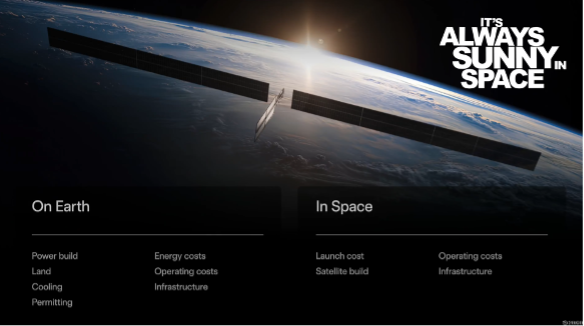
That means in contrast to Earth, solar energy in space is constant. This provides five times the energy of solar panels on Earth.
Musk plans to capture this energy with massive solar panels on satellites. Take a look…
Source: Musk’s Terafab Presentation at Seaholm Power Plant in Texas
Again, the plan sounds mind-boggling. But Musk points out that it’s significantly cheaper to build solar panels for space. The absence of weather means there’s no need for expensive protective components.
Overall, there’s a real set of incentives to deploy AI data centers in space. As Musk put it…
As soon as the cost to orbit drops to a low number, it immediately makes extremely compelling sense to put AI in space. It becomes a no-brainer basically.
Why Musk’s Hyper-Vertical Strategy Might Just Work
Musk’s plan is equal parts ambitious and implausible. But his career history shows how he could pull it off…
Musk is known to employ aggressive vertical integration – a supply-chain approach that dates to Henry Ford.
Vertical integration is all about controlling the entire supply chain. In Ford’s day, that looked like factories where coal and iron ore rolled in one door… and completed cars rolled out the other.
Musk has become the modern champion of Ford’s approach. In 2014, the CEO announced what would later become the Tesla Gigafactory in Sparks, Nevada. Here’s what he wrote at the time…
Processed ore from mines will enter by railcar on one side and finished battery packs will exit on the other.
According to the Las Vegas Review-Journal, Musk only completed about 14% of the proposed square footage for the Gigafactory. But this was enough for him to achieve his desired result. Today, Gigafactory Nevada makes enough battery cells to power more than half a million vehicles a year.
This shows the power of Musk’s vertical integration. He goes to extreme lengths to bring every aspect of the supply chain under a single roof – until the unit economics start to make sense.
His portfolio includes not just cars and batteries… but also AI, social media, space exploration, Internet networking, robotics, and much more. Each of these ventures feeds the others. And each new one builds on infrastructure the last one paid for.
We saw this strategy pay off in 2021. A chip shortage choked traditional automakers. But Tesla had the infrastructure to continue churning out its own critical components.
By the end of the year, the electric-vehicle maker reported record sales as competitors closed factories due to supply destruction.
In 2026, Musk has taken vertical integration to its logical extreme with Terafab.
This effort will unite the supply chain across all three of Musk’s companies – Tesla, xAI, and SpaceX. And even if the project doesn’t reach the scale Musk pitched last Saturday, the CEO will likely pursue it aggressively until orbital data centers make economic sense.
There are stiff logistical barriers to getting the Terafab going. But its feasibility may be beside the point. The underlying message of Musk’s announcement was this…
Musk is about to attack the semiconductor cost curve however he can. Even if he realizes a fraction of what he teased last Saturday, he’ll take a huge lead in the race to colonize space.
How to Get Exposure to SpaceX Before Musk’s IPO
The SpaceX IPO will be one of the biggest financial stories of our lifetimes.
However, you don’t have to wait for shares to hit the public market if you want SpaceX exposure today…
My colleague Jeff Brown at Brownstone Research has outlined a few companies that already own a slice of the SpaceX pie.
One example is EchoStar (SATS), which traded wireless-spectrum licenses to SpaceX in exchange for stock. Jeff broke the deal down as follows…
SpaceX will “pay”:
- $8.5 billion in cash
- Agree to pay $2 billion in cash towards interest payments on EchoStar debt through November 2027
- Up to $8.5 billion in SpaceX stock
EchoStar holds pre-IPO shares of SpaceX today. Buying this company is a great way to get ahead of the curve.
Jeff also suggests investors look into Google parent Alphabet (GOOGL). The search giant bought equity in SpaceX in as early as 2015 and reportedly holds 7.5% of the company.
Another vehicle for investing in SpaceX pre-IPO is the KraneShares Artificial Intelligence and Technology Fund (AGIX).
Following the merger of SpaceX and xAI in February, about 4% of this fund’s portfolio was converted from xAI into SpaceX shares. This fund has broad exposure to other private AI opportunities as well as SpaceX.
Finally, you could simply buy Tesla. Analyst Daniel Ives of Wedbush Securities said that the Terafab announcement signals the start of path toward a Tesla-SpaceX merger… and that the merger could come as soon as 2027. As Ives told investors…
While the timeline for this project is uncertain, this will accelerate the company’s ambitious AI path which we believe will set the foundation for TSLA to become an AI powerhouse.
This is less certain than investing in EchoStar, Alphabet, and AGIX. But Musk’s history of vertical integration makes it easy to see how the two organizations will be brought together under one roof.
His plan to colonize space may sound outlandish. But it only has one practical barrier – the semiconductor supply chain.
The chips were the last piece of the puzzle… and now Musk is building those, too.
Good investing,
Sean Michael Cummings
Editor’s Note: What should you invest in right now?
A renowned former hedge fund founder and his research team have found what they believe is the next big tech trend that could make investors rich.
It’s a breakthrough they’re calling “Helios” – and if you haven’t yet heard of it, you soon will.
Over the next few years, it could impact the food you eat… the water you drink… the places you live and work… and even the prices you pay for airfare, gas, electricity, and household goods.
“Helios” is going to cause a lot of people to lose money, too. Dozens of well-known businesses could go bankrupt.
But if you own a stake in this new tech, the positive effects will far outweigh the negatives. Get the facts for yourself. Make sure you’re not on the wrong side of this trend. Click here to see this new analysis…
Frequently Asked Questions
What is Terafab?
Terafab is a planned multibillion-dollar semiconductor fabrication facility announced by Elon Musk on March 21, 2026. It is a joint venture between Tesla, SpaceX, and xAI designed to consolidate the entire chip supply chain – from design to fabrication – under one roof in Austin, Texas.
Who is building Terafab?
Terafab is being built by Tesla, SpaceX, and xAI, all companies led by Elon Musk. The project has the backing of Texas Governor Greg Abbott and is planned for the North Campus of Tesla’s Giga Texas outside of Austin.
How much will Terafab cost?
Musk has estimated Terafab will cost between $20 billion and $25 billion to complete.
When will Terafab be built?
Musk has not provided a specific completion timeline. However, production for Tesla’s AI5 inference chip – which will take place at Terafab – is planned for 2027.
What chips will Terafab produce?
Terafab will produce two types of chips: edge-inference chips for Tesla vehicles and Optimus humanoid robots, and nonterrestrial chips designed for SpaceX’s orbital expansion.
Is SpaceX going public?
SpaceX is preparing for an initial public offering (“IPO”) expected later in 2026. Analysts project it could be one of the largest IPOs in history.
How can I invest in SpaceX before its IPO?
Several investment vehicles offer pre-IPO SpaceX exposure today. That includes EchoStar (SATS), which holds SpaceX stock received as part of a spectrum deal, Alphabet (GOOGL), which has held a SpaceX equity stake since 2015, and the KraneShares Artificial Intelligence and Technology Fund (AGIX), which converted an xAI position into SpaceX shares following the merger of both companies in February 2026.
What is the Tesla-SpaceX merger?
Wedbush Securities analyst Daniel Ives has suggested that Musk’s Terafab announcement signals the beginnings of a formal Tesla-SpaceX merger. He believes this could occur as early as 2027.
Why does Musk need his own chip factory?
Musk argues that current global chip production – approximately 20 gigawatts of computing power annually – represents only about 2% of what Tesla and SpaceX will eventually require. He has said publicly: “We either build the Terafab, or we don’t have the chips.”
Glossary
Terafab – Elon Musk’s planned semiconductor fabrication facility in Austin, Texas, targeting 1 terawatt of AI computing output annually.
Terawatt (“TW”) – 1 trillion watts of computing power, and Terafab’s stated production target (equivalent to roughly 50 times current global chip output).
Edge-Inference Chip – A semiconductor chip that runs AI models directly on a personal device rather than in the cloud. This is Terafab’s terrestrial chip, designed for Tesla vehicles and Optimus robots.
Nonterrestrial Chip – A semiconductor chip designed to operate in the hostile environment of space. It’s intended for SpaceX’s orbital AI satellites.
Vertical Integration – A manufacturing strategy in which a single company controls multiple stages of its own supply chain, reducing dependence on outside suppliers.
Gigafactory – Tesla’s name for its large-scale battery and component manufacturing facilities. Gigafactory Nevada, announced in 2014, is the direct predecessor to the Terafab concept.
Orbital Data Center – SpaceX’s proposed network of AI satellites in low Earth orbit, powered by space-based solar panels and designed to deliver cheap computing capacity from space.
Recursive Loop – Musk’s term for Terafab’s iterative chip design process, in which design, fabrication, testing, and redesign all occur under one roof, making for speedy development cycles.
AGIX – The KraneShares Artificial Intelligence and Technology Fund, a publicly traded vehicle with exposure to private AI companies including SpaceX.
ASML – Dutch company and sole producer of the lithography “etching” machines required to manufacture advanced semiconductors.
TSMC – Taiwan Semiconductor Manufacturing Company, the world’s dominant chip foundry and current primary supplier to Tesla and SpaceX.