
SolarEdge Technologies (SEDG), a global leader in smart energy technology, hit a 52-week intraday high of $53.28 on Friday, March 20, before closing at $51.73. The party was short-lived, though. By noon on Monday, March 23, share prices had already dipped to $46.16.
Welcome to the volatile world of renewable energy stocks.
In this analysis, we’ll explain why renewable energy stocks are historically volatile, how AI is fueling demand for more clean and renewable energy, and how SolarEdge’s recent performance encapsulates the entire renewable energy sector.
Why Renewable Energy Stocks Can Be So Volatile
Renewable energy stocks don’t typically fluctuate quite as much day-to-day as SolarEdge recently did. But they are historically prone to significant boom-and-bust cycles.
Maybe not to the degree of the oil industry, but there’s plenty of evidence that renewable energy stocks experience their shares of peaks and valleys.
Look at the Invesco WilderHill Clean Energy Fund (PBW) for example. This exchange-traded fund (“ETF”), according to Invesco, is composed of publicly traded companies that “are engaged in the business of advancement of cleaner energy and conservation.”
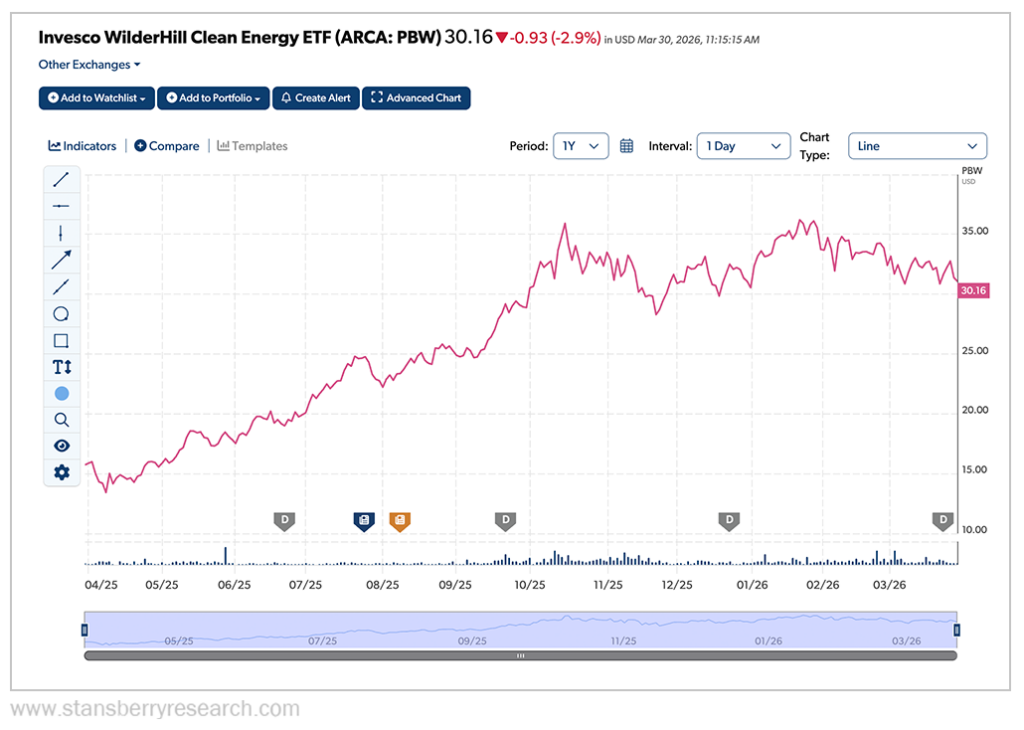
The fund saw major peaks from 2005 through 2007 before plummeting throughout 2008 and into 2009. Then came an uptick that lasted from mid-2009 until the spring of 2011. Following that, it experienced a steep drop that more or less lingered for around nine years.
Then, the clean and renewable energy markets exploded in the spring of 2020, partially driven by increases in wind and solar prices during the COVID-19 pandemic. Between March 2, 2020 and January 4, 2021, PBW shares skyrocketed by roughly 346%.
Just a year later, it saw a sharp decline of roughly 30%. And between January 3, 2022 and April 1, 2025, the ETF’s share price dropped another 78%.
Since that time, however, PBW shares have nearly doubled to around $32, where they sit today.
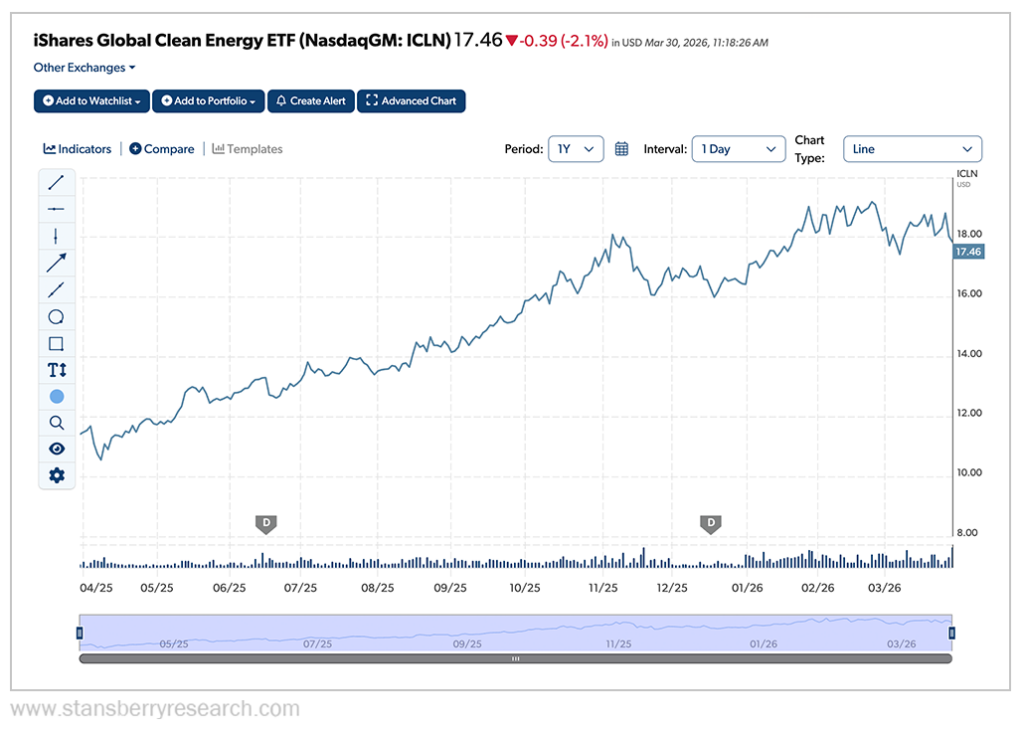
And it’s not just PBW. Another clean energy ETF, iShares Global Clean Energy Fund (ICLN), has followed a similar (although not as drastic) pattern.
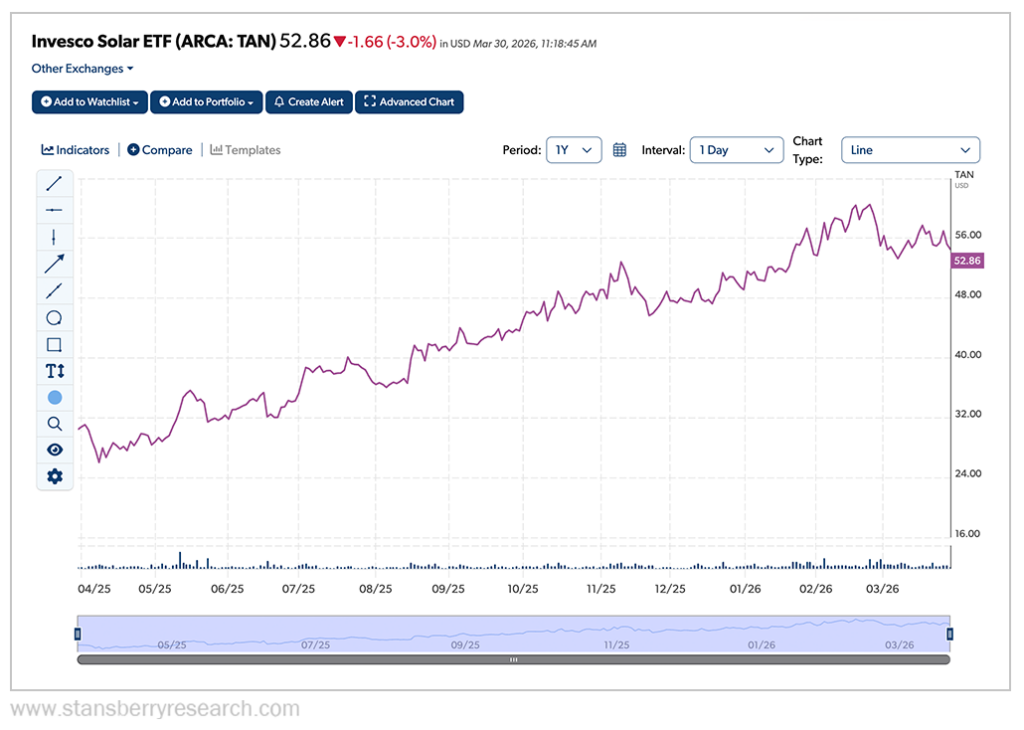
Same thing for the Invesco Solar Fund (TAN).
Why such volatility for this sector? There are a few reasons.
- Sensitivity to government policy: Government regulations, subsidies, and tax credits hold huge sway over clean and renewable energy companies. So, whenever there are major shifts or uncertainty related to policy, the renewable energy industry reacts accordingly. Look no further than the transition from President Joe Biden to President Donald Trump. Their environmental philosophies couldn’t be further apart, and we’re now watching as Trump undoes much of Biden’s clean energy progress.
- Rising inflation: As post-COVID-19 inflation spiked in 2022 and 2023, the renewables industry felt some pain. Solar and wind costs soared as prices for the materials used for renewable projects (like steel and aluminum) increased.
- Interest rate sensitivity: While good for the environment, renewable energy initiatives can be costly. That usually makes them vulnerable to high interest rates, which further increase their costs. That’s exactly what happened a few years ago as building and material costs rose with inflation. Higher interest rates made things even worse.
- Grid and supply-chain bottlenecks: Between reliance on raw minerals that are in short supply, lengthy manufacturing processes, and even geopolitical tensions, the renewable energy industry often runs into supply-chain issues that can stifle profitability. That – combined with notoriously slow permitting as well as insufficient grid capacity and infrastructure – results in significant momentum swings for renewable and clean energy companies.
These hurdles are enough to send the renewable energy sector into an occasional tailspin. But the industry may now be facing its most significant obstacle yet.
President Trump’s War on Clean and Renewable Energy
When President Donald Trump began his second term in 2025 after a four-year hiatus, the entire clean and renewable energy industry felt a chill up and down its collective spine.
Renewable energy was squarely in the Trump administration’s sights.
In the span of roughly 14 months since his inauguration, Trump and the federal government have:
- Pledged to oppose all new wind energy production
- Revoked more than 3.5 million acres of federal waters designated for offshore wind development
- Stopped $7 billion in grants for “Solar for All,” a program that delivers clean energy and lower prices to low-income communities
- Imposed tariffs on key trade partners, impacting supply chains for wind turbines, solar panels, and electric vehicles (“EVs”)
- Restricted the eligibility of wind and solar projects to qualify for tax credits
- Issued a new policy requiring wind and solar energy projects on federal land to match the per-acre energy output of fossil fuels
- Paused offshore wind projects under construction
Not surprisingly, the International Energy Agency projected the U.S. to add far less power from clean and renewable energy in the coming years than previously anticipated.
In its 2025 Renewables report, the agency stated that:
“The renewable energy growth forecast… for the United States is revised down by almost 50%. This reflects several policy changes, including the earlier phase out of federal tax credits, new import restrictions, the suspension of new offshore wind leasing and restricting the permitting of onshore wind and solar PV projects on federal land.”
The Trump administration’s policy shifts also have Deloitte predicting that annual solar, wind, and storage additions between 2026 and 2030 could fall to a range of 30 gigawatts (“GW”) to 66 GW. That’s down significantly from the projection of 54 GW to 85 GW prior to the signing of the One Big Beautiful Bill Act (“OBBBA”).
These are drastic downgrades. Despite the federal government’s recent push for fossil fuels over renewable energy, however, the industry has been thriving of late. The main reason isn’t surprising.
Artificial Intelligence’s (“AI”) Massive Power Demands Lead to Renewable Energy Resurgence
As we’ve covered here before, AI and its massive data centers require tons of power to operate.
Consider:
- Global data center power usage was 55 GW in 2025, with AI systems responsible for 14% of that usage.
- That figure is projected to reach 84 GW by 2027, with AI expected to be responsible for 27% of that power usage. (For perspective, 84 GW could power a city the size of San Francisco for nearly three months.)
- Data centers account for roughly 1% to 2% of global power demand. That could double to 4% by 2030.
Despite the Trump administration’s mandates to roll back clean and renewable energy initiatives, the need for power boils down to one question: What type of energy is ready to deploy right now to satisfy the unquenchable power needs of data centers?
The answer is clean, renewable energy. Why?
For one, it’s all around us. Because renewable energy, like solar and wind, relies on natural resources, there’s no need to spend on imported fuel and other energy sources. That creates energy independence.
Renewable energy technologies and systems are also generally faster to build than fossil fuel plants. That can expedite access to new energy sources.
Plus, renewable energy can often bypass the traditional electric grid, which is facing an astounding 2,600 GW interconnection backlog — mostly composed of solar, wind, and storage capacity projects.
Solutions include on-site or “behind-the-meter” approaches, where power generation happens at the point of consumption. Imagine a solar farm or wind power source on or next to the site of a data center or factory, using power sources that avoid the bottlenecked public grid.
Perhaps most importantly, renewable energy is cheaper. Solar and wind, for example, were roughly 41% and 53% less expensive, respectively, than fossil fuels in 2024.
As of 2025, renewable energy (primarily wind, solar photovoltaic, and hydro) comprised 27% of the electricity used by data centers. By 2030, however, renewable energy could reach a 50% share on the back of global solar and wind growth.
That said, Operation Epic Fury in Iran may complicate matters for the renewable energy industry.
Impacts from the Iran War on Renewable Energy
Typically, when war or trade tensions impact the oil and gas industry, alternative energy sources are the beneficiaries.
That may not be the case this time around as the war in Iran continues to rage.
Despite the closure of the Strait of Hormuz, which is choking off 20 million-plus barrels of oil and 290 million cubic meters of liquefied natural gas from passing through each day, renewable energy may not benefit from the fossil fuel supply disruption.
That’s because inflation concerns are rising as oil and gas prices have skyrocketed since the start of the war at the end of February.
And if higher inflation becomes reality, the cost of clean and renewable energy manufacturing will likely rise.
That’s what happened when Russia invaded Ukraine in 2022. The war drove prices for raw materials, labor, and logistics up, resulting in supply-chain issues for the industry. And that damaged the momentum renewable energy had built prior to the invasion.
The war in the Middle East has the potential to stagnate what has been a fast-growing industry. More investments in renewable energy helped clean power, such as wind, solar, and hydro, generate more electricity combined than coal in 2025.
And, surprising as this may be, clean energy stocks have recently outpaced AI stocks. In the past year, the ICLN fund rose roughly 55%. By comparison, Nvidia (NVDA) increased roughly 60%, while the Magnificent Seven tech stocks are projected to gain 26% in 2026.
In the first quarter of 2026, clean energy ETFs were still performing strongly, with positive year-to-date gains. This can be partially attributed to rate cuts by the Fed late last year, which lowered financing costs for renewable energy projects.
Despite some momentum in 2026, however, the renewable energy industry is still prone to volatility. SolarEdge is a perfect example.
How SolarEdge’s Volatility Mirrors That of the Entire Industry
Since the start of 2026, SolarEdge had been riding the wave of an impressive 65% rally that culminated in its 52-week high on March 20.
Then the trend reversed, and SolarEdge dropped nearly 10% on March 23.
Let’s examine why by using numbers from the company’s 2025 earnings call in February:
- Total revenues of $1.18 billion, up 31% from $901.5 million in 2024
- Generally accepted accounting principles (“GAAP”) gross margin of 16.6%, up from negative 97.3% year-over-year (“YOY”)
- GAAP operating expenses of $498 million, down from $831.1 million in 2024
- GAAP operating loss of $301.7 million, compared with $1.71 billion in 2024
- GAAP net loss of $405.4 million, compared with $1.81 billion in 2024
- GAAP loss per share of $6.88, compared with $31.64 in 2024
- Cash flow from operating activities of $104.3 million, compared with negative $313.3 million YOY
- Free cash flow of $76.9 million, compared with a free cash flow deficit of $421.5 million the prior year
Lots of positives for SolarEdge, especially compared with its performance in 2024. This has led some analysts to upgrade their ratings for SEDG, including Jefferies, Bank of America Securities, and BWG Global.
Looking at the bigger picture, however, there are concerns.
Yes, SEDG’s stock price has roughly tripled in the past year. But over the past five years, SEDG is down around 83%. And the company hasn’t been profitable for about three years. Its negative 34.23% net margin and forecasted negative 4.54 earnings per share for 2026 tell some of the story.
For the rest of the story, just reread the bullet points above to see how much the company lost.
After its roughly 13% spike on March 20, the stock appeared overvalued based on its March 20 closing price of $51.73 versus its fair value estimate of $33.80. The reality for SEDG is that the market still sees the company as turning a corner rather than fully profitable. The 10% plunge in stock price was simply the market correcting itself.
Despite those losses, SolarEdge’s 2025 financials – especially when compared with 2024 – and its early 2026 performance suggest a turnaround for the company.
The overall renewable energy industry may soon get a push as well.
Per OBBBA, all wind and solar projects must commence construction by July 4 of this year to qualify for tax credits. Any projects starting after July 4 are required to be placed in service by the end of 2027 to receive credits.
So, in a way, Trump’s push to abolish clean energy actually gave the industry a short-term jolt by pushing companies to expedite their projects.
That includes SolarEdge, which has big plans for 2026 as it transitions from the “inventory-clearing” phase of the past couple years to a growth plan, particularly in the residential market.
- It just launched the Nexis solar and storage platform, a high-capacity, modular inverter system that integrates inverters, batteries, and EV charging into one residential unit — and it takes just 30 minutes to install.
- SolarEdge’s facilities in Texas and Florida are also currently building inverters and exporting them to European markets.
- And the company is going after AI data center power growth in 2026 as it looks to replace traditional transformers with high-efficiency solid-state transformers.
Will these developments propel SolarEdge into profitability in 2026? And will it continue to mirror the rollercoaster the renewable energy sector continues to ride?
Time will tell.
Some macro-level concerns we covered (supply chain issues, rising interest rates, etc.) may inhibit renewable energy from achieving consistent growth. So, continued industry volatility wouldn’t come as a surprise.
However, if the renewable and clean energy industry can successfully adapt to the changing trade policies and supply chain disruptions, there’s plenty of promise.
If you’re looking to invest in renewable energy, SolarEdge remains an intriguing option based on its recent overall success. But this fact remains: Its shares are still extremely volatile, with 89 one-day moves greater than 5% over the past year.
A well-established clean energy ETF, on the other hand, offers more portfolio diversity and potentially more long-term growth. These ETFs may experience their share of volatility, but they’re typically a safer play.
Buckle up, investors. Renewable energy may take us all on a bumpy ride once again in 2026.
Regards,
David Engle
Editor’s note: It’s no secret that artificial intelligence is gobbling up energy at an unprecedented rate… straining America’s already vulnerable power grid.
All the big players are racing to find a new way to meet AI’s power-hungry daily demands, pouring in billions of dollars for alternative energy sources.
Regular folks can still get in on this tech, too – but time is running out.
Because Amazon (AMZN) may have cracked the code.
This breakthrough technology is being hailed as “the Holy Grail of Power,” and Amazon went all-in on it…
Get the details right here, including how to prepare and what to buy.