The White House recently announced that Americans’ average tax refunds could climb by $1,000 or more this year…
Already, early Internal Revenue Service (“IRS”) data shows refunds running nearly 11% higher so far this year… with an average check of $2,290 as of early February. That number should continue to climb as tax season goes on.
In fact, January data from the nonprofit think tank Tax Foundation shows average refunds could be as much as $3,800 this year.
The reason is straightforward… President Donald Trump’s “Big Beautiful Bill” added retroactive tax cuts for 2025 – including a bigger standard deduction, a higher child tax credit, new breaks for tip and overtime income, and a higher cap on state and local tax deductions. But the IRS never updated employer withholding tables. That’s what companies use to set aside money from workers’ paychecks.
Now, millions of Americans are getting that money back in one lump sum.
The question is: What do you do with it? (Find out immediately by clicking right here.)
A $1,000 Question Nobody’s Answering
Most financial planners will quickly rattle off the usual advice to “pay off high-interest debt first” or “build a three-month emergency fund.” That advice isn’t wrong. But it is incomplete.
Here’s what nobody tells you about a windfall like a tax refund…
It tends to vanish.
A 2025 survey from Talker Research, commissioned by TaxSlayer, found that most filers planned to use their refunds on essentials like rent, groceries, and paying down credit-card debt. There’s nothing wrong with that. But Piper Sandler’s analysis also noted that higher earners are more likely to save or invest the extra cash rather than spend it immediately.
In other words, the people who are already doing well financially tend to use windfalls to get further ahead. You should, too.
Because most people just watch that money disappear into the monthly budget within a few weeks. Research from JPMorgan Chase shows that while many families spend about a fifth of their tax return on paying down various bills, they also double their spending on durable goods – think new appliances, furniture, computers, and vehicles. And they more than double their cash withdrawals, pulling out about $200 more cash than usual.
There’s a better way to use your tax refund to grow your wealth…
And it starts with understanding a number that should terrify every investor who reads it.
The Underperformance Stat That Should Keep You Up at Night
Marc Chaikin, the 50-year Wall Street veteran who founded Chaikin Analytics, has been warning for months that 2026 could be a rough year for stocks. He even recently put the odds of a bear market at 65%.
But that’s not the worrying part. The real concern is that what happened in 2022 will likely happen again…
That year, the S&P 500 Index was down about 24% at its low point. But the average investor’s portfolio was down 44% during the scariest stretch of that same bear market.
This underperformance isn’t a fluke. It happens in bull markets, too… In 2023, the S&P 500 soared 26%. The average investor captured only 21%.
Year after year, regular investors trail the market. And the gap compounds over decades. (I explain why here.)
Marc believes that 2026 is shaping up to be the kind of year when the wrong stock pick could devastate an otherwise solid portfolio.
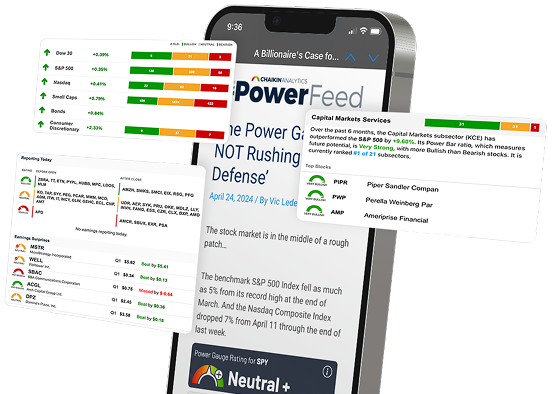
He’s spent the better part of his career trying to fix this problem. After watching his wife’s retirement account drop 50% in 2008 because of a money manager’s mistakes, he came out of retirement to build the Power Gauge, a 20-factor stock rating system designed to give regular investors the same kind of edge that hedge funds and banks have always enjoyed.
And right now is the perfect time for you to try out his tool to identify the highest-potential opportunities to grow your tax refund…
Why This Tax Refund Season Is Different for Investors
Today, millions of Americans are about to receive an unexpected windfall of $1,000 or more. At the same time, we’re staring down a stock market that’s been sending mixed signals for months.
Some of the biggest names in tech have been struggling, even as their businesses post record revenue. My colleague Ethan Goldman wrote about this pattern earlier this month. A few highlights…
- Earlier this month, Google parent company Alphabet (GOOGL) reported more than $400 billion in annual revenue for the first time ever. The stock has since fallen 10%.
- Data-analytics and AI firm Palantir Technologies (PLTR) posted 70% revenue growth… and its shares have dropped more than 20% over the past three months.
- And chipmaker Advanced Micro Devices (AMD) reported a 34% jump in revenue, and its stock lost 17% in a single day.
Something is off. A company’s earnings might look great on paper, especially if it’s one of the AI hyperscalers that my colleague James Royal wrote about late last week. But as he noted, the massive AI investments are cutting sharpy into their cash flow. And their stocks may be far more dangerous than they appear.
The Chaikin team has been tracking this disconnect closely. Joe Austin recently noted that the S&P North American Technology Software Index fell 15% in January alone, its worst monthly performance since 2008. AI-related stocks that seemed untouchable a year ago are now showing cracks.
This is the environment in which your extra $1,000 is about to land.
So, let me put the question to you directly: Are you going to let that money sit in a checking account earning almost nothing? Are you going to spend it on something you’ll forget about by April? Or are you going to try to make it work for you?
The Case for Investing Your Refund… Even in a Dangerous Market
I know what you’re thinking: If 2026 might be a bear market, why would I put money into stocks?
Fair question. And the answer has everything to do with how you invest, not just whether you invest.
Because here’s the thing that most people miss about bear markets, and it’s something Marc Chaikin has demonstrated over and over again: Even in the worst years for stocks, some corners of the market thrive. As he puts it, “right place, right time” stocks always exist.
In 2020, stay-at-home plays like Zoom Communications (ZM) and Peloton Interactive (PTON) soared while the rest of the market collapsed. In 2022, energy stocks climbed more than 50% while almost everything else sank. In 2023, the Magnificent Seven tech stocks powered ahead while the average investor missed the rally.
The money was there to be made each time. The problem was that most people didn’t know where to look.
Marc’s Power Gauge system rated every single Magnificent Seven stock as bullish early in 2023… before the run began. If you’d put $1,000 into any one of them at the time, you’d have made almost 50% in the worst case. In the best case, with Nvidia (NVDA), you’d have turned that $1,000 into $8,240.
And the system flagged winners in ugly years, too. Occidental Petroleum (OXY) earned a bullish rating on January 13, 2022. Months later, Warren Buffett started buying the stock for Berkshire Hathaway’s (BRK-B) portfolio. It more than doubled while the S&P 500 was in free fall.
What $1,000 Can Actually Do… as Long as You Don’t Make This Mistake
Let’s get specific about that extra potential $1,000 from your refund…
Put it into a high-yield savings account, and at today’s rates, you might earn $40 or $50 over the course of a year. That’s fine. That’s safe. And for some people, safe is exactly the right move.
But if you have your emergency fund covered and your high-interest debt handled, there’s an argument that $1,000 invested in the right stock could do far more for your financial future than $1,000 sitting in a savings account.
Because there’s a specific trap that many investors fall for, time and again. And I suspect that millions of Americans will do it again this tax season.
It’s the temptation to throw money at whatever stock is making headlines.
Right now, that means AI names. And while AI is a massive trend with incredible amounts of money behind it, the Chaikin Analytics team has been crystal clear that not all AI stocks are created equal. As Marc wrote last year, “blindly piling money into every AI-related stock could be a recipe for disaster.”
For example, the most prominent AI name in the market is probably high-performance chip designer Nvidia. I warned in November before Nvidia’s last earnings announcement that:
Good results and a bullish forecast could rescue the market from its worst November since 2008… But anything less than pure, unrestrained optimism and we may see the stock and market plunge far lower.
Nvidia is still down double digits from its highs last fall… and the market remains volatile. Nvidia’s fourth-quarter and full-year earnings results, which are expected to be announced next week, could certainly help the stock bounce back… but we don’t recommend blindly throwing your tax refund into it now.
You see, there are stocks in less flashy sectors that are quietly attracting institutional money. This is the pattern Marc has tracked across his entire career: The “smart money” on Wall Street starts buying shares of overlooked companies while retail investors chase the last cycle’s winners. You can follow where that money is going. Marc’s Chaikin Money Flow indicator, which is one of the 20 factors built into the Power Gauge, measures buying pressure versus selling pressure over time. When big institutions are quietly accumulating shares of a stock, it shows up in the data weeks or months before the price takes off. You can learn how it works right here.
What to Do With Your Extra $1,000 This Spring
If you end up with a higher-than-expected tax refund this season, treat yourself to something far more valuable than a new dishwasher or vacation.
- First, know that fear of investing is understandable… but it’s also one of the most expensive mistakes you’ll ever make. Every dollar you keep on the sidelines during a period when the right stocks are climbing is a dollar that’s slowly losing purchasing power to inflation.
- Second, please don’t invest blindly. Invest with a system. That can be a tool like the Power Gauge, which helps separate the stocks that are likely to outperform from the ones that could drag your portfolio down. Or you might have your own system. Just make sure that you check the data before you buy. And just as important, make sure you have a plan for when to sell.
- Finally, $1,000 invested well today will become something meaningful over time. It probably won’t come from one lucky pick, like Marc’s system spotting Nvidia long before most on Wall Street did. Instead, it should come from a lifetime of knowing the right stocks to buy at the right time. And if you continue putting “windfall money” like a tax refund to work, you’ll build a financial road map that can survive any bear market.
Tax refund season comes once a year. What you do with your refund today might help determine where you’ll be financially five or 10 years from now.
Don’t let that extra $1,000 just disappear.
To share more about his system and recommend exactly what stock you should feel confident putting $1,000 into today, Marc recently went on camera in a live interview. Click here to watch it for free.