The Walt Disney Company (DIS) has a new CEO… again. That’s because Bob Iger is retiring… again. And, unlike when he stepped away from the helm about six years ago, this time it’s official.
And that means all eyes are on Disney’s stock – which, given its recent performance, might not be a great thing for the entertainment giant.
But new leadership often gives shares a lift. And if that new leader – Disney Experiences Chairman Josh D’Amaro – brings fresh ideas and solutions to the table, Disney’s stock may just rebound again.
In the spirit of Disney, let’s take a roller-coaster ride to look at its revolving leadership, what has caused its stagnant stock performance, and what the company’s new CEO could mean for investors.
Disney’s CEO Carousel
Much like some of its theme park rides, Disney’s leadership carousel has been a bit dizzying throughout this decade. That turbulence followed 15 years of relative stability under Bob Iger during his first term as Disney’s CEO.
To say the company thrived under Iger is a major understatement. Driven by huge acquisitions of and investments in Marvel, Lucasfilm (Star Wars), Pixar, and Twenty-First Century Fox, Disney flourished. Consider these statistics from Iger’s initial run:
- Disney’s market cap soared from around $48 billion to more than $250 billion… an increase of more than 400%.
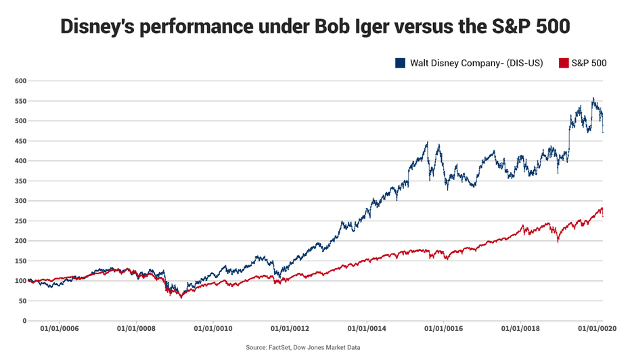
- Disney stock saw a 371% increase during Iger’s tenure as CEO from 2005 through 2020. That more than doubled the S&P 500’s 161% gain from the same period.
- Seven Disney movies grossed $1 billion or more in box office profits… in 2019 alone.
- Iger’s acquisitions have long since paid for themselves. Pixar, purchased in 2006 for $7.4 billion, brought Disney more than $40 billion in direct revenue by 2024. Marvel, acquired for $4 billion in 2009, made Disney $13 billion in revenue by 2024. And Lucasfilm, bought for $4 billion in 2012, reaped $12 billion in revenue for the company between its purchase date and 2024.

Source: Yale School of Management
Iger then announced his retirement in February 2020, taking investors by surprise.
That’s when Bob Chapek, the former chairman of Disney Parks, took over. And it cost Disney.
During Chapek’s time as CEO (from February 2020 to November 2022), Disney seemingly lost its way… and lost its shareholders a lot of money.
Disney shares plunged from about $200 to below $100 during Chapek’s time as CEO. Of course, the pandemic played a role, with the company’s theme parks and resorts shut down for months. (For context, in 2025 they accounted for around 46% of Disney’s total revenue and 68% of its total operating income).
Following a brief period of success in the first half of 2021, when the Disney+ streaming service hit 100 million subscribers and visitors began returning to the parks, Disney floundered under Chapek – especially in 2022.
Shortly after Disney’s 2022 Q4 earnings report was released, Chapek attempted to cut costs through layoffs and hiring freezes, undoubtedly driven by Disney being one of the year’s three worst performers in the Dow Jones Industrial Average.
Chapek didn’t help his cause (or Disney’s) by refusing to take a public stance regarding Florida Governor Ron DeSantis’ Parental Rights in Education Act. Even after releasing a statement and apologizing to employees, many Disney workers felt alienated by leadership.
At this point, Chapek had lost credibility among executives and board members. And some of his decisions weren’t popular among paying customers, either. Price increases at the parks angered guests, and Disney’s content releases were underwhelming.
Movies such as Strange World, Lightyear, Eternals, Black Widow, and Encanto were all box-office disappointments. And the films Turning Red, Soul, and Luca were released directly to Disney+ streaming, so they earned no box-office revenue at all.
In fact, not a single movie Disney made during Chapek’s tenure crossed the $1 billion threshold.
And Disney’s streaming division (Disney+, Hulu, and ESPN+), which was a significant focus during Chapek’s stint, absorbed more than $1 billion in operating losses each year between 2020 and 2022.
By the time Chapek was fired by the Disney board, shares had dropped around 19%. Meanwhile, the S&P 500 Index gained about 34% over that same period.

Who was chosen to clean up Chapek’s mess? None other than Bob Iger. But the damage was already done.
Disney Stock Continued to Struggle During Iger’s Second CEO Stint
Those expecting Bob Iger to be a miracle cure for Disney’s issues were likely disappointed. Upon the announcement of Iger’s November 20, 2022, return, Disney stock closed up 6.3%.
That may have been the high point. Since then, Disney stock stagnated between $80 and $125.
Investors lost patience. And they haven’t regained it.
The company continued to struggle throughout most of Iger’s second stint as CEO – especially at the box office. Flops like Ant-Man and the Wasp: Quantumania, The Little Mermaid, Elemental, Snow White, The Marvels, Haunted Mansion, and Wish left moviegoers unimpressed.
But there were some highlights.
Inside Out 2 became the highest-grossing animated film of all time, raking in more than $1.6 billion globally, until it was topped by Zootopia 2, which has grossed more than $1.7 billion. Oh, and Avatar: Fire and Ash brought in more than $1.4 billion worldwide.
Plus, Disney’s theme parks are thriving again. And Disney+ is finally turning a profit. So, there is hope…
Which is what made Disney’s fiscal year (“FY”) 2026 Q1 earnings call, and the reaction to it, so interesting.
Disney’s Surprising Q1 2026 Earnings Call… and the Equally Surprising Reaction
On February 2, Disney released its first quarterly earnings report of FY 2026. The results appeared promising.
Among the highlights:
- Revenue increased 5% year over year to $26 billion.
- Entertainment segment revenue grew 7% year over year.
- Disney experiences, which includes theme parks, saw a 6% year-over-year sales jump to $10 billion… and its operating income also popped 6% to $3.3 billion.
- Streaming revenue rose 11%, with margins reaching 8.4%.
But the market’s reaction was somewhat surprising. Despite what Disney executives labeled “record quarterly revenue and operating income in Q1,” shares plunged by around 7% the day of the earnings call.
Why the sudden drop? For one, Disney investors have high expectations. The highlights above would be seemingly positive news for most companies. But investors hold Disney to higher standards because it has been such a consistently dominant brand for such a long time. What might be small wins for other companies are considered disappointments for Disney.
Not to mention, Disney’s earnings call wasn’t all Mickey Mouse-shaped lollipops…
The sports segment’s operating income fell 23% from Q1 2025. The entertainment division’s operating income plunged 35%, driven by more customers cutting the proverbial “cord.” And Disney’s overall operating income dropped 9% to $4.6 billion.
It’s also likely that investors weren’t thrilled with Disney’s decision to stop reporting subscriber numbers for all of its streaming services.
Investors also have some concerns about the company’s future growth, as well as climbing operational costs in 2026.
So, despite some promising revenue numbers and an improving box office (with some exciting releases planned for 2026, like Toy Story 5, The Mandalorian and Grogu, Avengers: Doomsday, a live-action Moana film, and the new Pixar movie Hoppers), Disney’s stock hasn’t gained much momentum.
Will a new CEO change the tide?
Who Is Disney’s Next CEO? And Will He Turn the Stock Around?
On February 3, Disney’s Experiences chairman, Josh D’Amaro, was named the next CEO of The Walt Disney Company. He will officially succeed Bob Iger on March 18.
Will a new leader positively impact Disney’s stock?
History tells us yes, at least in the short term. It should be noted, however… an hour after Disney’s official announcement, shares had actually dropped about 1.5%.
For Disney, however, a positive impact could linger longer than usual.
Since Iger initially resigned in February 2020, Disney has struggled to find – or regain – its identity. Constant leadership changes, internal friction, and underwhelming output have left the entertainment giant in a state of limbo for nearly six years.
Assuming Disney gets it right with D’Amaro, the company can move forward under one voice and a unified vision for years to come. That goes a long way toward rebuilding investor confidence.
While we don’t know specifically what D’Amaro’s vision entails, the company and its investors can take comfort in the fact that its new CEO was quite good at his previous job.
Since he took over the Disney experiences segment, D’Amaro led a 10-year, $60 billion investment strategy pushing expansion and new attractions. Under his watch, Disney theme parks added the World of Frozen and announced the expansion of the Avengers Campus. He was also a key figure in opening the Star Wars Galaxy’s Edge lands in Disneyland and Walt Disney World.
And that expansion continues with a slew of upcoming additions, including a Monsters, Inc. land, a land built around Disney villains, and new Avatar attractions. When you factor in new, innovative ride experiences and an expansion of Disney Cruise Lines, it’s easy to see why the experiences division hit $10 billion in quarterly revenue for the first time during Q1 2026.
Plus, bookings and attendance have already increased in 2026.
Whether D’Amaro’s success in experiences extends to Disney’s other segments is yet to be seen. If so, Disney’s stock will be an intriguing option for investors.
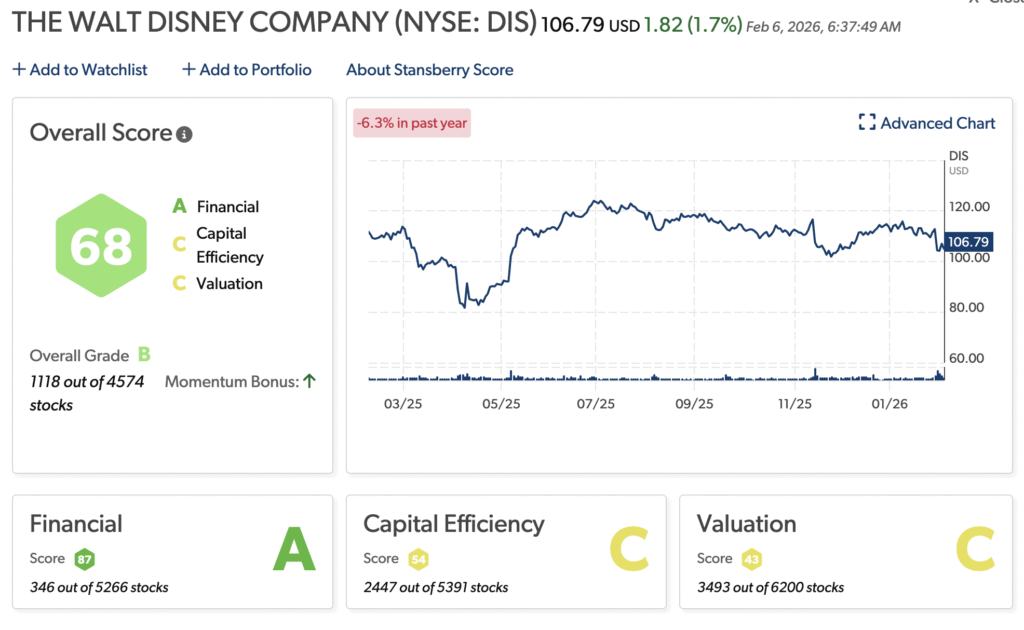
Disney’s current Stansberry Score (courtesy of our subsidiary Stansberry Research), a valuable tool that assesses a stock’s value and long-term investment potential, grades DIS favorably at an overall “B.”
Its Financials are strong (“A”), placing it within the top 400 stocks ranked in that category… out of more than 5,200. Disney’s stock is weighed down a bit by its average Capital Efficiency and Valuation (“C”).
Bottom Line: Disney Stock Is Worth a Spot on Your Watch List
The Walt Disney Company is an American institution. No, make that a global institution. Despite its challenges – which have consumed the decade thus far – and some recent fears of its stock bottoming out, Disney is not just an important company. It’s part of the global culture.
That may sound a bit over the top, but think about it for a moment.
If you’ve ever been to a Disney park, that experience is likely forever etched in your mind.
If you’ve watched a Star Wars or Marvel film, you may have become a lifelong fan.
If you’ve ever had a family movie night, it was probably centered around a Disney or Pixar animated film.
Disney is all around us. It’s inescapable. Whether you consider that a good thing or a bad thing is a matter of opinion.
But that’s what makes it an important company. And that makes its stock a consistently intriguing option for investors.
Time will tell whether Disney’s new CEO can return the company to its former glory. It should be an interesting story to follow along the way.
Regards,
David Engle
Editor’s Note: A strange change is coming to the stock market – and it’s about to have dramatic consequences for anyone older than 50.
“If you own popular AI stocks like Nvidia, you’re in for a big shock,” says Whitney Tilson, who predicted the 2000 Tech Wreck and founded a $200 million hedge fund firm.
He isn’t the only leading figure warning investors to tread carefully.
Michael Burry, who made hundreds of millions shorting banking stocks before 2008, just placed a $1 billion bet against AI stocks – He’s short on both Nvidia and Palantir Technologies.
And if Whitney is correct, what’s coming for AI stocks next won’t be a crash or mass rush for the exits…
It’s something far more dangerous – a permanent change that could leave millions behind.
That’s why he’s stepping forward today to reveal the one place you can move your money to, which could outperform stocks, bonds, and gold in the near future.