
Bitcoin (BTC) spent this month doing something it hasn’t done much of lately: holding steady.
After a choppy start to 2026, this steadiness could signal that it has already hit its “floor,” or bottom. That’s what some investors believe happened. And if they’re right, the implications stretch well beyond the price of a single coin.
A few things are driving that view.
U.S. regulatory clarity is improving, which strengthens bitcoin’s medium-term case. Institutional demand is also holding steady. And companies like Coinbase Global (COIN), the exchange sitting at the center of the entire infrastructure build-out, are quietly positioned to benefit from all of it.
The “digital gold” narrative – that bitcoin can store value during uncertain times – is back. Geopolitical tensions are driving investors to diversify. And the machinery underneath crypto markets is more institutional than it has ever been…
You see, crypto as a whole is becoming part of the traditional financial landscape. The New York Stock Exchange (“NYSE”) announced on March 24 that it’s partnering with the crypto tokenization platform Securitize to develop a system for issuing and trading tokenized securities – essentially turning traditional financial assets, like stocks, into digital representations that are recorded on a blockchain.
This will enable 24/7 trading and near-instant settlement. Meanwhile, asset-management firm Franklin Templeton recently announced that it’s launching tokenized exchange-traded funds (“ETFs”) with the crypto platform Ondo Finance.
And these partnerships are just the beginning.
Securities and Exchange Commission (“SEC”) Chairman Paul Atkins stated in December that U.S. market tokenization will ramp up over the next couple of years. That will bring a big share of traditional assets on-chain.
The U.S. stock market consists of $69 trillion in value as of January 2026, while the total crypto market cap stands at around $2.5 trillion right now. Many investors are excited about this potential influx of value. They’re preparing for a flood of integrations and institutional blockchain-based infrastructure.
Bitcoin makes up more than half of the entire market cap of cryptocurrencies. When capital flows into crypto, BTC tends to be the leader.
So let’s take a look at how it has been acting so far this year…
Bitcoin’s 2026 Outlook
With the Middle East conflict ramped up, BTC gained roughly 7.8%, outperforming the S&P 500, Nasdaq 100, gold, and silver.
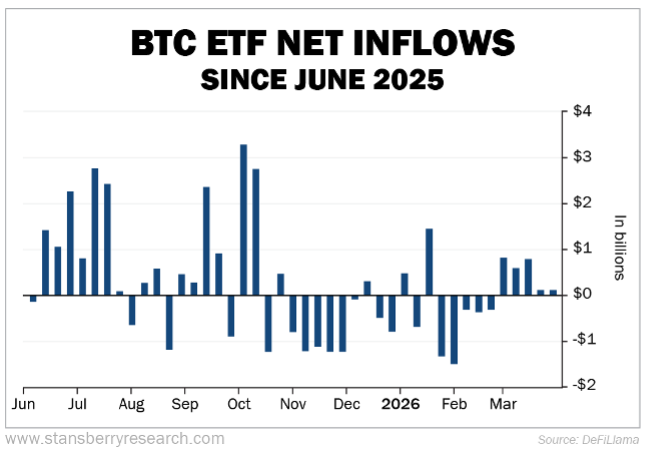
From the beginning of March, BTC has been stuck in a range between $63,000 and $76,000. But it has also experienced the best month it has had in ETF inflows since October 2025, when the crypto reached its all-time high of more than $126,000.
Digital-value tracker DeFiLlama shows around $1.53 billion in net inflows since the beginning of March, with a few days left to go. In other words, investors are buying the dip…
And who’s sitting at the center of that institutional buying? Coinbase.
Coinbase serves as the custodian for the majority of U.S. spot bitcoin ETFs. It basically holds the underlying bitcoin behind those funds. This includes BlackRock’s iShares Bitcoin Trust Fund (IBIT), the fastest-growing ETF in Wall Street history.
Every dollar flowing into those ETFs is flowing through Coinbase’s infrastructure. And when ETF inflows are steady and institutional, as they are right now, that’s a direct tailwind for Coinbase’s revenue.
The stock has pulled back significantly from its highs alongside the broader crypto market. The CLARITY Act – a key crypto-regulation bill currently in the Senate – has called earning yield on stablecoins into question. If it passes, it could disincentivize users from keeping cash parked on the exchange.
For Coinbase, that would likely mean lower user engagement, less asset retention, and less monetization tied to on-platform balances.
But the underlying business remains strong. It’s more institutional, more diversified, and more embedded in the financial infrastructure that’s being built right now than it has been.
Meanwhile, the Crypto Fear & Greed Index has remained in the “Fear” to “Extreme Fear” range for the past month, signaling that many retail investors are remaining cautious despite the renewed interest in BTC ETFs.
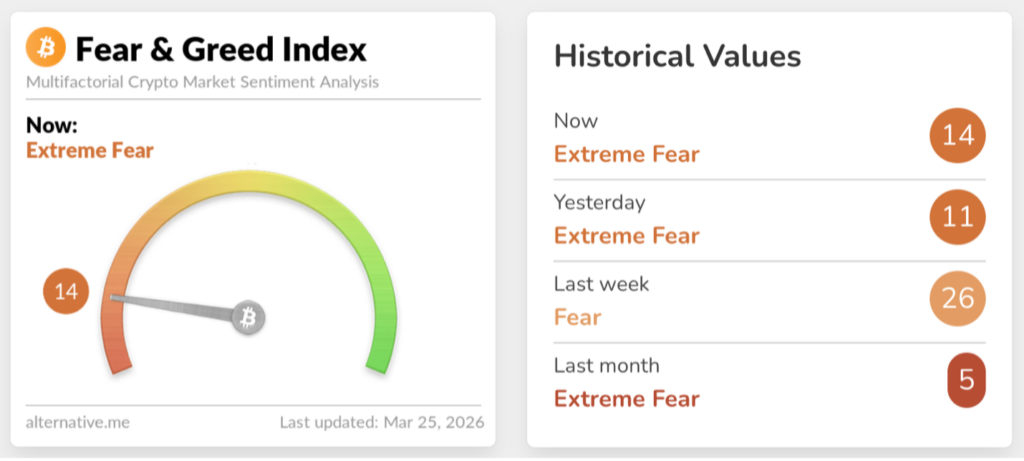
That disconnect matters. Flows show capital moving in, but sentiment is showing hesitation. When these two factors diverge, price tends to resolve in one direction with force… And right now, capital is winning over sentiment.
Put simply, what matters is who’s buying. Retail investors tend to react to price, which makes them more emotional – quick to buy and sell. But institutional investors are tied to structure. They’re more rational and less volatile.
What we’re seeing this month looks more like structural positioning than emotional retail investing. BTC’s ETF inflows are steady, not explosive, which suggests institutional buying.
Supply is also a factor at play right now – though it’s easy to overlook. Bitcoin recently crossed its 20 million-mined milestone. That means that out of BTC’s 21 million maximum supply, less than 1 million BTC are left to be issued over the next century.
New supply entering the market is already constrained. Plus, bitcoin halves its rewards for new mining every four years… So the next halving in 2028 will reduce supply even further. When steady demand meets a consistently tightening supply, that’s going to push prices higher, even if sentiment lags behind.
And as I stated earlier, macro conditions are shifting in a way that supports bitcoin’s “digital gold” narrative.
Geopolitical instability tends to push capital toward neutral “reserve assets.” Gold has played that role for decades. Bitcoin is increasingly being tested in that same role, especially among global investors who want something digital, portable, and outside traditional systems.
Where The Market Goes Next
All of this is to say that BTC has a good case ahead of it. But it’s not likely to move in a straight line.
The current range between $63,000 and $76,000 reflects a large degree of uncertainty. Markets are still digesting regulatory developments, ETF demand, and global risk factors all at once.
Breakouts from ranges like this usually require a catalyst. And there are a few key ones to watch…
First, if ETF inflows continue at current levels, that would signal sustained institutional demand. Second, regulatory decisions from U.S. agencies, such as the CLARITY Act, would make things easier for large allocators. Finally, further escalation in global conflicts could accelerate the search for alternative stores of value, like BTC.
Of any publicly traded company, Coinbase has perhaps the most to gain from regulatory clarity. The CLARITY Act and other efforts – including those led by Paul Atkins at the SEC – are aimed at reducing the legal confusion that has weighed on crypto businesses for years.
Coinbase has been fighting that battle in court, and in Washington, for a long time. A clearer regulatory framework strengthens the legal and operational foundation of the exchange itself.
For investors who want exposure to the crypto opportunity but prefer an equity over a spot asset, COIN offers a leveraged bet on the same factors I’ve covered today: rising institutional adoption, expanding tokenization, and a regulatory environment that’s finally moving in the right direction.
On the downside, a sharp reversal in ETF flows or unexpected tightening in financial conditions could stall the momentum we’re seeing.
For now, based on the data, this is a market that is building a base. Price is holding steady, capital is coming in, supply is tightening, and sentiment remains cautious. This combination tends to favor higher prices over time.
If bitcoin did set a floor this month, it likely will not be obvious until after the next move higher. But you might miss your chance if you wait around.
Crypto is an extremely volatile market, as we’ve seen this year. It’s important to invest cautiously and to research how to keep yourself safe in crypto markets.
I talk about this at length with Stansberry Research Editor Eric Wade in the Crypto Capital publication… So if you’re looking for a good place to start, we have guides and educational materials to help you along the way.
Good investing,
Stephen Wooldridge II
Editor’s Note: What should you invest in right now?
A renowned former hedge fund founder and his research team have found what they believe is the next big tech trend that could make investors rich.
It’s a breakthrough they’re calling “Helios” – and if you haven’t yet heard of it, you soon will.
Over the next few years, it could impact the food you eat… the water you drink… the places you live and work… and even the prices you pay for airfare, gas, electricity, and household goods.
“Helios” is going to cause a lot of people to lose money, too. Dozens of well-known businesses could go bankrupt.
But if you own a stake in this new tech, the positive effects will far outweigh the negatives. Get the facts for yourself. Make sure you’re not on the wrong side of this trend. Click here to see this new analysis…