Listen to the audio version of this article (generated by AI).
Today’s issue in preview:
-
Here’s how to trade AI stocks in the wake of Jensen Huang’s return
-
Pressure is building for a big rally in these stocks
-
Learn our Top Themes to buy now
Here’s how to trade AI stocks in the wake of Jensen Huang’s return
Credit: ChatGPT
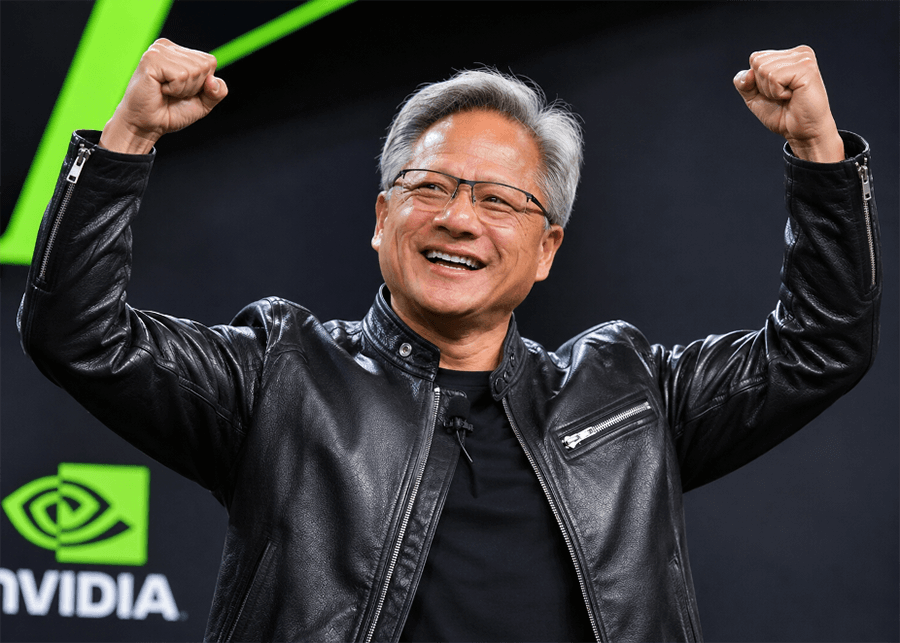
Jensen is back. And shareholders are rejoicing.
This morning, the world’s leading AI semiconductor company, Nvidia (NVDA), announced that its board has decided to reinstate founder Jensen Huang as CEO.
Most likely, a variety of threats were made by either senior employees, major investors, interested parties inside the U.S. government, or – most likely – all three. We will soon learn those details.
But no matter the reasons, Jensen Huang – one of the most consequential technology leaders of our time – is back at the helm of his company… most likely with a renewed focus on industry dominance and shareholder value over romantic interests.
As a result, beaten-up Nvidia (NVDA) stock surged 34% this morning. The news sent many other key AI infrastructure stocks up 10%-25%. The all-important VanEck Semiconductor ETF (SMH) surged 16% in morning trading.
Does this incredible turn of events make it so “the world’s most important trend” gets a clean bill of “trend health”?
Let’s take a look and create a trading plan based on what we see.
First, a quick refresher on the situation…
Over the past three months, we’ve published a special series of research notes analyzing the AI infrastructure boom… which we’ve called “the world’s most important trend.”
The status of this critical trend has become one of the great sagas of the business and investment world… a source of intense disagreement among industry bulls and bears. It’s a trend whose outcome could have large effects on your portfolio.
Given AI’s enormous promise, large tech firms such as Alphabet (GOOG) and Microsoft (MSFT) have invested over $1 trillion in AI infrastructure. They are on pace to invest over $700 billion this year alone and more than $3 trillion after that.
Both the scale and the velocity of this investment boom are unprecedented. It is the largest collective investment effort in history.
Big Tech’s historic investment boom has made the entire “AI infrastructure” trend responsible for a large share of America’s GDP growth and stock market returns over the past two years. It has also drawn the skeptical scrutiny of many widely followed investment analysts who claim the trend is a bubble… one that will soon explode and cause tremendous damage to stock prices and the global economy.
I believe the AI infrastructure trend has years to run. I believe the world’s smartest, most connected tech insiders who know the true state of bleeding-edge AI development and have real-time stats on AI investment ROI, such as Elon Musk, Satya Nadella (Microsoft) and Andy Jassy (Amazon), perhaps maybe… just might… know far more about AI and their businesses than outsiders know about it.
As much press as AI gets, let’s remember that less than 1% of the global population pays for top-tier AI programs. And I estimate less than 10% of large companies believe AI has made a meaningful impact on their businesses.
This revolutionary technology hasn’t yet proliferated, achieved mass adoption, or had mass impact.
However, the Agent Supernova is coming.
I like to know the bull and the bear case for any trend. But regular readers know I care a lot more about what the market thinks of any stock, trend, or theme than what any one person thinks of it, including me.
You can be bullish or bearish on a trend all you like, but if that trend is moving strongly against you, then your idea isn’t worth a hell of a lot in my book.
One of the best ways to gauge what the market thinks of AI infrastructure is analyzing the VanEck Semiconductor ETF.
This fund is full of key semiconductor firms whose fortunes rise and fall with AI infrastructure spending trends. Major holdings include Nvidia, Taiwan Semiconductor (TSM), AMD (AMD), Texas Instruments (TXN), ASML Holding (ASML), and Micron (MU).
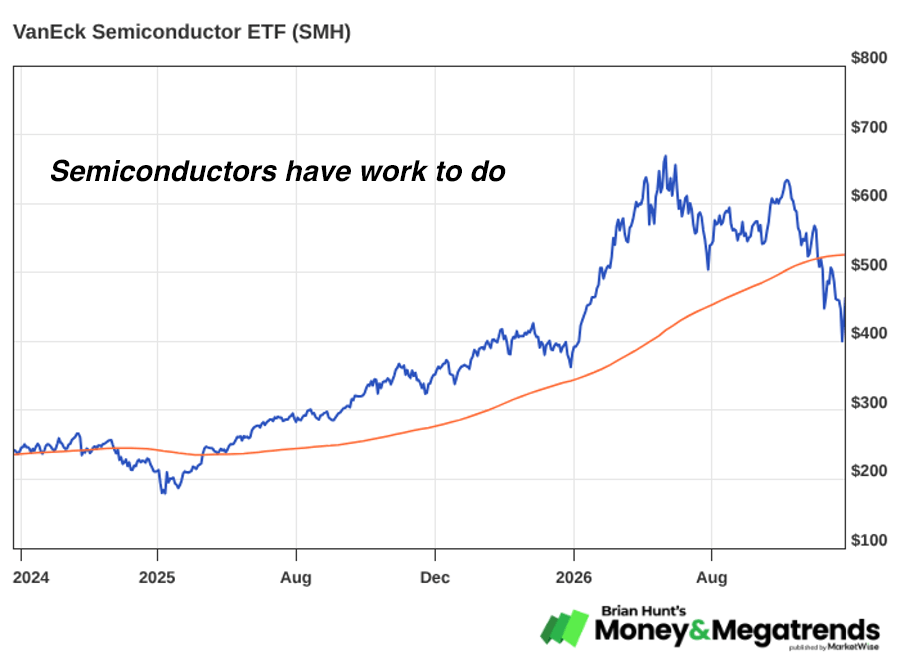
As you can see in the two-year chart below, SMH enjoyed a gigantic run from June 2025 to June 2026. The fund gained 176%. After reaching a high in June 2026, however, the fund corrected and moved in a volatile, sideways pattern.
Enormous selling pressure over the past month – much of it catalyzed by the Jensen Huang saga – sent SMH out of its consolidation pattern, into meaningful new lows, and below its 200-day moving average.
Today’s Jensen news and subsequent enormous rally in Nvidia and other key AI infrastructure names is a big step in the right direction towards restoring health to this megatrend.
However, as you can see in the SMH chart below, this fund remains well below its summer/fall consolidation zone and its 200-day moving average.
Despite today’s positive news and giant rally, this trend still has plenty of work to do before we can say the AI infrastructure climate is favorable for investors. I need to see SMH power past $570 to get interested in trading AI infrastructure from the long side. Your move, Jensen.
Recommended Link:
Former Congressman Ron Paul’s Biggest Warning Yet

They mocked him for warning about the housing bubble. Then 2008 happened. They called his predictions about the dollar crazy. Now groceries cost double what they did in 2020. Today, at 91 years old, Dr. Ron Paul is stepping forward with what may be the most important warning of his life: a crisis he believes could wipe out the savings of millions of Americans. He explains everything — and the #1 first step every American should take to prepare — in a new interview, here.
Pressure is building for a big rally in these stocks
Credit: SweetBunFactory
In last Thursday’s issue, we analyzed the widely followed Dow Jones Industrial Average and noted this key stock gauge is trading below its 200-day moving average.
This new development indicates an unpleasant climate for stock market investors.
By itself, the Dow breaking below its 200-day moving average isn’t reason to sell all your stocks, convert the cash to gold, move to the middle of Montana, and await the financial apocalypse. However, this is a red flag we’d be foolish to ignore.
If the Dow continues to trade below the 200-day moving average, we can say that the rising tide of money flowing into our capital markets, which has kept stock prices buoyant, is receding. In that situation, the investor is swimming against the current rather than with it.
In situations like these – where the financial climate is unpleasant – I prefer to spend much more of my time learning about stocks than I do buying them. I like to study what industries and businesses are growing and proliferating despite stock market weakness.
The learning I do during these times is like making investments that will generate substantial returns in the years to come.
Here’s why…
During a correction or bear market, the world’s strongest technological and business trends typically grow rapidly and proliferate, regardless of what is happening to stock and bond prices. Their fundamental underpinnings typically stay quite strong.
For example, global internet adoption surged during the epic 2000 – 2002 tech stock bear market. Revenue at Amazon, Cisco, and Microsoft grew during that epic bear market.
And remember, iPhone sales soared from 2008–2010, which was the worst of the Great Financial Crisis and its recessionary aftermath. Facebook adoption, Google’s search engine revenue, and Netflix’s streaming revenue all soared during that time as well.
In other words, stock market corrections and bear markets don’t stop the growth and proliferation of revolutionary technologies and business models.
However, since the tide of money is flowing out of capital markets rather than into them, stock prices in general go down. The innovation and growth continue. The stock price gains do not.
Eventually, any megatrend that continues to grow will act as a magnet for its depressed or consolidating stock prices. It eventually pulls them back up.
Sometimes, that process can take two months. Sometimes, it can take two years. The stock or trend’s level of overvaluation s at the beginning of the correction/bear market has a lot to do with how long the process takes. The more extreme the starting valuation, the longer the bear market will last.
During times when the general monetary tide is flowing out rather than in, it’s a good idea to stock up on knowledge of the world’s strongest, most compelling trends. Rather than staying busy buying stocks, you can stay busy studying and learning.
This way, you are fully informed on what stocks, commodities, and ETFs could do well when the “money tide” begins to flow back in. It is time and energy well spent. It can produce huge ROIs in the years to come.
For example, avid Money & Megatrends readers know we are very bullish on robotics in the long term. Specifically, the companies that make precision equipment for large robot makers like Tesla and Figure AI.
The Robotics Revolution is a giant, multifaceted megatrend poised to change our world in thousands of ways. Decades of progress in this field are now yielding autonomous cars, automated factories, surgical robots, military drones, delivery drones, and humanoid robots. Last year, Amazon announced it uses more than one million robots across its business. This figure will soon exceed the company’s number of human employees.
Investing in this trend has allowed us to score wins in Vishay Precision Group (VPG), Allient (ALNT), Ouster (OUST), and Cognex (CGNX).
These firms produce various precision-engineered “body parts” for the robotics industry… and their market values have climbed at several points over the past three years, driven by growing awareness of the emerging robotics megatrend.
However, no long-term trend – no matter how strong the fundamental drivers behind it – runs higher in a straight line. Even the strongest trends experience large corrections and periods of moving sideways. It’s just how the market works.
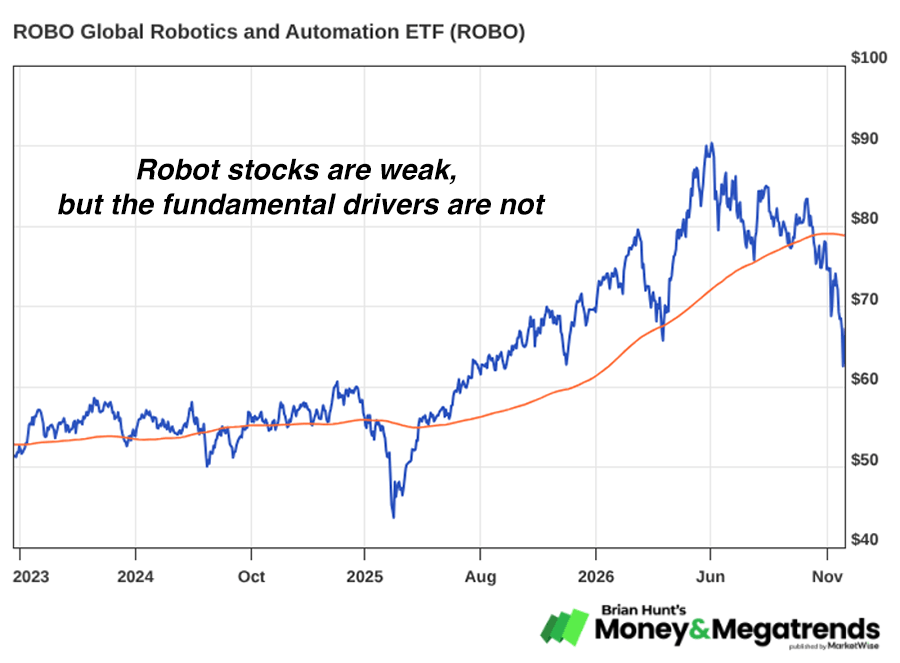
In robotics, the current trend is downward. The robotics sector has suffered alongside almost every other tech sector. The ROBO Global Robotics and Automation ETF (ROBO) is trading at its lowest point since late 2025.
The trend in robotics stocks may be down currently, but investment in the technology – and the technology’s progress – are continuing full speed ahead.
Some facts and figures to consider include:
Agility Robotics, which we flagged when it announced plans to go public, began trading on the Nasdaq under the ticker AGLT on Nov. 5. That makes it the first U.S.-listed pure-play humanoid robotics company. The deal raised about $465 million in gross capital.
Agility also holds more than $300 million in committed multi-year orders for its next-generation Digit 5 robot, subject to milestones and specifications. Its customers include GXO, Schaeffler and Toyota Motor Manufacturing Canada, and farm-equipment giant AGCO has signed up for a Digit pilot in 2027.
The first 1,000-robot humanoid plan. GXO Logistics signed a letter of intent with robotics firm Apptronik to expand trials of its Apollo humanoid. The deal sets a path to deploying up to 1,000 Apollo robots worldwide over the next four years, with the first North American deployments targeted for late 2027. The rollout depends on the robots hitting agreed productivity and safety targets.
Venture funding remains on track for a record year. F-Prime Capital projects that global robotics investment will reach $60.7 billion in 2026. Through September, robotics companies had raised $50.7 billion, compared with $22.1 billion in all of 2025.
F-Prime also estimates that about 25,000 humanoid robots shipped in the first half of 2026, up 432% from a year earlier. This month’s big rounds include Genesis AI, an Nvidia-backed startup based in Paris and California that builds AI models to run across many kinds of robots, plus its own general-purpose robot, Eno. It raised $500 million at a $3.5 billion valuation, just 16 months after a $105 million seed round.
Path Robotics, an Ohio company whose AI lets industrial robots weld, raised a $300 million Series E at a $2.45 billion valuation.
The big players are consolidating. Hyundai took full ownership of Boston Dynamics by buying SoftBank’s remaining 9.65% stake on November 17th. In addition, Rockwell Automation agreed to acquire mobile-robot maker AGILOX on November 18th, and John Deere bought agricultural AI firm Orchard on November 20th.
Intuitive Surgical (ISRG), the surgical robotics leader, grew third-quarter revenue 22% to $3.05 billion. It placed 546 da Vinci systems, up from 427 a year earlier, and its installed base now stands at 12,094 systems. Procedures grew 15%.
Tesla’s (TSLA) robotaxi rollout is accelerating. Tesla now offers robotaxi rides in eight U.S. cities. It launched in Fort Worth on Nov. 2 and in San Antonio on Nov. 9, which is its largest initial service zone yet. On Nov. 19, the purpose-built Cybercab began giving rides in Dallas, its first city outside Austin. Tesla also registered another 200 Cybercabs with the Texas DMV on Nov. 17, up from the 573 it had registered as of late October.
As you can see, robotics adoption and investment are very strong even if the stock prices are not.
That said, with the broad market averages now trading below their 200-day moving averages, this isn’t an environment for being aggressive. Stock prices in general are swimming against the current rather than with it.
We recommend keeping this trend on your radar, including the key robotics firms we’ve covered recently: the Tokyo-listed stocks Nabtesco (6268) and Harmonic Drive Systems (6324), as well as Cognex (CGNX),Ouster (OUST), and RBC Bearings (RBC).
Given the robotics megatrend’s strong fundamental drivers, you’ll want to know its key players and their positions when the market environment turns favorable to longs. We will keep you updated as it unfolds.
Market Notes
-
Our March 27 recommendation to own cybersecurity stocks continues to pay off. Zscaler (ZS) jumped 18% today after CrowdStrike (CRWD) agreed to buy it in an all-stock deal worth about $43.9 billion. This is another bullish sign for the cybersecurity trend.
-
Neocloud stocks Nebius (NBIS), IREN (IREN), and CoreWeave (CRWV) all rose more than 20% on news of Jensen Huang’s return to Nvidia (NVDA).
-
Homebuilding giant NVR (NVR) reached a new one-year low today.
-
Crude oil reached its lowest point since late August.
-
Refining giants Valero (VLO) and Marathon Petroleum (MPC) reached new three-month lows today.
-
Natural gas giant Expand Energy (EXE) reached a new one-year low today.
Top Themes to Buy Now
🦾 Amazon’s stock is doing something extraordinary
⚒️ These stocks are the best inflation hedges you don’t know about
📈 Quality dividend payers are delivering stability in a volatile market
Regards,


Brian Hunt
Editor, Money & Megatrends
An urgent message from our colleagues:
Missed Nvidia’s 44,000%? This is the next big opportunity

In February 2016, Nvidia was trading at $2.51, split-adjusted. The name barely came up in investment circles. But my data had flagged something. A pattern the market hadn’t priced in yet. I sent my readers a single, clear recommendation. And anyone who acted could’ve got in on the biggest investment story of this decade. The company I’ve identified today is in the same position. Same pattern. Same kind of gap. And the window is open right now. I’m revealing it, down to the ticker, in a new free presentation.
Click here now – before I’m forced to take it down.