
Listen to the audio version of this article (generated by AI).
Today’s issue in preview:
-
Elon Musk is betting big on this industry… and these four stocks could soar
-
This company could soon release the next “mega blockbuster” health treatment
-
The bull market in agriculture generates another round of new highs
-
Learn our Top Themes to buy now
Elon Musk is betting big on this industry… and these four stocks could soar

Credit: Figure
Sony. Casio. Canon. Seiko. Toyota. Nikon. Yamaha.
For over 50 years, the brand-name manufacturers above have made Japan a world leader in precision manufacturing.
Maybe it’s in the DNA. Maybe it’s something in the water. But for generations, the Japanese have set standards in reliability and quality in many fields, such as cameras, automobiles, batteries, calculators, watches, and stereos.
Most of us over 40 can remember owning a Sony Walkman, a Seiko watch, a Casio keyboard, an indestructible Toyota sedan, a Nintendo video game system, or a Canon camera. The Japanese love high-tech manufacturing, and they are very, very good at it.
Given all this, it’s no surprise that a bullish investigation of the robotics industry and its key players will quickly take you to the Land of the Rising Sun. It’s fair to say the country is a robotics powerhouse.
Around 38% of the world’s industrial robots are produced by Japanese manufacturers, according to the International Federation of Robotics. That makes Japan the world’s leading robot-producing country by this measure.
Avid Money & Megatrends are familiar with our Robotics Revolution megatrend thesis.
In 2024, I named it as one of my top long-term investment themes… an industry where investors get to enjoy a gale-force tailwind at their backs.
The Robotics Revolution is a giant, multifaceted megatrend poised to change our world in thousands of ways. Decades of progress in this field are now yielding autonomous cars, automated factories, surgical robots, military drones, delivery drones, and humanoid robots. Last year, Amazon announced it uses more than one million robots across its business. This figure will soon exceed the company’s number of human employees.
Investing in this trend has allowed us to score large wins in Vishay Precision Group (VPG), Allient (ALNT), Ouster (OUST), and Cognex (CGNX). These firms produce various precision-engineered “body parts” for the robotics industry.
Back in February, we looked at the humanoid robot facet of the robotics boom. Elon Musk has said this application will be “the biggest product of all time.”
During Tesla’s fourth-quarter 2025 earnings call, Musk announced that the company would phase out two car models to free up factory capacity to build Optimus humanoid robots.
Humanoids are poised to become one of the most impactful, most popular innovations in history. Imagine millions of robots in our homes, factories, mines, and fields doing work most of us consider to be dirty, dangerous, and tedious. (Personally, I’m most excited about the humanoid that displaces me from my job as family dishwasher.)
In pursuit of humanoid market dominance, venture capitalists and large tech firms such as Tesla (TSLA), Alphabet (GOOG), and Amazon (AMZN) are pouring billions of dollars into humanoid factories and related R&D. Over a dozen humanoid makers are competing for the title of “king of the humanoid market.”
F-Prime/PitchBook, a platform that tracks private market investment data, estimates that investment in humanoids and robotic foundation models rose from about $300 million in 2023 to $2 billion in 2024 and $6.1 billion in 2025 – roughly a 20x increase in two years.
Dealroom, another private investment site, estimates that humanoid robotics startups had already attracted $8.7 billion in venture capital through July 22, 2026, nearly double the full-year 2025 record by its methodology.
Individual investment rounds in humanoids are becoming enormous: Leading humanoid developer Figure raised $1 billion+ in 2025 at a $39 billion valuation. CB Insights says industrial humanoids were the most active venture market by deal count in both Q2 and Q3 2025.
In our February analysis, we pointed out the merits of investing in the robotics megatrend via specialized manufacturers that make precision-engineered components for robot joints, gears, bearings, and sensors. We believe this approach is a safer bet than trying to pick a single dominant robot maker.
Producing humanoid components is a difficult business. Robot joints, frames, gears, batteries, motors, and sensors must achieve a very hard-to-achieve balance of lightness, precision, durability, and functionality. This is ultra-high-tech manufacturing.
Plus, any big-league humanoid component maker must be able to fill large orders from the likes of Tesla. Being able to produce 2,000 precision components is one thing. Being able to produce 1 million of them is a different thing.
We believe key parts of the robotics supply chain could soon see orders come in that far exceed its capacity to meet those orders… much like how the AI data center building boom has created for optical networking firms and computer memory makers since 2024. Both industries have seen skyrocketing share prices.
A big increase in demand could allow robot component supplies to make money via both increased order volume and increased per-unit prices they can charge.
However, investing in the top component suppliers requires getting your portfolio a passport…
Over the past 50 years, the U.S. has largely ceded robotics manufacturing to the likes of Japan and China. This means for many key parts of the global robotics supply chain, there are no large, liquid publicly traded U.S. companies an investor can buy to play them.
However, since Japan is a robotics powerhouse, an investor can find at least a handful of dominant firms that should thrive during the Robotics Revolution. Such firms could see orders for their specialized components and systems soar over the next five years.
Compelling investment candidates include:
Nabtesco (6268) is a $3.4 billion company that holds almost 60% of the market share in the cycloidal reducer market. These are the precision gearboxes that sit inside the joints of robots that convert force into quick but controlled movements. Cycloidal reducers do more of the heavy lifting, hence why they’re used more in the base, the core, and the shoulder joints, where more load is likely carried.
When a large robot is carrying a heavy box across the factory floor, the cycloidal reducer is a key component that enables the robot to do so repeatedly without joint wear or loss of precision. The company also makes aircraft hydraulic systems and automatic train doors, but the true value sits inside their Precision Equipment segment.
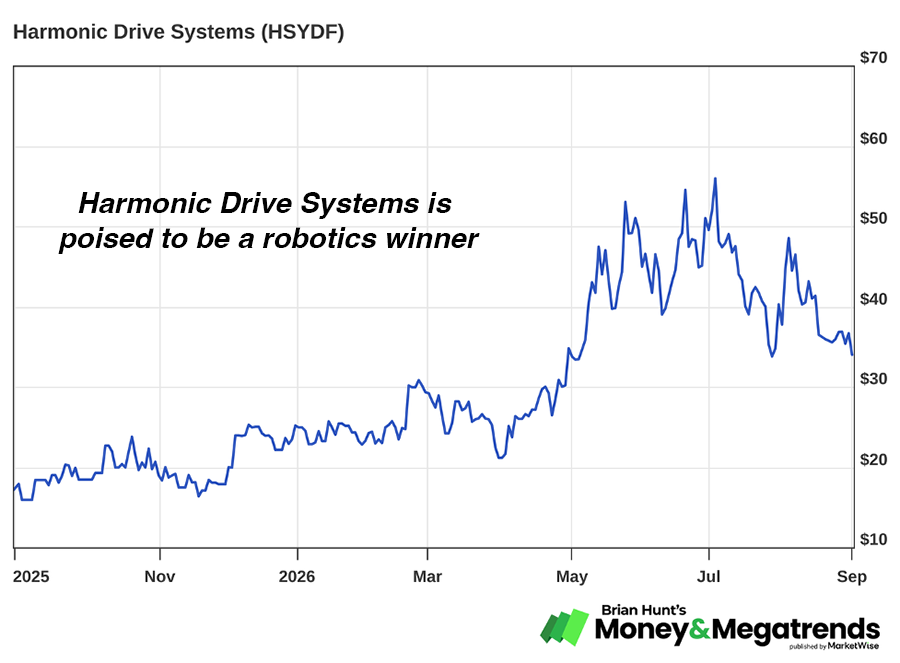
Harmonic Drive Systems (6324) is a $3.3 billion company that has a strong lead in the harmonic drive market. This is another type of reducer and therefore the other player in the duopoly with Nabtesco, but they serve a different role. Harmonic drives are more suited to the wrist, forearm, and smaller joints where loads are likely less. They’re cheaper and smaller, but wear down faster under heavier loads. Orders surged 56% in the recent quarter, mainly due to robotics demand, which led management to raise full-year FY27 guidance by over 60%.
Yaskawa Electric (6506) is a sub-$10 billion company that sits on both sides of the picks-and-shovels debate. It has a Motoman division, which manufactures complete industrial robot arms, so there is exposure to the finished product. But it is also a leading producer of servo motors, which give robots accuracy and control.
FY26 operating profit increased by more than 70% year over year, and it recently acquired Tokyo Robotics as part of an aggressive push into the humanoid world. Yaskawa also has a partnership with NVDA as of mid-2026, where Yaskawa will be building on Nvidia Cosmos to advanced AI-powered robotics.
THK (6481) is a $4.6 billion company that has a leading position in precision rails, ball screws, and linear bearings that allow robot arms to move perfectly in straight lines with near-zero friction. THK is going through a difficult period lately as restructuring costs and high tariffs are hurting the financials, but it recently completed a $276 million share buyback, which shows conviction in its business in the long term.
If your brokerage allows you to buy Japanese stocks, you can buy their local listings. However, all four firms have U.S. Over-The-Counter (OTC) listings. These stocks are not as liquid as say, Tesla stock, so use limit orders if you decide to accumulate shares.
The robotics revolution is global but many of the supply chains run through Japan. For investors who want exposure to the megatrend without betting on a single robot maker, these companies offer you those rare monopolies on precision manufacturing needed for the robotics megatrend.
Recommended Link:
I paid $5,000 to hear Elon say this

I recently paid $5,000 to be in a room with Elon Musk in Los Angeles. What he’s launching right now could be his biggest move yet (and make you more money than anything he’s done so far). If you buy just one stock in 2026, I urge you to make it the one I’m giving away for free: Get the ticker & full details here.
This company could soon release the next “mega blockbuster” health treatment

Credit: stockdevil
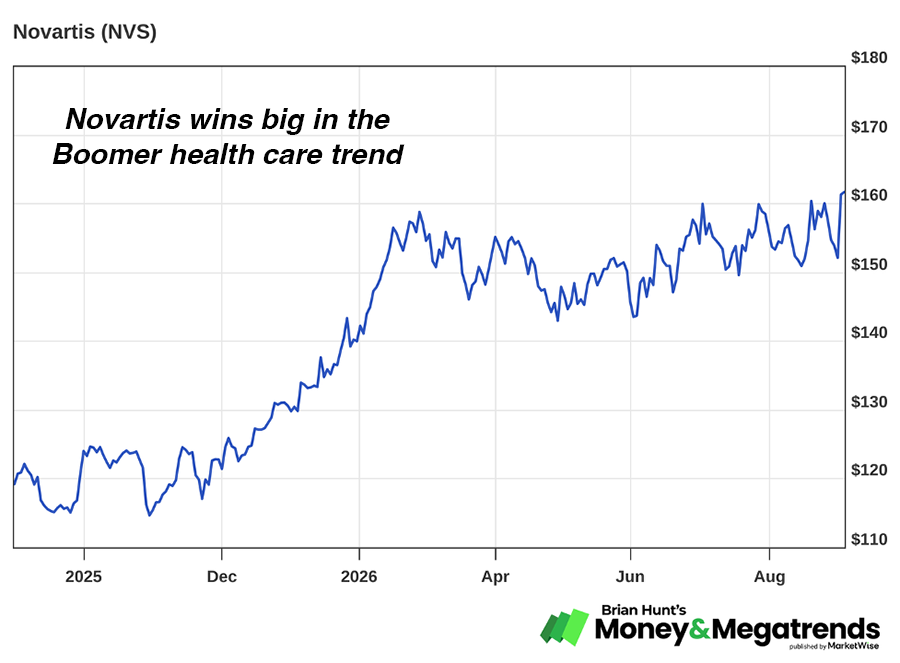
It turns out, being bullish on the Boomer health care trend is a great idea. This week, the megatrend created another round of wealth by sending pharmaceutical giants Pfizer (PFE) and Novartis (NVS) to new all-time highs.
For more than three years, I’ve made “Boomer health care” one of my highest conviction long-term investment themes. This means I’ve been bullish on biotech, genomics, and healthcare in general. In more than 20 Money & Megatrends research notes over the past year, we’ve been very bullish on stocks and ETFs related to this trend.
Regular readers are familiar with the bull case here. More than 10,000 Americans reach retirement age every day. The U.S. population aged 80 and older is projected to roughly double, from 14.7 million in 2025 to 29.4 million by 2045.
This is the enormous Baby Boom generation entering the phase of life where health care and longevity spending skyrockets. For many boomers, a typical month involves going to see at least one doctor to have something looked at, removed, or treated.
This means many health care businesses are experiencing huge demand now – and will for at least the next decade. It means boom times ahead for many “ology” businesses, stocks, and careers. Dermatology. Cardiology. Radiology. Oncology. Anesthesiology. Ophthalmology. The list goes on.
Investing in many healthcare businesses over the next decade will be investing with a gale-force tailwind at your back. If you’re a parent and worried about your child getting a job, just point them to the booming healthcare industry.
But don’t take my word for it. Take the market’s word.
Investing in this theme has been very rewarding over the past 12 months. The world’s largest healthcare stock ETF – the Health Care Select Sector Fund (XLV) – has returned 27%. The Invesco Pharmaceuticals ETF (PJP) has returned 42%. The S&P Biotech ETF (XBI) has returned 82%. Our in-house Senior Living index has returned 32%.
And this week, drug giants Pfizer and Novartis reached new all-time highs.
Pfizer is a $162 billion pharmaceutical firm. Its largest 2025 products were Eliquis ($8.0B, blood clots), Prevnar ($6.5B, pneumococcal disease), Vyndaqel ($6.4B, cardiac amyloidosis), Comirnaty ($4.4B, COVID-19), and Ibrance ($4.1B, breast cancer). Pfizer is navigating declining COVID revenue and upcoming patent expirations while investing heavily in new drugs. Its $43 billion acquisition of Seagen significantly strengthened its oncology portfolio, particularly in antibody-drug conjugates.
Novartis is a $306 billion market cap pharmaceutical giant focused on cardiovascular disease, immunology, oncology, and neuroscience. Its largest 2025 products were Entresto ($7.7B, heart failure), Cosentyx ($6.7B, inflammatory diseases), Kisqali ($4.8B, breast cancer), and Kesimpta ($4.4B, multiple sclerosis).
Novartis has a potential new “mega blockbuster” drug in development called Pelacarsen. It could treat Lp(a), a genetically inherited cardiovascular disease risk factor that cannot be reduced with diet or exercise. About 20% of the global population has it.
The giant business, tech, and demographic trends that shape our world tend to play out in five or more years, not five months. This means the stock market trends they manifest play out over the same time periods.
With this trend truism in mind, I once again remind you that if you like money, keep it invested in the Boomer health care megatrend.
Market Notes
-
Our recommendation to own farm machinery giant Deere & Co. (DE) is working well. The stock reached a new all-time high today.
-
Our July 21 bullish research note on Netflix was well timed. The stock is up 22% since then and just reached a new three month high.
-
The bull market in agricultural commodities we’ve been detailing just drove the VanEck Agribusiness ETF (MOO) to a new one-year high. The iShares MSCI Agriculture Producers ETF (VEGI) reached a new one-year high.
-
The bull market in healthcare drove cancer treatment giant Exelixis (EXEL) to a new all-time high today.
-
The Iran War and its constriction of Middle Eastern oil supplies continue to work to the advantage of U.S. oil refiners. Industry giants Marathon Petroleum (MPC), Phillips 66 (PSX), HF Sinclair (DINO), and Valero Energy (VLO) reached new all-time highs today.
Top Themes to Buy Now
⛏️ Here’s why silver could resume its explosive uptrend
Regards,


Brian Hunt
Editor, Money & Megatrends
An urgent message from our colleagues:
Huge AI Announcement Coming on September 3

The last time this firm did this, it skyrocketed overnight. Now – backed by a $51 billion backlog, a SpaceX partnership, and President Trump’s ringing endorsement – the gains could be even bigger.