Listen to the audio version of this article (generated by AI).
Today’s issue in preview:
-
The AI boom is about to create a crisis. These stocks will benefit
-
The most alarming chart in the world for stock investors
-
Learn our Top Themes to buy now
The AI boom is about to create a crisis. These stocks will benefit

Credit: ismagilov
Grounded airplanes. Banking systems down. Charles Schwab going offline. Millions of Microsoft Outlook users unable to send or receive email. A giant $6.3 billion stolen from the cryptocurrency exchange Binance.
Were any of these incidents the product of AI-powered cyberattacks?
The people in charge of most businesses and government agencies are saying “no.”
Hmm. Let’s remember that no business or government agency wants to spook the public and then suffer a major loss of business, face a PR nightmare, or be known as the inept organization that can’t keep customers or taxpayers safe.
Whether the recent systemic problems are the product of AI-powered cyberattacks or not, there’s no denying that AI can be a tremendous “force multiplier” for crooks and terrorists seeking to steal money, cause harm, or sow chaos.
Instead of having to carry out cyberattacks “by hand” the old-fashioned way, nefarious characters can now use thousands of AI agents working around the clock to steal money and cause chaos.
In other words, your average cybercriminal group recently became many thousands of times more capable of attacking you, me, businesses, and governments.
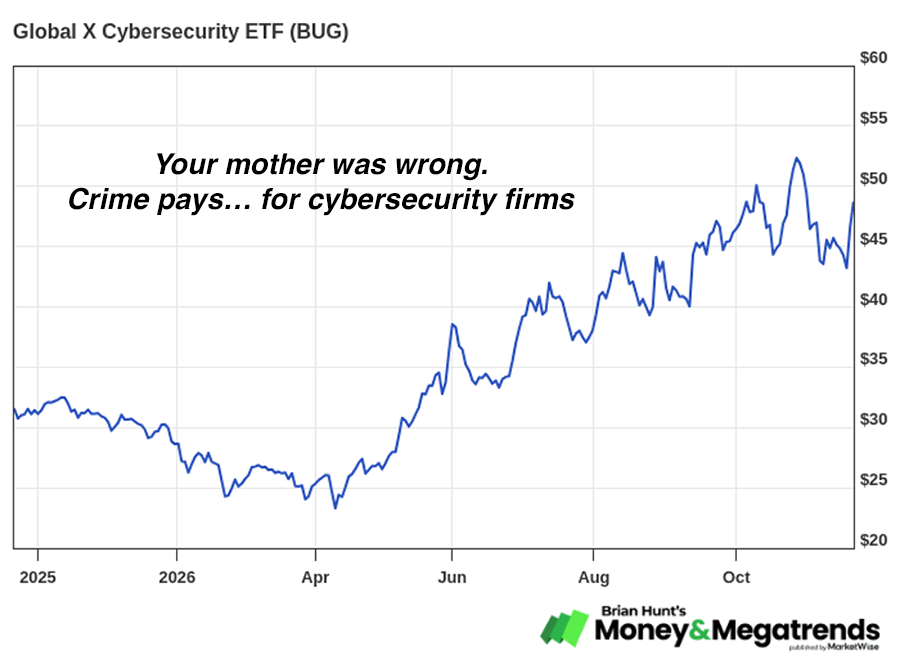
Given all this, it’s no wonder cybersecurity stocks are enjoying a bull market. And it’s no wonder that, among the more than 150 industry groups we track to spot trends and opportunities, few have delivered stronger performance over the past eight months than cybersecurity.
Back in March, we detailed how cybersecurity stocks were a compelling way to invest in our forecasted Agent Supernova, which is the explosion of AI agents that work for us, think for us, shop for us, invest for us, and solve hundreds of different problems for us.
In that issue, we covered how this Agent Supernova was poised to explode, creating a huge number of new cybersecurity threats across banking, transportation, social media, energy production, healthcare, manufacturing, and many other industries.
If we’re going to have millions of AI agents performing billions of daily tasks in health care, education, energy, transportation, manufacturing, and technology, then we’re going to have billions of points of cybercrime vulnerability. And remember, crooks get to use AI too.
If agents can roam the web, communicate for you, log in to your apps, move money, and modify data at machine speed, then a compromised agent can do the same damage just as fast – now with far less human oversight to catch mistakes or intrusions.
We stated this is why well-positioned cybersecurity companies are poised to enjoy years of booming business.
Concerns about AI safety have surged over the past three months, driven by the events mentioned above. Plus, current and former Anthropic employees have publicly aired concerns that AI “could kill us all.”
They have shared precious few details on exactly how AI would do that, but presumably, they have some movie scenarios in mind: “bad” AI taking over nuclear missile launches, developing a killer virus, or taking over transportation systems and causing catastrophic accidents.
Adding fuel to the fire of concerns are recent reports from cybersecurity giant Cloudflare (NET) that AI-powered attacks can continuously test system weaknesses and change attack methods based on what they learn.
Unlike the cybercriminals of days past, these malevolent AI agents will work 24 hours a day, 7 days a week, without a break.
Think of it like a thief walking down a long line of parked cars, lifting door handles to find the one car whose owner forgot to lock the doors… looking for the easy, vulnerable target.
Now picture that dynamic working with AI cyberattacks. In less than a minute, one malicious group can use AI agents to check many digital systems for weaknesses and vulnerabilities at warp speed. The AI can “lift a million door handles” in less than a minute.
Given all this, many of us are justifiably spooked over AI-powered cyberattacks. Political leaders are spooked over AI. And business leaders are spooked over AI.
This is all bullish for the cybersecurity business. After all, few things drive large increases in corporate cybersecurity budgets like a global AI panic.
We can see the future very clearly: Your average Fortune 500 CEO will be encouraged by his board to increase the cybersecurity budget. He will be encouraged by his executive team and workforce to increase the cybersecurity budget.
Even his wife and kids will encourage him to increase the cybersecurity budget.
At the time of our March note, cybersecurity stocks – a special type of software stock – had suffered a sharp decline due to investor concerns that AI would disrupt software.
Soon after our note, cybersecurity stocks staged a huge rebound as investors began to believe AI wouldn’t disrupt the business as much as they had thought.
Industry leader CrowdStrike (CRWD) has returned 157%. Palo Alto Networks (PANW) has returned 131%. The Global X Cybersecurity ETF (BUG) has returned 94%.
AI is the most exciting and potentially transformational technology of our time. Recent digital system failures and the high-profile concerns raised by AI insiders over the past few months suggest it’s probably also the most dangerous.
Add it all up, and you get the current bull market in cybersecurity.
Recommended Link:
Former Congressman Ron Paul’s Biggest Warning Yet

They mocked him for warning about the housing bubble. Then 2008 happened. They called his predictions about the dollar crazy. Now groceries cost double what they did in 2020. Today, at 91 years old, Dr. Ron Paul is stepping forward with what may be the most important warning of his life: a crisis he believes could wipe out the savings of millions of Americans. He explains everything — and the #1 first step every American should take to prepare — in a new interview, here.
The most alarming chart in the world for stock investors
Credit: lucky-photographer
In yesterday’s issue, we analyzed the world’s most widely followed technology stock index – the Nasdaq 100 – and noted this key stock gauge is trading below its 200-day moving average.
I believe this is the most alarming business and investment news you’re not hearing about in the mainstream financial press.
Although I’d like to say there is good news to balance the bad news, I can’t do that today. The Nasdaq 100 trading below its 200-day moving average is the bad news.
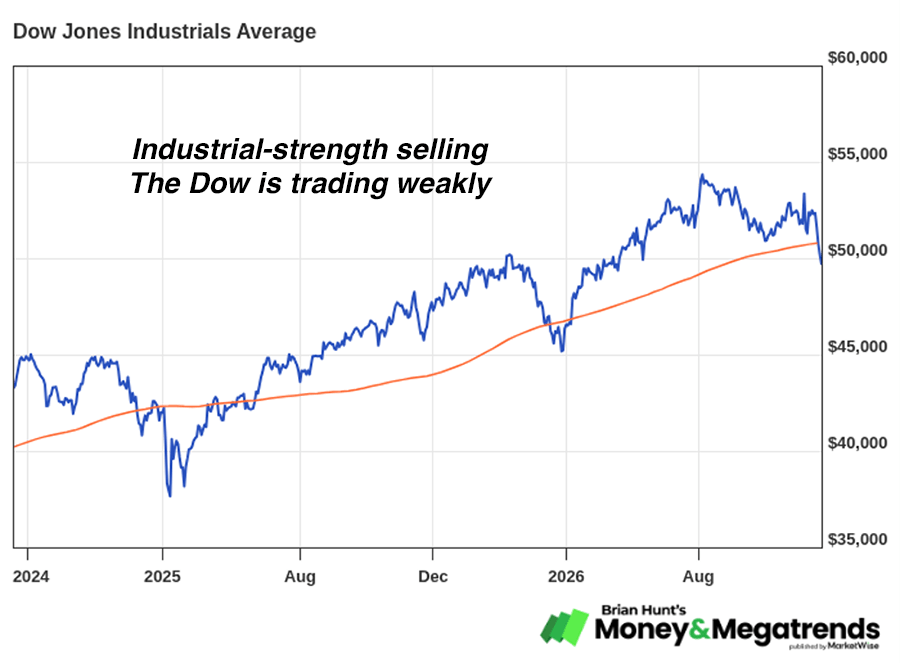
The worse news is that the Dow Jones Industrial Average recently sliced below its 200-day moving average as well.
A moving average smooths out a stock’s daily price fluctuations by calculating its average price over a set period, such as 50 or 200 days. Investors use moving averages to identify trends and gauge momentum.
I use the 200-day moving average to gauge long-term trends. A security below its 200-day moving average is on the wrong side of the tracks. That’s the ugly part of town. All the really bad things – crashes, panics, crippling retirement account losses – happen below the 200-day moving average.
Unlike the Nasdaq 100, the Dow Industrials is – by design – not heavily leveraged to the ups and downs of the technology sector.
It is a much more diversified index that aims to track a variety of industries including banking, housing, insurance, manufacturing, healthcare, and consumer goods. This makes it one of the world’s most widely followed stock indices.
Stocks with large weights in the Dow Industrials includes Goldman Sachs (GS), Caterpillar (CAT), Microsoft (MSFT), Amgen (AMGN), Visa (V), The Travelers Companies (TRV), UnitedHealth Group (UNH), Apple (AAPL), The Sherwin-Williams Company (SHW), and Home Depot (HD).
After enjoying a large run higher off its Iran War lows in March, the Dow traded in a sideways consolidation from August to early November.
Investor concerns over inflation, rising interest rates, and the health of the AI megatrend have helped send the Dow much lower since then.
As you can see in the two-year chart below, this selling pressure has sent the Dow below an important low it registered in September and below its 200-day moving average.
This is the most alarming market news you’re not hearing in the mainstream financial press.
My interpretation of this new information echoes my interpretation of the Nasdaq 100’s recent weakness.
By itself, the Dow breaking below its 200-day moving average isn’t reason to sell all your stocks, convert the cash to gold, move to the middle of Montana, and await the financial apocalypse.
The Dow could rally right back above it next week, restoring health to the trend. It has done so several times in the past three years.
However, this is a red flag we’d be foolish to ignore.
If the Dow continues to trade below the 200-day moving average, we can say that the rising tide of money flowing into our capital markets and keeping stock prices buoyant is receding.
In that situation, the investor is swimming against the current rather than with it.
If the Dow stages a powerful rally above the 200-day moving average and gets back into the 53,000 level, we can say a favorable investment climate has returned. I’m keeping a close eye on this critically important situation. I’ll provide updates as it unfolds.
Market Notes
-
Our March 27 recommendation to invest in the cybersecurity space is paying off. SailPoint (SAIL) just hit a new high, and it’s now up 90% since our recommendation.
-
Our Oct. 27 recommendation to go long biotech continues to generate gains. RNA therapeutics developer Silence Therapeutics (SLN) reached a new high today.
-
Indian banking giant ICICI Bank (IBN) reached a new high today. This is a bullish signal for the Indian economy and emerging-market financials.
-
Chinese tech giant Alibaba (BABA) just hit another one-year low.
-
Entertainment streaming giant Netflix (NFLX) reached a new one-year low today.
-
Airplane manufacturer Boeing (BA) reached a new one-year low today.
-
Lithium mining giant Albemarle (ALB) reached a new one-year low today.
-
Defense firm Kratos Defense & Security (KTOS) reached a new one-year low today.
Top Themes to Buy Now
💊 An important “tell” from the market.
🛢️ How the AI boom can pay you steady streams of income
🤖 This stock is the best way to invest in AI and robotics at the same time
Regards,


Brian Hunt
Editor, Money & Megatrends
An urgent message from our colleagues:
He Calls it Elon’s Shadow Trust… and Wall Street is Piling In

As we speak, JPMorgan is sitting on a $3.2 billion stake. BlackRock is at over $5 billion. Citadel’s Ken Griffin put in $77 million. Even Ray Dalio owns a bunch. While the little guy? He has been LOCKED OUT. That changes today. Rob Spivey is blowing the lid off an income structure he calls Elon’s “Shadow Trust.”
The next payout arrives December 15…