Listen to the audio version of this article (generated by AI).
Today’s issue in preview:
-
These stocks are the best inflation hedges you don’t know about
-
The most alarming chart in the world for technology investors
-
Here’s why gold should run higher, but isn’t doing it right now
-
Learn our Top Themes to buy now
These stocks are the best inflation hedges you don’t know about
Credit: f9photos
In yesterday’s issue, I highlighted how Stan Druckenmiller’s purchase of leading gold miners Newmont (NEM), Barrick (B), and Agnico Eagle (AEM) is one of the most interesting takeaways from “13F Season.”
Four times a year, large money managers are required to disclose their stock holdings to the SEC. These disclosures, known as Form 13F filings, are required of institutional investment managers overseeing at least $100 million in qualifying securities. They’re due within 45 days of the end of each calendar quarter.
Those filings are made every quarter and are public.
These investors typically have large research budgets and teams of smart analysts working like dogs for them. They often have access to privileged information and expert insight into industries and companies.
Reviewing their new buys is like having a world-class research team working for you for free. It’s an activity that has made me a lot of money over the years.
Druckenmiller wasn’t the only large money manager making moves of interest to us. Another activity of note is Chris Hohn’s continued accumulation of construction aggregate giants Vulcan Materials (VMC) and Martin Marietta (MLM).
Chris Hohn isn’t a name you see much on CNBC or in the Wall Street Journal, but he’s one of the world’s most respected money managers.
In 2025, Hohn’s TCI Fund Management generated $18.9 billion for clients. It’s believed to be the biggest annual dollar gain in hedge fund history.
Hohn is a long-term “quality” investor, cut from a similar cloth as Warren Buffett. Hohn looks to invest in world-class companies with giant competitive advantages that can reliably earn high returns on the capital they invest. He likes entrenched, dominant companies that are extremely difficult to compete with, like Visa (V), Mastercard (MA), GE Aerospace (GE), and Alphabet (GOOG), all of which he holds.
Hohn is also ultra-selective. He’s very picky about what he buys and typically runs a concentrated portfolio of less than 15 stocks. And he’s been buying Vulcan and Martin Marietta.
Back in June, we detailed these two firms as “unique inflation hedges you’ve probably never considered.”
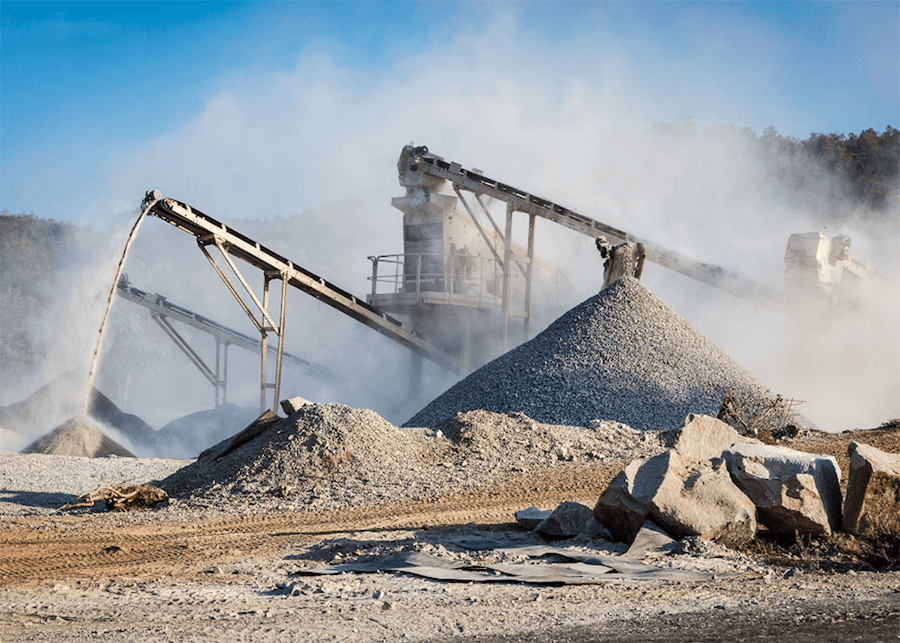
Vulcan and Martin Marietta are America’s two largest construction aggregate producers.
Together, Vulcan and Martin Marietta own and operate hundreds of mines across America that produce gravel, sand, and crushed stone – aka “construction aggregates.”
These raw materials are literally the foundation of highways, bridges, airports, offices, apartments, homes, and factories.
You are virtually guaranteed to have driven on a road made possible by the construction aggregates produced by Vulcan or MM. They are the giants of the industry.
Importantly, many of Vulcan and MM’s mines are in coveted locations near America’s major metropolitan areas. This is key because construction aggregates are very heavy and therefore costly to transport over long distances. Transporting $5 million worth of gold and transporting $5 million worth of gravel are two very different things.
Vulcan and MM’s stranglehold on the country’s best aggregate mines near major metropolitan areas is a significant advantage over their competitors.
Given how difficult, expensive, and time-consuming (or outright impossible) it can be to permit and develop a large gravel mine near a metro location, we can say both VMC and MLM own irreplaceable collections of scarce, in-demand resources.
Importantly, these scarce resources cannot be printed or “vibe coded” into existence.
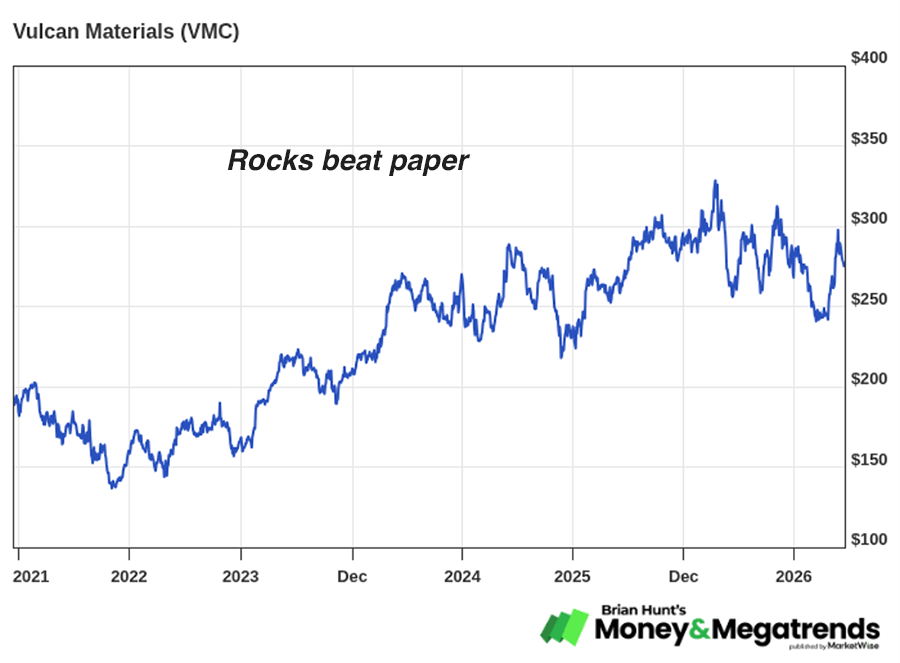
Those attributes are key to playing inflation defense. They’ve allowed the market values of VMC and MLM to rise and outpace dollar debasement over the past seven years.
You probably know why being vigilant against inflation is important: governments in most Western nations have promised far too many things to far too many people. They are spending far more on taxpayer benefits and wars than they collect in tax revenues.
The related debts and obligations governments have taken on cannot possibly be paid back with sound money. They can only be paid back with debased, devalued money… much of which is created out of thin air. This is driving inflation and significant currency debasement.
Prices are going up because the value of our money is going down.
Measured against a basket of widely used raw materials like crude oil, corn, copper, natural gas, sugar, and soybeans, the U.S. dollar has lost 48% of its value over the past eight years.
Owning a collection of gravel pits and sand mines isn’t as exciting as owning SpaceX or AI stocks.
However, if you want to play inflation defense by owning irreplaceable collections of scarce, in-demand assets whose prices can rise along with the rate of money creation, consider VMC and MLM.
Both stocks are getting a blue-ribbon endorsement from a world-class appraiser of asset quality.
Recommended Link:
Urgent AI Warning – Make this move before November 30

TradeSmith CEO Keith Kaplan’s firm has spent $17M building AI tools, and his platform is used by over 100,000 people. Now he’s issuing an urgent warning: the AI market is entering a dangerous new phase, and most investors are completely unprepared. He’s identified one critical move to make before November 30th — and he’s sharing it free in his new briefing. Get the full details now.
The most alarming chart in the world for technology investors
Credit: lucky-photographer
Over the past month, the AI world has produced some truly incredible figures indicating both strong current growth and the likelihood of strong growth in the near future.
For example, SpaceX (SPCX) announced it plans to spend $74 billion on AI computing centers. Amazon (AMZN) announced it is on track to spend $220 billion on AI-related capex in 2026. And Anthropic is on track to go public at a valuation of over $1.4 trillion.
However, all this news isn’t helping to alleviate a dark situation for the global benchmark technology index, the Nasdaq 100.
The Nasdaq 100 is the world’s most widely followed large technology stock index. It tracks 100 of the largest nonfinancial companies listed on the Nasdaq stock exchange.
The index is heavily weighted toward technology giants such as Nvidia (NVDA), Apple (AAPL), Microsoft (MSFT), and Meta (META).
The Nasdaq 100 includes some “non-tech” firms such as Walmart (WMT) and Costco (COST), but it is so heavily weighted toward tech stocks that it remains arguably the world’s most-cited gauge of tech stock performance.
The Nasdaq 100 index is also the index tracked by one of the world’s largest and most actively traded ETFs, the Invesco QQQ Trust (QQQ).
For years, QQQ has provided investors an easy “one-click” way to profit from bleeding-edge technology. Over the past 10 years, QQQ is up 497% vs. the “less tech-heavy” S&P 500’s 295% return.
The QQQ has made so many people so much easy money that it’s a treasured asset in many American households. It’s right up there with the family dog and the digital photo albums.
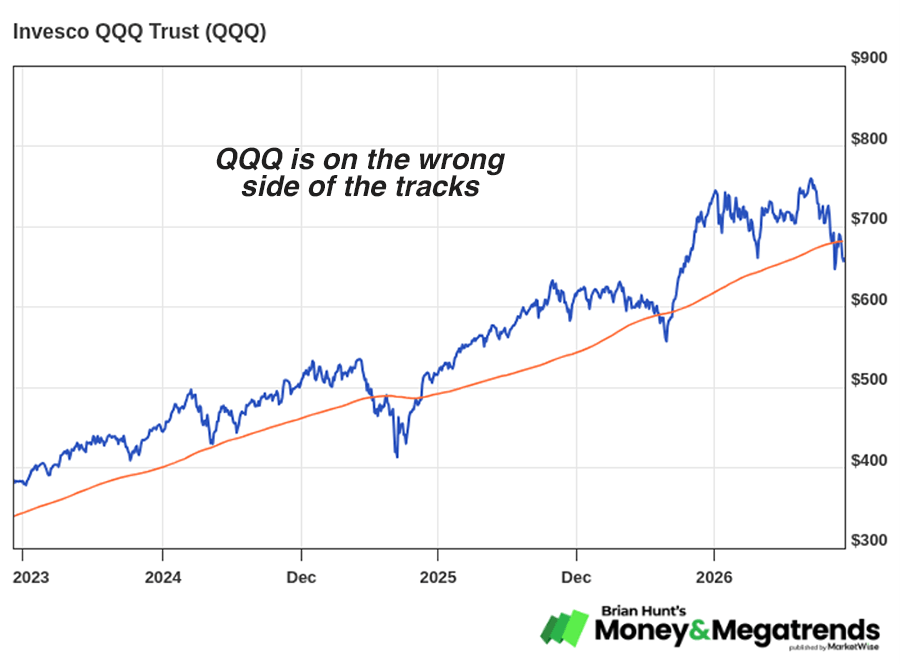
Although QQQ’s long-term returns are outstanding, its short-term performance is concerning. Since Oct. 6, QQQ is down 13.5%.
This decline has taken the fund below its 200-day moving average.
A moving average smooths out a stock’s daily price fluctuations by calculating its average price over a set period, such as 50 or 200 days. Investors use moving averages to identify trends and gauge momentum.
I use the 200-day moving average to gauge long-term trends. A security below its 200-day moving average is on the wrong side of the tracks. That’s the ugly part of town. All the really bad things happen below the 200-day moving average. QQQ is below it. This is the most alarming market news you’re not hearing in the mainstream financial press.
By itself, the QQQ breaking below its 200-day moving average isn’t reason to sell all your stocks, convert the cash to gold, move to the middle of Montana, and await the financial apocalypse. The fund could rip right back above it next week and restore health to the trend. It has done so several times in the past three years.
However, this is a red flag we’d be foolish to ignore.
If QQQ continues to trade below the 200-day moving average, we can say that the rising tide of money flowing into tech industries such as AI, robotics, and blockchain is receding. In that situation, the tech investor is swimming against the current rather than with it.
So, if you’re a long-term tech investor or a trader who likes to trade tech from the long side, keep this situation near the top of your watch list. The QQQ’s red flag is flying, and you’d be unwise to ignore it.
Here’s why gold should run higher, but isn’t doing it right now
Credit: Igor Barilo
Speaking of assets on the wrong side of the tracks…
I believe that in the future, gold and gold stocks will most likely be higher than where they are now. They will richly reward their owners someday.
But as we said about Bitcoin last week, they certainly are not doing it now.
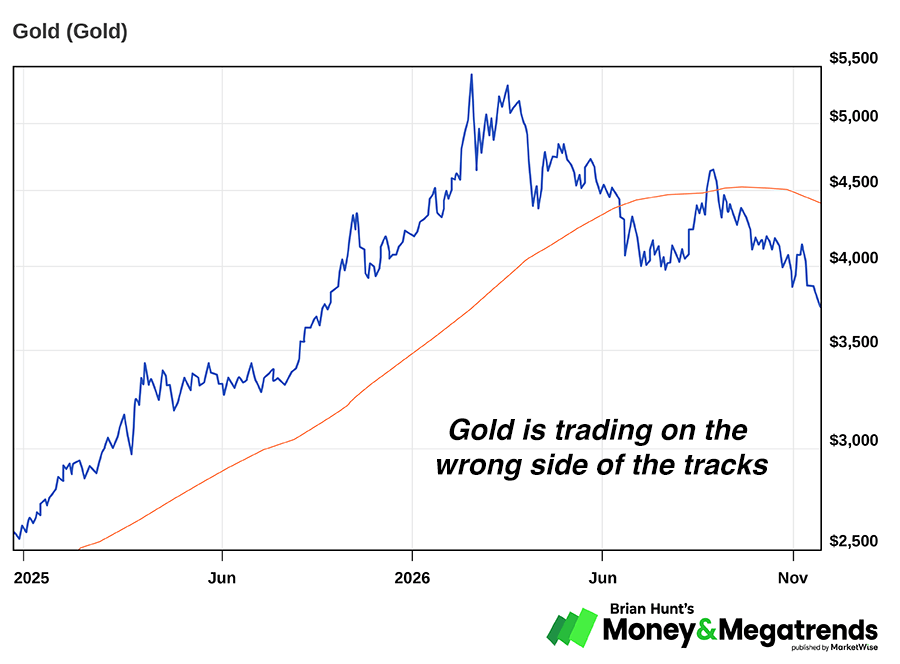
Like the QQQ detailed above, gold is below its 200-day moving average. Just as alarming, the yellow metal recently staged a downside breakout below a recent level of support and hit a new one-year low.
This is all deeply negative stuff for gold’s trend health. So, let’s review the situation…
In 2003, I placed over half of my net worth into physical gold. Since making that bet, gold has risen over 900%, far outperforming stocks. I haven’t sold one ounce along the way. Over the years, I’ve held huge positions in gold stocks.
And now, all these years later, the best reason I can find to be bullish on gold is the same reason why I bought gold in the first place…
The U.S. government is spending far more money than it takes in and then makes up the difference by borrowing and printing money by the trainload. Every freshly printed unit of currency debases an existing one. This raises the nominal price of real money (gold). Gold has spent the past 23 years constantly revaluing itself to accommodate the huge increase in the number of new currency units.
Here in late 2026, the problem is worse than ever. In America, millions of people are net tax recipients – meaning they receive more in benefits than they pay in taxes.
Plus, a huge portion of the population is employed directly or indirectly by federal, state, and local governments. There are too many people on the receiving side of government expansion.
This means no politician can win a major election by promising reduced spending. Too many people are now riding the gravy train. Democrat or Republican, it doesn’t matter. Campaigning on sensible spending is a sure loser.
This means making sure your financial life has a strong “inflation defense” component to it is a sound idea. This can include
When I provide guidance on inflation defense, I urge people to keep my number one rule in mind: own in-demand, useful assets that cannot be easily replaced or replicated.
That is inflation defense in a nutshell. You want to own assets, businesses, and properties that produce in-demand, scarce resources, products, experiences, and services.
This group of assets includes quality farmland, beachfront real estate, timberland, mountain-view properties, great businesses, and oil and gas pipelines.
When a very difficult or impossible-to-replicate business or property produces in-demand, scarce resources, products, experiences, or services, it tends to hold its value no matter what the dollar is doing.
Its price will constantly “recalibrate” to accommodate an increase in currency units. It’s like the difference between slicing a pizza into 6 or 8 pieces. The number of slices changed, but the amount of pizza is the same.
Gold is unique in that the “service” it provides is acting as real money that cannot be printed into existence. It has served in this role for over 4,000 years.
Although the long-term fundamentals are bullish for gold, anything can happen in the short term. Right now, expectations of Federal Reserve rate increases are boosting the value of the dollar, which is a negative for gold and Bitcoin.
So, although I’m long-term bullish on the yellow metal due to the intractable government spending, borrowing, and printing dynamic detailed above, I’d need to see gold regain its footing and trade back into the low $4,000-$4,200 area before I say this trend has healthy buying support. Like QQQ detailed above, this trend is high on our watch list. We will update you as it unfolds.
Market Notes
-
The American consumer continues to spend money with enthusiasm. Full-service restaurant giant Darden Restaurants (DRI) reached a new one-year high today.
-
Chinese technology giant Alibaba (BABA) reached a new one-year low today.
-
Cryptocurrency brokerage and infrastructure giant Coinbase (COIN) reached a new one-year low today.
-
Silver mining giant Pan American Silver (PAAS) reached a new one-year low today.
-
Quantum computing firm IonQ (IONQ) reached a new one-year low today.
-
Lithium mining firm Albemarle (ALB) reached a new one-year low today.
-
Bring back Jensen? AI giant Nvidia (NVDA) reached a new one-year low today. The stock is down 36% since early October.
Top Themes to Buy Now
💊 An important “tell” from the market.
🛢️ How the AI boom can pay you steady streams of income
🤖 This stock is the best way to invest in AI and robotics at the same time
Regards,


Brian Hunt
Editor, Money & Megatrends
An urgent message from our colleagues:
Forget SpaceX. THIS is Elon’s next BIG bet

Forget SpaceX. Elon’s next BIG bet is a radical “light-speed” device that’s turning AI into “Accelerated AI” – and making it 100 times faster and 100 times more energy efficient. The mainstream hasn’t caught on yet. But “Accelerated AI” stocks are breaking out as we speak: 133%, 217%, or even 320% or more… and it’s just getting started.
Click here to learn more about Elon’s next play and how to get ahead of it.