Listen to the audio version of this article (generated by AI).
Today’s issue in preview:
-
Three stocks to invest in the coming revolution in money
-
This country is a great AI investment vehicle you never considered. How to invest in it.
-
This bull market in energy is generating huge winners. Here are four good ways to invest.
-
Learn our Top Themes to buy now
Three stocks to invest in the coming revolution in money
Credit: ISerg
Back in March, we introduced our “Agent Supernova” megatrend thesis, which is poised to be one of the biggest business and technology trends of the next decade.
Years of development have made AI advanced enough to perform many everyday tasks people do now… and the list of tasks is only getting bigger.
In the next 12–24 months, AI agents will assist with managing factories… performing financial analysis… managing business inventories… writing software… designing websites… creating legal documents… and thousands of other things.
Within the next two years, the number of AI agents operating in the American economy isn’t poised to increase by 10X… or 50X… or even by 1,000X. Try at least 10,000X.
This is the coming Agent Supernova. Agents working with people. Agents working with other agents. Agents helping to run businesses.
The Agent Supernova is about to introduce billions of “AI workers” into our economy to perform all kinds of roles.
The business and investment implications are huge. The Agent Supernova will transform many businesses and industries, and end many as we know them… while creating new ones. The economic deck is about to get reshuffled.
The proliferation of AI agents offers all kinds of investable angles, but one of the most compelling is its impact on our financial system.
In multiple research notes, we have detailed how the Agent Supernova will drive a significant increase in stablecoin transaction volume.
You can think of dollar-backed stablecoins like dollars you spend online, only faster and more flexible. Stablecoins are digital dollars that can move on open blockchain networks, while conventional dollars in your bank account generally move through closed banking systems.
This aspect of stablecoins – that they are on blockchains and outside the conventional banking system – is very important.
Blockchain is a digital record-keeping system that stores transactions across a network of computers rather than in one central location. Once information is recorded, it is extremely difficult to change or erase. This allows people and businesses to securely exchange money or information without relying on a central authority to verify every transaction.
When you send $100 from one bank to another, the money may pass through banks, payment processors, and card networks. Those systems have operating hours, geographic boundaries, fees, and settlement delays.
With a stablecoin, $100 can move directly from one blockchain wallet to another, anywhere in the world, 24/7, with settlement often occurring within seconds or minutes. No recipient bank needs to be open. You don’t wait for a bank to approve a request to transfer money.
Stablecoins are particularly useful because the internet itself effectively becomes the payment infrastructure. Software and AI agents can also transact with stablecoins automatically, which could make them especially important for agent-based commerce.
Now, take what you know about stablecoins and apply it to asset ownership.
Think of society having a much faster, much cheaper, much more flexible system for recording and archiving who owns which asset… and a correspondingly better system for buying and selling assets.
This is the promise of tokenization, which is another compelling investable facet of the coming revolution in money, banking, and asset ownership.
Tokenization is simple. Take any real-world asset – a US treasury bond, a share in a private equity fund, a piece of commercial real estate, a share of AAPL, a corporate bond – and represent fractional ownership of it as a digital token on a blockchain.
Think of a blockchain as a record book that anyone can verify, but no single bank or government controls. It’s the ledger that makes digital ownership trustworthy without needing the middleman.
Instead of paper certificates of ownership, settlement agents taking a fee, and a multi-day clearing cycle, ownership becomes digital, with no human middleman, and practically instant.
A token of ownership can be transferred in seconds, fractionalized to a percentage of its original size, and plugged directly into a liquid market.
The market for tokenized real-world assets on public blockchains is already nearly $30 billion in 2026. But that number is purely a proof of concept. Forecasts from the likes of Boston Consulting Group and McKinsey assert this market is headed towards the $16-$30 trillion range in the next 5-8 years.
That’s a 433x increase in potential tokenized assets. That’s the same order-of-magnitude leap the internet made from a niche experiment to global infrastructure.
And for even more proof, Larry Fink – the CEO of BlackRock and one of the most powerful figures in finance, with over $11.5 trillion in assets under management – has consistently advocated for tokenization.
In his 2025 annual letter to investors, he described tokenization as “the next generation for markets.”
“If we could digitize every asset, we could have a more seamless way of going from a digital wallet to ownership of real assets.”
He’s not alone in this view, and some major institutions are already on board. Kinexys, J.P. Morgan’s enterprise blockchain and digital asset business unit, has now processed over $1.5 trillion in tokenized transactions. Franklin Templeton has a tokenized fund across multiple blockchains.
The bigger the impact a megatrend can have on our world, the bigger the capital gains it can generate in your portfolio. This is why tokenization, as a subset of the Agent Supernova, is such a big opportunity.
Here are the most interesting stocks to play this theme:
Coinbase (COIN): COIN is a $50 billion company that is “everything crypto” and tokenization is also a key part. COIN’s Base blockchain, which we covered in the context of stablecoins, is also becoming the settlement layer for tokenized assets. As the amount of tokenized assets grows, BASE will win as the underlying infrastructure.
COIN also provides custody infrastructure – think of this as the digital vault where institutions will safely store their tokenized assets. Just as a bank holds your cash, COIN will hold tokenized assets on behalf of the world’s biggest funds and financial institutions.
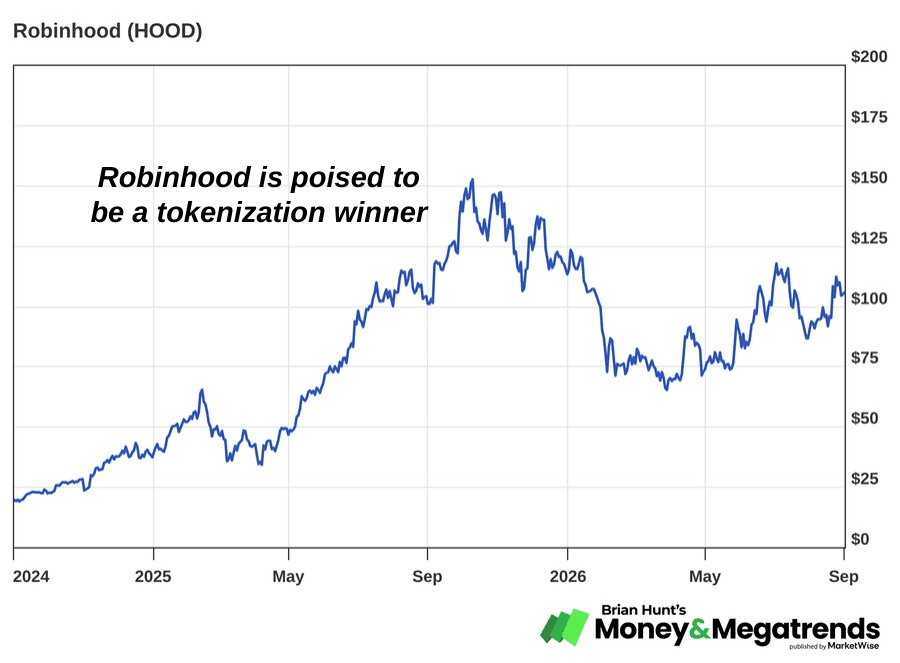
Robinhood (HOOD): HOOD is a $100 billion giant, and the leading traditional brokerage in the tokenization race today. In July 2026, HOOD launched its own blockchain, called Robinhood Chain. CEO Vlad Tenev has described tokenization as an “unstoppable freight train” coming to “take over the entire financial system.” HOOD’s edge in the race is that it already has over 24 million funded accounts and a huge generation of retail investors on the platform. Tokenization right now needs distribution, and that’s exactly what HOOD offers.
Securitize (SECZ): SECZ is a $1 billion company and the purest play on tokenization infrastructure in the public markets today. It’s the platform that powers BlackRock’s tokenized money market fund, called BUIDL, Franklin Templeton’s tokenized offerings, and dozens of other tokenization projects.
It is essentially the entity that tracks who owns what, issues tokens on-chain, and oversees the compliance and infrastructure layers that make tokenization legal. As tokenization becomes the norm, SECZ will be the pure play doing all the work behind the scenes.
You can also consider investing in the cryptocurrency Ethereum (ETH).
Ethereum is the blockchain on which most tokenized assets actually live. So as the volume of tokenized assets grows, more activity will flow through Ethereum’s network, and more demand will be created for ETH.
By owning a cryptocurrency such as ETH, you own the asset that powers and helps secure the network, rather than a stake in a company that owns the network.
In the AI-driven revolution in money and finance, stablecoins are the payments layer, and tokenization is the asset layer. Together, they’re the twin foundations of a financial system being rebuilt from the ground up, and we’re still very early.
Recommended Link:
September 3: Major Turning Point for SpaceX?

Thanks to a recent $45 billion deal with AI giant Anthropic, Elon’s closely guarded – and closely watched – AI lab in Tennessee is now SpaceX’s single largest revenue line. According to reports from Barron’s, Bloomberg, and CNBC… this entirely different company (name and stock symbol revealed here) is one of the biggest beneficiaries of Elon’s AI spending spree. This could translate to huge returns for investors who get in now. But you have to move quickly. It’s scheduled to make a huge announcement at 4:30 PM Eastern on September 3 – and everybody on Wall Street will be tuning in. Click here to get the name and ticker symbol of Elon’s #1 AI supplier.
This country is a great AI investment vehicle you never considered. How to invest in it.

Credit: isitsharp
Over the past month, we have detailed how many members of the critical resources complex have recently reached new one-year highs or have displayed strong short-term trend performance.
This list includes copper miners, which recently reached a new all-time high. It includes agricultural commodities, which recently reached one-year highs. It includes oil and gas firms, which recently reached new highs.
These strong performances help make the case that we’re in a favorable environment for Brazilian stocks.
Back in September 2025, I detailed the bullish price action in Brazilian stocks and recommended owning them. At the time, I noted that Brazil was a good way to invest in the uptrend in critical resources.
Critical resources are the building blocks of the economy. Think raw materials like crude oil, natural gas, iron ore, copper, corn, and cotton.
Mining, extracting, planting, harvesting, processing, refining, and transporting these critical resources is a multi-trillion-dollar business that drives the economy.
With technologies like AI changing the world, it’s easy to forget about critical resources as an asset class. But when they enter uptrends, those uptrends tend to last a long time, and they tend to go higher than most people think is possible.
For many professional investors, Brazil is a preferred way to play commodities in the stock market. It is a true commodity superpower.
Brazil is the world’s largest producer of soybeans, sugar, and coffee. It’s a major producer of cattle, cotton, corn, and orange juice. It’s a major producer of iron ore and crude oil. This makes the Brazilian economy and stock market heavily “geared” towards resource markets.
Brazil is also a beneficiary of the historic AI infrastructure spending boom.
Given AI’s enormous promise, large tech firms such as Alphabet (GOOG), Amazon (AMZN), and Microsoft (MSFT) have invested over $1 trillion in specialized semiconductors, data centers, and other AI infrastructure components. They are on pace to invest over $700 billion this year alone and more than $3 trillion after that.
Both the scale and the velocity of this investment boom are unprecedented. It is the largest collective investment effort of all time.
Brazil’s extensive river network also makes it a major producer of hydroelectric power. This makes it an attractive destination for power-hungry AI data centers. Brazil also has large reserves of rare earth elements. Demand for these raw materials is soaring, driven by growth in AI infrastructure, robotics, and defense tech.
To add a cherry on top of this bullish cake, Brazil has a big-spending, deep-pocketed trading partner in the United States. U.S. companies can buy all the compute and rare earths that Brazil can bring to market.
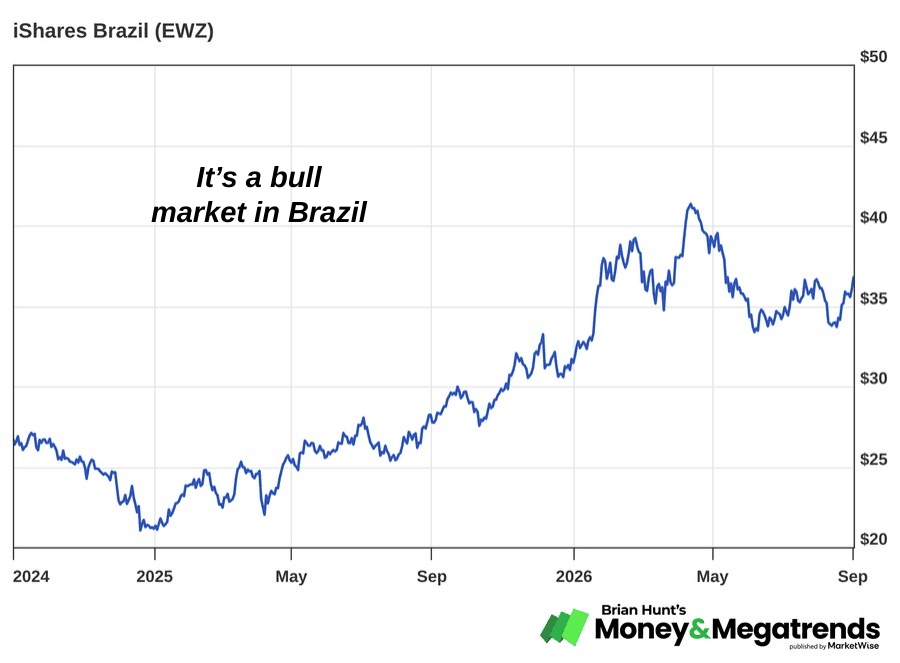
Soon after my September note, Brazilian stocks – via the iShares Brazil ETF (EWZ) – surged 38% in less than seven months. It then experienced a natural, healthy bull market correction from mid-April to mid-June.
As you can see in the chart below, this correction has ended. Brazilian stocks have paused, refreshed, and are now bolstered by a variety of strong individual resource trends. I’m still bullish on Brazil.
This bull market in energy is generating huge winners. Here are four good ways to invest.

Credit: Stock87
In yesterday’s issue, we pointed to the fresh all-time high in oilfield services giant SLB (SLB) as evidence that the business of finding and producing oil outside the Middle East is in a strong bull market.
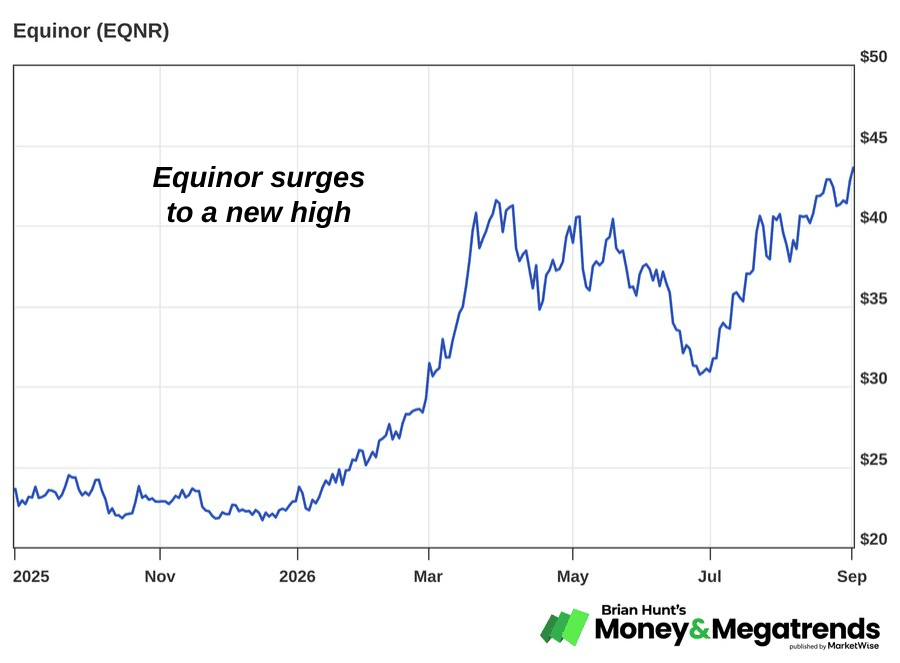
Today, we received further confirmation of this bull market via the new all-time high in Equinor (EQNR).
Equinor is one of the largest and most important companies that most people have never heard of. It is the largest Norwegian company and one of the world’s largest oil and gas firms. The bulk of its production comes from enormous fields off the coast of Norway and in the North Sea.
Equinor is also Europe’s largest “non-Russian” producer of natural gas. It is something of a “national champion” of Norway, with the government there owning a large stake in the company.
My friend and colleague Eric Fry has pointed out that the last detail is a significant financial opportunity for Equinor. Not only is Equinor a producer of “not Middle Eastern” energy, but it is also a producer of “not Russian” energy. Conflicts raging in both Ukraine and Iran make Equinor’s production extremely valuable from both a business and a geopolitical position. As Eric recently stated:
Before the [Ukraine] invasion, Russia supplied roughly 40% of the natural gas Europe consumed annually. Norway was a distant second, supplying 20% to 25%. But as European countries have spent the past four years phasing out Russian supply, they have been phasing in Norwegian supply. Equinor sits directly in the path of that substitution, and it has not squandered the opportunity.
As Europe has scrambled to secure “non-Russian” natural gas supplies, Equinor has begun supplying the continent with around 25% of its gas needs. This makes it Europe’s largest individual gas supplier. The revenues and earnings generated from this position have helped power the stock to a new all-time high and an 85% return over the past year. (Eric has scored a huge win with the stock in his Fry’s Investment Report.)
As I’ve covered over the past five months, for many countries and businesses, the Iran War is a brutal reminder: If your survival or smooth operation depends on uninterrupted resource flows from the Middle East, you are in a dangerous, vulnerable position. The same goes for Russian oil and gas assets that are either sanctioned or being crippled by Ukraine.
No politician, CEO, or major shareholder wants their business to be in that position. No citizen wants their country to be in that position. Many powerful and influential people are realizing this is a big risk that must be mitigated if humanly possible. Executives and politicians will get fired for not addressing it effectively.
This means building and buying as many forms of “not Middle Eastern” and “non-Russian” resource supply chains as possible economically… like those from safe, resource-rich Canada, Norway, and Brazil. It means lots of oil exploration off the shores of South America, Africa, Mexico, and eventually the Arctic shelf.
With the recent surges in SLB and Equinor in mind, I repeat my big-picture takeaway: It’s a bull market for finding and producing oil and gas in safe, secure locations. Bullish for Canada. Bullish for Brazil. Bullish for offshore drillers. Bullish for Norway!
Market Notes
-
The Iran War and its constriction of Middle Eastern oil supplies continue to work to the advantage of U.S. oil refiners. Industry giants Marathon Petroleum (MPC), Phillips 66 (PSX), HF Sinclair (DINO), and Valero Energy (VLO) reached new all-time highs today.
-
The VanEck Oil Refiners ETF (CRAK) also hit a new high today.
-
LNG shipping leaders are hitting new highs. Pyxis Tankers (PXS) just hit a new high as it rose +12% today, and BW LPG (BWLP) is nearing highs again.
-
The Boomer health care theme continues to generate winners. Pharma giant Pfizer (PFE) reached a new one-year high today.
-
Solar manufacturer Array Technologies (ARRY) and Jinkosolar Holding (JKS) just hit new lows. ARRY is now down 52% in the last year.
Top Themes to Buy Now
⛏️ Here’s why silver could resume its explosive uptrend
Regards,


Brian Hunt
Editor, Money & Megatrends
An urgent message from our colleagues:
SpaceX ‘Dark Energy’ Replaces Foreign Oil

For years, we’ve been told SpaceX is a rocket company. But according to new satellite images from 300 miles above the Earth’s surface, there is something very strange going on at SpaceX right now that has nothing to do with space. It could soon replace our need for foreign oil forever and ignite a $10 trillion boom for the stocks involved.
Click here to learn more.