
Listen to the audio version of this article (generated by AI).
Today’s issue in preview:
-
How to trade the world’s most important trend
-
This chart shows why you should be bullish and buy stocks
-
Why you should be bullish on Bitcoin right now
-
Learn our Top Themes to buy now
How to trade the world’s most important trend

Credit: KanawatTH
The world’s most important trend just got a big boost from Nvidia (NVDA).
Last night, the world’s largest semiconductor firm reported extraordinary second-quarter results that came in well ahead of estimates.
Nvidia CFO Colette Kress said that the company expects revenue growth of 70% for fiscal 2028, which goes from February 2027 to January 2028. CEO Jensen Huang said demand “is much greater than 70%,” but Nvidia is constrained on how much product it can supply.
In response to this good news, Nvidia shares climbed 7.5% during the morning trading session. It also sent the VanEck Semiconductor ETF (SMH) up 2.17%.
Over the past month, we have published a special series of research notes analyzing the semiconductor trend, a key part of “the world’s most important trade.”
The status of this critical tech sector has become one of the great sagas of the business and investment world… a source of intense disagreement among industry bulls and bears.
The semiconductor industry has always been a critical part of our high-tech economy. Semiconductors are the “tiny engines” that power our computers. However, the proliferation of AI has turbocharged the industry’s revenues, stock prices, and importance to the global economy. It has also made industry leader Nvidia a $5+ trillion colossus. The stock is up more than 1,300% since Jan. 1, 2023.
In June 2025, semiconductor stocks broke out of a sideways consolidation pattern and began a rally for the ages. During this rally, the world’s largest semiconductor ETF – SMH – gained 147% in just under a year.
Individual semiconductor leaders AMD (AMD), Marvell Technology (MRVL), and Lattice Semiconductor (LSCC) gained more than 200% during that time. Stock gains of 25% in a month became commonplace.
When a sector gains 50% in a year, that’s considered incredible. What semis returned was “triple incredible.”
Avid Money & Megatrends readers know what drove those giant returns. Given AI’s enormous promise, large tech firms such as Alphabet (GOOG), Amazon (AMZN), and Microsoft (MSFT) have invested over $1 trillion in AI infrastructure. They are on pace to invest over $700 billion this year alone and more than $3 trillion after that.
Both the scale and the velocity of this investment boom are unprecedented. It is the largest collective investment effort in history.
A lot of this money was used to purchase semiconductors. Semiconductor industry revenue totaled $793 billion in 2025, an increase of 21% year-over-year, according to Gartner, Inc.
Big Tech’s historic investment boom has made the entire “AI infrastructure” trend responsible for a large share of America’s GDP growth and stock market returns over the past two years. It has also drawn the skeptical scrutiny of many widely followed investment analysts who claim the trend is a bubble… one that will soon explode and cause tremendous damage to stock prices and the global economy.
I believe the AI infrastructure trend has years to run. I believe the world’s smartest, most connected tech CEOs who have the greatest access to information on AI advancement and return on AI infrastructure spend like Jensen Huang, Satya Nadella (Microsoft) and Andy Jassy (Amazon) just might know more about this business than the bearish armchair AI quarterbacks know.
As much press as AI gets, let’s remember that less than 1% of the global population pays for top-tier AI programs. And I estimate less than 20% of large companies believe AI has made a meaningful impact on their businesses. It’s probably closer to less than 10%.
This revolutionary technology hasn’t yet proliferated, achieved mass adoption, or had mass impact.
Regular readers know I care a lot more about what the market thinks of any stock, trend or theme than what any one person thinks of it, including me. You can be bullish or bearish on a trend all you like, but if that trend is moving strongly against you, then your idea isn’t worth a hell of a lot in my book.
With this in mind, let’s look at industry giant Nvidia’s effect on the state of semis. The semiconductor sector is our preferred way to track and analyze the hugely consequential AI infrastructure megatrend.
Given its AI drivers and big returns, it’s no wonder semis became the world’s “hottest trade” this summer. And when any theme becomes the world’s hottest trade, it becomes a leading candidate to experience a significant correction or something worse.
That’s just how the stock market works. When a bull market grows very popular and attracts a lot of speculation, it likes to “buck off” market participants with a sharp correction or worse.
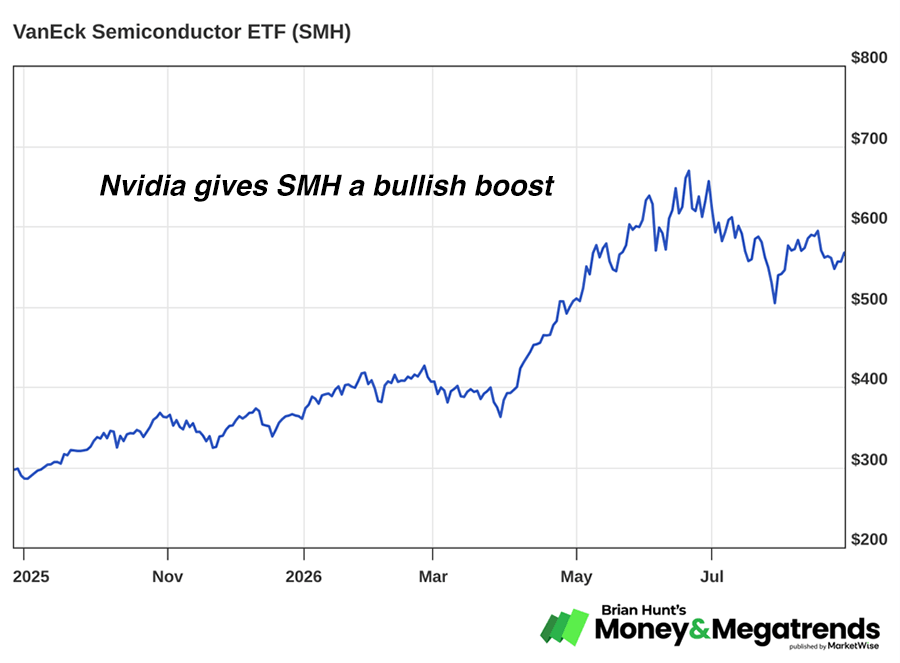
That’s what has happened to the semiconductor trade this summer. After soaring from June 2025 to June 2026, SMH declined 24%. Some individual semi names declined by more than 35%.
As you can see in the two-year chart below, the SMH share price declined from the mid-$600s to the mid-$500s. Since reaching a low in late July, SMH has traded up and down, failing to establish a meaningful trend. In other words, “becalmed” as described above.
In my July 20 health analysis of SMH, I stated that if long-term AI bulls are proven right by the market, SMH will likely “digest” its summer losses by trading in a sideways consolidation pattern for 3-6 months… and then recover to trade back to the mid-$600 area and beyond.
If the AI bears are right, SMH won’t see that mid-$600-per-share level for years… and we are much better off focusing on other trends.
As you can see in the chart below, SMH is getting a boost today… but it is still trading in a directionless sideways consolidation pattern. If the current rally can take SMH back to the $620 level, we can say this critical trend is enjoying restored health. We will keep you updated.
Recommended Link:
Tonight, Louis Navellier Closes the Doors

Until midnight, you can claim a full year of Louis Navellier’s brand-new research… the project that ended his 47-year run as Chief Quant Analyst… at 60% off. It’s a totally new approach to the AI boom, built with Eric Fry and Luke Lango – one the team believes could realistically double your entire portfolio in the years ahead. Doors close at midnight. Until then, click here for the full details.
This chart shows why you should be bullish and buy stocks

Credit: Art Wager
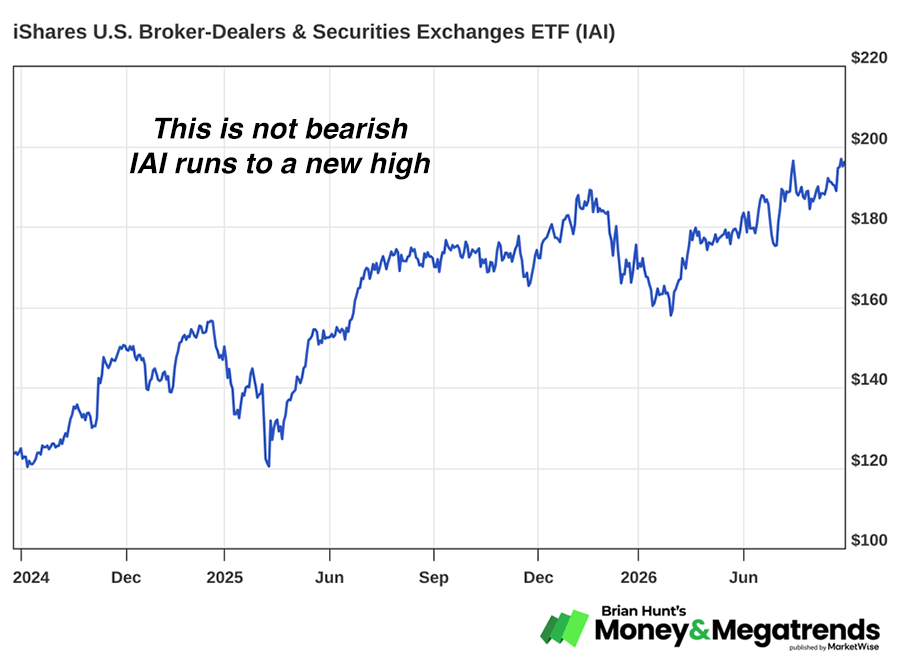
If you’re looking for reasons to be optimistic on the U.S. economy and U.S. stocks, look no further: The iShares U.S. Broker-Dealer & Securities Exchanges ETF (IAI) recently registered a new all-time high.
This is a bullish signal for America… and for your 401(k).
Since the current bull market began in 2023, a whole doom-and-gloom industry has been built on bearish stock and recession forecasts. Anyone who listened to the “prophets of the apocalypse” and avoided stocks has missed a historic wave of wealth creation. The bears have sounded clever, but they’ve been very, very wrong.
Sure, the U.S. economy has imbalances and problems. But it also has tremendous forces working in favor of prosperity. Energy independence. Food independence. The world’s most dynamic system for creating and funding new businesses. The world’s largest and most innovative technology industry. A system that rewards hard work, risk-taking, and value creation.
These “forces for good” are manifesting themselves in IAI’s all-time highs.
IAI is a unique ETF focused on companies in the business of money flows… companies that function as the business and investment world’s “circulatory system.”
The fund includes investment banks, securities exchanges, stock brokerages, financial index providers, and credit rating agencies.
Major holdings include diversified giant Goldman Sachs (GS), fellow giant Morgan Stanley (MS), brokerage firm Charles Schwab (SCHW), brokerage firm Robinhood (HOOD), credit rating agency Moody’s (MCO), and financial exchange giant CME Group (CME, formerly Chicago Mercantile Exchange).
These firms provide the grease and gears that make the world’s financial markets engine go. They eventually get a substantial “cut” from all kinds of financial activities, such as IPOs, 401(k) management, option trades, stock index administration, ETF management, stock purchases, commodity transactions, wealth management, debt issuance, and credit ratings.
Their fortunes rise and fall with the health of global financial markets. The new highs reached by their ETF are a bullish economic signal. The fund has returned a stellar 57% over the past two years.
Over the past 10 months, I’ve written over a dozen research notes analyzing the soaring share prices of highly economically sensitive industry groups, including trucking stocks, regional banks, manufacturing stocks, diesel engine makers, steelmakers, shopping mall operators, and hotel chains.
At the end of each note, I pointed to their soaring stock prices and told readers that the U.S. economy is doing much better than most people think.
This exceptional price strength in key components of America’s economic machine means the economy is doing much better than the news you hear from the mainstream media.
We can add IAI’s new highs to this long list of positive market trends. The business of money, investment, and corporate finance is booming. Manage your financial affairs accordingly!
Why you should be bullish on Bitcoin right now

Credit: Vertigo3d
Minute by minute… day by day… things keep getting a little better for Bitcoin bulls.
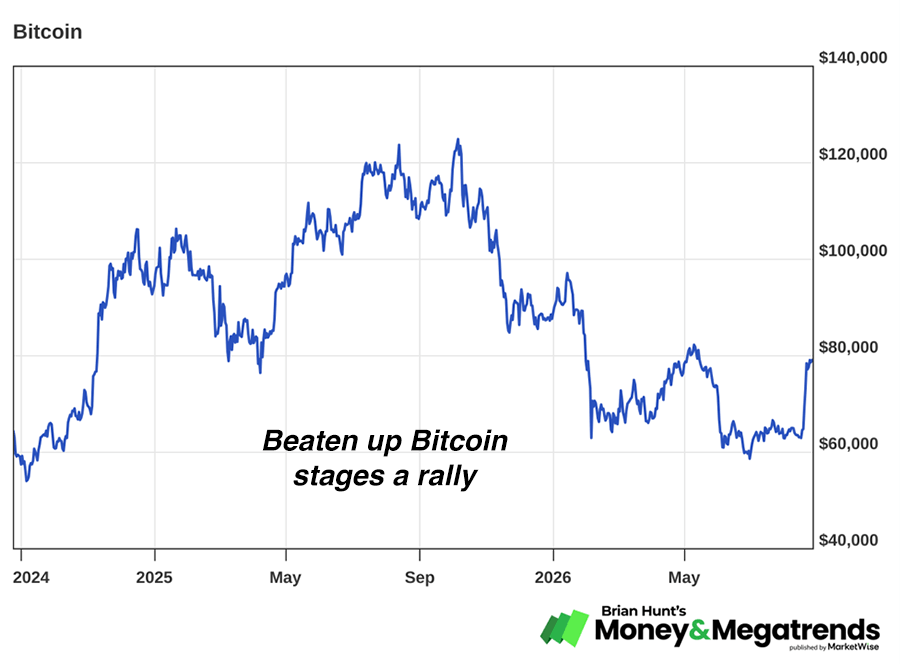
This week, the beaten-up cryptocurrency rallied to reach $80,000 – its highest price in three months. This action gives me confidence in saying that our bullish March 13 note was well-timed.
After reaching an all-time high of around $125,000 last October, Bitcoin entered a brutal bear market, declining by about 48% to the mid-$60,000 range.
Crypto specialists attributed this decline to the U.S. government withdrawing liquidity from financial markets, as well as to gold and AI trades drawing money flows that could have been directed toward Bitcoin.
Most long-term Bitcoin believers see it as a “store of value” that should maintain its purchasing power like gold and beachfront homes do. It should be a digital form of “hard money.” Sounds great.
However, from October 2025 to February 2026, Bitcoin traded more like a failing technology company than anything you’d call strong and stable.
In March, Bitcoin’s trading behavior underwent a significant change. It formed a bottom and gained 9.5% in one month, while technology stocks dropped and gold gained just 3.2%. Importantly, Bitcoin outperformed stocks and gold as Operation Epic Fury created tremendous market volatility and hammered many sectors of the stock market. It was a “port in the storm.”
Importantly, Bitcoin recently rallied above its long-term 200-day moving average. This is a good sign of an improving health trend. Remember what we say about the 200-day moving average around here: Securities below their 200-day moving average are on the wrong side of the tracks. It’s the ugly part of town. All the really bad things happen below the 200-day moving average. Bitcoin just broke about it.
So, after a year of disappointing believers, has Bitcoin regained its place as a “store of value”? Is it ready to be a “port in the storm” and a stabilizing component of serious portfolios? I hope so. The world is a better place when Bitcoin is rising, and we have not one but two forms of hard money to own. Plus, I like it when the “crypto bros” get chirpy on X and antagonize the skeptics.
Count me bullish on Bitcoin and its new rally.
Market Notes
-
Our recommendation to invest in cybersecurity is paying off nicely. Okta (OKTA) just reached a new yearly high, and Palo Alto Networks (PANW) is up 10% today. PANW is now +150% since our March recommendation.
-
Our recommendation to invest in the genomics megatrend continues to pay off. Cancer genomics leader NeoGenomics (NEO) just hit a new high. It’s now up 166% in the last month. Genomics analytics giant Illumina (ILMN) reached a new one-year high.
-
Global and community banks are showing strength. Japanese investment banking giant Nomura Holdings (NMR) and community lender Private Bancorp of America (PBAM) reached new highs today.
-
Our Oct. 2, 2025, recommendation to own the natural gas theme is doing very well. The US Natural Gas Fund (UNG) just hit a new high, as individual names like Range Resources (RRC) have gained around 7.5% this month.
Top Themes to Buy Now
🔌 This “AI Power” trade is moving higher… are you on board?
Regards,


Brian Hunt
Editor, Money & Megatrends
An urgent message from our colleagues:
Wall Street veteran goes ALL in on Bank of Elon

A 20-year Wall Street veteran – who worked at a $10 billion hedge fund – is putting ALL his money in Elon Musk’s new bank. He says he can see the writing on the wall for traditional banks. And he’s not the only one.
See if you should join him here (not just for the 6% yield).