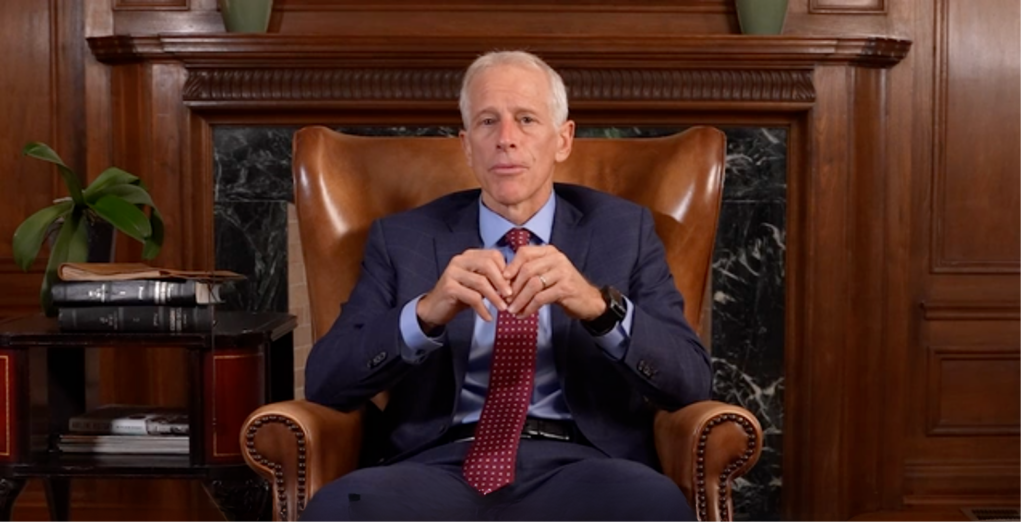

Image Credit: Associated Press
Listen to the audio version of this article (generated by AI).
In Tolkien lore, the “palantíri” were indestructible dark crystals used to “see” across vast distances telepathically. The stones themselves weren’t necessarily dangerous. But the person who controlled them could be a major threat… Alex Karp, who named his company after these stones, seems to wield this massive power. And Wall Street is hanging on his every word.
This past Monday, Aug. 3, Palantir Technologies (PLTR) reported an “otherworldly” quarter as revenue accelerated to its fastest pace ever. At the same time, U.S. commercial sales grew 149% year-over-year, and management lifted full-year guidance by roughly half a billion dollars.
The next morning PLTR stock rose about 30%, its largest single-day move in years, and closed back above a technical line it had failed to hold all year. So, is Palantir stock a buy? Karp’s conference call seemed to answer with a simple idea: in the age of interchangeable frontier AI models, the value goes to whoever holds the stone.
And right now, that’s Palantir.
Palantir’s Q2 2026 Earnings, by the Numbers
Palantir posted second-quarter revenue of $1.935 billion, up 93% year-over-year, its highest growth rate as a public company. Adjusted earnings came in at 41 cents per share against consensus near 35 cents, the ninth straight beat. GAAP earnings also reached 41 cents, a sign the profits were real rather than a product of adjustments.
The U.S. business is what carried the quarter. U.S. commercial revenue surged 149% to $764 million. U.S. government revenue grew 90% to $809 million. Combined, U.S. revenue reached $1.573 billion, up 115%, now more than 81% of the total.
The forward-looking metrics have changed how analysts are modeling the company.
Net dollar retention climbed to 157%, up 700 basis points from the prior quarter, meaning existing customers spent 57% more than they did a year earlier. U.S. commercial total contract value bookings hit $2.132 billion, up 153% and nearly $800 million above the prior record. Adjusted operating income was $1.194 billion, a 62% margin. Adjusted free cash flow reached $1.22 billion, a 63% margin. The company’s Rule of 40 score, which adds revenue growth to profit margin, reached 155%, well above the 40 threshold considered elite.
Management raised full-year 2026 revenue guidance to a range of $8.15 billion to $8.158 billion, roughly 82% growth at the midpoint, up from $7.65 billion to $7.66 billion. The company also guided U.S. commercial revenue above $3.424 billion, at least 134% growth. “This quarter was otherworldly,” Karp said in the release.
Palantir’s “SaaSmageddon” and Why Better AI Makes PLTR More Valuable
On the other side of the AI boom, one particular “anti-trend” dominated the discourse for much of 2026: “SaaSmageddon.” The idea is simple: if AI agents can do the same work as certain software, then enterprises will opt for the AI over a per-seat subscription model.
By SaaStr’s measure, software’s forward price-to-earnings (P/E) multiple collapsed from 84.1 times at the 2020-2022 peak to 22.7 times by March 2026, the first time the sector traded below the S&P 500 on that basis. Salesforce (CRM) fell about 30% and Workday (WDAY) fell 33% over that same stretch.
Initially, Palantir itself was part of the SaaSmageddon thesis, with investors worried the company would be eaten alive by frontier AI. But Karp turned that criticism of his company on its head, going to the media to argue that raw model access is the commodity, and value only goes to the layer that connects AI models to proprietary data and workflows.
This layer is what Palantir calls its “Ontology,” which is wrapped in its Artificial Intelligence Platform (AIP) and staffed with engineers who deploy at client sites. Take its partnership with Nvidia (NVDA): Palantir runs Nemotron models air-gapped in customer-controlled environments. And, as Karp notes, more and more enterprises are refusing to become “vassals” of the large-language labs.
Bottom line: The cheaper AI models become, the more valuable the plumbing (the layer that governs and connects AI to enterprise operations) becomes. If you needed evidence of that, look no further than the 157% net dollar retention metric Palantir posted this quarter. If SaaSmageddon were affecting Palantir, customers would not be expanding their usage. This marks the first quarter with hard evidence against that thesis.
Is Palantir Stock Still a Buy After Its 30% Pop?
Palantir’s recent earnings surge repaired some of the technical damage to the stock, but PLTR is still down ~13% as of this writing. Let’s talk about this a bit before getting to the meaty bits.
PLTR stock peaked around $207.52 in November 2025, before collapsing throughout 2026 and bottoming near $106 in June. That’s a ~49% drawdown from Palantir’s highs. Heading into earnings, shares were still close to a 30% shave YTD. Palantir stock formed a death cross when it fell below its 200-day moving average (MA) in February. After earnings, the stock is back above the 200-day MA (around $153). Nevertheless, it’s still below its old high, so there’s more room for PLTR to run.
After the recent quarter, several analysts lifted (or affirmed) their Palantir stock price targets. Citi’s Tyler Radke lifted his target to $245 from $200, Mizuho to $215, and D.A. Davidson to $200, while Bank of America reiterated its Street-high $255 target. Deutsche Bank’s Brad Zelnick upgraded the stock to “Buy” at $200, calling Palantir “a time traveler, having already arrived in the AI future others are still aspiring towards.” Per TipRanks, the consensus is a “Moderate Buy” across 21 analysts, with a pre-surge average target near $187 to $189.
On the road to $200+, Palantir’s nitrous boost, if you will, is the sovereign AI argument. That is, if enterprises and governments increasingly reject frontier AI labs in favor of AI they own and control, then it is Palantir that’s best-positioned to be the operating layer for such demand.
Still, the risks involved with investing in Palantir stock cannot be overstated.
The first big risk is valuation.
Even after the drawdown and even on raised guidance, PLTR trades near 43 to 50 times forward sales, against a software peer group closer to five times enterprise-value-to-revenue. RBC’s Rishi Jaluria kept an “Underperform” rating with a $90 target, writing that PLTR “remains the most expensive stock across our RBC All-SaaS universe at ~40x EV/CY26” and that “we struggle to underwrite a scenario that justifies current valuation levels.” Morningstar’s Mark Giarelli pegs fair value at $153, below where the stock closed after the pop. A move from a 77-times forward P/E down to a still-rich 40 times, with no change in estimates, would roughly halve the stock.
The second big risk is political contagion.
On Aug. 5, the Centre for International Corporate Tax Accountability and Research published an analysis, commissioned by European public-service unions, estimating Palantir’s global effective tax rate at 1.4% on pre-tax profit of about $1.66 billion, with under $21.7 million in global net corporate tax and zero U.S. federal tax in 2025, achieved by booking European revenues in the U.S. parent. Unison’s Andrea Egan said “systems that enable tax to be shirked on an industrial scale clearly have to change.” But Palantir calls this sort of transfer pricing “entirely standard practice.”
That’s not all, however.
The European backlash to Palantir is pulsating and tangible. Germany’s domestic intelligence service, the BfV, picked French firm ChapsVision over Palantir, the German army cut ties entirely, France’s Thales is courting Belgium, the Netherlands and others, and Palantir is suing London’s Mayor’s Office for Policing and Crime (MOPAC) after losing a Metropolitan Police contract. All the while, a £330 million NHS contract faces parliamentary pressure. As such, Palantir’s international revenue slipped to roughly 19% of the total in Q2, from 26% a year earlier. For a company billing itself as selling sovereignty, there’s an irony in being the sovereign no European nation actually wants.
So again, is PLTR stock a buy? Going only off Palantir’s growth, it’s an album with a story told in two sides:
The A-Side: An American growth machine and sovereign AI beneficiary.
The B-Side: A European trust deficit.
The verdict: Palantir delivered the quarter the bulls were waiting for, and the fundamental case is stronger than at any point in its history. But the valuation now prices in flawless execution, and the European resistance caps the global ambition the multiple assumes. PLTR is a buy for investors who can hold through 20%-plus swings and who are buying the operating layer rather than the price. For everyone else, the layers around Palantir are cheaper
3 Palantir Alternatives to Buy
If data and workflow layers increase in value the more frontier models are commoditized, then there are several stocks to buy that own those layers at a fraction of Palantir stock’s multiple. Here they are, in no particular order:
PLTR Alternative No. 1: Snowflake (SNOW)
Snowflake is the proprietary-data layer. Its fiscal Q4 2026 product revenue grew 30% to $1.23 billion, remaining performance obligations jumped 42% to $9.77 billion, and net revenue retention held at 125%. More than 9,100 accounts use its AI weekly, and consumption pricing means revenue scales as AI workloads grow. It trades near 12 to 14 times forward sales, rich for software but well below Palantir. The catch is GAAP losses and a forward P/E near 124. Clean, governed data is the fuel every enterprise AI system needs, and Snowflake stores it.
PLTR Alternative No. 2: ServiceNow (NOW)
ServiceNow is the workflow and agent-orchestration layer, what CEO Bill McDermott calls the “AI control tower.” Q2 2026 subscription revenue grew 24.5% to $3.877 billion, AI annual contract value crossed $1 billion for the first time, and agentic AI production deployments grew ninefold in nine months. The stock fell about 37% in 2026 on the same SaaSmageddon fear, leaving it near 5.8 times enterprise-value-to-revenue, a discount that looks misplaced against accelerating growth. As enterprises deploy fleets of agents, someone has to govern them. ServiceNow is building to be that someone.
PLTR Alternative No. 3: MongoDB (MDB)
MongoDB is the operational data backbone of AI-native applications. Fiscal Q4 2026 revenue grew 27% to $695.1 million, Atlas grew 29%, and the company posted its first GAAP-profitable quarter. Its document model plus integrated vector search and Voyage AI embeddings puts it under the applications developers are building on top of models. It trades far below Palantir’s revenue multiple.
The Bottom Line on Palantir Stock
Palantir’s earnings, much like the palantíri seeing-stones, do not lie. The company is more valuable than ever to enterprises, especially those who wish to free themselves from frontier model vassalage.
Yet, the road ahead for Palantir stockholders isn’t clear of wheel-breaking stones. Both the valuation question and the resolution to the European backlash still encircle the company. For the remainder of 2026, Alex Karp needs to prove that the company selling sovereignty is sovereign in its own right.
Editor’s Note: What ever happened to the AI stock boom? Even AI darlings like Nvidia have essentially gone nowhere since summer 2025. Our friend and colleague at InvestorPlace, Louis Navellier, may have the answer. According to Louis, the AI industry is quietly “staging” ahead of the next great AI breakthrough… a new class of AI he calls “Superintelligence… but better.” How will it trigger a $100 trillion reset of the AI markets. How will the launch of this tech send some stocks to zero, and others soaring? And why does Louis say: Don’t buy or sell an AI stock in 2026 until you see what’s coming next? Go here for the full story (and Louis’ #1 pick).
Is Palantir Stock a Buy? Your Questions Answered (FAQ)
Is Palantir stock overvalued? By conventional measures, yes. At roughly 43 to 50 times forward sales, it is among the most expensive large-cap software stocks, and bears like RBC see fair value near $90. The counter is that Palantir grows several times faster than peers with 60%-plus margins, which no traditional software comparison captures.
Is it too late to buy Palantir stock? It is too late to buy it cheap. It closed near $162 after the pop, below its $207 high but far above its June low near $106. Investors buying now are paying for years of execution, and the technical reclaim of the 200-day moving average argues the trend has turned.
What are the best alternatives to Palantir? For exposure to the same “own the layer” thesis at lower multiples: Snowflake for data, ServiceNow for workflow and agent governance, and MongoDB for the operational backbone.
Will Palantir stock keep going up in 2026? Analysts lean yes, with a median target near $200, but the range runs from $90 to $255, which tells you how uncertain the answer is. The upside needs continued triple-digit U.S. commercial growth. The downside is a valuation reset or a widening European backlash.