Image Credit: MarketWise
Listen to the audio version of this article (generated by AI).
Wall Street veteran Whitney Tilson has spent decades hunting for one thing…
A business so durable, and so hard to copy, that an investor could build an entire retirement portfolio around it.
For years, his answer was Warren Buffett’s Berkshire Hathaway (BRK-B).
Whitney owned shares… recommended the company to his friends, family, and readers… and even flew to Omaha for 27 of the past 28 Berkshire annual meetings.
But today, he says he has found a business that could deliver even bigger, more durable returns… and keep delivering for decades.
Whitney calls it “America’s Greatest Retirement Stock.”
It’s a company that most investors have never heard of. It has barely more than 100 employees and sits on a stretch of West Texas and New Mexico bigger than the size of Rhode Island.
Now, Texas might make you think about oil…
But this company doesn’t drill wells… doesn’t own a data center… or generate any power. Instead, it owns the ground beneath one of the largest industrial build-outs in modern American history.
And every single time someone wants to use that ground… this company collects a payment.
Whitney recently took a helicopter out to see it for himself… Click here to watch his exclusive investigation.

Or read on as we dig into this compelling opportunity…
Table of Contents
Why You Should Buy America’s Greatest Retirement Stock
Before we get to the company itself… and yes, Whitney reveals the name and ticker symbol free of charge, which we’ll cover below… it helps to understand why he’s making such an extraordinary claim in the first place.
After all, this is a legendary investor who spent nearly two decades running hedge funds in Manhattan. And for most of his career, he told anyone who would listen that Berkshire Hathaway was the single best place to park retirement money.
He hasn’t turned against Berkshire, exactly. In his free daily letter this January, Whitney highlighted several of his favorite stocks for 2026. There, he noted Berkshire’s share price was trading at about a 7% discount to its intrinsic value, concluding that:
At that price, I view Berkshire as a comfortable hold, not a buy.
And sure enough, so far this year, Berkshire has traded in a fairly tight, go-nowhere range.
More recently, as the stock pulled back to near its lows in May, Whitney did a full analysis of Berkshire stock, upgrading his advice slightly…
The stock is trading at a 14.6% discount to my estimate of intrinsic value.
So, in the past year, Berkshire has swung from being 8.9% overvalued to 14.6% undervalued. That’s why it wasn’t attractive then – but is today.
I’m especially bullish because in addition to today’s discounted stock price, I’m optimistic that [new CEO Greg] Abel can create value via operational improvements and capital allocation.
This combination leads me to believe that Berkshire’s stock is highly likely to beat the S&P 500 [Index] over the next five years, perhaps by a margin of two to three percentage points. So if the S&P 500 compounds at 5%, I would expect Berkshire to do roughly 7% to 8% – with a bias toward the upside.
That’s a solid outperformance expectation… But if you’re putting new money to work for the next 10 or 20 years, Whitney believes there’s a better option.
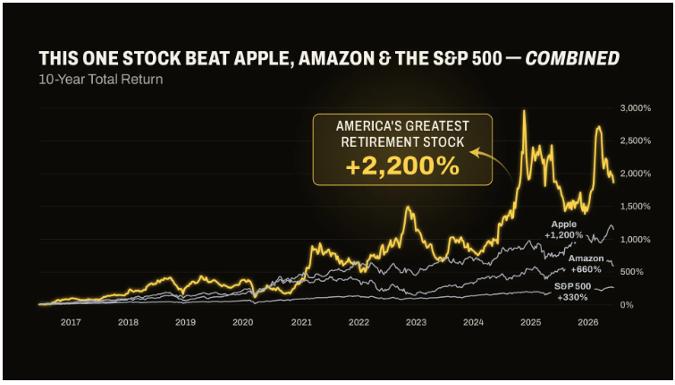
This single stock returned more than 2,200% over the past decade. Over that same stretch, he notes, the S&P 500 returned about 330%, Amazon (AMZN) returned about 660%, and Apple (AAPL) returned about 1,200%.
By his math, this single company beat Apple, Amazon, and the S&P 500… combined.
The question is… can it do it again?
Can This Company Turn $10,000 Into $220,000?
This company operates what Whitney calls the world’s most profitable tollbooth.
It’s a surprise beneficiary of two industries that the federal government is now treating as matters of national security… artificial intelligence (“AI”) and energy. Plus, it overlaps with a third resource that almost nobody on Wall Street is watching.
The core business of America’s Greatest Retirement Stock is simple: It owns land… And it leaves the hard work to everyone else.
When an oil giant pumps crude from under its land, the company collects a royalty.
When someone pulls natural gas from the same ground, another royalty.
When a tech giant wants to build on the surface, it pays lease and easement fees.
And when anyone needs water out in that desert… sure enough, they buy it from this company, too.
That’s four separate streams of income, just from owning a big patch of dirt. And because the company operates like a tollbooth, it hardly has any costs.
As a result, this company’s business model produces incredible numbers…
It carries no debt, has averaged gross margins of around 90% for the past five years, and converts more than 60 cents of every dollar in revenue into pure profit.
All that cash has to go somewhere. That’s why, while the company pays a regular quarterly dividend like many blue chips, it also pays a special dividend once or twice a year to shareholders that can run 5 to 10 times the size of the normal payout.
By Whitney’s count, an investor who held 1,000 shares would have collected more than $45,000 in total dividends in 2024 alone… and roughly $146,000 over the past six years.
Of course, those amounts depend entirely on when you buy and how much you own. But the point is that this is a business that gushes cash and hands it back to its investors. And Whitney expects it will keepdoing so, just as it has through the many booms and busts over the past century.
And right now, the heavyweights are taking notice…
Eric Schmidt, the man who ran Alphabet’s (GOOGL) Google for a decade, jumped in this past December. He’s building massive AI data-center campuses on this exact stretch of West Texas land. Schmidt explained his reasoning in an interview with Fortune magazine earlier this year:
Energy is the main constraint in scaling AI. If we want to keep America competitive, we have to solve this problem… We realized that combining my technical expertise with [this company’s] unrivaled land, abundant water, and access to low-cost energy could create the infrastructure needed to meet the virtually infinite demand for compute.
One of the most connected technologists alive looked across the entire country for the best place to solve AI’s biggest problem… and picked this company’s land.
Add it all up, and Whitney lands on an extraordinary projection. He believes a $10,000 investment in this company today could grow into $220,000 over the long term. (You can watch his full interview by clicking here.)
That’s not a guarantee, of course. But Whitney argues that number could even prove conservative if the build-out he witnessed in Texas keeps accelerating.
So let’s dig into the details that Whitney believes will drive the next decade of gains…
The Largest Construction Boom in American History
America’s Greatest Retirement Stock, according to Whitney Tilson, is Texas Pacific Land (TPL).
It owns roughly 882,000 acres across West Texas and southern New Mexico, with most of that footprint sitting in the Permian Basin… the most productive oil basin on the planet. As Fortune noted, that’s more acreage than the entire state of Rhode Island.
For years, that land mostly just sat there… Then came the shale revolution, and the royalty checks started rolling in. And now, something even bigger is happening…
On his first full day back in the White House, President Donald Trump stood beside three of the most powerful men in technology… OpenAI’s Sam Altman, Oracle’s (ORCL) Larry Ellison, and SoftBank’s (SFTBY) Masayoshi Son… and announced a venture called Project Stargate.
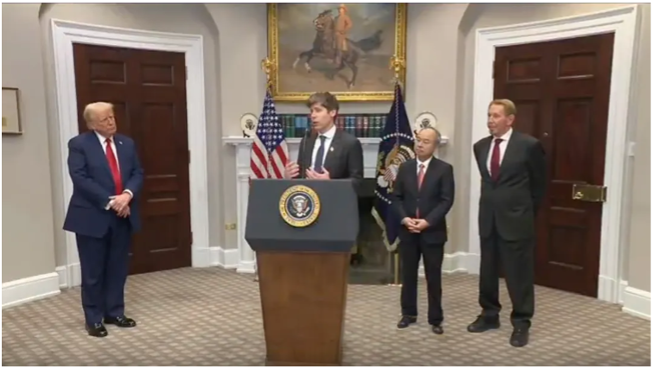
The plan calls for up to $500 billion of AI infrastructure spending in the U.S. by 2029.
Trump framed the program as a response to a national emergency, and promised to use executive orders liberally to clear the way for the construction permits and power plants the facilities will need.
And right now, the first Stargate data-center campus is going up outside Abilene, Texas.
The campus now covers ground equal to about 750 football fields, with plans for enough electricity to power 750,000 homes. And just down the road, the Pentagon is pouring $1.6 billion into Dyess Air Force Base to prepare it for the B-21 Raider, America’s new stealth bomber.
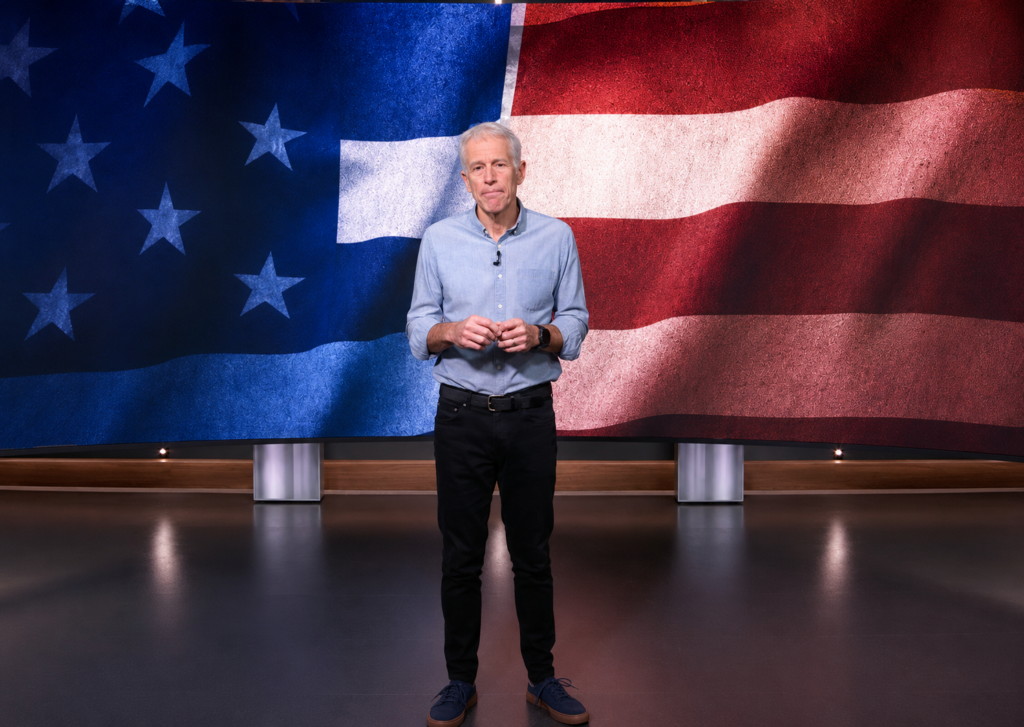
Whitney flew to Abilene with his research team, then rented a helicopter to see all this construction from the air. His guide was an old friend and longtime source – third-generation Texas wildcatter Charles Schroeder… who everybody simply calls “Cactus.”
Cactus lives in Abilene and drives past these sites every day. As Cactus notes in Whitney’s interview:
It’s like it pops up overnight… Those construction people are working 24/7. They have lights. They work all night, they work all weekend.
AI spending by the biggest tech companies is expected to jump 71% this year alone, from roughly $380 billion in 2025 to an estimated $650 billion in 2026, according to my colleague Jim Royal’s analysis of the major tech companies. Whitney pegs spending by the five biggest players at nearly $700 billion this year.
And this stretch of West Texas is ideal for four reasons, as Whitney notes:
Vast open acreage… cheap and abundant power… massive water supplies… and the right geology – rock formations that hold the natural gas needed to power these projects.
America’s Greatest Retirement Stock controls all four on nearly a million acres… in the exact region where all of this is happening.
In addition, West Texas is remote… There’s almost nobody around to object to these massive projects. The permit fights and lawsuits I noted in my data-center backlash coverage mostly happen where data centers crowd against suburbs.
Out past Pecos and Abilene, the nearest angry neighbor might be a herd of cattle.
It’s no surprise that land values out there have gone vertical. When Cactus started working this land decades ago, Whitney says, ranch land changed hands for $300 to $500 an acre. Today, AI companies are paying as much as $50,000 an acre.
Of course, TPL isn’t selling…
Instead, the company collects its surface leases, easements, and access fees… keeping its ownership of the dirt underneath. And a tech giant building a data center stuffed full of billions of dollars of chips is one of the “stickiest” long-term tenants out there.
But as big as the land story is, Whitney believes Wall Street is missing an even bigger opportunity…
Every Data Center Needs Water
A single large data center can consume up to 5 million gallons of water per day… about the same as a city with 50,000 residents.
And dozens of these data centers are planned for West Texas…
That’s another big opportunity for TPL. Over the years, it has built one of the largest water operations in the Permian Basin.
Oil drillers were TPL’s original customers. Every fracked well needs massive volumes of water to get the oil out. And now, data centers are lining up for access, too.
That helped TPL’s water sales volumes cross 1 million barrels per day earlier this year, for the first time in the company’s history.
And one man was focused on water long before most on Wall Street…
Remember that Eric Schmidt deal we mentioned earlier? As Whitney puts it in his documentary:
As part of the joint venture, America’s Greatest Retirement Stock holds the right of first refusal to supply water to every project built through the partnership.
In other words, Schmidt agreed to make this company his water supplier – for every facility he builds.
Even Schmidt himself called out this company’s “abundant water” as one of the key reasons he made this $150 million bet.
Mark my words: Within 24 months, Wall Street analysts will be valuing the water business of America’s Greatest Retirement Stock alone at billions of dollars. Right now, most of them barely mention it.
Already, TPL’s water business – through water sales and produced water royalties – made up nearly half of its revenue in its latest fiscal year. And it’s growing fast.
The chart below from the company’s recent investor presentation compares its net income for its land and resource operations with its water business…
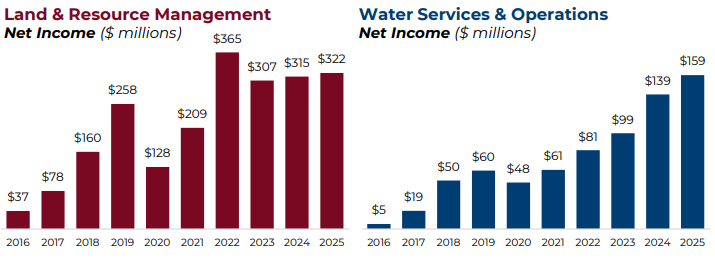
The kind of repricing that Whitney is expecting can move TPL stock massively.
And of course, we still haven’t gotten to the company’s true focus…
Royalty Checks on Both Oil and Natural Gas
TPL’s vast acreage is in the Permian Basin, where ExxonMobil (XOM) and Chevron (CVX) run some of their largest operations. So when those oil majors pull crude oil from under TPL’s land, the company collects a royalty on every barrel.
It’s one of the world’s best businesses…
While an oil producer has to spend millions on drilling holes and hiring crews, a royalty business like TPL that owns the land just collects a check. That makes royalties one of the cleanest hedges for inflation, rising energy prices, and a falling dollar.
But Whitney believes TPL’s oil royalties are only part of the story now… and that its natural gas income stream is about to surge.
AI data centers require electricity on a scale the American power grid simply cannot deliver. Whitney’s presentation puts the average wait to connect a large new facility to the grid at more than eight years. That’s not a realistic time frame for hyperscalers trying to win the AI race.
My colleagues and I have been tracking that same bottleneck across our research network for the past year. As I wrote in my “Dark Energy” guide to the AI power crunch:
The U.S. power grid can’t keep up with AI’s electricity demands.
Mainstream publications like the Wall Street Journal and the Washington Post have called the current U.S. grid “archaic” with “onerous and outdated” regulation and years of underinvestment.
The North American Electric Reliability Corporation (“NERC”), the body responsible for ensuring grid reliability, has warned of growing risks of widespread blackouts. The Department of Energy is also projecting sharp increases in blackout risk by 2030.
So, to power its data centers, Big Tech companies have stopped waiting and started building their own power plants… typically fueled by natural gas.
In Texas alone, natural gas power projects in development will add nearly 58 gigawatts of new generating capacity. For comparison, that’s more than the annual peak demand of the entire state of California. And most of that new capacity – 40 gigawatts’ worth – was specifically planned to power data centers.
And this summer, the biggest behind-the-meter deal yet landed right in TPL country.
My colleague Nick Koziol detailed the agreement shortly after it was signed:
Project Kilby is expected to consume about 2.7 gigawatts (“GW”) of power. According to CNBC, that’s enough power to fuel more than 2 million homes. Construction hasn’t started just yet. The data center is expected to start receiving power in 2028.
Chevron has a large footprint in the Permian Basin in West Texas and southeastern New Mexico. This allows it to quickly and efficiently supply power to Texas data centers like Project Kilby, says Jeff Gustavson, Chevron’s president of New Energies, in a statement announcing the deal.
Follow the money on this kind of deal, and you can watch TPL cash in on every single one of its four main royalty streams…
- When Chevron pulls Permian gas to fuel its turbines, TPL collects a percentage.
- When Microsoft (MSFT) builds its data center on leased TPL land, it collects a rent check.
- When millions of gallons of water are used for cooling the chips inside the data center, TPL’s water business gets paid.
- And when pipelines and power lines cross TPL’s acreage to supply these data centers, the company also gets paid easement fees.
And its customers are some of the richest corporations on Earth, spending money at a pace investors couldn’t have imagined just a few years ago. Whitney puts it like this in his exclusive presentation:
In nearly 20 years of running a hedge-fund firm, I’ve analyzed thousands of businesses. I have never seen anything like this one.
It has no debt… nearly $500 million in annual free cash flow… more than 60 cents of every revenue dollar converted into net profit… and remarkably low operating expenses – because this company doesn’t drill, doesn’t build, and doesn’t lay pipe.
It makes deals and turns those assets into cash.
You don’t have to guess which AI company wins. You don’t have to pick the best oil driller, either. You can simply buy TPL and enjoy its regular royalty stream as the AI race grows more frenetic.
Of course, while TPL is a great way to play this trend over the long term, Whitney also points to potentially much bigger gains to be made in the short term, too…
How to Make Even Bigger Gains From the Commodity Supercycle
Now, the one commonality across TPL’s royalty streams is that they’re largely focused on hard assets… land, oil, natural gas, water.
Commodities.
And right now, Whitney believes we may be at the beginning of the biggest commodity supercycle of our lifetimes.
His presentation charts more than 100 years of commodity prices against the stock market and identifies four prior stretches when hard assets became radically undervalued compared with the stock market… 1929… the late 1960s… the late 1990s… and now. (Click here to read the transcript from Whitney’s briefing – this link does not go to a long video.)
In each cycle, he says, the best resource investments handed early buyers gains of 500%, 1,000%, or more… even as ordinary stocks stagnated.
Take the late 1960s and early 1970s…
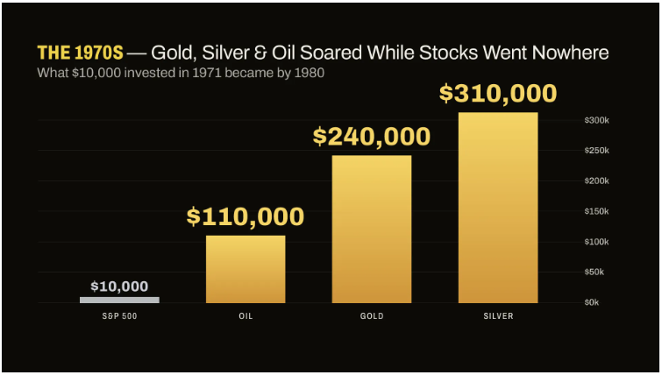
By his figures, silver exploded 3,000% in the following decade, gold soared 2,300%, and oil climbed 1,000%… while the S&P 500 went nowhere for 10 straight years.
And today, commodities are currently trading near the cheapest levels of the past century. Whitney charted out 120 years of commodity prices with the stock market in his presentation:
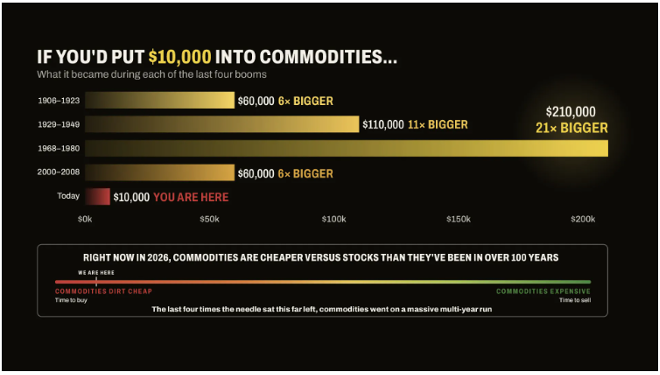
Why is this supercycle kicking off right now? Whitney points to three specific catalysts:
First, a decade of starved supply has sent prices higher. Mining exploration budgets have collapsed about 40% from their 2012 peak, and oil and gas capital spending has fallen from $900 billion in 2014 to $570 billion in 2025.
Second, demand is exploding, courtesy of the AI build-out we covered above. Every data center needs massive amounts of electricity, copper, steel, and fuel.
Finally, the dollar itself is under pressure. Gold has been shattering records as central banks swap Treasury bonds for bullion, a trend Whitney notes has topped 1,000 tonnes of official annual gold purchases for three consecutive years.
When paper money weakens, hard assets tend to rise. And TPL may be the hardest asset of them all… land that gets paid royalties from oil, gas, and water… located smack-dab in the one place America’s biggest companies are spending trillions.
What Investors Should Do Today
Whitney believes commodities are the single best thing you can own in the world today.
And he has the credentials to back up that claim…
- As a former hedge-fund manager, he grew $1 million into a collection of funds worth more than $200 million.
- He has helped his readers get into stocks like Netflix (NFLX) at 78 cents, adjusted for stock splits, before it soared more than 11,000%… Apple at 38 cents, before it climbed 80,000%… and Amazon at $2.80… before it went on a 9,000% run.
- And he has been featured in practically every major financial publication and TV show, including two appearances on CBS’s 60 Minutes to announce a major stock exposé.
After leaving the hedge-fund world, Whitney moved into investment research and education and now heads a team of analysts at one of the largest independent financial publishers in the world.
There, he shares his highest-upside opportunities with tens of thousands of subscribers… including at least five paid-up billionaires.
And of course, Whitney is offering a full 30-day money-back guarantee for all new subscribers. So you can give his research a try without a long-term commitment today.
Or, if you’d prefer to skip a long video, click here to get immediate access by going directly to the Commodity Supercycles order page.