

When markets drop, many investors face a split-second choice: panic or pounce. MarketWise recently surveyed 1,000 US investors to find out who’s actually buying the dip, how they’re doing it, and whether it’s paying off. For anyone who’s ever watched a downturn unfold and wondered whether to hold, fold, or go all in, this data offers a clearer picture of what separates the active investors from the wishful thinkers.
Key Takeaways
- 45% of US investors bought the dip in the past 12 months, with Gen Z investors the most likely to do so (53%).
- 65% of investors who bought the dip within the first few days say they came out ahead, compared with 55% of investors who waited 2-4 weeks to buy.
- Gen Z investors went in hardest and profited the least, committing the biggest slice of their portfolio (17%) and buying the dip more than any other generation, yet only 54% came out ahead.
- Gen Z was the most likely to feel excited during the last market downturn (30%), yet the least likely to feel confident in their dip-buying strategy (13%).
- 36% of US investors have panic-sold during a downturn and watched the market recover; Gen Z is the least likely to panic-sell (33%).
- 54% of investors who bought the dip say they made the decision in the moment with no advance plan.
- 27% say “not buying the dip when I had the chance” is their biggest regret about the market downturn.
The Intention Gap: Many Want to Buy the Dip, But Few Have a Plan
Most investors say they’re ready to act when markets fall, but readiness and preparation are two very different things.
When asked how they respond to a market downturn, U.S. investors shared the following:
- 26% intend to buy the dip but don’t always follow through.
- 25% have bought the dip before but don’t do it consistently.
- 19% actively try to buy the dip whenever they can.
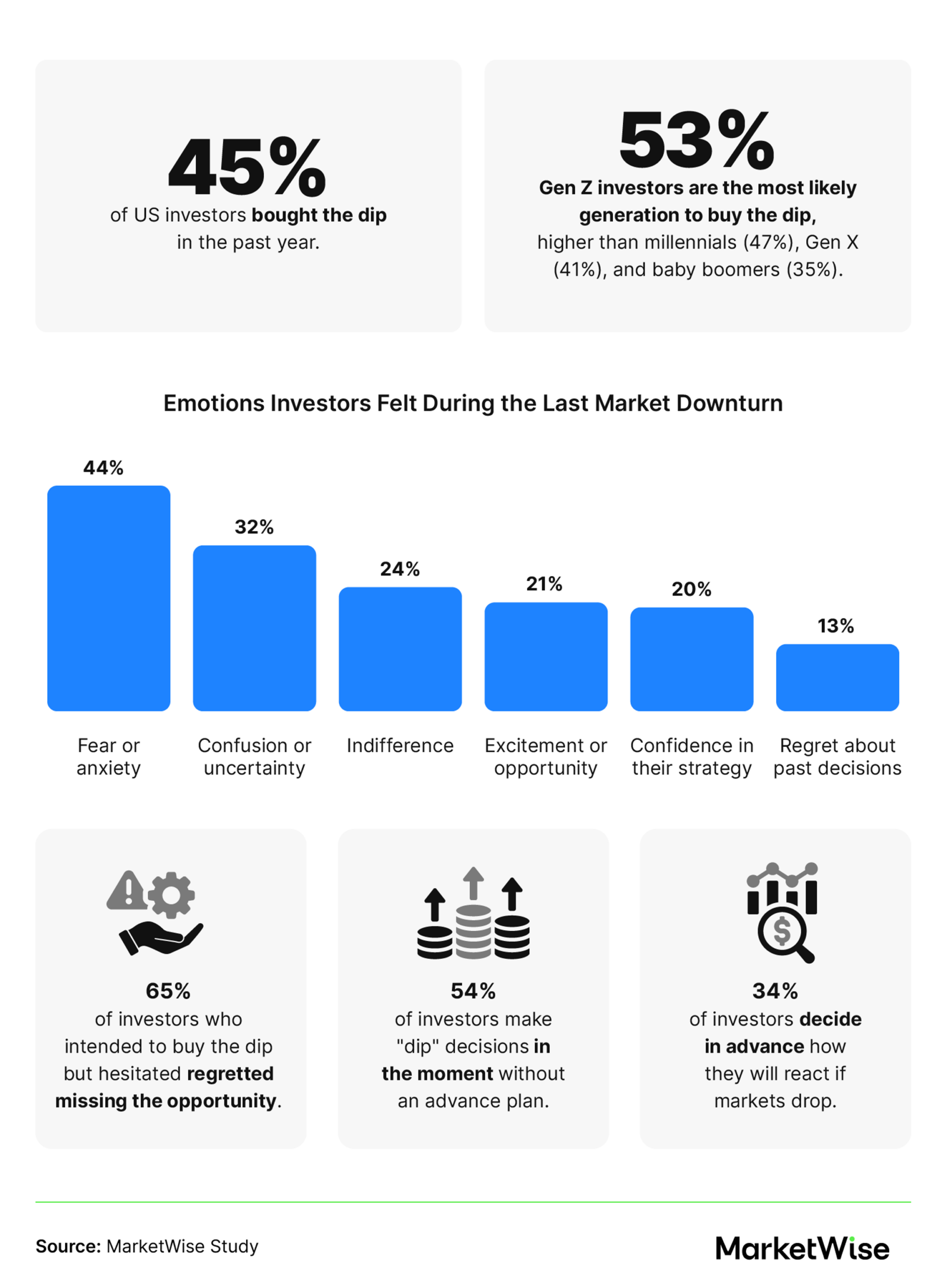
In the past 12 months, 45% of all American investors reported buying the dip at least once. Male investors bought the dip at a rate 57% higher than female investors (55% versus 35%). Only 34% of these buyers had a strategy in place beforehand, while 54% made dip decisions entirely in the moment.
The generational spread tells an interesting story, with younger investors being more likely to buy the dip than older ones. Gen Z investors (age 18–29) led all groups in dip-buying participation at 53%, followed by millennials (age 30–45) at 47%. This dropped to 41% among Gen X investors (age 46–61) and 35% among baby boomers (age 62–80).
The dominant emotion among US investors during the last downturn was fear or anxiety, reported by 44% of respondents. That’s nearly double the rate of those who felt excitement or saw opportunity (21%).
Gen Z was the most likely generation to feel excited during the downturn (30%), yet the least likely to feel confident in their dip-buying strategy (13%). In other words, Gen Z is the most eager to jump in, but also the least sure they’re doing it right.
Timing and Tactics: What the Winning Dip Buyers Actually Did
Among those who acted, outcomes varied considerably based on when they bought, what they bought, and how much they committed.

Overall, 63% of dip buyers reported that they came out ahead. Another 20% roughly broke even, 13% were still holding and unsure of their outcome, and just 4% reported losing money. The majority of those who bought the dip had a positive experience, and nearly all of them would do it again.
A full 97% of dip buyers said they’d repeat the strategy, though opinions varied on how:
- 42% would do it the same way.
- 24% would act sooner.
- 21% would invest more
- 9% would choose different assets.
Among investors who bought within the first few days of a decline, 65% reported coming out ahead, compared with 55% among those who waited 2 to 4 weeks. This underscores a theme in market history: recovery often begins before most investors feel comfortable acting. Early movers capture more of the rebound.
Individual stocks were the most popular vehicle for dip-buying, chosen by 47% of buyers. ETFs came in second at 20%, followed by crypto at 17% and index funds at 13%. On average, dip buyers allocated about 15% of their portfolio value to purchases during downturns, a meaningful but not reckless commitment.
Gen Z, however, committed an average of 17% of their portfolio, the highest of any generation, and yet reported the lowest success rate at 54%. More capital, more confidence issues, and fewer years of market experience may all be contributing factors.
Regret, Panic, and What Investors Wish They’d Done Differently
The flip side of dip-buying success is the sting of inaction, and the data shows that regret runs deep across every generation.
The most common regret among American investors wasn’t panic-selling, it was not buying the dip when they had the chance. A total of 27% cited missed dip-buying as their top market downturn regret, edging out both panic-selling regret (20%) and buying-too-early regret (20%). Sitting on the sidelines, it turns out, feels worse than getting in too early.
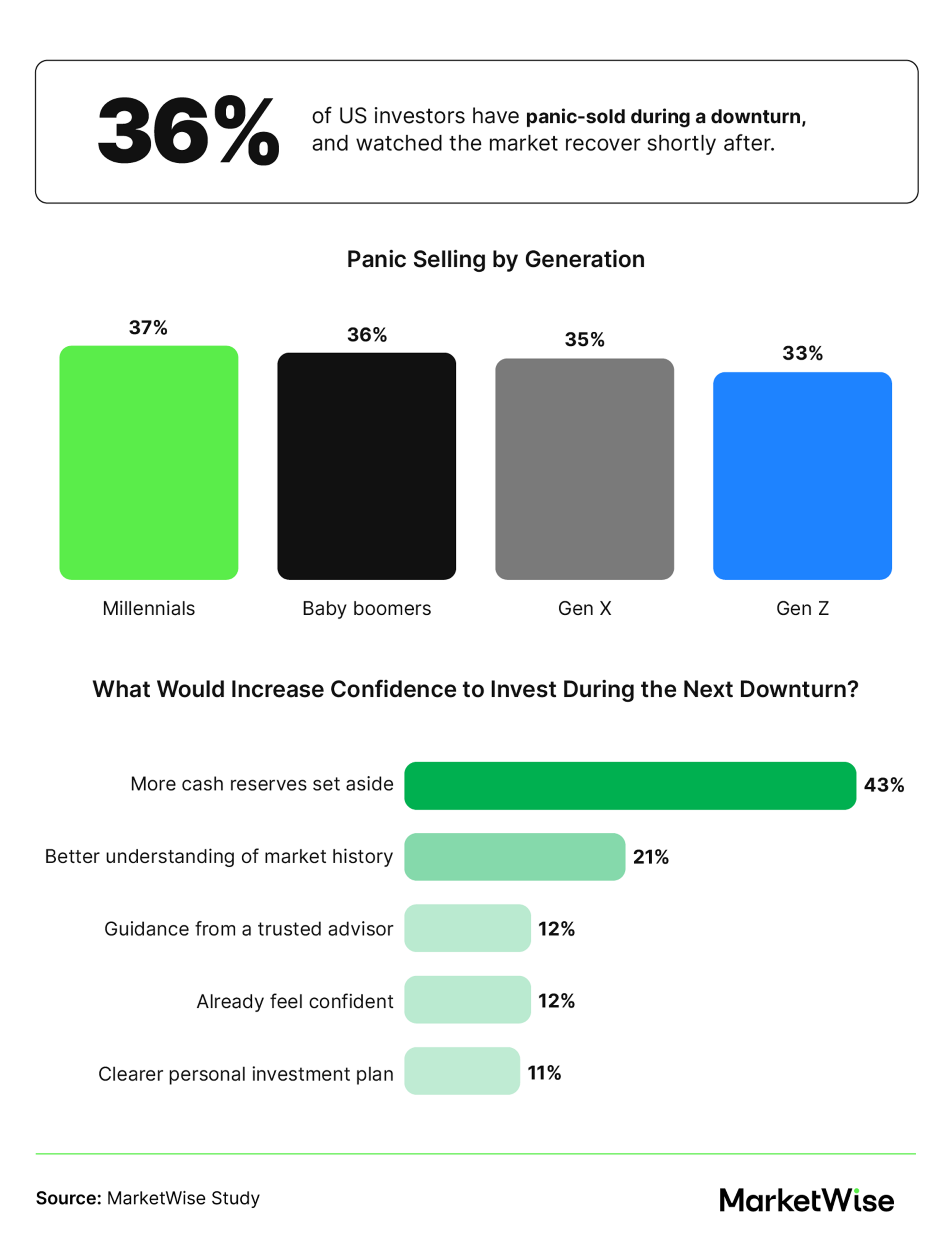
Panic-selling is its own costly mistake, and 36% of investors admitted to doing it and then watching the market recover. Millennials were the most likely to panic-sell (37%), followed by baby boomers (36%), Gen X (35%), and Gen Z (33%).
A clear majority (71%) said they regret not having more cash available to invest during past downturns. When asked what would increase their confidence to act during the next one, 43% pointed to more cash reserves set aside in advance, followed by:
- Better understanding of market history (21%)
- Guidance from a trusted advisor (12%)
- Already feeling confident (12%)
- Having a clearer personal investment plan (11%)
The takeaway is practical: Preparation before a downturn matters more than courage during one.
The Dip Is Coming — Will You Be Ready?
Market volatility isn’t a surprise; it’s a feature. What separates investors who profit from downturns from those who watch from the sidelines often comes down to preparation made before the market moves. Having cash reserves earmarked, a target entry strategy in place, and a clear sense of which assets to add are the building blocks of confident action.
The investors in this study who came out ahead weren’t necessarily smarter. They were simply more ready. The next dip will come, and the question worth asking now is whether your plan will hold up when the red starts flashing.
Methodology
MarketWise commissioned an online survey of 1,000 US investors conducted in April 2026. Respondents were required to currently hold at least one investment vehicle, including individual stocks, ETFs, index funds, cryptocurrency, bonds, real estate, or other assets. The sample was distributed across gender and generation, with millennials comprising 52%, Gen X 26%, Gen Z 14%, and baby boomers 9%.
About MarketWise
MarketWise is a leading financial research and education platform serving self-directed investors. Through a network of independent brands, including Stansberry Research, Altimetry, Chaikin Analytics, TradeSmith, InvestorPlace, Brownstone Research, and Wide Moat Research, MarketWise delivers independent insights, tools, and software to help individuals navigate complex markets with confidence. Whether you’re exploring emerging opportunities or seeking stability, MarketWise supports every investor with credible research and actionable strategies.
Fair Use Statement
We welcome the use of this study for noncommercial purposes. If you share or reference any part of this content, please include a link back to this page to credit MarketWise appropriately.