
Image Credit: Associated Press
Key Points
- Intel is partnering with Elon Musk’s Terafab project, alongside Tesla, SpaceX, and xAI, in a surprise announcement that moved its stock sharply higher.
- Terafab aims to build the largest semiconductor facility in the world, integrating the entire chip supply chain under one roof.
- Intel is likely to play a critical role in manufacturing, given Musk’s companies lack semiconductor production experience.
- However, execution risks remain high, including construction timelines, production scale, and Intel’s past manufacturing challenges.
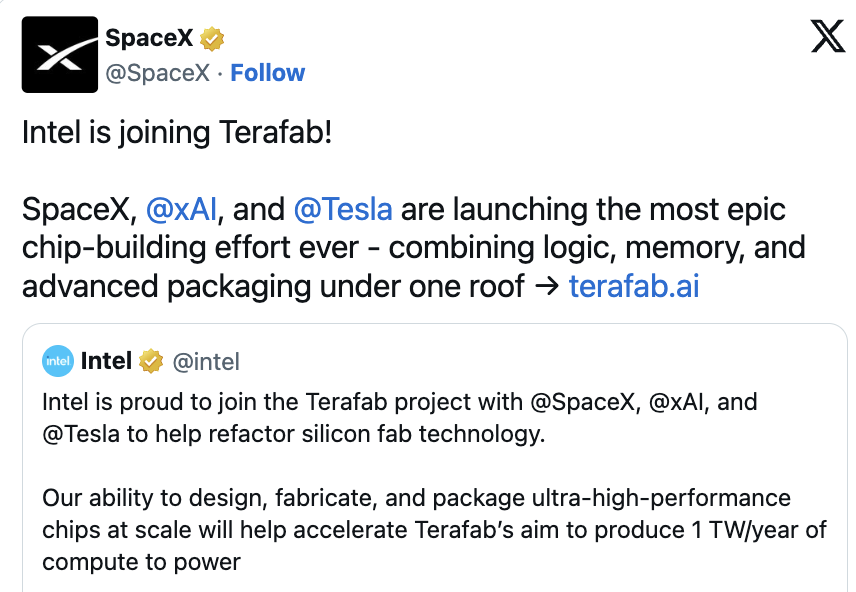
American semiconductor giant Intel (INTC) posted something unusual and attention-grabbing on the social media platform X on Monday, April 7. The company announced it will join Tesla (TSLA), xAI, and SpaceX for Elon Musk’s well-publicized Terafab project.
The tech industry muttered a collective “Huh?” upon hearing the news.
Not only would this be the first collaboration between Intel and Musk, but the absence of Securities and Exchange Commission (“SEC”) filings or even official press releases made the announcement rather strange.
But the most pressing question may be: what exactly will Intel be doing? Let’s back up a bit before we theorize on that.
What Is Elon Musk’s Terafab Project?
My colleague Sean Michael Cummings described the project and what it aims to do in his March 27 article about Terafab:
Elon Musk is designing a chip factory unlike anything on Earth – one he says is a prerequisite for building a “galactic civilization.”
In front of a crowd at the Seaholm Power Plant in Austin, Texas last Saturday, Musk announced a new $20 billion to $25 billion compound dedicated to building semiconductors.
The plant, called “Terafab,” would bring the fragmented semiconductor supply chain together under one roof… from design all the way to fabrication.
By Musk’s projections, Terafab will be the largest chip-building facility on the planet.
This project very much aligns with Musk’s vision of vertical integration or having an entire supply chain – from design to packaging – contained in one facility.
Musk never lacks ambition. It’s how he has built his undeniably impressive empire. But Musk’s grand visions don’t always translate well to reality.
And his Terafab project raises some questions, including where Intel fits into the plan.
The Main Challenge Facing the Terafab Project
Elon Musk has achieved some pretty amazing feats over the past few decades. He helped revolutionize online payments by founding a company called X.com (not to be confused with his social media platform formerly known as Twitter), which merged with PayPal (PYPL) within a year.
He launched SpaceX, which has pioneered advances in rocket propulsion, human spaceflight, reusable launch vehicles, and satellite Internet technology.
And, of course, Musk (legally speaking) co-founded Tesla, the trillion-dollar-plus company responsible for bringing electric vehicles into the mainstream, creating humanoid robots, and advancing rechargeable-battery technology, among other innovations.
One thing Musk hasn’t yet accomplished? Building semiconductors.
Though Terafab is being promoted as the “most epic chip-building effort ever” that will combine “logic, memory, and advanced packaging under one roof,” neither Musk nor his companies have any experience making semiconductors.
Semiconductor manufacturing is a wildly complicated process (and supply chain) involving nanotechnology, ultraviolet lithography, and silicon wafers.
And building a semiconductor fab is incredibly resource-intensive – both financially and time-wise. Intel, in 2023, estimated that it cost about $10 billion and took three to five years to build one of its fabs. Some fabs cost more than $20 billion to construct.
The proposed size and cost of Musk’s Terafab blow those numbers out of the water.
Musk is planning for Terafab to be a 100 million square foot facility, roughly 12 times bigger than a standard large-scale fab. It would even be 10 times larger than Musk’s massive Giga Texas factory. For context, 100 million square feet is roughly the equivalent of 2,000 football fields.
While no one really knows how much Terafab will cost to build (aside from the initial $20 billion to $25 billion investment), one semiconductor analysis firm believes that – based on Musk’s ultimate goal of producing billions of artificial intelligence (“AI”) chips that consume an unprecedented 1 terawatt (“TW”) of power a year – the cost could hit $5 trillion.
Yes, $5 trillion.
Money typically isn’t a concern for Musk, but that price tag is mind-blowing. And he’d likely be facing a construction window of at least a few years before Terafab is completed. That may test his patience.
And that’s merely the first hurdle Musk will encounter. Once the gigantic facility is built, who’s going to manufacture the semiconductors? It probably won’t be Tesla, considering the company has no experience in that sector.
This is where Intel steps in – and where things may get particularly interesting.
Will Intel Be Tapped to Run Musk’s Terafab?
The seemingly intentional wording of Intel’s announcement doesn’t explicitly specify how Intel fits into the Terafab puzzle.
But, reading between the lines just a bit, it requires only a small leap to conclude that Intel will probably (at least initially) run the manufacturing within the Terafab. It bears repeating – neither Tesla nor SpaceX has any semiconductor-manufacturing experience whatsoever. So, how exactly did they think they would operate the largest semiconductor fab in the world?
They didn’t, and they likely knew this all along. The Intel partnership announcement specifically references Intel’s expertise in designing, fabricating, and packaging chips. But it doesn’t specify Intel’s actual role in this collaboration.
But it’s not hard to put two and two together.
This would certainly be a mutually beneficial arrangement.
Intel – which has been practically left in the dust by chip giants Nvidia (NVDA), Advanced Micro Devices (AMD), and Taiwan Semiconductor Manufacturing (TSM) – needs partners like Tesla and SpaceX for its foundry business.
And Tesla/SpaceX/xAI need Intel’s expertise in process, equipment, and packaging to make Terafab and its goal of producing 1 TW of computing power annually a reality – even if it’s an ambitious reality.
The idea that companies with no semiconductor experience could build and operate what would be the biggest fab on the planet – from scratch, on Musk’s aggressive timeline, and with never-before-achieved output goals – was optimistic, to say the least.
Intel’s involvement makes that idea seem somewhat more realistic.
How quickly the Terafab facility is built and how long it takes to become fully operational are to be determined.
But it’s safe to say that Tesla, SpaceX, and xAI will benefit from Intel’s presence by getting the exact chips and processors they need – in the quantities they need – to push toward their power goal. All of it is being done under one roof and overseen by Musk.
How Does Intel’s Terafab Involvement Impact Its Stock?
On April 6, Intel closed at $50.78. The next day, when the Terafab announcement was made, Intel closed at $52.91, a jump of more than 4%. The following day, April 8, Intel shares closed at $58.95, an increase of more than 11% from the day before and roughly 16% higher than April 6.
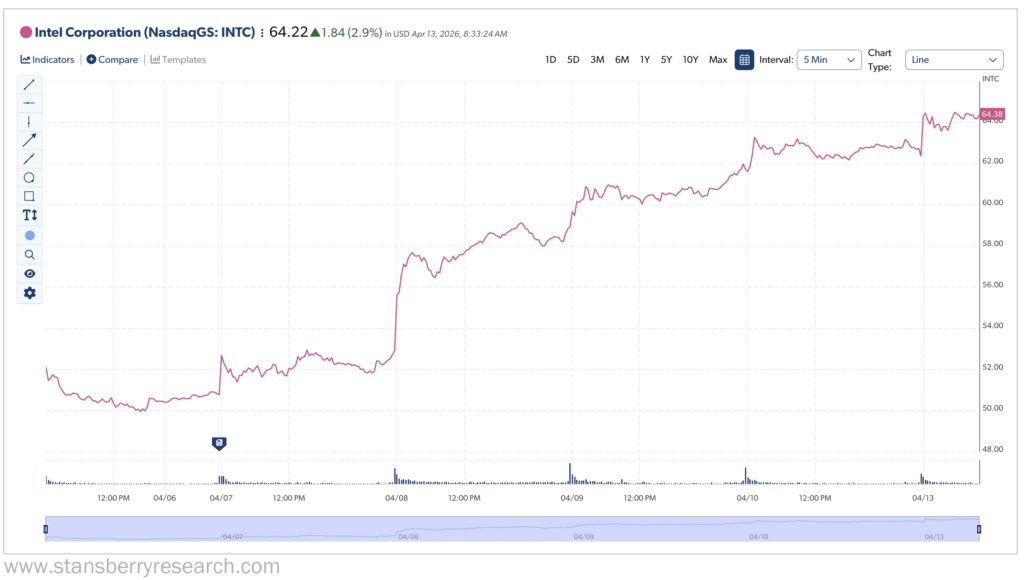
Intel’s collaboration with Musk’s companies clearly made a positive impact.
And it could certainly use the boost. Based on its Stansberry Score, a tool that helps determine the quality and long-term value of thousands of stocks, Intel stock is simply nowhere near the likes of Taiwan Semiconductor, AMD, or Nvidia.
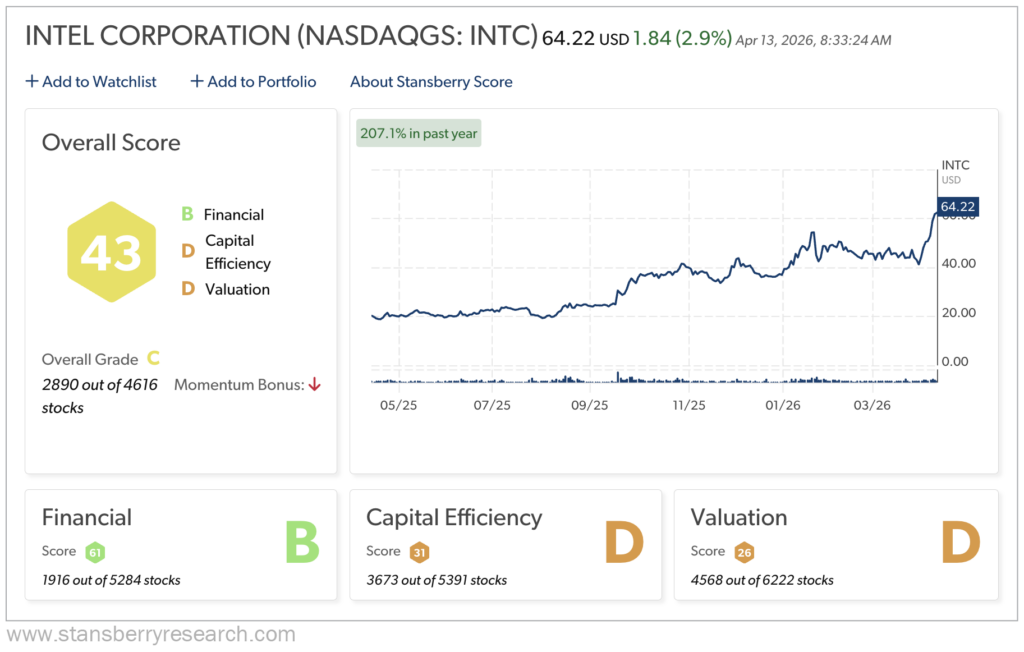
Even with the U.S. government purchasing 10% of Intel’s nonvoting shares back in September, Intel stock still lags well behind its competitors.
That’s primarily because Intel’s capital efficiency and valuation are subpar. There are a few important reasons why:
- Intel, despite spending billions on fabs around the world, still isn’t producing consistent revenue. The company’s 2025 revenue was $52.9 billion, which was relatively flat compared with 2024. More specifically, Intel’s fourth-quarter 2025 revenue was down 4% year-over-year (“YOY”) at $13.7 billion. And the company’s foundry segment reported a $10.3 billion operating loss last year. That has all led to negative free cash flow.
- There have been significant manufacturing yield issues, specifically regarding Intel’s advanced 2-nanometer-class 18A process node, which will be a major product coming out of the Terafab. Those issues have largely been resolved, but the wasted wafer output hurt the company’s bottom line.
- For a long stretch, Intel was slow to market, especially when it came to advanced manufacturing nodes. As Intel dragged its feet, competitors rolled out their advanced nodes and gained market share in the process. Intel’s 18A node is being counted on to regain that market share and catch up to (or pass) its rivals.
- All these factors have also contributed to Intel’s poor valuation. Today, Intel’s price target falls in the $46 to $49 range, so it’s currently trading up to 20% above its target. And its current price-to-earnings (“P/E”) ratio is 123.03 times, which is astronomically high and essentially demands perfection from Intel – with Terafab and every other aspect of its business.
But there are positive signs. Intel stock has been on a roll for a year, up more than 200% over that time.
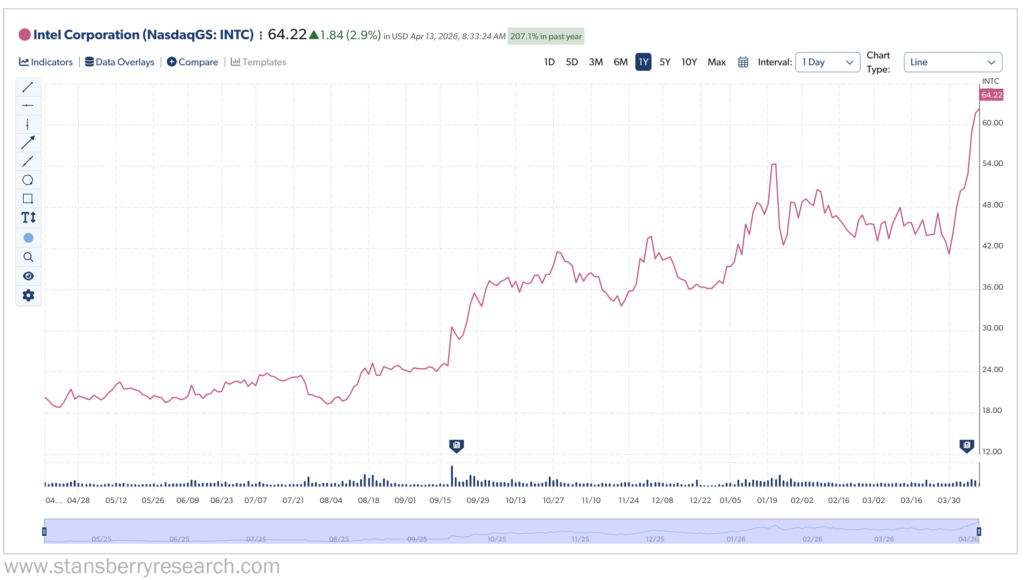
Assuming the Terafab project moves along as planned, Intel should benefit from what could be a massive production output and long-term revenue gain over the next several years.
Is Intel a Buy Right Now?
Musk’s stamp of approval could go a long way toward revitalizing Intel’s struggling foundry business. After all, if Elon Musk wants your product, it stands to reason that other companies will follow suit.
That sentiment has helped move the needle on Intel shares over the past few days, a positive sign for investors.
But there are important risks to consider if you’re thinking of buying Intel stock. For one, Terafab hasn’t been built yet. And it will take time to build a factory the size of 2,000 football fields.
Yes, smaller-scale production will probably begin (likely in or near Tesla’s Giga Texas facility) this year. But volume production likely won’t start until 2027. And it may not reach peak capacity for a few more years after that. Especially considering Musk is aiming for up to 200 billion chips to be produced per year, with one million wafer starts per month at full scale.
That all means Intel isn’t likely to generate consistent Terafab-driven revenue for at least a year.
Let’s throw a hypothetical in the mix, too. What if reality gets in the way of Musk’s ambitions? It certainly seems possible. His public proclamations regarding Terafab’s output scale are extremely aggressive and a very challenging ask for any semiconductor manufacturer. Let alone one with Intel’s spotty track record of execution.
If Intel fails to hold up its end of the bargain, or if Terafab winds up being an example of Musk biting off more than he can chew, Intel winds up a loser in the deal.
There are too many unknowns in play right now to consider Intel a buy. Yes, the Terafab deal could be a game changer for Intel by securing the company’s long-term revenue and rejuvenating the American AI and semiconductor supply chain.
Plus, as Intel CEO Lip-Bu Tan posted on X after the partnership announcement, “Elon has a proven track record of reimagining entire industries. This is exactly what is needed in semiconductor manufacturing today.”
Tan is not wrong.
But that’s not convincing enough to call Intel a good buy opportunity right now. It’s certainly worth keeping on your watch list, however, as Musk’s Terafab moves along in the coming months.
Regards,
David Engle
Editor’s Note: Whitney Tilson — the hedge fund manager CNBC called “The Prophet” — says America has reached its “Ripping Point.“ The old financial order is being torn apart, and he believes most investors have no idea what’s coming in the next six months. He’s named the stocks he thinks will be destroyed in the chaos — and the ones he believes will soar. Watch his free presentation while it’s still available.