Image Credit: Associated Press
Software giant Microsoft (MSFT) is sliding toward a 52-week low. The stock has already wiped more than $1 trillion off its market cap. Is the “OpenAI trade” the cause of this severe sell-off?
Now, Microsoft is not quite there yet…
In April 2025, the stock bottomed at about $345 per share, while right now the stock sits around $359. Another rough stretch for the market, and the stock is there… Or it could also reach a 52-week low by merely standing still – another few weeks of holding this price level would roll the calendar forward past last April’s bottom…
In either case, something has changed for this formerly hot stock.
And there’s a key difference between this year’s performance and last year’s…
Last year, the whole market was plummeting as President Donald Trump’s tariffs roiled investors, sending the S&P 500 Index lower. However, within weeks, Microsoft stock was roaring higher again.
In fact, Microsoft went on to set a series of new all-time highs in 2025. The stock peaked at an all-time high of $555 in July and a market cap north of $4 trillion. After a small decline late summer, the stock approached those highs again by late October.
But its latest decline – down around 35% from that peak and firmly in a bear market – seems to have everything to do with Microsoft itself…
The stock’s last significant peak occurred right as the company reported earnings in late October. The decline became even more pronounced three months later, when Microsoft reported earnings.
The downdrafts at earnings time could not be more pronounced…
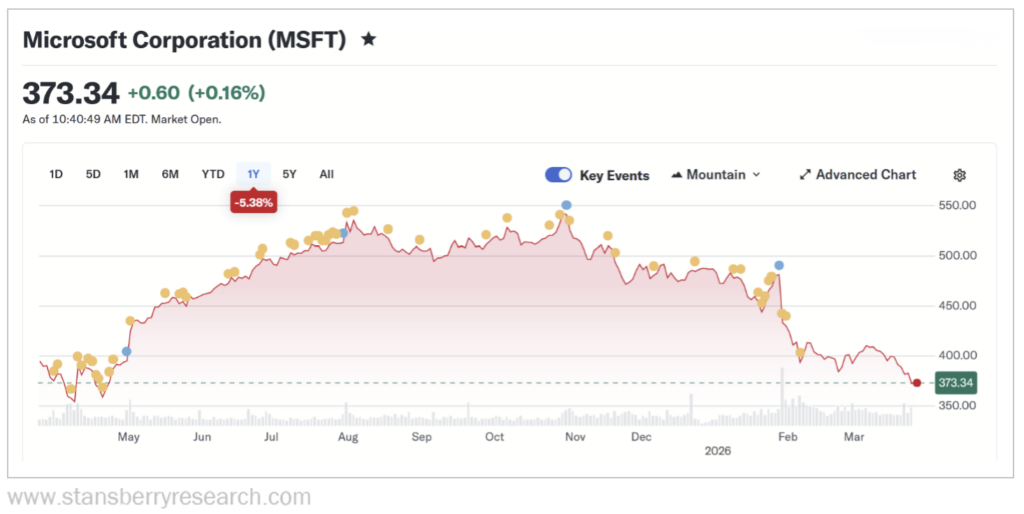
Sure, the market has been in a downdraft recently as the Iran war and soaring oil prices dent confidence. But even on days when the market rallies, Microsoft lags…
So why are investors giving Microsoft the cold shoulder, especially as it trades at less than 22 times its expected June 2026 earnings and less than 20 times next year’s earnings (in June 2027)?
It may be the OpenAI trade.
What is the OpenAI Trade?
I pointed out how the market seemed to be targeting Microsoft right after its January earnings. But a number of other key artificial intelligence (“AI”) plays have also been hit in the past six months.
[It’s] what’s called the “OpenAI trade” – companies that include Oracle (ORCL), CoreWeave (CRWV), and SoftBank (SFTBY). These businesses are aligned with OpenAI and have suffered relatively larger declines than other AI plays in the past few months.
These players have been hammered since October, as you can see in the graphic below.
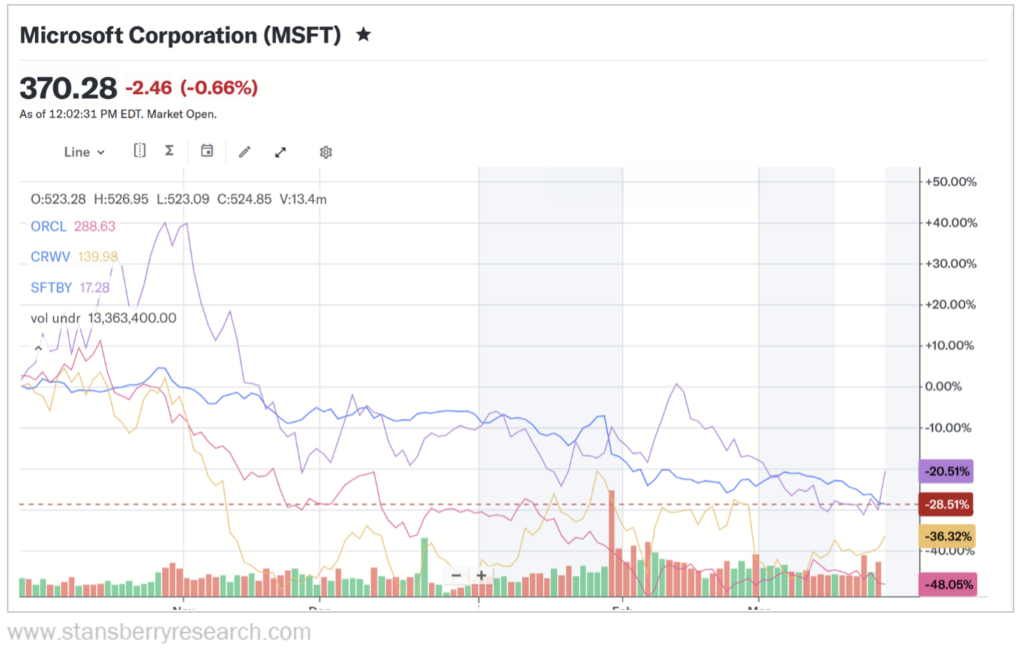
That trend has not let up in the almost two months since I wrote those words. It may even be intensifying.
Long-time stalwart Oracle is down around 50% late Ocotober. Upstart CoreWeave is also down sharply, after a huge post-Liberation Day upswing in mid-2025. (It’s not inspiring confidence that CoreWeave insiders are selling shares aggressively.)
Even brief rallies – like what investment holding company SoftBank saw in February – are being met with relentless selling pressure.
And investors continue to furiously sell shares of Microsoft…
And what about other Magnificent Seven stocks involved in the AI world? The Mag 7 stocks propelled the market to strong gains from 2023 to 2025 – are they holding up?
Key stocks are down, but they’ve peaked on a different time frame and more recently. Let’s take two: Alphabet (GOOGL) and Apple (AAPL).
Alphabet’s Google is working on its own AI model – Gemini. Alphabet hit its all-time high at $349 per share in early February. Since then, it’s down nearly 20%, much less than Microsoft is from its peak.
It’s a similar story for Apple, which has avoided massive AI data-center spending. It has opted to outsource its AI model to Google’s Gemini, which will form the basis for “Apple Intelligence,” its suite of AI tools on the iPhone and other devices.
While Apple hasn’t completely avoided a drawdown either, it’s off about 12% from its all-time high in early December 2025. (Legendary investor Warren Buffett’s Berkshire Hathaway has been selling Apple stock anyway.)
So, we have two big tech stocks not directly involved in the OpenAI trade that are declining but clearly holding up better than Microsoft’s approximately 33% decline. They also peaked at different periods than the “OpenAI trade” stocks.
OpenAI May Burn $14 Billion in 2026 – Maybe More
This downturn may be especially surprising since the valuation of OpenAI has soared in recent fundraising rounds:
- October 2024: Valued at $157 billion
- March 2025: Valued at $300 billion
- October 2025: Valued at $500 billion
Reportedly, OpenAI has been trying to raise more cash at an $830 billion valuation. Even if that doesn’t happen, that valuation has galloped ahead in just a year.
Since Microsoft owns 27% of OpenAI, this rising valuation should be a benefit to the company. But even 27% of $500 billion is relatively small in the context of the multi-trillion-dollar Microsoft.
But Microsoft shares were an indirect play on the private company, at a time when only a few ways existed to actually buy into the still-private OpenAI.
But what we’ve been seeing suggests that the stake may not be benefiting Microsoft.
What has got investors down on the OpenAI trade? It could be a few things, but let’s start with the company’s massive cash burn and highly uncertain time frame for breaking even.
OpenAI’s own projections show the company losing $14 billion in 2026. The losses may be higher this year. In any case, that’s not where the losses end. It’s also projecting losses in future years, such as a $74 billion loss in 2028 as AI demand ramps up.
Analysts are not expecting the company to begin turning a profit until the 2030s – complicating any potential IPO plans.
It all means that OpenAI must keep raising cash until it can begin to “turn the corner” on costs.
Another worrisome trend: OpenAI’s share of U.S. daily active users on mobile has slid from a year ago. In January 2025, OpenAI’s ChatGPT held 69.1% of the market, according to research firm Apptopia. In January 2026, the figure stood at just 45.3%.
The biggest winners over that period? Google’s Gemini, which went from 14.7% to 25.2% of the market. Also count Grok – now owned by SpaceX – which nabbed its highest-ever 15.2% share.
But Apptopia also has news that is more troublesome for the AI industry as a whole. U.S. daily active users (at least on mobile) have flatlined from October 2025 to January 2026.
And October happens to coincide with some major downturns in the “OpenAI trade” stocks.
Following a huge loss of market share late in 2025, OpenAI CEO Sam Altman declared a “code red” in December. Altman made huge promises for the latest iteration of its flagship chatbot, GPT-5.2, which was released later that month. The reality was decidedly less impressive.
And OpenAI’s market share continued its slide into January.
To make matters worse, even 27% investor Microsoft doesn’t seem to want to work with OpenAI.
The software maker turned to key rival Anthropic, maker of the Claude series of chatbots, for its recently announced AI tool, Copilot Cowork.
It does look like the market has soured on the stocks related to OpenAI, and even its own major investor wants to work with a rival.
Regards,
James Royal
Editor’s Note:Elon Musk reinvented the auto industry, sparked a new era of space exploration, and built the world’s largest satellite network. But his new initiative – “Project Apex” – could become the crown jewel of his career. And, like Tesla, it could make early investors incredibly wealthy. Click here for the details on what some are calling a ChatGPT Killer…