Today’s issue in preview:
-
How to invest in an extraordinary new phase of the AI bull market
-
The beatings will continue until morale improves: S&P 500 update
-
These three stocks are long term winners from Epic Fury and its aftermath
How to invest in an extraordinary new phase of the AI bull market

Credit: imaginima
Prepare for the Agent Supernova – an enormous, world‑changing megatrend that could make you a lot of money.
That’s the “takeaway” from our March 16 issue on the coming super‑boom in AI task managers… aka “agents.” This will prove to be one of the most valuable pieces of business and investment advice you’ll ever receive.
Years of development have made AI advanced enough to perform many everyday tasks people do now… and the list is only getting bigger. Over the next 12–24 months, AI agents will help manage factories, perform financial analysis, manage inventories, write software, design websites, create legal documents… and thousands of other tasks.
Within two years, the number of AI agents operating in the American economy isn’t poised to increase by 10X… or 50X… or even 1,000X. Try at least 100,000X.
This is the coming Agent Supernova: agents working with people, agents working with other agents, agents running businesses, and negotiating with other agents.
The Agent Supernova is about to introduce billions of “AI workers” into our economy with very little day‑to‑day human oversight. The business and investment implications are huge. It will transform many businesses and industries, end many as we know them, and create entirely new ones.
As we covered yesterday, one compelling theme inside this megatrend is internet traffic. Just one AI agent working for a business can create enormous amounts of web traffic.
Agents don’t take breaks or vacations. They can search for information and transact at the speed of light. An explosion of agent usage will generate an explosion of internet traffic. This will greatly benefit communication equipment and network firms such as Cisco (CSCO), Ciena (CIEN), and Akamai (AKAM).
But there’s another major consequence of having millions of AI agents working 24/7 in our economy: If we’re going to have millions of AI agents performing billions of daily tasks in health care, education, energy, transportation, manufacturing, and technology, then we’re going to have billions of points of cybercrime vulnerability. And remember, crooks get to use AI too.
If agents can roam the web, communicate for you, log in to your apps, move money, and modify data at machine speed, then a compromised agent can do the same damage just as fast – now with far less human oversight to catch mistakes or intrusions.
Traditional cybersecurity models were built for a small, known set of human users following repeatable routines. Agentic AI breaks that assumption. We’re moving from managing people at keyboards to managing growing populations of software “workers” that operate continuously and mostly out of sight.
This is why well-positioned cybersecurity companies are poised to enjoy years of booming business. Companies poised to benefit include:
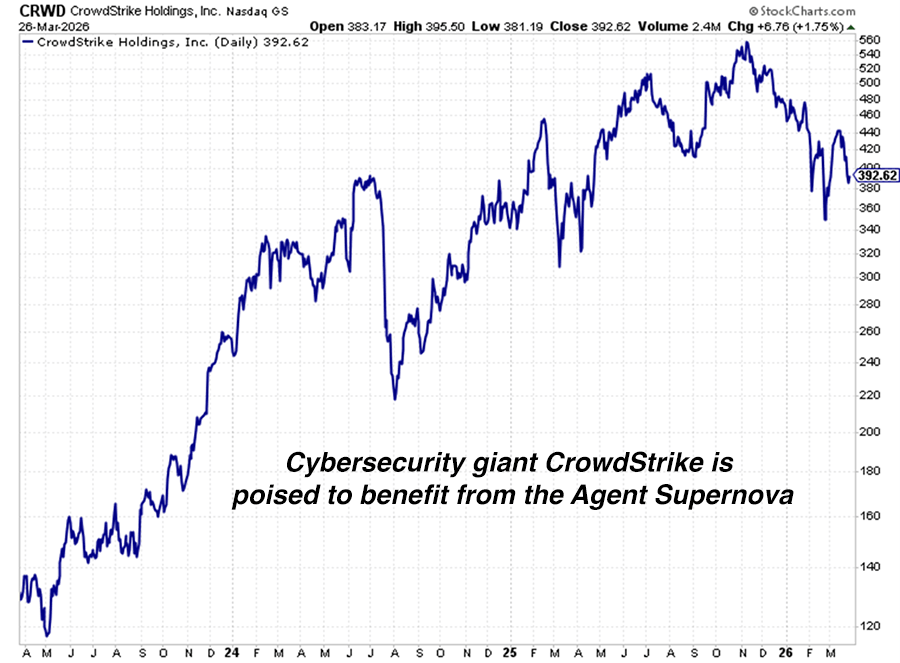
CrowdStrike (CRWD): CRWD is arguably the clearest winner in the agentic AI space. Its Falcon software already sits on millions of laptops and servers, watching everything they do and blocking hackers in real time. Now, CRWD is turning that same platform into a security system for AI agents. It has launched tools that can find all AI agents within a company, monitor their activity, and shut them down if they start behaving unexpectedly. With a $100 billion market cap and about $6 billion in revenue, CRWD has the distribution and data edge over most competitors, which makes it a much safer bet on this theme.
Palo Alto Networks (PANW): PANW is the broadest, most “full‑stack” way to play the agentic AI security theme. Rather than specializing in one niche, PANW is building an AI‑driven security platform for the whole enterprise, making it a less risky way to play the theme, like CRWD. At the same time, PANW is also going after the pure agentic opportunity with AgentiX, a “workforce for autonomous AI agents” that can detect and fix issues automatically. It’s also planning to acquire Koi, which is designed to secure the emerging “agentic endpoint” layer.
Zscaler (ZS): ZS fits well with the agentic AI wave because of its “zero trust” model, in which every connection must be checked and allowed one by one. Think of ZS as the gatekeeper in a world where hundreds of thousands of humans and agents are trying to connect to apps. It doesn’t specialize in one narrow cybersecurity niche, but it’s a strong candidate to win as more and more companies route their AI traffic through a zero‑trust system.
SailPoint (SAIL): SAIL’s CEO just called agentic AI the “single greatest market expansion driver we have ever seen.” SAIL focuses on identity security – deciding who or what is allowed to access which apps and data, and ensuring those permissions stay correct over time. SAIL is a recent IPO (February 2025) with a market cap of about $6 billion and close to $1 billion in annual revenue, making it relatively cheap compared to the bigger players above, while it is tightly aligned with securing non‑human and agent identities.
Radware (RDWR): RDWR is a $1.1 billion company focused on AI‑driven Distributed Denial-of-Service (DDoS) protection (stopping huge waves of attack traffic) and bot management. In an agentic world, a large share of internet traffic will be generated by bots and agents instead of humans. RDWR’s platform watches this traffic in real time and uses machine learning to spot patterns that look malicious while letting legitimate agents reach websites, apps, and platforms. This makes RDWR a strong play in a niche part of the AI stack. Management expects roughly $330 million of revenue in 2026, about 9% growth over 2025.
If you don’t feel comfortable picking one (or a few of the above), another way to get exposure to the cybersecurity theme is to buy the Global X Cybersecurity ETF (BUG). This fund owns a diversified basket of cybersecurity stocks.
The Agent Supernova is poised to hit our economy like a tidal wave. It will create enormous change and opportunity. Investing in businesses that keep agents operating safely and securely is a big way to benefit.
Recommended Link:
America’s Next Big Bankruptcy

The headlines right now are impossible to ignore. But here’s what 47 years of analyzing financial crises has taught Louis Navellier: The real danger is never where everyone is looking. Right now, while the world watches the Middle East and Silicon Valley… his quantitative system is flashing the biggest warning he’s seen since 2008. He calls it America’s Next Big Bankruptcy. Don’t let the headlines distract you from the real story. Make sure you’re prepared, and you can come out on the right side of this. Get Louis’ full analysis on America’s Next Big Bankruptcy here.
The beatings will continue until morale improves: S&P 500 update

Credit: Art Wager
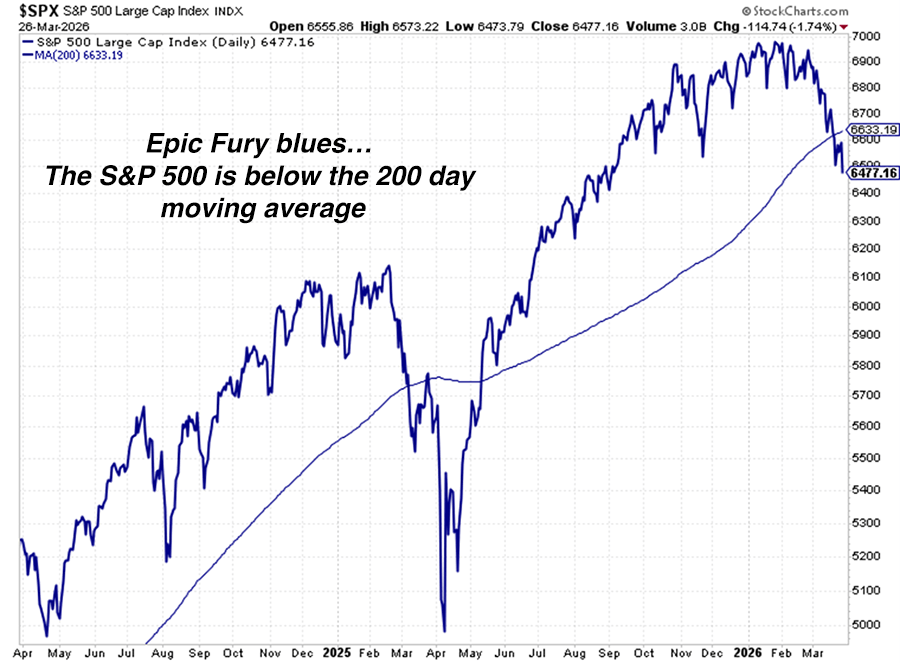
In past research notes, I’ve described the 200-day moving average as a “demarcation line” that separates the good and bad sides of market trends.
A moving average is an indicator that averages a security’s price over a set time period to give you one number… an “average price” over that period of time. Moving averages can be very short-term – like five days – or long-term – like 200 days.
There’s nothing intellectually deep or doctrinaire about using a 200-day moving average to gauge a market’s trend. You could use a 198 or 203-day moving average and I wouldn’t complain. A 200-day moving average just happens to be a widely used gauge for sizing up a market’s primary trend. The legendary trader Paul Tudor Jones used it, which helped its popularity.
Stocks, ETFs, and indexes below their 200-day moving average are “on the wrong side of the tracks.” It’s the ugly part of town. All the really bad things – crashes, panics, horrible bear markets – happen below the 200-day moving average.
If you’re looking to own healthy, rising trends, then you want to own stocks and funds trading above their 200-day moving averages. You want to own stocks and funds that are doing the opposite of what the benchmark S&P 500 index is doing right now. As you can see from the chart below, the Operation Epic Fury-induced selling has sent this critical stock index below its 200-day moving average.
I wish I had some inside scoop to share with you on how this situation resolves… or I wish I could link you to an interview with a brilliant investor like Stan Druckenmiller or PTJ (see above) that provides answers. But the fact of the matter is that price action in the broad market averages and most individual stocks is not being driven by industry fundamentals, valuations, or interest rates. It’s almost all being dictated by Operation Epic Fury and Donald Trump’s social media posts.
If the war ends soon, the S&P is very likely to pop higher and get back on the right side of town. If the war does not end soon, its constriction of critical resource supplies will seriously damage the global economy and stocks will trade lower. That’s all price action direction comes down to these days. That’s it. It’s all quite tedious and plain. Trump makes a claim. Iran makes a counterclaim. The Strait of Hormuz might open. The Strait of Hormuz stays closed. Stocks go up a little on optimism. Stocks fall on pessimism.
Rinse and repeat.
Groundhog Day for investors.
The stock market beatings will continue until war-dominated morale improves. Now let’s get back to waiting for the next presidential social media post…
These three stocks are long-term winners from Epic Fury and its aftermath

Credit: halbergman
As shown by the S&P 500’s weak trading below the 200-day moving average, Operation Epic Fury and its constriction of critical resources are bad for most stocks and industries.
However, it’s good for any company with the unique designation of “supplier of critical resources sourced from anywhere but the Middle East.”
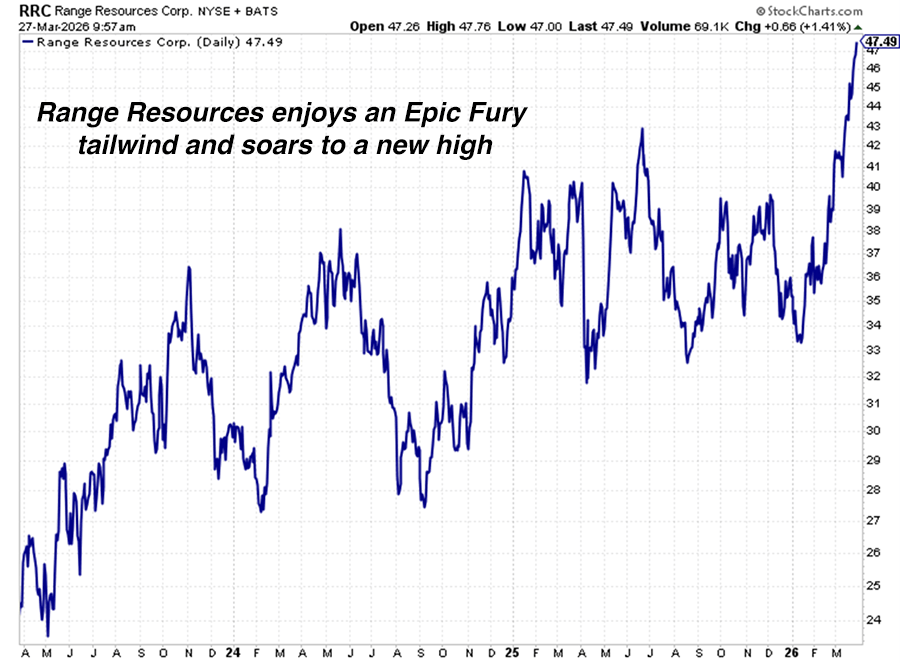
For evidence, I point you to the new all-time highs reached this week by U.S. natural gas producers Range Resources (RRC), Antero Resources (AR), and EQT (EQT).
In yesterday’s issue, I detailed how Epic Fury and its lessons will be a bullish driver for industries involved in electric power production.
Closing the critical Strait of Hormuz justifiably gets a lot of press. The Strait of Hormuz is a vital waterway through which roughly 20% of global oil consumption flows.
In addition to oil, vital natural gas and fertilizer supplies flow through the strait. Its closure is having destructive consequences for businesses and countries that depend on Middle Eastern resource flows. Those consequences could go from “destructive” to “catastrophic” if the closure lasts another month.
For many countries and businesses, this situation is a brutal “slap in the face” reminder: If you’re a large business or country whose survival or smooth operation depends on uninterrupted resource flows from the Middle East, you are in a dangerous, vulnerable position.
If your business or country depends on resource flows from the Middle East, you are not truly safe or secure. No CEO or major shareholder wants their business to be in that position. No citizen wants their country to be in that position. Many powerful and influential people are realizing this is a big risk that must be mitigated if humanly possible.
This means building and buying as many forms of “not Middle Eastern” resource supply chains as possible economically… with electric power production being the most important.
The drive to become more energy independent is not a one-year-and-you’re-done project. It is a multi-decade megatrend. It will act as a long-term tailwind for virtually every form of energy production, helping businesses and countries become less reliant on Middle Eastern oil and gas. Solar energy. Nuclear energy. Geothermal energy. Hydroelectric energy. U.S. natural gas. South American, African, and Canadian oil and gas. It’s all going to catch extra bids.
U.S. natural gas producers Range, EQT, and Antero are uniquely well-positioned to benefit from this trend. The U.S. is endowed with enormous natural gas reserves and production. It is rapidly building out export infrastructure to enable it to ship increasingly large volumes of in-demand natural gas worldwide. My advice from October still stands: Be bullish on U.S. natural gas producers.
Market Notes
-
Our September 29th recommendation to own oil stocks is paying off like a broken slot machine. Oil giants Occidental Petroleum (OXY), ConocoPhillips (COP) and Permian Resources (PR) all hit new all-time highs today.
-
High-end athleisure brands Nike (NKE), On Holdings (ONON), and Lululemon (LULU) all hit one-year lows today.
-
Software giant SAP (SAP) reached a new low today. AI adoption continues to be a dangerous force in the software industry.
Regards,


Brian Hunt
Editor, Money & Megatrends
An urgent message from our colleagues:
“This stock has a 93% history of soaring, every spring”

One of the most popular stocks in America has a 100% history of rising on one particular date – every single spring. In fact, it’s gone up beginning this ONE specific day – year after year – at a rate fast enough to double your money in 12 months.
Click here to see the name of the stock, free of charge.