
Today’s issue in preview:
-
Directed energy weapons are poised to revolutionize warfighting. How to invest in a potential Defense Tech winner
-
Will AI become so powerful that it hurts one of the world’s most popular tech investments?
-
Soaring AI power demand is poised to send this sector higher. Do you own it?
Directed energy weapons are poised to revolutionize warfighting. How to invest in a potential Defense Tech winner

Credit: mikcz
In late 2024, I urged friends and colleagues to invest in the drone industry for one simple reason: After years of progress and innovation, military and surveillance drone makers had begun producing large amounts of effective drones at low cost. Many drone applications now have very high “cost-to-damage inflicted” ratios.
That’s why drones played a significant role in the Russia/Ukraine war and in Operation Epic Fury. It’s also why shares of key drone industry players are up hundreds of percent since my original note.
Drones aren’t the only high-tech defense trend, however. Although it sounds like science fiction, lasers are becoming a big part of the high-tech battlefield as well.
In December 2025, the Israeli Defense Force deployed the “Iron Beam,” a high-energy laser weapon system designed to intercept drones and missiles. It’s believed to be the first (or at least one of the first) times a high-energy laser weapon was used in live battle.
In January this year, Vice Admiral Brendan McLane of the U.S. Navy told a public audience that lasers have been successfully tested and will be used in live fire aboard ships. Although verifiable details are scarce, it’s believed the U.S. Navy used lasers in Epic Fury.
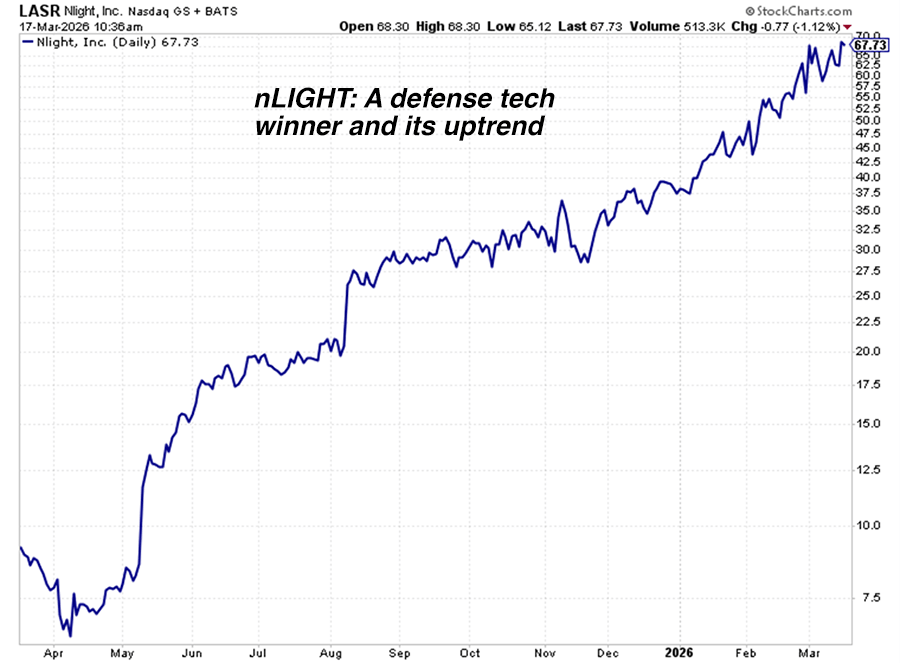
This brings us to a Defense Tech player you probably haven’t heard of: nLIGHT (LASR).
nLIGHT is currently the only pure-play, publicly listed company focused on developing megawatt-class directed-energy weapons (aka “lasers”). Directed energy weapons damage targets using concentrated energy (like a laser beam) instead of a physical projectile (like a bullet). Megawatt class refers to the power of that energy beam. Once you get into the megawatt class, you have enough power to engage with ballistic and hypersonic missiles.
The bull case here is simple.
Israel’s Iron Beam is now the first operational high‑energy laser air‑defense system, and nLIGHT is a confirmed supplier to that program. The Golden Dome in the US explicitly contemplates a laser layer, inspired by Israel’s Iron Dome. And nLIGHT has said it is already responding to Golden Dome RFPs (Request for Proposals). The U.S. Navy’s top surface warfare officer is openly talking about “a laser on every ship” after successful at‑sea tests.
It’s clear that laser weapons are rapidly becoming a necessity.
This shift is driven by both performance and economics. On the performance side, high‑energy lasers offer speed‑of‑light engagement, pinpoint accuracy, and effectively “bottomless” magazines as long as you have electric power. You don’t run out of bullets or missiles.
On the economics side, once the system is installed, each additional shot costs little more than the electricity to fire it.
That combination – tactically superior and lower cost – is why militaries are increasingly taking lasers very seriously.
nLIGHT is central to this shift. It already has a $171 million contract with the US Department of War to scale its beam architecture from ~300 kW to 1MW. It is the only contractor publicly known to be tasked with developing a full megawatt laser weapon.
LASR isn’t just a risky pre-revenue play on future contracts. Today, aerospace and defense sales are already growing 40-50%, and the company just raised $200 million to expand its US high-energy laser manufacturing capacity ahead of the huge demand on the horizon. This is a strong company today… and likely a much stronger company in a few years.
Global defense spending exceeds $2.5 trillion annually and is growing. War continues to go very high-tech. nLIGHT is a company to watch as this megatrend develops.
Recommended Link:
A $10 Trillion Market Shock to Hit on April 24th

As Silicon Valley power players battle to achieve Artificial General Intelligence, a more powerful force threatens to stop AI’s progress dead in its tracks. As this critical bottleneck comes to light, investors will witness a market-wide regime change, violently ejecting today’s winners and replacing them with a brand-new class of unexpected companies. Futurist Eric Fry has full list of companies he says to buy and sell as this $10 Trillion Market Shock plays out beginning April 24th. Sign up for FREE to attend FutureProof 2026 and get the full list of stocks…
Will AI become so powerful that it hurts one of the world’s most popular tech investments?

Credit: lucky-photographer
Will AI become so useful… and so powerful that it could hurt one of the world’s most popular technology investments?
We asked this important question on February 24, and we continue to think about it now. The answer has enormous consequences for your 401(k).
This year, I’ve written many times about how AI is powering a K-Shaped stock market… full of big losers and big winners. Companies vulnerable to AI disruption are plummeting. Many companies that make things you can stub your toe on are soaring.
AI is the fastest-evolving technology in history… and Big Tech firms such as Google and Amazon are investing record amounts to accelerate its progress. As you read this, AI is advanced enough to perform many high-paying white-collar tasks. Nobody knows for sure how fast it will displace the tens of millions of humans that currently perform them. We only know for sure that it will bring enormous change and volatility.
This brings us to one of the most successful investment vehicles of all time, the Nasdaq 100 ETF (QQQ). The “Naz 100” is like the Dow Jones Industrial Average for technology firms. It’s an index heavily weighted towards Big Tech and software firms. For years, QQQ has provided investors an easy “one click” way to profit from bleeding-edge technology. Over the past 10 years, QQQ is up 505% vs. the “less tech-heavy” S&P 500’s 230% return.
The QQQ has made so many people so much easy money that it’s a treasured asset in many American households. It’s right up there with the family dog and the digital photo albums.
But… there’s a real chance that AI enables so many competitors to enter enough tech-focused industries that it damages QQQ returns. Hordes of AI-centric competitors could enter tech industries, lower service costs, and throw a heavy wet blanket on the growth rates, profit margins, and P/E multiples of existing tech firms.
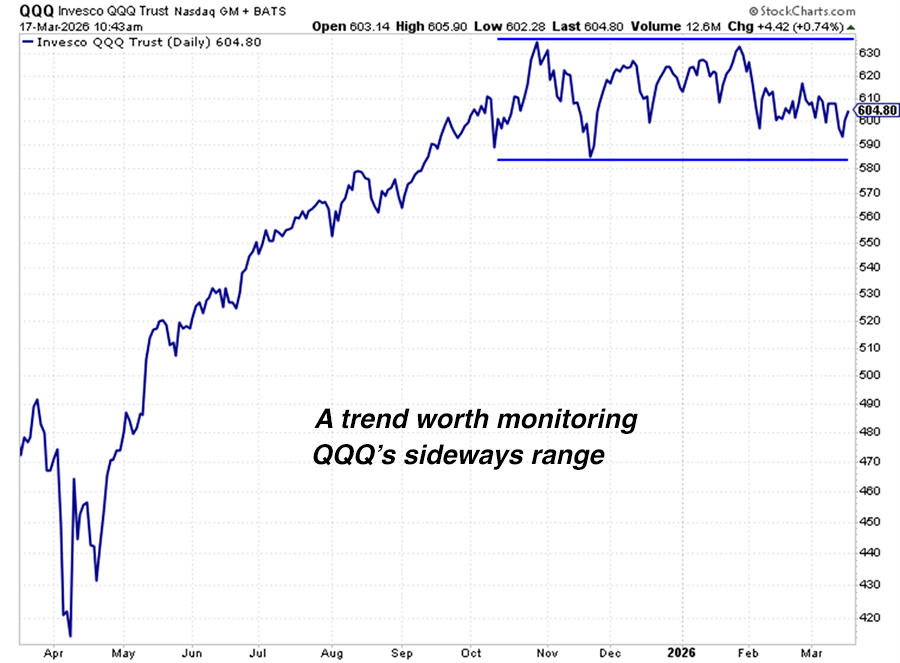
Regular readers know we like to stay on top of both the bear case and the bull case for any investment… but it’s what the market thinks that really matters to us. In this case, we can learn what the market thinks of QQQ’s prospects by watching how it resolves its current consolidation phase in the $585-$635 range.
As you can see in the chart below, QQQ enjoyed a big rally off the April 2025 “tariff tantrum” lows. But over the past four months, concerns about Big Tech’s profitability and the software industry’s future have kept the QQQ treading water in a sideways range.
The QQQ punching through the bottom of this range would be a huge red flag that signals AI is paradoxically becoming so powerful that it hurts, rather than helps, many tech companies. QQQ gets the benefit of the doubt for now.
Soaring AI power demand is poised to send this sector higher. Do you own it?

Credit: RHJ
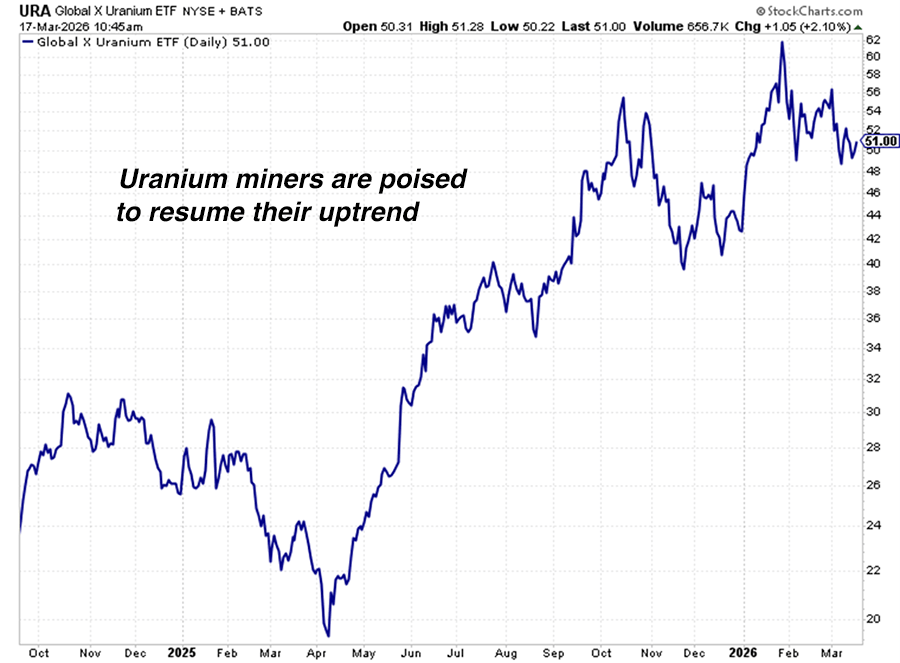
After suffering a sharp “Epic Fury-induced” selloff, uranium miners are back in shape and ready to run higher.
In 2022, I sent a bullish note to colleagues, highlighting the emerging uptrend in uranium miners such as Cameco (CCJ) and Uranium Energy (UEC).
Since my original call, uranium miners have generated massive returns. CCJ is up 300%, and UEC is up 194%. If you missed that trade, I’ve got good news!
The big trend in uranium miners is likely to continue.
Regular readers know one of the largest and most profitable facets of the AI megatrend is power consumption. Thanks to AI’s enormous promise, giants like Google, Meta, Microsoft, and OpenAI are spending hundreds of billions of dollars a year on data centers, AI chips, and other infrastructure components.
All that AI infrastructure is poised to consume huge amounts of electricity. Goldman Sachs forecasts global data center power demand will climb 50% by 2027 and as much as 165% by the end of the decade.
Given this outlook, AI companies and their power providers are spending heavily to expand nuclear power capacity. Nuclear provides “always on” carbon-free baseload power. Bloomberg reports that surging nuclear demand will drive $350 billion in nuclear spending in the US by 2050.
This “Nuclear Renaissance” theme depends on uranium as fuel. Demand for uranium is soaring, but supplies are constrained right now and will be for years to come. Like we’ve covered with copper mines, AI cannot code a uranium mine into existence.
You can get long on this theme in several ways. In the past, I’ve mentioned nuclear power equipment and service companies such as BWX Technologies (BWXT), Mirion Technologies (MIR), and Centrus (LEU).
You can also take the “one click, and you’re done” route with a uranium miner fund such as the Global X Uranium ETF (URA) or the Sprott Uranium Miners ETF (URNM). Both funds own diversified baskets of uranium miners and both hold huge positions in blue-chip Cameco.
As you can see in the URA chart below, uranium miners suffered a sharp selloff during the height of Operation Epic Fury. However, it has rallied 1.7% off its lows and is poised to reach new highs. Given nuclear energy’s bullish demand outlook, I bet those new highs arrive soon.
Market Notes
-
Our September 29th recommendation to own oil stocks is paying off like a broken slot machine. Oil giants BP (BP), Shell (SHEL), Equinor (EQNR), Devon Energy (DVN), and Canadian Natural Resources (CNQ) all hit new yearly highs today. Fidelity Energy MSCI ETF (FENY) also hits new yearly highs today.
-
The AI infrastructure buildout is still in full flow. Mobile infrastructure provider Solaris Energy Infrastructure (SEI) jumps 13% today. AI bulls are starting to look a bit stronger with VanEck Semiconductor ETF (SMH) only 5% away from highs
-
The AI Agent Supernova we described yesterday is set to continue. Circle Internet Group (CRCL), the USDC stablecoin issuer, is now up 102% in the last month on this AI agent megatheme.
-
AI-focused insurance firm Lemonade (LMND) is up 12% today, nearing its one-month high.
Regards,


Brian Hunt
Editor, Money & Megatrends
An urgent message from our colleagues:
Have $500? Invest in Elon’s AI Masterplan

Everyone is talking about Elon Musk’s Space X IPO. CNBC even called it “the big market event of 2026.” But according to tech investing legend Jeff Brown, this is NOT about launching rockets to Mars, satellite internet, or anything you’ve heard from the media. It’s much bigger than that… Because this IPO is a key part of Elon Musk’s secret AI masterplan.