
Image Credit: Associated Press
Jack Dorsey didn’t sugarcoat anything…
Last night, the Block (XYZ) cofounder told his 10,000-plus employees that more than 4,000 of them were done. Gone. Roughly 40% of the company, eliminated.
He explained his reasoning in a letter to shareholders. “Intelligence tools have changed what it means to build and run a company,” Dorsey wrote. “A significantly smaller team, using the tools we’re building, can do more and do it better.”
That’s the polite version. The blunt version is that Block’s CEO believes artificial intelligence (“AI”) can do most of their jobs, and for far cheaper.
Wall Street loved it… Block shares soared more than 20% in after-hours trading. The company reported a 24% year-over-year jump in gross profit for the fourth quarter, to $2.9 billion. Revenue came in at $6 billion. The business, by every financial measure, is healthy.
That’s the part that should worry you.
Block isn’t cutting jobs because it’s struggling. Dorsey said as much himself in a post on X:
We’re not making this decision because we’re in trouble. Our business is strong. Gross profit continues to grow, we continue to serve more and more customers, and profitability is improving.
Block is cutting nearly half its workforce simply because it can. And because AI tools, like the company’s internal system called Goose, have made it possible to operate with far fewer humans.
Dorsey thinks every other big company in America will reach the same conclusion within the next 12 months. “I don’t think we’re early to this realization,” he wrote in his shareholder letter. “I’d rather get there honestly and on our own terms than be forced into it reactively.”
We doubt whether the 4,000 newly jobless workers found comfort in that sentiment.
The Layoff Wave Is Accelerating
We warned back in October that the AI layoffs were only beginning…
At the time, Amazon (AMZN) was the canary in the coal mine, announcing plans to cut up to 30,000 white-collar workers and crediting AI for the efficiencies that made it possible.
Now the canaries are everywhere.
According to outplacement firm Challenger, Gray & Christmas, U.S. employers announced 108,435 layoffs in January 2026 alone. That’s the highest January total since 2009, during the global financial crisis. It’s more than double the numbers from the prior January and more than triple the numbers from December.
Meanwhile, companies announced just 5,306 new hires that same month. That’s the fewest January hiring plans since Challenger started tracking the data in 2009. As CNBC reported…
“Generally, we see a high number of job cuts in the first quarter, but this is a high total for January,” said Andy Challenger, workplace expert and chief revenue officer for the firm. “It means most of these plans were set at the end of 2025, signaling employers are less-than-optimistic about the outlook for 2026.”
Here’s a quick look at some of the damage from just the first two months of the year…
- Amazon cut another 16,000 corporate jobs in January, on top of the 14,000 it slashed last October.
- Software maker C3.ai (AI) is laying off more than a quarter of its workforce.
- United Parcel Service (UPS) announced plans to eliminate 30,000 operational positions.
- Chemical giant Dow (DOW) is cutting 4,500 jobs under a restructuring it calls “transform to outperform” as part of a $2 billion savings plan.
- Social media juggernaut Meta Platforms (META) pushed out 1,500 workers from its Reality Labs division.
- Software maker Autodesk (ADSK) eliminated 1,000 positions to allocate more resources toward AI.
- The Washington Post gutted a third of its newsroom.
- Auction site eBay (EBAY) is laying off 800 workers.
- Virtual bulletin board Pinterest (PINS) is trimming about 15% of its workforce… again, focusing on AI.
- Financial services giant Citigroup (C) is shrinking by some 20,000 workers over a multiyear reduction plan.
- And chipmaker ASML (ASML) is cutting 1,700 roles across the Netherlands and the U.S.
And we’re not yet through February.
AI Is the Excuse… But Is It the Reason?
The part to keep in mind about every one of these announcements is that laying the blame on AI isn’t entirely the full story. As Challenger’s report noted (my emphasis added in bold):
“It’s difficult to say how big an impact AI is having on layoffs specifically. We know leaders are talking about AI, many companies want to implement it in operations, and the market appears to be rewarding companies that mention it,” said Challenger.
Each time a CEO invokes AI and slashes headcount, their stock gets a sugar rush. Again, Block’s stock jumped more than 20% overnight.
Salesforce (CRM) CEO Marc Benioff has been practically gleeful about replacing customer service workers with AI agents, saying, “I’ve reduced it from 9,000 heads to about 5,000, because I need less heads.”
Amazon CEO Andy Jassy warned employees last summer that AI would reduce the corporate workforce “in the coming years.”
And while effective AI tools are gaining capability at a rapid pace, some of these firms are also using AI as an excuse. Many companies overhired during the pandemic boom… And now they’re correcting that error and giving AI the credit – or blame.
None of this means AI won’t eventually replace millions of jobs. It absolutely will.
It just means that the current layoffs are only the beginning.
As we wrote last fall:
Goldman Sachs says that AI can already replace 2.5% of the American workforce – that’s more than 4 million employees. And looking ahead, it expects as much as 14% of the current U.S. workforce could ultimately be at risk within the next five years.
That would be roughly 22 million Americans, suddenly out of work…
We predict that number may ultimately be even higher
AI’s Perfect Storm for Jobs and the Market
AI is almost certainly a speculative bubble, at least in part. But it can grow far more manic.
And here’s the question no one on Wall Street or in Washington, D.C. wants to answer…
What happens when an investment bubble pops, but the technology behind it keeps working – or even grows better?
We’ve seen plenty of bubbles before. The dot-com mania. The housing frenzy. Tulip bulbs, if you want to go way back. In every case, the story ended roughly the same way. The hype outran reality, prices collapsed, and everyone who bought near the top got crushed.
But there was always a silver lining in those crashes. The underlying promise turned out to be overblown. Pets.com wasn’t a viable business… at least at the time. Subprime mortgages shouldn’t have been packaged as AAA bonds. The tulips were just pretty flowers.
So the technology didn’t match the hype, the bubble popped, and eventually the economy moved on.
What we’re staring down with AI is something different. And it could be far worse.
Investors are already losing patience as the so-called “Magnificent Seven” tech giants pour hundreds of billions into AI spending. As my colleague Nick Koziol reported a few days ago:
Meta, Microsoft, Alphabet, and Amazon have all reported their fourth-quarter and full-year results for 2025. But investors weren’t too worried about their operations.
Instead, all the focus was on how much these companies are investing in AI in 2026. For example…
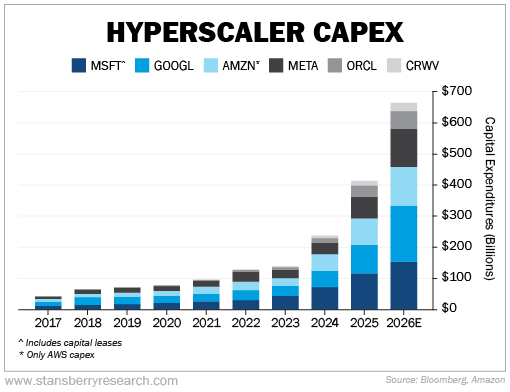
- Alphabet expects total capital expenditures (“capex”) of $175 billion to $185 billion this year… up to double the $90 billion the company spent on capex in 2025.
- Amazon forecasts $200 billion in capex this year, up 53% from 2025 and well above Wall Street’s estimate of $145 billion.
When you add in Meta Platforms and Microsoft, the four “hyperscalers” have pledged more than $650 billion in combined capex for this year – up 71% from 2025. Just take a look at this chart from the Stansberry’s Investment Advisory team…
All that spending is going toward building something real…
AI works. The chatbots write code. The agents schedule meetings. The models analyze contracts, generate images, and draft legal briefs. And this tech’s improving fast…
After all, dozens of companies are already using it to replace people.
So what if the most dangerous thing about AI isn’t that it might fail… But instead, that it’s going to succeed?
An AI Market Bubble Thought Experiment
In a normal bubble, the collapse is painful but self-limiting. Stocks crash. Companies go bankrupt. People lose money. Then the economy resets and rebuilds. And most important, people are still needed to do the rebuilding.
The AI bubble-and-crash scenario won’t work that way…
Even after a stock market crash, the data centers don’t disappear. The chips don’t stop working. The trained models don’t forget what they’ve learned.
Companies won’t stop using AI when their stock prices fall. They’ll use it more aggressively… because now they’re desperate to cut costs.
That means when the stock market crashes, practically every job that can be replaced by AI will be replaced by AI.
Consulting giant McKinsey estimates that “currently demonstrated technologies could, in theory, automate activities accounting for about 57% of U.S. work hours today.”
Geoffrey Hinton, the Nobel Prize-winning computer scientist known as the “Godfather of AI,” made a similar prediction:
“What’s actually going to happen is rich people are going to use AI to replace workers,” Hinton said in September. “It’s going to create massive unemployment and a huge rise in profits. It will make a few people much richer and most people poorer.
He predicted that in 2026, AI will gain the capabilities to replace many, many jobs… a fact that we’re already seeing as the new AI models roll out, each more capable than the last.
This is how the divide in America widens between people who have saved and invested and watched their capital compound… and folks living paycheck to paycheck who see their employers quietly hand their job descriptions off to a spruced-up chatbot.
How Might the AI Doom Loop Start?
In past technological boom-and-bust disruptions, displaced workers could switch to new industries. Farm workers became factory workers. Factory workers became office workers.
But if AI can do existing cognitive work and also learn new cognitive tasks as they’re invented, the usual escape route for tens of millions of displaced workers may not exist.
There’s historical precedent for this… During the early Industrial Revolution, there was a 50-year stretch that historians call the “Engels’ pause.” GDP growth exploded, but workers’ wages stagnated for half a century. All the gains went to capital owners. That transition happened slowly, in an era before democracy and consumer-driven economies.
We believe that ultimately, people will figure out new human jobs in industries that don’t yet exist. But it will also take time.
Here’s how the pieces might fit together…
First, something triggers the AI bubble to pop. Maybe it’s a big earnings miss from AI market leader Nvidia (NVDA). Maybe it’s a major geopolitical event. Maybe it’s rising interest rates making the multitrillion-dollar build-out unaffordable. Maybe it’s something totally different.
The stock market crashes. The Magnificent Seven, which make up more than a third of the S&P 500 Index, get cut in half – destroying upward of $10 trillion in market value. And we would expect the broader S&P 500 to ultimately decline somewhere between 30% and 50% over time… a $20 trillion to $35 trillion loss.
Investors are shellshocked. The wealth effect reverses… hard. People who felt like they were doing just fine six months ago are suddenly terrified.
Even as the market drops, AI models keep getting better… and cheaper. And now companies are panicking about their balance sheets.
So what do they do? They cut costs. And the fastest way to cut costs in 2026 or 2027 is to replace humans with AI systems that just got cheaper because of the crash. The overspending on AI infrastructure during the bubble means there’s now a surplus of cheap computing capacity, just like there was a surplus of cheap bandwidth after the dot-com bust.
Workers get laid off. Unemployment rises. Americans stop spending. Consumer spending, which makes up nearly 70% of U.S. GDP, starts to contract.
When spending contracts, businesses lose revenue. In turn, they cut more costs and add more AI. More layoffs follow. Spending falls further.
This is the AI ‘doom loop.‘ And unlike previous recessions, where cost-cutting eventually hit a floor because you still needed human beings to do the work, AI potentially gives companies an ever-improving tool to keep replacing labor.
Each turn of the cycle has a better, cheaper AI model to deploy.
How Bad Could It Get for the Average American?
The U.S. currently has an unemployment rate around 4.3%, with a labor force of roughly 170 million people. During the Great Depression, unemployment peaked at about 25%. During the 2008 financial crisis, it peaked at 10%.
If AI displacement accelerates on top of a stock market crash and recession, where does unemployment go?
The honest answer is that nobody knows. We’ve never seen this combination before. But we can run the scenarios.
A standard recession with elevated AI displacement might push unemployment to 12% to 15%… or roughly that 22 million figure from Goldman Sachs we mentioned previously.
That’s worse than 2008, and it would absolutely be brutal.
But it’s not the worst case.
The nightmare scenario, where a true depression collides with rapid AI adoption, could push unemployment toward 20% to 30%.
At 25% unemployment, the Great Depression saw GDP contract by nearly 30%. Industrial production fell 47%. Consumer prices dropped 25%. Around 7,000 banks failed, wiping out a third of the banking system.
There’s a rule of thumb in economics called Okun’s Law. It says that every 1-percentage-point increase in cyclical unemployment corresponds to roughly 2 percentage points of GDP decline below potential.
Moving from 4.3% to 25% unemployment would imply a GDP decline of roughly 40%. That tracks with what actually happened during the Depression.
On the road to 25% unemployment, consumer spending plummets. Not only would unemployed folks cut back, but still-employed workers would save every penny they could out of the justifiable fear that their job is next on the chopping block. Economists call this the “paradox of thrift.” When everyone saves at once, total spending collapses even further.
For comparison, the 2008 financial crisis produced a 4.2% GDP contraction.
This scenario would be nearly 10 times worse.
Again, this is a worst-case scenario for the market and for the nation. It is not a prediction.
But it’s worth considering to ensure that you and your family will survive if it comes.
How Investors Can Survive the AI Doom Loop
So let’s say some version of this plays out. Not necessarily the worst case. Maybe something in between.
If you’re an investor, what do you actually do?
The first lesson from history is that the biggest crashes take years to recover from.
- After the Great Depression’s 89% decline, the Dow Jones Industrial Average didn’t get back to its 1929 level until 1954.
- After the dot-com bust, the Nasdaq Composite Index took 15 years to recover.
- Even the S&P 500, with its “mere” 57% decline in 2008, required five and a half years for a nominal recovery.
If you’re 30, you can probably ride it out. If you’re 55, a 50%-or-more drawdown with a decade-long recovery could wreck your retirement. The most important things you can do now to prepare are simple. And it’s exactly the same advice we gave in October:
You can’t stop the hundreds of billions of dollars going into AI, whether they’re ultimately profitable or not… If anything, those capital flows are still gathering speed.
And you can’t stop corporations from focusing on efficiencies, even at the cost of millions of American jobs… America’s embrace of innovation is why it has been the world’s wealthiest economy for so long.
But you can keep yourself from ending up on the wrong side of this widening chasm in America by relying on yourself, not the government.
Our advice is simple: Pay off debt. Save rather than spend. And invest in strong businesses and assets that can survive a crisis.
This boom will ultimately end. You must invest now, before it does. And you must focus on owning the companies that will still be around after the bust.
The second lesson builds on our advice, in that what you own often matters more than when you sell.
Marc Chaikin, the 50-year Wall Street veteran behind the Power Gauge rating system, has been warning that we’re entering a period where the wrong stocks could cost you 40% of every $1,000 you invest.
His point isn’t that everything will crash. It’s that the dispersion between winners and losers is about to get extreme. (Marc explains his Power Gauge system in a video interview here.)
Finally, remember that some investments, like gold, have stood the test of time, crisis after crisis.
We’ve written extensively about why gold is having its best run in decades and how to position yourself in the gold bull market that’s underway right now.
Gold already crossed $5,000 an ounce. But as we noted:
If you adjust for inflation and money-supply growth, gold would need to exceed $6,000 just to match its 1980 peak in real terms.
More important, the fundamentals driving gold higher haven’t changed. Central banks are still buying. Government debt is still growing. And retail investors haven’t arrived in force. The final blow-off phase of a gold bull market typically produces the biggest percentage gains. We’re not there yet.
Looking back at the global financial crisis, gold gained nearly 40% from 2007 to 2009, even as everything else fell apart. (You can learn how to get immediate access to the No. 1 gold stock to buy in 2026 by clicking right here.)
In addition, when asset prices fall, the purchasing power of cash and government bonds goes up. That can keep you alive if and when the bust comes.
Again, I’m not predicting this worst-case scenario will play out exactly as described here.
But the fact is, we’re already seeing many of these big trends today…
Companies are already replacing workers with AI. Valuations are already stretched to extremes last seen before some of the worst stock-market crashes in history. And the folks buildingAI are warning about both a speculative bubble and massive job losses.
You still have time to prepare. But you don’t have long.