Image Credit: Unsplash
AI has reached the point of automation. And it’s starting to take a toll on human workers…
On January 29, chemicals giant Dow (DOW) announced that it’s slashing 4,500 jobs as it pivots toward a more automated and AI-driven workforce.
It’s not just Dow. According to a Forrester study released earlier last month, an estimated 6% of American jobs will be lost due to AI and automation by 2030.
As Forrester’s vice president and principal analyst, J.P. Gownder, wrote:
That equates to 10.4 million jobs. To give you a sense of the magnitude, the U.S. lost 8.7 million jobs during the Great Recession. The numbers aren’t directly comparable, since jobs lost to AI are structural and permanent, while those lost during a recession are cyclical and macroeconomic. But no matter how you view it, the numbers are meaningful and worthy of our attention.
This shift is partly because AI has evolved beyond what you might use on your phone or computer. (Think ChatGPT… or an AI assistant like Siri, Alexa, Gemini, or Copilot.)
In short, AI is now a part of our physical world… thanks to AI-driven robots.
Here’s what I wrote about robots back in December:
Robots have already successfully worked on automotive assembly lines, picked and sorted items in warehouses, and built electronic items. And they’ve performed all those jobs efficiently without sacrificing quality.
It’s only a matter of time before robots learn how to handle even more complex tasks.
Many of the jobs I referred to here are done by humanoid robots. These are AI-equipped, human-like machines that can walk, see, lift, act, and even make decisions.
Importantly, humanoid robots are only in the pilot stage…
These deployments on the factory floor are still undergoing the long process of testing and improvements.
But like it or not, smart businesses are opening their eyes to the potential cost savings of using humanoid robots over human labor. Take e-commerce and web giant Amazon (AMZN), for example.
Shipping and physical tasks are crucial for Amazon. Here’s another excerpt from my December article on Amazon’s new automation playbook…
Amazon plans to go almost fully automated. You may have heard about this in the news recently after Amazon’s internal documents were leaked. The numbers, reported by the New York Times, are startling…
- The Amazon robotics team wants to automate 75% of the company’s operations.
- This automation plan means Amazon could avoid hiring as many as 600,000 employees in the coming years. Yet the company still expects to sell twice as many products by 2033.
- By 2027, Amazon hopes to avoid hiring more than 160,000 new workers by using automation.
- Automation is expected to save Amazon around $12.6 billion between 2025 and 2027.
This is exactly what companies hope to achieve with robotics investments… massive savings.
You’ll find plenty of robotics news stories focused on which robot will win the automation race. But as I’ll cover today, that may be the wrong question to ask.
Instead, the question investors should be asking is, “Who sells the technology that makes intelligent robotics possible?”
We have an entire ecosystem of competing robotics companies… But they all depend on key technologies, layered on top of one another.
They add up to the end product – a finished robot. But this won’t necessarily be a winner-take-all market… So, for investors, it’s best to look at these contenders by their area of expertise.
Today, we’ll highlight some of the companies that will gain the most from this global push toward automation.
Why Capital Is Flowing Into Humanoid Robot Stocks Now
Cost savings is one benefit of this shift – at least, someday. But another benefit is fixing the manufacturing labor shortage…
A study by Deloitte and the Manufacturing Institute projects there will be a shortage of 2.1 million U.S. manufacturing workers by 2030. That includes skilled trades such as general assembly, welding, and warehouse logistics operations.
The projected shortage is driven by exceptionally high annual employee turnover rates (46% according to the study) in warehousing. That’s due to several factors… the physical demands of the jobs, injuries, low wages, senior workers retiring, and younger workers’ general lack of interest in industrial careers.
But the economy still needs warehouse operations and manufacturing. If human labor can’t keep up, that demand will only get more urgent.
Enter the robots…
New humanoid robots have demonstrated that they can perform simple tasks. But they’re also getting better decision-making skills and the ability to work alongside humans… all thanks to AI.
This is one solution to the projected labor shortage. And solving the problem is sure to be big business…
Barclays Research from January 2026 expects the humanoid-robotics market to hit around $200 billion by 2035.
Capital is flowing into the businesses responsible for making and deploying humanoid robots. Each company develops different parts of this technology… from the physical robot body to the “brain” within.
Let’s dig into a few of them now.
Tesla (TSLA)
Tesla CEO Elon Musk is all in on humanoid robots. He made that clear at the World Economic Forum’s meeting in Davos, Switzerland in January this year…
“We do have some Tesla Optimus robots doing simple tasks in the factory. By the end of this year, I think they will be doing more complex tasks… By the end of next year, I think we’ll be selling humanoid robots to the public,” Musk predicted.
Humanoid robots available for public purchase by 2027? Well, Musk might want to slow down a bit.
We know Musk often makes bold predictions too early. And Musk himself has conceded that mass production of Tesla’s Optimus humanoid robots – which the company is aiming to begin late this year – will likely be “agonizingly slow” to start.
For now, Optimus is effectively still in training mode on the factory floor.
But if these robots do well at more meaningful, complex factory tasks, that should accelerate Musk’s vision of selling them to the public sometime in 2027…
And if they don’t meet expectations, Tesla has the luxury of holding off and continuing to tweak Optimus internally before it’s rolled out on a larger scale.
Either way, Tesla hopes to do for robots what it did for electric vehicles… reset the entire market.
That’s because solving the scalability puzzle is the first step to solving the affordability puzzle. Musk envisions Tesla selling Optimus robots for between $20,000 and $30,000 each, once mass production ramps up.
That would save factories and warehouses a lot of money compared to hiring human workers. And that price tag is even affordable for some consumers.
But that’s Musk’s hope for the future. Let’s look at the current reality…
First, costs to build Optimus units are currently much higher than Musk’s desired price tag. Tesla doesn’t publicize those numbers. But reports from outside analysts estimate its materials alone may cost between $40,000 and $60,000 per unit.
Second, public Optimus demos have not succeeded consistently. Sure, the robot can jog and dance… But it has also shown slow response times and has fallen down repeatedly. And the company still often features human remote operators in its demos – not full autonomy.
Investors aren’t impressed by dancing robots. They want to see Optimus complete its tasks effectively and efficiently, with little intervention.
The uncertainty makes Tesla a high-risk bet on humanoid robots. But it could also be high-reward.
Investors should note (with a huge, Musk-sized grain of salt) that Musk told shareholders in June 2024 that the robots could be worth $25 trillion in market cap. And in September 2025, he predicted that 80% of Tesla’s value could someday come from Optimus.
Global financial-services firm Morgan Stanley offers a more realistic picture of the potential for humanoid robots…
- The humanoid robot market should exceed $5 trillion by 2050. That’s around double the revenue of the world’s 20 biggest automakers in 2024… combined.
- Adoption will be “relatively slow” until 2035… likely around 13 million humanoids deployed between now and then.
- Around 1 billion robots could operate globally by 2050.
- One Morgan Stanley analyst estimated in June 2025 that Tesla could save up to $2.5 billion by replacing just 10% of its human staff with Optimus robots.
In short, the challenge with Tesla is to balance lofty expectations with real potential.
A look at our Stansberry Score (courtesy of our subsidiary Stansberry Research) shows Tesla stock as a generally solid yet expensive investment…
The score gives high ratings for the company’s financials (“A”). But its capital efficiency is only average (“C”)… And Tesla’s valuation of “C” suggests it’s likely overvalued.
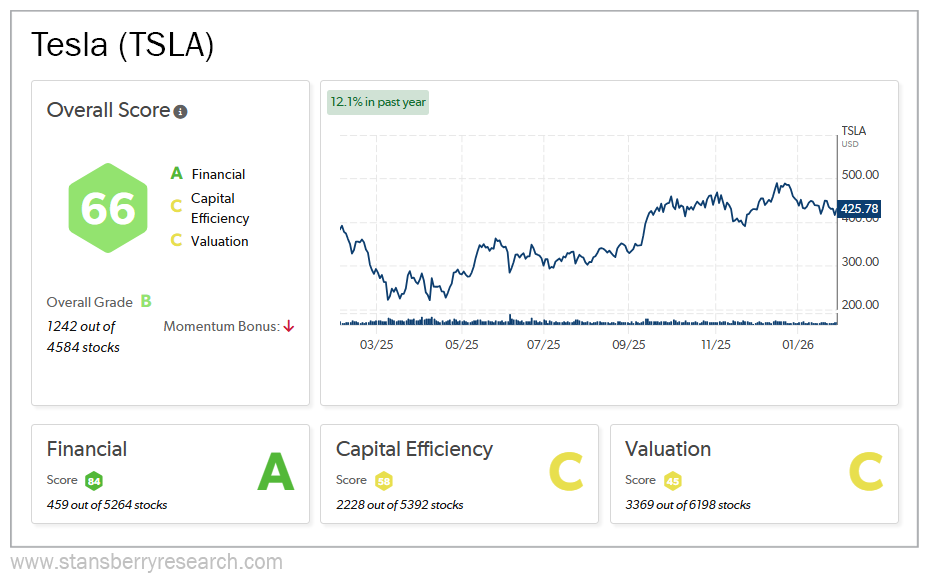
Still, a high valuation doesn’t necessarily mean that Tesla has nowhere to go.
Musk’s vision is that Optimus robots will be everywhere… not only automating industrial practices, but also serving the public as teachers, caretakers, and security guards.
Not to mention his big bombshell: “My prediction is there will be more robots than people.”
Time will tell, Elon.
Hyundai Motor’s (HYMLF) Boston Dynamics
Tesla may dominate the headlines, but companies like Boston Dynamics are working quietly on humanoid automation too.
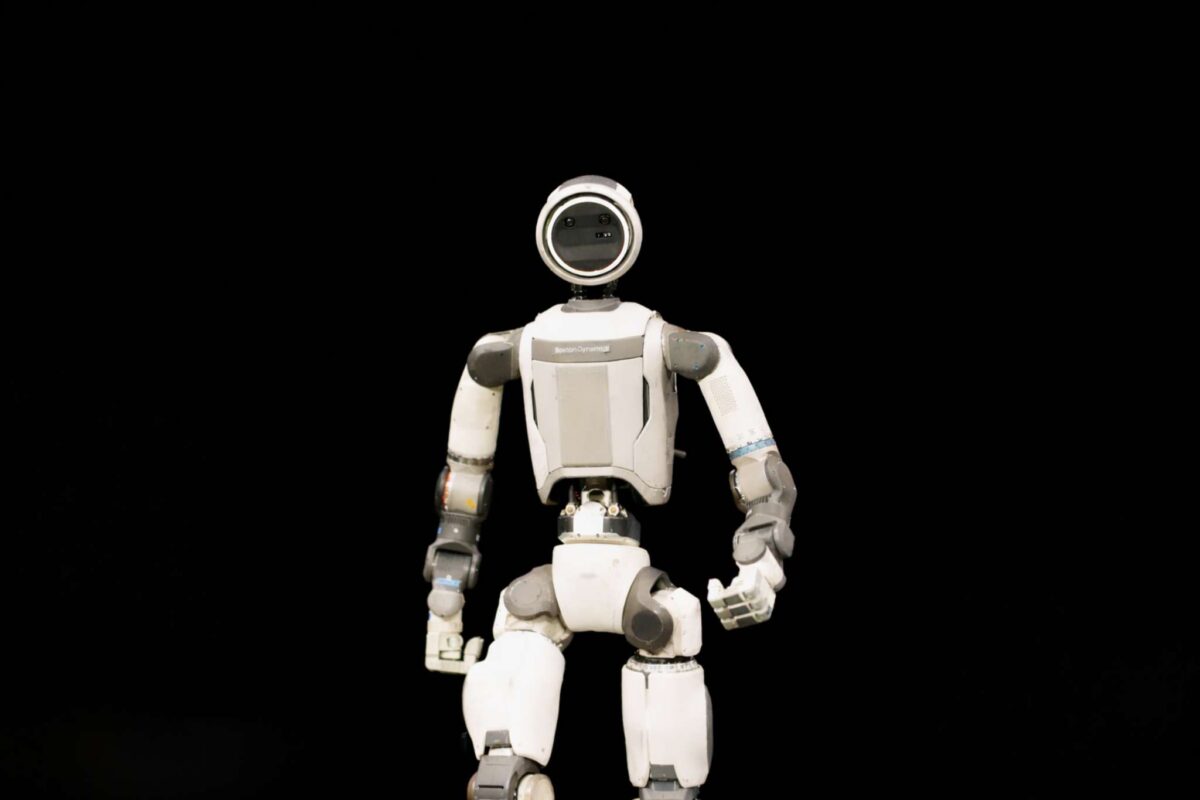
Boston Dynamics, 80% of which is owned by automotive giant Hyundai Motor Group, recently unveiled its new, fully electric robot named Atlas.
Atlas, unlike Tesla’s Optimus, is designed solely for industrial and warehouse work… not consumer use. Atlas can tackle assembly, machine tending, and other tasks. And it’s built with a safety system like that used in autonomous vehicles to detect hazards and people.
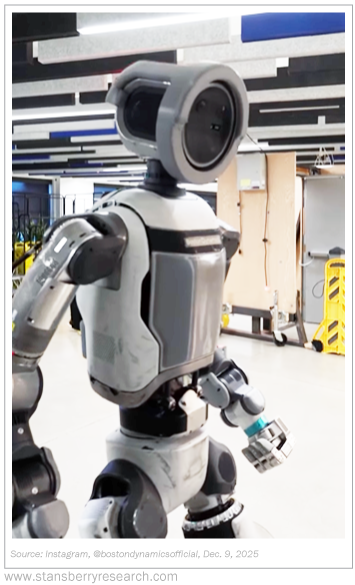
Among Atlas’ impressive features are its 56 independent joints, 360-degree vision, and ability to lift up to 110 pounds. It can also work continuously for up to four hours on a single charge. It can even change its own batteries in less than three minutes.
And Atlas is built with advanced AI models from Nvidia and Google. This helps the robot learn its environment and master most of its industrial tasks – such as part sequencing, machine tending, order fulfillment, and more – in a day or less.
These partnerships with AI “brain” companies help position Hyundai as a somewhat-surprising physical AI leader.
In fact, this year, the company plans to open a U.S. manufacturing and AI foundry plant – the Robot Metaplant Application Center – to train its robots.
For now, however, Boston Dynamics is testing Atlas in Hyundai’s Metaplant America in Georgia, a massive automotive factory. Atlas will handle the critical process of sorting car parts prior to assembly.
The company’s reasoning is that if Atlas can consistently succeed with this type of task, Boston Dynamics will have overcome the challenge of autonomous, flexible material handling in an actual unstructured industrial environment.
Pilot testing of Atlas in Hyundai’s Metaplant Americain Georgia is scheduled to last throughout 2026 and likely into 2027. Hyundai has tentatively planned initial deployment for 2028, with a phased rollout at Metaplant America. The company’s goal is to deploy 30,000 humanoid robots per year, starting in 2028.
By 2030, Hyundai expects Atlas to take on more complex tasks – including assembly and more dangerous jobs – in more production sites.
Hyundai’s goals may not be as lofty as Tesla’s. But the company is demonstrating a more measured, workmanlike approach to its deployment of Atlas.
Most important for investors, Hyundai isn’t distracted by the idea of robots for personal use. It’s laser focused on solving the human manufacturing labor shortage… and that’s where the real return on investment lies.
Nvidia (NVDA)
Without the technology that allows them to see, navigate, “think,” and perform tasks, humanoid robots would be nothing more than expensive mannequins.
Nvidia provides that technology.
Nvidia stands to benefit regardless of which company “wins” the humanoid robotics race. Many of these robots need Nvidia’s AI chips and software… so it doesn’t matter to Nvidia who’s the first to produce humanoids on a large scale.
Nvidia is already selling technology to a wide range of robot makers, including Boston Dynamics, LG Electronics, Caterpillar (CAT), Franka Robotics, and Neura Robotics.
The bottom line is, Nvidia makes money no matter who is paying for its tech.
Nvidia’s AI platform for robots is known as Jetson Thor…
Backed by Nvidia’s Blackwell graphics processing unit, Jetson Thor is specifically designed to power the AI necessary for machine vision, agentic capabilities, and more. In other words, it’s the onboard supercomputer that drives humanoid robots and other autonomous systems.
Jetson Thor is part of Nvidia’s ecosystem of robotics products. The company also makes…
- Omniverse, the foundational design platform that allows users to create 3D environments and simulation
- Isaac Sim, an open-source simulator application built on Omniverse just for robotics
- Isaac Lab, the open-source framework built on top of Isaac Sim for training
That ecosystem provides a simulation space where humanoid robots can learn to walk, navigate environments, and practice manipulation and assembly tasks in a virtual space. Robots can practice their actions millions of times in a safe space, where failure doesn’t damage physical hardware or threaten human safety.
Nvidia stock has been on a roll for a few years. In October 2025, Nvidia became the first company to hit a $5 trillion market cap.
All this is evident in NVDA’s Stansberry Score, where it earns outstanding marks in financials and capital efficiency (“A”). In the latter of the two categories, it earns a No. 7 overall ranking out of nearly 5,400 stocks. Its overall grade (“B”) takes a slight hit from its valuation (“C”).
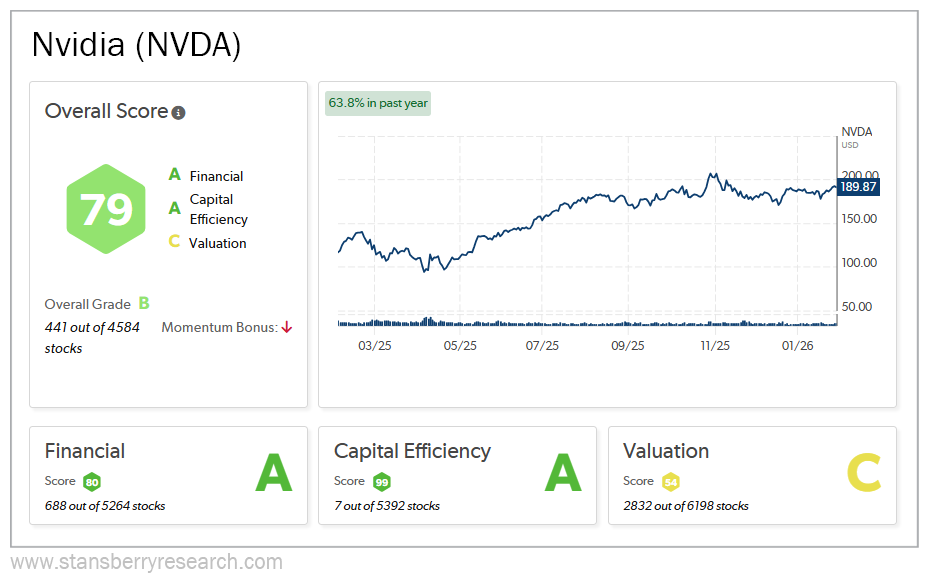
That said, even with the market’s sky-high expectations… my colleague Mike Barrett wrote on January 21 about how Nvidia might actually be undervalued right now.
Nvidia’s sales have soared over the past two years. And the company’s growth rate has naturally slowed as the market matures. That will likely continue, though not to the degree implied by its current share price.
We don’t expect Nvidia to lose substantial market share to competitors like Advanced Micro Devices (AMD). It’s too good an innovator to let that happen…
We estimate Nvidia’s intrinsic value to be $290 per share, or about 33 times NTM [next-12-months] earnings before interest, taxes, depreciation, and amortization (“EBITDA”). At the current share price, near $180, the stock is trading at a hefty 38% discount.
At the end of the day, Nvidia is a strong bet to become the picks-and-shovels winner in the humanoid robot space.
How to Invest in Humanoid Robot Stocks Without Picking a Single Winner
If you’re considering investing in humanoid robot stocks, it’s important to look at the entire robotics ecosystem…
Specifically, the companies we looked at today all hold important pieces of the humanoid robotics puzzle. One can’t exist without the others.
Humanoid robots need three things:
- “Brains”: Nvidia’s AI platforms and simulation environments
- “Body”: Tesla’s and Hyundai’s in-house parts
- “Labor”: Nvidia’s training ecosystem and Hyundai’s expertise in industrial and manufacturing tasks
So, an investment in Tesla would cover the body (Optimus). Investment in Boston Dynamics through Hyundai would cover the body and the labor (Atlas, Spot, or Stretch robots). And an investment in Nvidia would offer exposure to the brains and labor infrastructure.
By taking a stack-like approach to humanoid robots, investors can bet on the strengths of the broad industry… rather than weighing the pros and cons of specific robots.
Bottom Line: The Smart Way to Think About Humanoid Robot Stocks
Investors can bet on which humanoid robot will “win” the robotics race. But an actual “winner” may not be determined for decades… if there even is a winner.
A better idea is to take a stacked, or layered, approach to investing in humanoid robot stocks. Look for a diversified mix of stocks covering each layer of the humanoid robot stack (body, brains, labor infrastructure). That way, you’re investing in the whole ecosystem, where each layer depends on the other.
Also, in the end, the real value of the AI boom may not be in the expensive parts and hardware. It likely lies in the AI and intelligence software – “the brain” – that runs humanoid robots.
As humanoid robots gradually move from demos to deployment, the brain is what offers the most scalability… as well as consistent revenue for the long term.
Regards,
David Engle
P.S. Amazon recently slashed 30,000 jobs – the largest layoff in its history – and almost no one’s talking about the real reason why.
Former hedge-fund manager Whitney Tilson says it’s part of a much bigger shift. One that could reshape how we all work, invest, and build wealth in the years ahead.
He has spent the last decade preparing for this moment… and he recently released something that could help everyday Americans get ahead.
Click here to learn more about this market move while there’s still time.