Image Credit: Associated Press
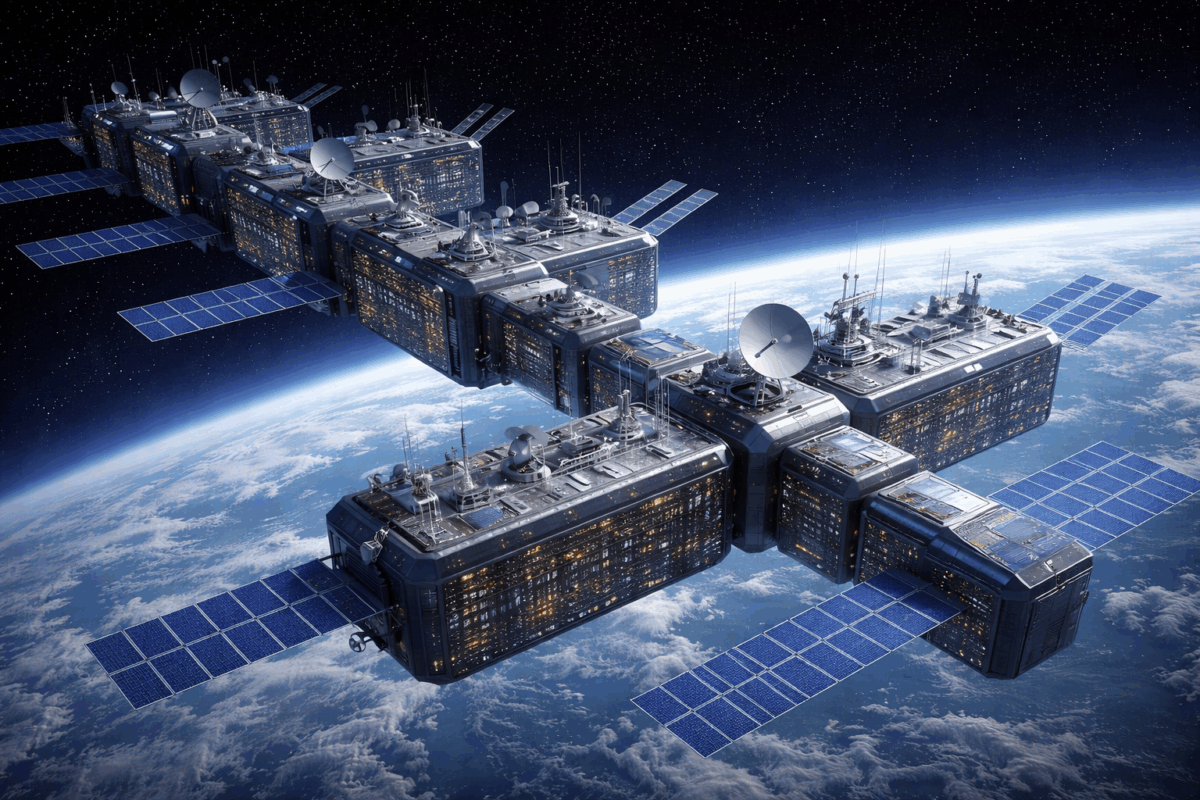
Yes, data centers in space. On the surface, that concept might sound far-fetched. But if Elon Musk plans on building a city on Mars, why not data centers in space?
Of course, Musk is known for his ambitious goals and aggressive timelines that have, at times, fallen short. But space-based data centers are a realistic possibility with several advantages over traditional data centers.
It all comes down to one word – energy. Earth-bound centers are running into power constraints. But above Earth’s atmosphere, there’s a virtually limitless supply of power that can be harnessed more efficiently.
Let’s dig in.
Why AI Infrastructure Is Running Into Limits on Earth
We’ve written about how power-grid bottlenecks are slowing AI data-center expansion to a crawl. We’ve also detailed the challenges data centers face in providing the water and power needed to sufficiently cool sophisticated AI hardware.
But, to recap, let’s take a quick look at those AI infrastructure bottlenecks and challenges.
Here’s what I wrote back in October 2025:
According to Deloitte analysis, the power demand from AI data centers alone could increase more than 30 times in the U.S., going from 4 [gigawatts (“GW”)] in 2024 to 123 GW by 2035. That’s enough to electrify nearly every household on the East Coast, or 100 million homes.
The report noted that AI only accounted for 12% of the 33 GW U.S. data-center power demand in 2024… a figure set to grow to 70% in 10 years.
As far as cooling needs, I wrote this in November…
These [data-center] facilities generate extreme heat. Graphics processing unit (“GPU”) packages operating under heavy computational loads can reach temperatures of 105 degrees Celsius. That would be 221 degrees Fahrenheit, more than hot enough to fry an egg.
And that means that liquid cooling is vital.
Put simply, there’s a power problem that must be addressed if the grids are going to support the expansion of data centers across the globe.
Then there are the seemingly endless permitting delays that grind data-center timelines to a halt – not to mention political and community pushback on the construction of AI data centers.
But these roadblocks to data-center construction and operation are lessened or erased when we go above Earth’s atmosphere.
Consider the following:
- Power advantages: Above Earth’s atmosphere, solar are efficient –as much as 28 to 30% more. If placed in sun-synchronous orbit, these centers would also have uninterrupted access to solar power.
- Cooling advantages: Temperature works differently in space. Without atmosphere, there is no convection. Radiation is how objects in space are heated or cooled. So, space-based data centers would ditch the large water systems used on Earth and rely on radiator panels to “dump” heat into space. This technology is already common on satellites.
- Protection from natural disasters:Space-based data centers would (obviously) be immune to natural disasters like hurricanes or earthquakes that could knock a terrestrial center out of commission.
- Lower regulatory hurdle/community opposition:The red tape that slows down data centers on Earth disappears in space. After all, there’s no zoning, environmental approvals, or local permitting in space. And, of course, there’re no communities in space, which means no public opposition. That doesn’t mean there are zero regulations in space. But it means dealing with a centralized licensing agency rather than dozens of local, state, and federal regulators.
Those are some of the advantages. There are, of course, disadvantages. We’ll discuss those below. But this all means that space-based data centers could become a reality. And some companies are already taking some early steps.
The 2025 Breakthrough That Launched Data Centers Into Space
In November 2025, a space startup company called Starcloud launched a satellite holding an Nvidia (NVDA) H100 GPU into Earth’s orbit. This was a test to see whether a powerful GPU could operate in space and run AI models.
So far, it has been a success.
The GPU has already analyzed images of Earth and generated answers for Google’s Gemma AI model, demonstrating that AI queries can be performed in space.
As far as scalability, that will likely be determined within the next couple of years as more companies test their technology in space. And plenty are planning to do so…
- Starcloud, as we mentioned, already launched an Nvidia GPU-equipped satellite and plans to create bigger orbital data centers that use lasers for connectivity.
- Google, owned by Alphabet (GOOGL), and its Project Suncatcher will launch two prototype satellites with AI tensor processing unit (“TPU”) chips into space early in 2027 to test their capabilities.
- Musk’s SpaceX is looking into using his company’s Starlink Gen-3 satellites for data processing and to build data centers in space. He’s currently seeking billions in funding for the project. My colleague Jim Royal wrote about the likelihood of a 2026 SpaceX IPO to raise that capital.
- Axiom Space and Spacebilt are collaborating to create optically interconnected data-center infrastructure on the International Space Station (“ISS”) in 2027.
The next couple of years are likely to be busy ones for tech companies aiming to launch data centers in space. The technology has been proven on a small scale. The question now – can this technology be scaled up, and will the companies find the capital to do it?
Let’s have a closer look at some of the players in this space.
The Major Companies Building Data Centers in Space
As we covered, Google’s Project Suncatcher will launch two satellites into space in early 2027. And Google will do so using its proprietary TPUs, which are designed to handle massive AI workloads.
Google’s TPUs are energy efficient, and they can withstand high levels of radiation found in low-Earth orbit (“LEO”). Google tested the chips’ radiation resistance in a controlled environment. While that environment isn’t quite space, the TPUs withstood heavy doses of radiation during the tests – far more, in fact, than they’d actually be exposed to during a five-year span in space.
Google is classifying it as a “moonshot” project. So, any short-term revenue is likely out of the question. For now, it’s worth watching.
Starcloud (formerly Lumen Orbit)
Starcloud, which launched its satellite with an Nvidia GPU last fall, is a privately held company based in Washington state. And they’re all in on data centers in space.
In fact, that’s all they do… develop and deploy orbital data centers in space. Starcloud is considered a pioneer in this area. In December 2025, the company reported that it successfully trained a NanoGPT model in orbit, from scratch, on the complete works of Shakespeare as its dataset.
By supplying satellite hardware, Starcloud opens the door to a wide range of potential tech partnerships – especially companies that want their chips in space. Starcloud CEO Philip Johnston offered this simple explanation of what Starcloud is all about…
In the long term, you can think of this more like an energy provider. We tell [Crusoe Cloud, a strategic partner of the company], “We have this box that has power, cooling, and connectivity, and you can do whatever you want with that. You can put whatever chip architecture you want in there, and anything else.”
Securing Nvidia as an early tech partner was an impressive – and important – first step. And by proving that its hardware can withstand the intense environment of space, it’s likely Starcloud could have a long line of chipmakers hoping to collaborate.
Johnston clearly has high hopes for the company. He recently said that, “In 10 years, nearly all new data centers will be being built in outer space.” There’s no imminent IPO ahead for Starcloud… but it’s clearly a company to monitor.
Lonestar Data
Lonestar Data, based in St. Petersburg, Florida, has an ambitious goal – creating data centers on the moon.
The privately held space tech company specializes in what they call “Resiliency as a Service” (“RaaS”). According to the company, RaaS securely backs up terrestrial data against natural disasters and cyberattacks and stores it in space… more specifically, on Earth’s moon.
Lonestar Data launched its first data-center payload, Independence, into orbit in February 2024. A year later, Lonestar sent its Freedom data-center payload into lunar orbit and then traveled to the moon on a lunar lander vehicle.
The Freedom data center remained intact—despite a botched touchdown for the land— and was set to undergo testing and perform operations on the moon’s surface. These will determine whether AI data centers on the moon are feasible.
As of late 2025, Lonestar was planning to launch its first commercial service in LEO sometime during the fourth quarter of 2026.
Like Starcloud, Lonestar Data has no short-term plans to go public as it continues to secure funding for its commercial operations.
Aetherflux
According to Aetherflux’s website, the company is “building an American power grid in space, with initial applications to perform AI compute in orbit and to deliver power to contested environments on Earth.”
Aetherflux is taking full advantage of the sun’s limitless power in its attempt to solve the world’s impending energy crisis due, in part, to AI’s insatiable appetite for power.
As we covered above, there are plenty of AI bottlenecks, specifically around energy. Aetherflux intends to eliminate those bottlenecks by harnessing space’s solar power to run massive AI computing workloads. This will be accomplished with a constellation of orbital data-center satellites Aetherflux calls “Galactic Brain.”
The company is aiming to launch its first data-center node for commercial use in the first quarter of 2027. And it has the backing to make it happen.
Among Aetherflux’s high-profile Silicon Valley investors are Index Ventures, Andreessen Horowitz, New Enterprise Associates, and the Bill Gates-backed Breakthrough Energy Ventures.
Risks Investors Should Understand About Data Centers in Space
Of course, there are some risks and challenges associated with building out data centers in space. Some of them are:
- Kessler Syndrome/space debris: Kessler Syndrome is a potential scenario where the density of objects in LEO (where space data centers are/will be) becomes so high that collisions between satellites and debris create a runaway chain reaction. This would, in theory, create many more debris fragments that would leave a large portion of orbit unusable for decades or centuries. This scenario would paralyze important satellite services like weather forecasting, GPS, and global communication.
Space debris presents a problem as well. While not as potentially catastrophic as Kessler Syndrome, even the tiniest piece of space junk moving at incredibly high speeds can damage or destroy expensive equipment.
- Launch costs: Putting a data center into space is extremely expensive. SpaceNews reported that a launch on the SpaceX Falcon 9 rocket costs around $2,500 per kilogram (“kg”) of payload. And that’s one of the more affordable rates.
The Starcloud satellite, launched in November 2025, weighed around 60 kg. The solar arrays needed to capture the sunlight to power an orbital data center can weigh significantly more. SpaceNews’ example assumed a launch of 1,000 kg of solar arrays. That alone would cost $2.5 million on the SpaceX Falcon 9 rocket. And a data center in space would likely require far more than 1,000 kg of solar arrays – not to mention several satellites.
- Hardware lifespan: Low-Earth orbit is a harsh environment. It’s a vacuum with no air. There’s a high amount of radiation and atomic oxygen. And temperatures are extreme, fluctuating from intense heat up to 300 degrees Fahrenheit in sunlight to negative 150 degrees Fahrenheit in shadow. Radiation can also cause electronic issues and degradation of materials.
Data centers in space are a reality right now… on a very small scale. Now, it’s a question of whether these companies can scale this technology as a realistic alternative/supplement to terrestrial data centers.
Regards,
David Engle
P.S. Speaking of investing in AI, a former hedge-fund manager known for spotting early winners is sounding the alarm once again.
He called Netflix (NFLX) at $7.78 (up 4,200% since), Apple (AAPL) at $0.35 (up 20,000%), and Amazon (AMZN) at a split-adjusted $2.41 (up 3,200%).
Now, this renowned investor just released a new list of his favorite AI stocks… and not a single Magnificent Seven name made the cut.
Instead, an AI stock you’ve likely never heard of just flagged as “near perfect” in his new investing scoring system.
Click here to watch his brand-new presentation, where he reveals the name, ticker symbol, and why this could be the smartest AI move of the year… especially if you’re over 50.
Recent Articles

KKR, Blackstone, and Brookfield Bet $16 Billion on Kuwait’s Oil Pipeline Deal

Bloom Energy’s Recent Mega Sell-Off Could Be a Buying Opportunity After a Blowout Earnings Report