

Artificial intelligence is no longer just a tech buzzword. It’s a market mover. Over the past five years, AI-related news has consistently coincided with notable shifts in the S&P 500 and tech stock performance. From product launches and policy updates to massive layoffs and high-volume trading days, investors are reacting in real time to the pace and tone of AI news.
In this analysis, we examined how AI headlines have influenced stock market activity. Using Google’s Global Knowledge Graph and public market data, we tracked five years of AI-driven news events and their impact on stock performance across major U.S. companies. The findings shed light on how the growing influence of AI is affecting investor sentiment and where market momentum may be headed next.
Key Takeaways
- AI has become a market-moving force. The S&P 500’s consistent responsiveness to AI headlines shows how deeply this technology is now embedded in market psychology.
- Markets reward AI-driven layoffs. Counterintuitively, investors have cheered workforce reductions framed as AI efficiency plays, reading them as cost discipline and not distress.
- Product launches are a mixed bag. Unlike layoffs, product announcements trigger unpredictable reactions depending on how investors assess disruption risks and monetization potential.
Broader conditions shape the response. AI headlines don’t exist in a vacuum; 2022’s bear market and investors’ concern over Fed policy colored how investors interpreted AI news, reminding us that context matters as much as the headline itself.
How AI Headlines Have Moved the Market
AI headlines aren’t operating in the background. They’re front and center, triggering immediate investor reactions that ripple through portfolios and indices alike. From groundbreaking product launches to regulatory shifts, the market has responded to AI news with heightened sensitivity, and not always in predictable ways.
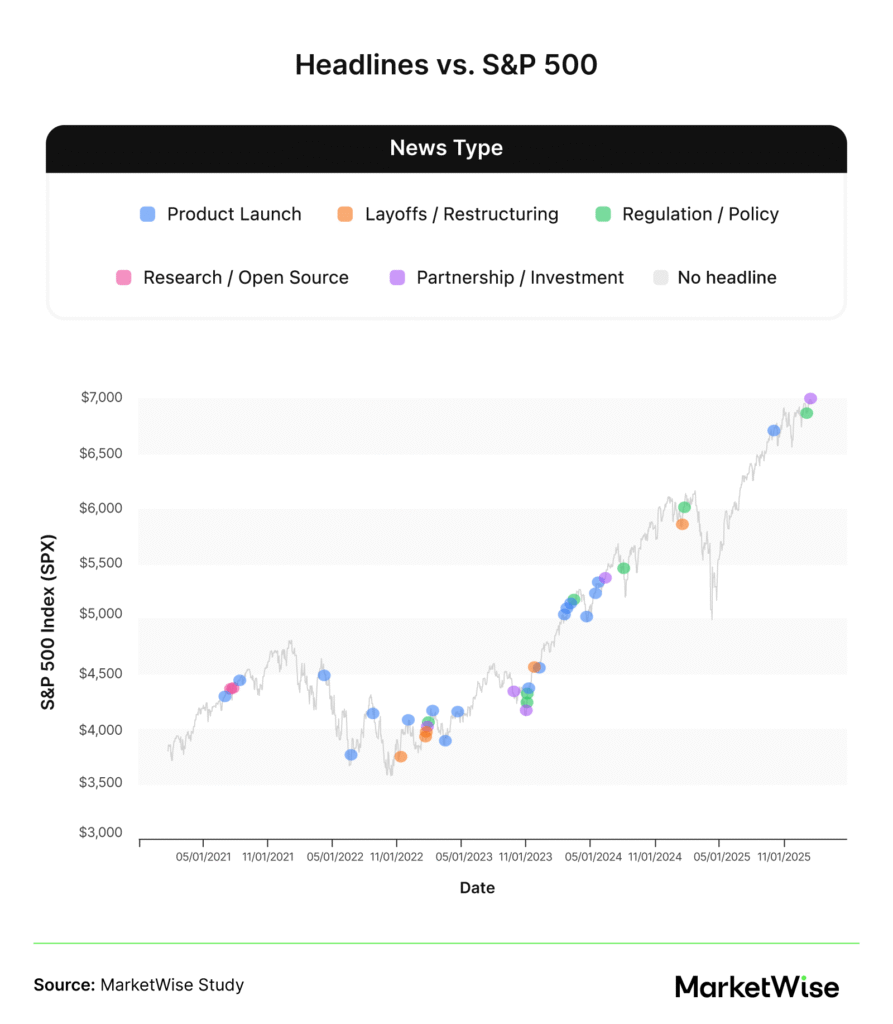
The timeline above maps key AI news events (color-coded by type) against the movement of the S&P 500. From 2021 through late 2025, announcements tied to layoffs, regulation, partnerships, and research releases all appear to influence stock market momentum, suggesting a growing link between AI developments and investor confidence.
The Early Days: Research and Product Optimism (2021)
In 2021, the market was still finding its footing with AI. Early momentum came from product launches and research breakthroughs that signaled technological progress without triggering alarm.
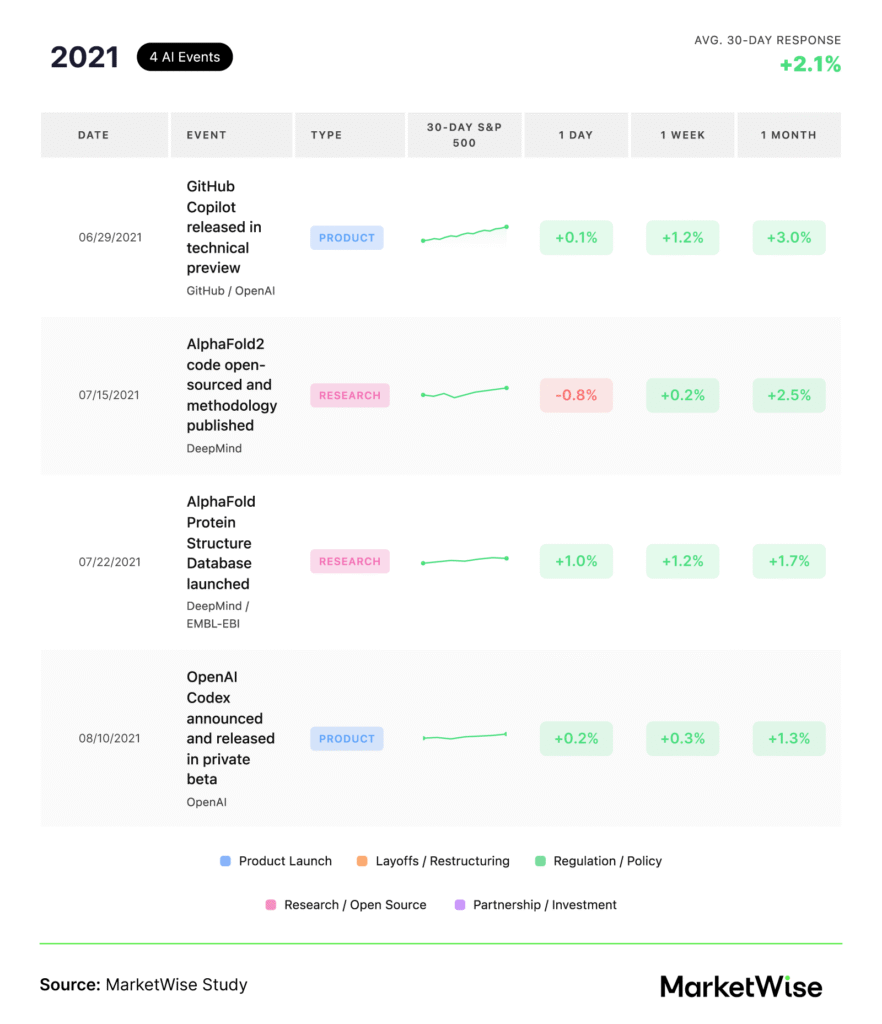
GitHub Copilot’s technical preview and the launch of the AlphaFold Protein Structure Database (DeepMind’s open-access repository of AI-predicted protein structures, a major breakthrough for drug discovery and biological research) were met with modest optimism, each driving daily increases ranging from 0.1% to 1% in the S&P 500.
But even then, investors weren’t universally enthusiastic. DeepMind’s publication of AlphaFold2 (a genuine scientific milestone) saw the S&P 500 dip 0.8% on the day of the announcement. The following month told a different story, however, with the index climbing 2.5%. It was an early sign that AI news could spark short-term jitters even as longer-term confidence remained intact.
Volatility Takes Hold: Layoffs and Open-Source Shockwaves (2022)
By 2022, the market’s sensitivity to AI developments had intensified. Investors were no longer treating AI news as background noise. They were reacting swiftly, and sometimes sharply, to each new development.
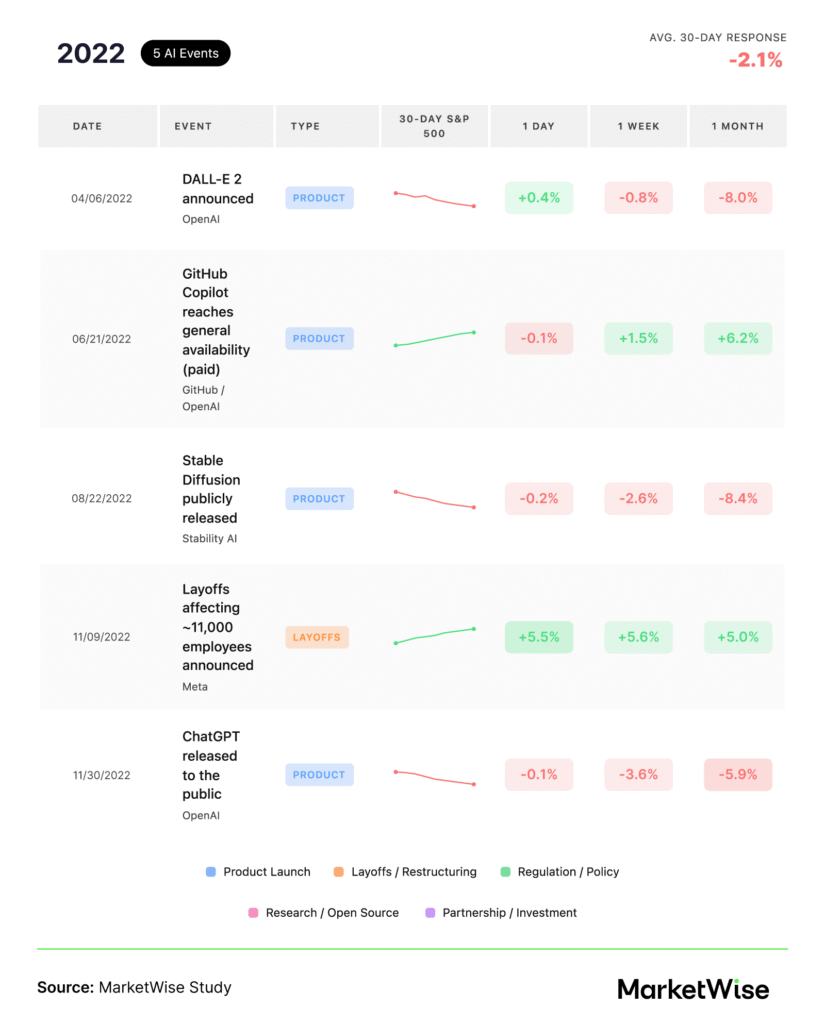
Some events delivered strong positive momentum. GitHub Copilot’s general availability in June triggered a 6.2% gain over the following month, reflecting investor confidence in AI-powered developer tools becoming mainstream products. But not all AI news was greeted warmly.
Stable Diffusion’s open-source release (a text-to-image AI model that anyone could download and run for free) in August seemed to worry investors. When advanced AI becomes free for anyone to use, does that hurt the big companies trying to monetize it? The S&P 500 dropped 2.6% within a week and 8.4% over the month.
Then came November 9, 2022, and one of the most counterintuitive market reactions in the dataset. Meta announced it was laying off 11,000 employees, a significant portion of its workforce, as part of a strategic pivot toward AI and efficiency. The S&P 500 surged 5.5% the next day. For investors, the layoffs weren’t a red flag. They were a signal that a major tech player was getting leaner and more focused on AI-driven growth. The market rewarded the discipline.
Just three weeks later, OpenAI released ChatGPT to the public on November 30. The reaction was markedly different. Over the next week, the S&P 500 fell 3.6%. By the end of the month, it was down 5.9%. ChatGPT’s explosive popularity may have thrilled users, but it rattled investors who suddenly faced questions about disruption, regulation, and which companies would emerge as winners in a rapidly shifting landscape.
Partnerships, Policy, and the Power of Regulation (2023)
In 2023, the narrative shifted. AI was no longer just about innovation. It was about who was partnering with whom, and how governments would respond.
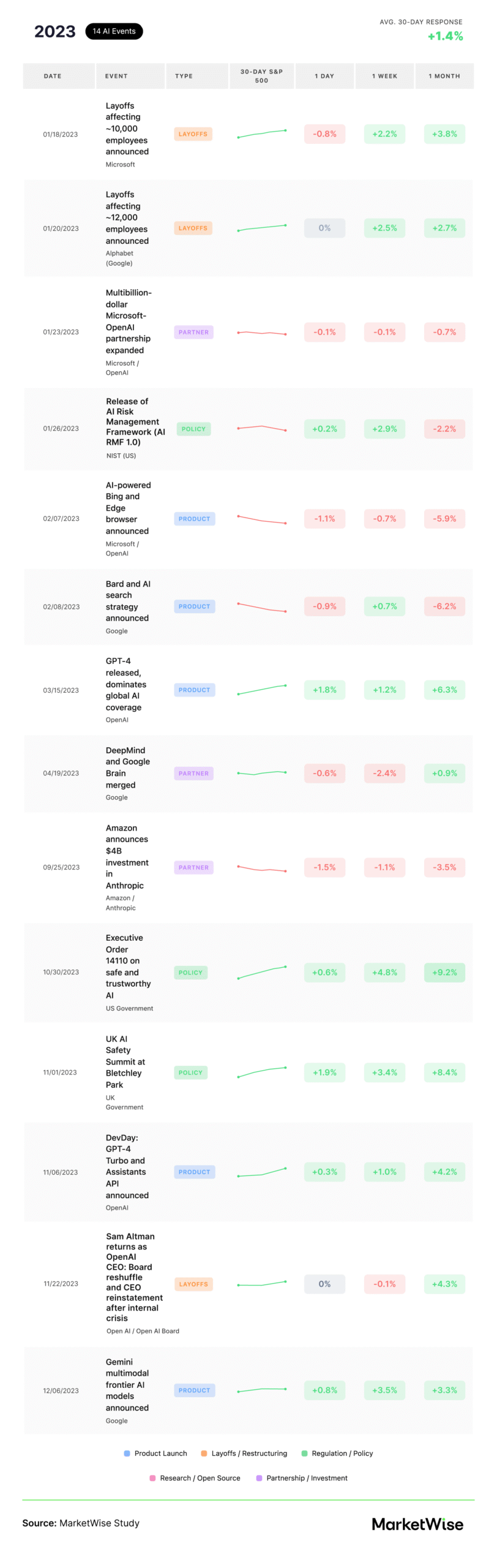
Microsoft’s multibillion-dollar investment in OpenAI and the release of NIST’s AI Risk Management Framework both generated mixed reactions, with modest upticks and dips that suggested the market was still calibrating its response to partnerships and early regulatory guidance.
But when OpenAI released GPT-4 in March, investor enthusiasm was clear. The S&P 500 jumped 1.8% that day and climbed 6.3% over the month. Cutting-edge AI models, it seemed, still had the power to inspire confidence.
Not all partnerships landed the same way. Amazon’s $4 billion investment in Anthropic drew a more muted response. The S&P 500 slipped 1.5% on the day of the announcement and declined 3.5% over the following month. Whether due to market fatigue, uncertainty about Anthropic’s competitive positioning, or broader economic concerns, investors weren’t ready to celebrate every AI deal with the same fervor.
Then came October 2023, when President Biden signed Executive Order 14110 on safe and trustworthy AI. The market’s response was decisive. The S&P 500 climbed 9.2% over the next 30 days, the largest month-over-month gain tied to any AI regulatory announcement in the dataset. Just days later, the U.K. AI Safety Summit on November 1 reinforced the momentum, delivering a 1.9% daily jump and an 8.4% monthly gain.
Regulation Meets Reality (2024–2025)
Not every regulatory moment inspired optimism. When the EU AI Act officially entered into force on August 1, 2024, the S&P 500 declined 1.8% the following day.
Whether investors saw the European regulation as too restrictive, too vague, or simply premature, the reaction stood in contrast to the enthusiasm that greeted U.S. and U.K. policy moves a year earlier.
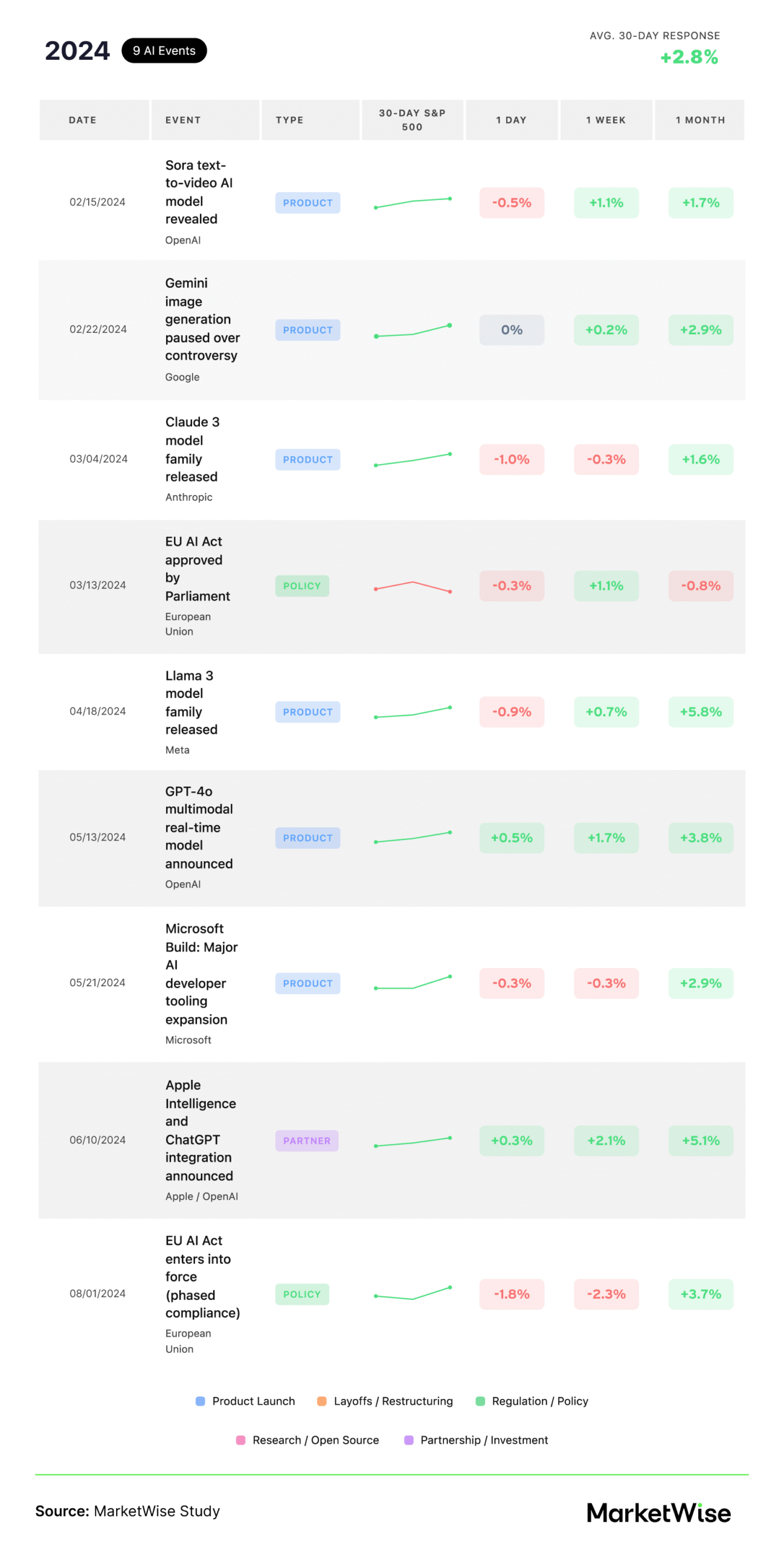
By 2025, the market had settled into a pattern. Layoffs framed as AI-driven efficiency plays, policy announcements signaling government support, and major product launches all tended to generate positive momentum.
Investors had learned to read AI headlines not just for their immediate content, but for what they signaled about the pace of change, competitive positioning, and regulatory clarity.
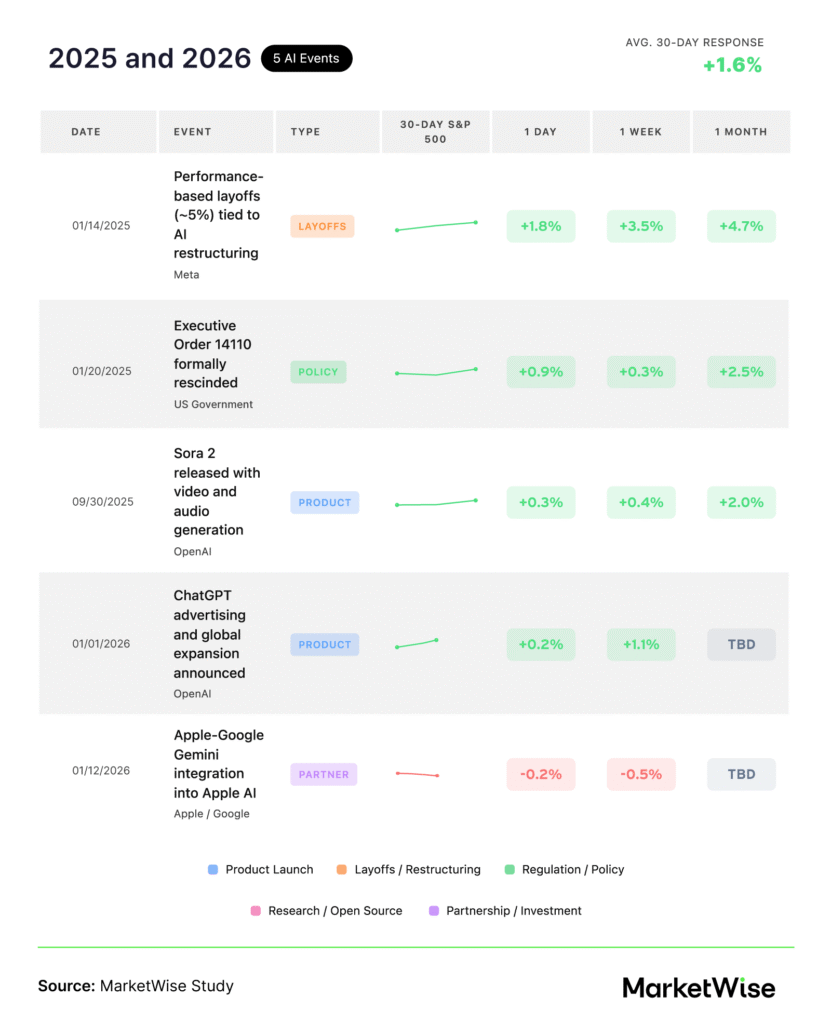
As we move into 2026, all eyes will remain on how AI headlines continue to shape market behavior, especially as innovation, policy, and public interest intersect in new and unpredictable ways.
Which AI Stocks Delivered the Biggest Gains?
While the S&P 500’s reactions to AI headlines tell one story, individual tech stocks tell another. One of dramatic outperformance, concentrated gains, and high-stakes bets on which companies will define the AI era.
Among the 25 major tech companies analyzed for AI involvement, Palantir led the field with a staggering 876% increase from its 2021 closing price to the end of 2025. That growth far outpaced even the most celebrated names in AI infrastructure: NVIDIA (534%) and Broadcom (420%).
Palantir’s ascent wasn’t gradual. The largest single-year leap for any company in the dataset occurred between 2023 and 2024, when Palantir’s stock surged 341%. This inflection point reflects a broader shift in investor sentiment. AI was no longer a speculative bet on the future. It was becoming foundational infrastructure, and platform providers like Palantir were positioned at the center of that transformation.
For investors, the question wasn’t just whether AI would matter. It was about which companies would capture the value it created. And for those who bet early on the platforms enabling AI deployment across government and enterprise, the returns were extraordinary.
When AI Headlines Trigger Panic Buying (The Highest-Volume Trading Days)
To better understand how AI-related developments influence trading behavior, we analyzed the 10 highest-volume trading days among major tech companies from 2021 to 2025 that had a direct tie to AI.
NVIDIA tops the list, with over 1.5 billion shares traded on May 25, 2023, following an earnings report that shattered expectations and underscored surging demand for AI chips. Other major spikes reinforced the same theme: Intel, AMD, and Broadcom all saw massive volume around AI-related earnings and product guidance, while Arm Holdings’ 2023 IPO reflected investor appetite for AI chip infrastructure.
The data also highlights how AI narratives now permeate companies beyond traditional chipmakers. Apple’s iPhone 16 launch drove significant volume thanks to the Apple Intelligence upgrade cycle. Oracle soared 36% in its highest-volume day on cloud and AI positioning, its largest single day increase since 1992. Even Lenovo’s trading spike was tied to the emerging AI PC product cycle.
What these moments share is a common thread: AI has become the lens through which investors evaluate major tech moves. High-volume trading around AI-adjacent events suggests the market’s sensitivity to this sector is only growing.
A Market Fueled by AI Momentum
As AI continues to reshape industries, it’s also reshaping the market. Over the past five years, headlines around product breakthroughs, layoffs, and regulations have directly aligned with stock surges and dips. Palantir’s explosive growth and the S&P 500’s response to AI-related news show how deeply this technology is now embedded in market psychology.
Looking ahead to 2026, investors would be wise to stay alert, not just to the innovations themselves, but to the stories driving perception.
Methodology
For this study, we scraped AI-related news headlines leveraging the GDELT 2.1 Global Knowledge Graph endpoints to understand which days have had large AI news headlines within the last five years. In conjunction, we scraped price movements of the S&P 500 and major tech companies involved in AI to understand how AI-related news moved the market.
About Marketwise
MarketWise is a leading financial research and education platform serving self-directed investors. Through a network of independent brands, including Stansberry Research, Altimetry, Chaikin Analytics, TradeSmith, InvestorPlace, Brownstone Research, and Wide Moat Research, MarketWise delivers independent insights, tools, and software to help individuals navigate complex markets with confidence. Whether you’re exploring emerging opportunities or seeking stability, MarketWise supports every investor with credible research and actionable strategies.
Fair Use Statement
We welcome the use of this study for noncommercial purposes. If you share or reference any part of this content, please include a link back to this page to credit MarketWise appropriately.