

Most investors eventually realize they have made at least one investing mistake. Sometimes it’s waiting too long to start. Other times it’s chasing a hot trend or panic-selling during a market drop. And increasingly, it’s following financial advice from social media that turns out to be wrong.
MarketWise surveyed 1,000 American investors to understand the most common investing mistakes, how they differ across generations, and where bad advice is doing the most damage.
Key Takeaways
- Nearly 2 in 3 American investors (65%) said they started investing too late, estimating they missed an average of 11 years of compounding growth.
- Half of Gen Z investors panic-sold during a market downturn, the highest rate of any generation.
- The top 3 most common investing mistakes: waiting too long to start investing (42%), holding onto a losing investment for too long (24%), and chasing a trending asset (15%).
- The top 3 investing regrets: not starting early enough (52%), not learning about investing sooner (42%), and not investing more aggressively when able (31%).
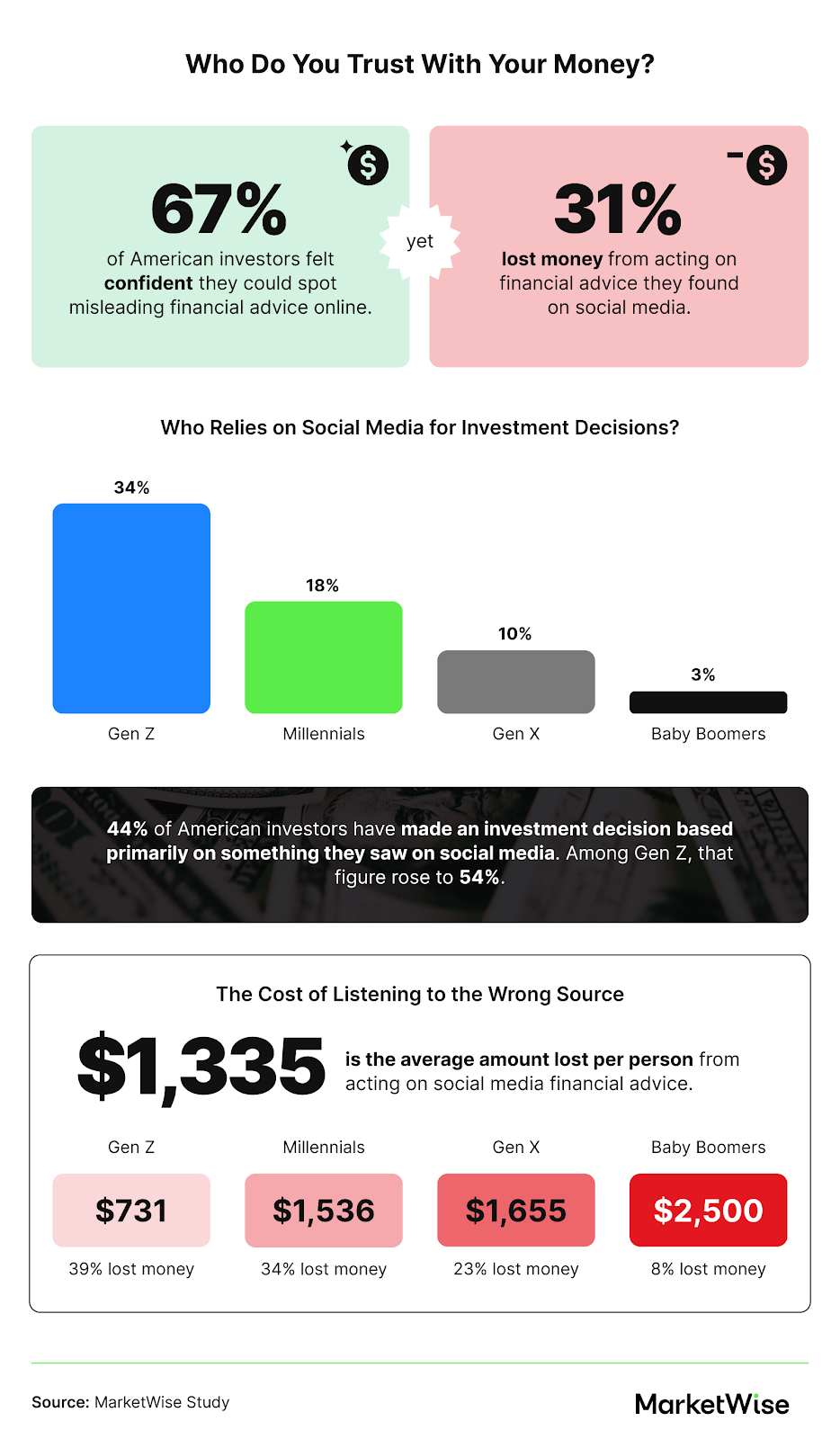
- 31% of investors lost money acting on social media financial advice, averaging $1,335 per person.
- 44% of investors made an investment decision based on something they saw on social media. Among Gen Z, that figure rose to 54%.
The Investing Mistakes Nearly Everyone Makes (and Their Biggest Regrets)
Investors across all age groups tend to face many of the same problems. However, once the data is broken down by generation, clear differences begin to appear.
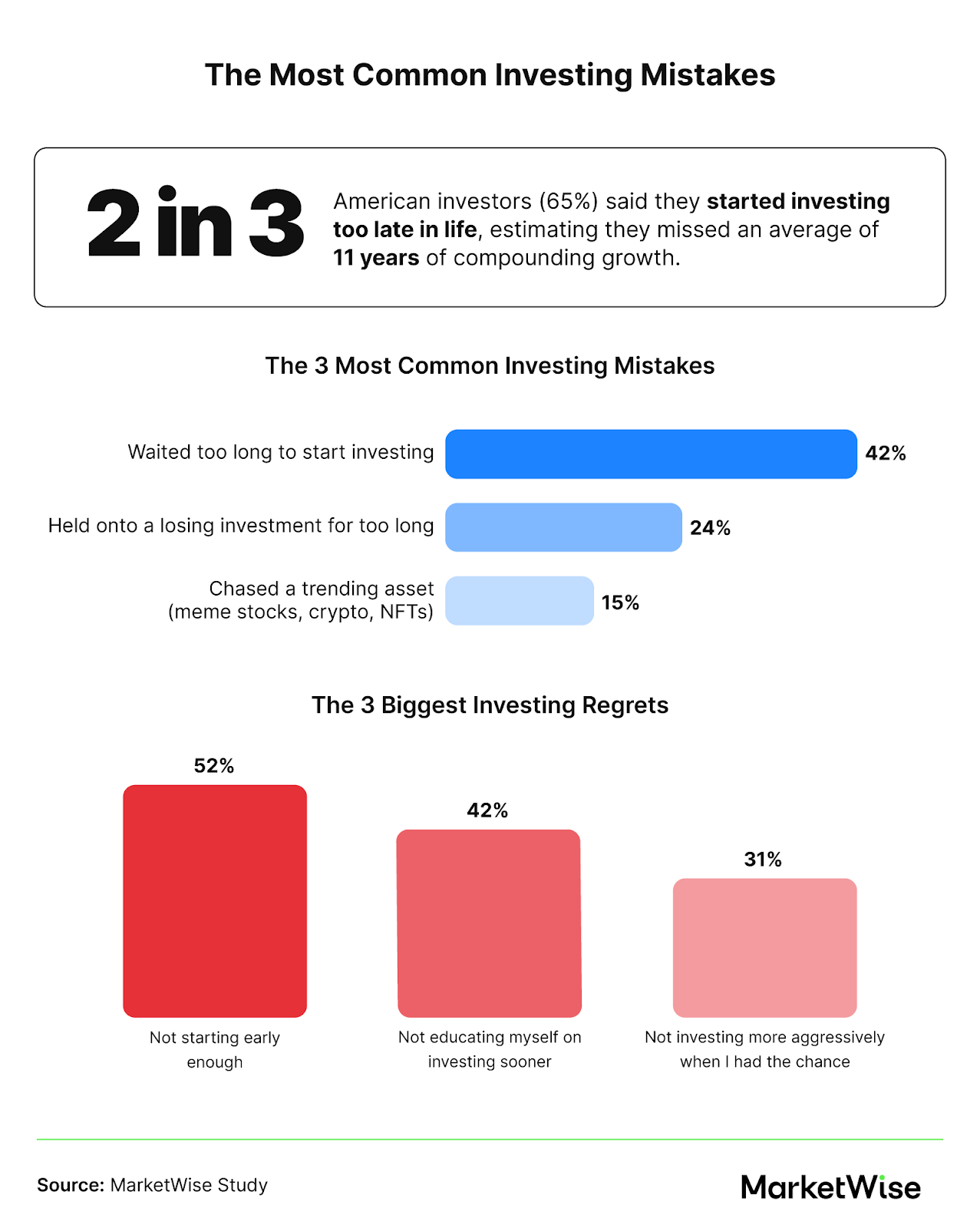
The top two investing mistakes were consistent across all four generations. Overall, 42% of American investors said waiting too long to start investing was their biggest mistake, while 24% said they held onto a losing investment for too long.
The differences among generations appeared in the third-ranked mistake, where each group revealed its own pattern:
- Gen Z: trying to time the market (18%)
- Millennials: chasing trending assets (17%)
- Gen X: early retirement account withdrawals (16%)
- Baby boomers: following bad advice (16%)
Among all respondents, 15% said they made a mistake by chasing a trending asset, such as meme stocks or crypto. Men were nearly twice as likely as women to say this was their biggest investing mistake (19% vs. 10%). Among millennial investors, 40% said they had invested heavily in a trending asset without fully understanding the risks.
Where are investors finding these trends? In many cases, social media. Nearly half of all investors (44%) said they made an investment decision based on something they saw on social media, and among Gen Z that figure rose to 54%. The line between a common investing mistake and acting on bad advice from an online source is getting thinner, especially for younger investors.
Across all respondents, the top 3 investing regrets were:
- Not starting early enough (52%)
- Not educating themselves on investing sooner (42%)
- Not investing more aggressively when they had the chance (31%)
Gen Z was the only generation in which not educating themselves (45%) outranked not starting sooner (39%).
Half of female investors said not investing sooner was their biggest mistake, compared to 36% of male investors.
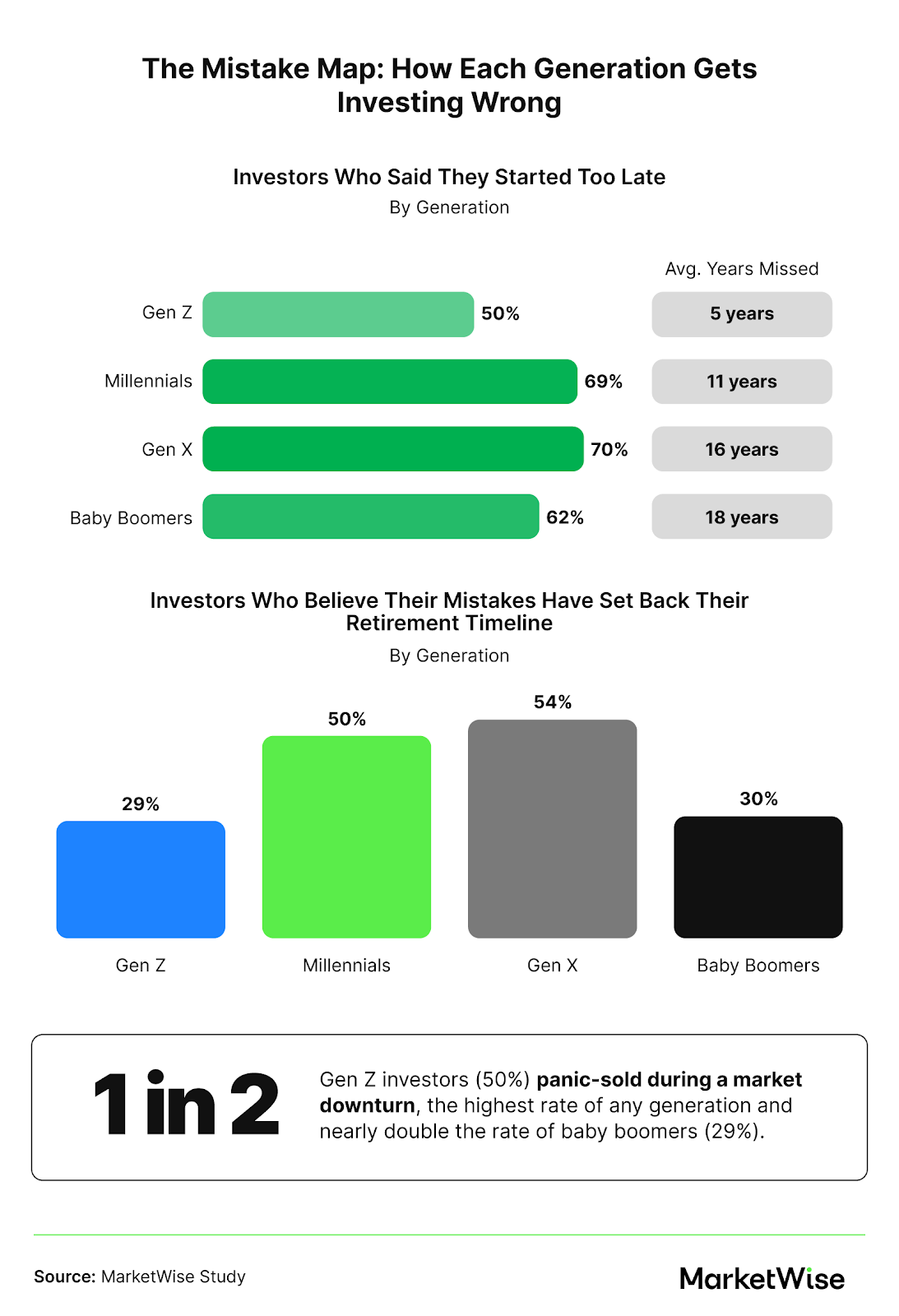
Among the 65% of American investors who said they started investing too late in life, the average estimate was 11 years of missed compounding growth. That estimate varied by generation:
- Gen Z: 5 years
- Millennials: 11 years
- Gen X: 16 years
- Baby boomers: 18 years
Gen X investors were the most likely to say they started too late (70%), followed by millennials (69%), baby boomers (62%), and Gen Z (50%).
More than half of Gen X investors (54%) said their investing mistakes delayed their retirement timeline. Half of millennials, 30% of baby boomers, and 29% of Gen Z said the same.
Income also played a role. Investors earning $50,000 to $74,000 were the most likely to say their mistakes delayed their retirement timeline, at 54%, compared with 33% of those earning $150,000 or more. Mistakes happen across the income ladder, but they’re harder to recover from when the margin for error is thin.
A Closer Look at Gen Z Investor Behavior
Younger investors clearly recognize the importance of time in the market. Only 7% of Gen Z investors said waiting too long ranked among their top investing mistakes when compared with other options. Still, 39% listed not starting early enough as their biggest regret.
Gen Z investors were also the most reactive to market volatility over the past 12 months: 25% said they became more conservative, 14% became more aggressive, and 11% temporarily exited positions.
Baby boomers were far less likely to change course. Seventy percent said they made no changes at all during the same period, compared with 41% of Gen Z investors.
Half of Gen Z investors said they panic-sold during a market downturn, the highest rate among all generations. That compares with 39% among Gen X, 39% among millennials, and 29% among baby boomers. Moves like that often lock in losses instead of giving investments time to recover.
That reactivity doesn’t happen in a vacuum. Gen Z is also the generation most influenced by social media when making investment decisions, and the data suggests those two patterns are connected.
Social Media Influences Investors and Costs Them
Confidence can be helpful in investing. Problems start when confidence in the wrong advice begins to replace careful judgment.
Alt text: Infographic on trusting financial advice online and social media investing losses.
A full 67% of investors rated themselves as confident or very confident in spotting misleading financial advice. However, 44% said they had made an investment decision based on social media content. That gap between confidence and behavior helps explain why 31% of investors said they lost money after acting on social media financial advice, to the tune of $1,335 per person, on average.
The generational divide was clear:
- Gen Z investors were the most likely to make investment decisions based on social media (54%), followed by millennials (48%), Gen X (33%), and baby boomers (14%).
- For Gen Z, social media was the second most common source of investment guidance, ahead of licensed financial advisors (34% vs. 20%).
- For baby boomers, the pattern flipped: 43% used a licensed financial advisor, while only 3% relied on social media.
Losses followed the same trend line. About 2 in 5 Gen Z investors (39%) had lost money from social media advice, compared to 34% of millennials, 23% of Gen X, and just 8% of baby boomers.
Among all investors, 31% reported losing money after following social media financial advice, with an average loss of $1,335 per person. Men were more likely than women to report this type of loss (35% vs. 25%).
Experience helped boost confidence among investors. Just 34% of beginner investors said they were confident in distinguishing credible from misleading advice. This rose to 65% among intermediate investors and 91% among advanced investors.
Another pressure point sat in the background: 70% of investors said the rising cost of living had made investing harder, with millennials reporting the highest rate (75%) and baby boomers the lowest (46%). That matters because bad advice may look more appealing when investors are already financially stretched.
Where Investor Education Falls Short
Many investing mistakes do not begin with a bad trade. They begin much earlier, with unclear explanations, missing context, and the persistent belief that investing requires a large amount of money to start.
A striking 85% of millennial investors said investing was not clearly explained to them growing up. This was higher than baby boomers (81%), Gen X (81%), and Gen Z (73%). Women were slightly more likely than men to say their investing education was lacking (83% vs. 80%).
The top topic investors most wished they had learned earlier was how to start investing with a small amount of money, selected by 65% of respondents. Baby boomers were the most likely to wish they had learned this (71%). When people don’t know they can start small, they often delay until they think they can do it perfectly (which usually leads to not doing it at all).
Gen X investors were the most likely to say they wished they had learned more about tax implications (31%). Just 7% of Gen X investors said they learned what they needed when they needed it, the lowest share of any generation.
Gen Z was the most likely generation to have received investing education growing up, at 27%. They were also the only generation where the risks of emotional investing ranked among the top 5 topics they wished they had learned, at 31%. That’s worth noting alongside Gen Z’s high rate of social media-driven decisions: knowing the terms is one thing, but keeping your cool when a trending stock blows up your feed is something else entirely.
What These Investing Mistakes Reveal
Every generation makes investing mistakes, but the patterns are surprisingly consistent. Many investors wait too long to start, react emotionally during market swings, or follow advice that turns out to be unreliable. What’s changed is where that unreliable advice comes from. With nearly half of investors making decisions based on social media content, and close to a third losing money because of it, the source of influence matters as much as the mistake itself.
When investors understand these pitfalls and where they originate, they’re better positioned to avoid them. Starting early, learning the basics, and being skeptical of financial advice on social media can go a long way toward building confidence and better outcomes over time.
Methodology
For this study, we surveyed 1,000 American investors about the most common investing mistakes across generations, how those mistakes affected their financial timelines, and where they turned for financial guidance. Among them, 57% identified as male, 41% identified as female, and 1% identified as non-binary. Generationally, 7% reported as baby boomers, 21% as Gen X, 51% as millennials, and 22% as Gen Z. The survey was conducted on Connect Cloud Research between February 24 and March 2, 2026.
About MarketWise
MarketWise is a leading financial research and education platform serving self-directed investors. Through a network of independent brands, including Stansberry Research, Altimetry, Chaikin Analytics, TradeSmith, InvestorPlace, Brownstone Research, and Wide Moat Research, MarketWise delivers independent insights, tools, and software to help individuals navigate complex markets with confidence. Whether you’re exploring emerging opportunities or seeking stability, MarketWise supports every investor with credible research and actionable strategies.
Fair Use Statement
We welcome the use of this study for noncommercial purposes. If you share or reference any part of this content, please include a link back to this page to credit MarketWise appropriately.