Today’s issue in preview:
- Investing in the coming missile restocking boom, Part 2
- The safe way to invest in soaring AI power demand
- It’s practically raining money here. How to get your share of Big Tech’s giant AI spending spree
Investing in the coming missile restocking boom, Part 2

Credit: vadimrysev
On March 18, we detailed how Operation Epic Fury has caused significant stock market losses and left many unanswered questions. However, at least one thing is certain: Missile stockpiles must be rebuilt.
This is bullish for missile makers and their downstream component and material suppliers. It’s also another facet of the Defense Tech theme we’ve been bullish on for more than two years.
In January, National Defense magazine reported that global defense spending is on pace to reach a colossal $2.6 trillion in 2026. This total would represent an 8.1% increase over 2025. Operation Epic Fury is showing us how this tidal wave of money will be spent on bleeding-edge technology.
Unlike the “boots on the ground” wars of the past, Operation Epic Fury is being fought by the U.S. almost completely with drones, missiles, and satellites. Numerous sources have reported that the U.S. fired over 400 Tomahawk missiles in the first three days of the conflict. Iran has fired thousands of drones and missiles in return. The Pentagon recently told Congress that the first six days of the war cost $11.3 billion.
In this high-tech version of war, the foot soldier is growing less and less relevant… and having more and better high-tech drones, missiles, and satellites than your enemy is critical.
As a result, the U.S. and the Gulf States are using huge stores of both offensive and defensive missiles during Epic Fury. Rebuilding these stores will add even more demand to already strained global missile supply chains, which should provide a tailwind to producers of missiles and missile components. In our ABC issue, we detailed three producers poised to benefit from a big restocking.
However, a missile supply chain isn’t worth much if it lacks the critical raw materials needed to produce its very high-tech products.
Every precision missile, interceptor, drone, and radar system relies on a small set of critical minerals that can withstand extreme heat, remain very strong, and be light enough to fly.
When missile stockpiles are massively drawn down, you’re not just pressuring the manufacturers; you’re pressuring the entire supply chain of rare earths and exotic alloys, which are already strained and geopolitically sensitive.
The most overlooked critical metal is scandium. When combined with other metals like aluminum, it creates a very lightweight, but high-strength structure. This is why securing critical minerals like scandium has become a national security imperative. Without scandium, the US doesn’t have the most advanced missiles and drones.
By definition, increased missile manufacturing equals increased critical metals demand. Companies poised to benefit include:
Doubleview Gold Corp (DBLVF): DBLVF is a small-cap mine development firm that owns a project in British Columbia that is mostly copper. This has it positioned to benefit from soaring copper demand. But Doubleview is also a play on scandium, as its deposit has significant scandium content as well. DBLVF is a risky play, though, as it is still in development rather than an operating mine. This makes this a very leveraged, speculative way to play the scandium and copper thesis, but with clear risks of dilution, permissions, commodity prices, and execution.
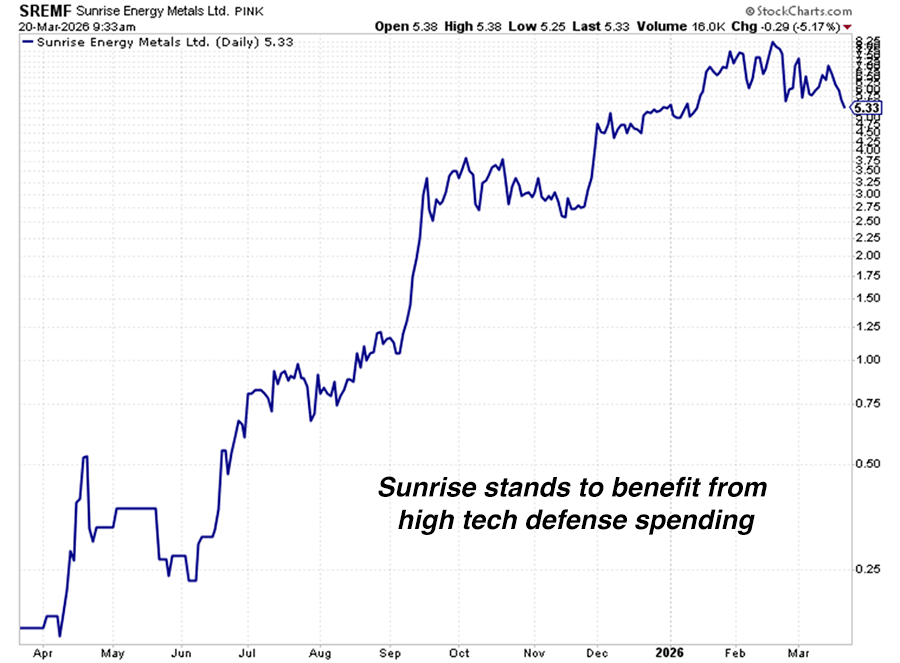
Sunrise Energy Metals (SRL): SRL is another small-cap mine developer. Its Syerston project in Australia is one of the largest scandium resources in the world and contains nickel and cobalt as well. Sunrise is slightly less risky than Doubleview because its project is development-ready with key permits in place. Sunrise has also signed a five-year scandium option with Lockheed Martin (LMT), giving LMT the right to purchase up to 25% of Sunrise’s scandium. The company is backed by mining powerhouse Robert Friedland.
MP Materials (MP): MP is a $10 billion critical metals mining and processing company with lower risk. MP controls the Mountain Pass in California, which is one of the richest rare-earth deposits in the world and the only large-scale rare-earth mine in the US. MP doesn’t have scandium, but it does have neodymium and praseodymium, which are used in high-strength magnets for missiles, drones, motors, and EVs.
In the wake of Epic Fury, depleted missile arsenals must be restocked. This is bullish for missile makers, missile component makers, and well-positioned critical metal suppliers.
Recommended Link:
Trump Did What!?!?

“I recently visited Mar-a-Lago… And now I’m prepared to put my reputation on the line. One investment I just uncovered could be my biggest winner of all… It involves President Trump, Elon Musk, trillions of dollars, China… And a MAJOR upgrade to the artificial intelligence revolution. If you buy just one stock in 2026, I urge you to make it this one.” – Louis Navellier Click here to see the name and ticker symbol of the company at the center of it all.
The safe way to invest in soaring AI power demand passes a key test
Credit: Ron and Patty Thomas
During the chaotic trading week of March 9–13, industries such as airlines, homebuilding, financials, and industrials suffered large declines. It’s no wonder investors sold these industries with enthusiasm. Every morning that week, we could have woken up to news that an oil tanker had been sunk in the Strait of Hormuz and oil was trading for $142 a barrel.
Yet during that chaotic week in the markets, major utility stocks Exelon (EXC), Duke Energy (DUK), FirstEnergy (FE), and Southern Co (SO) reached new all-time highs. These firms displayed tremendous “relative strength” during a time when most industries and themes traded lower.
These moves were yet more evidence that the “AI Power Consumption” theme is alive and well… and that utility stocks are a great way to play it.
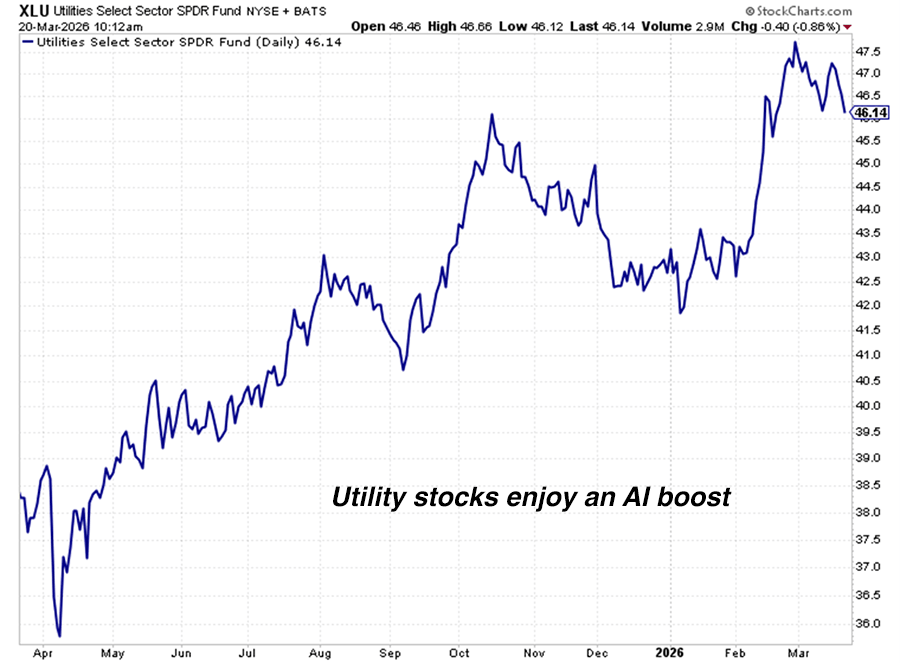
On July 8, I highlighted the emerging uptrend in the Utilities Select Sector SPDR Fund (XLU) and said AI power demand was poised to drive it higher.
Regular readers know one of the largest and most profitable facets of the AI megatrend is power consumption. Thanks to AI’s enormous promise, giants like Google, Meta, Microsoft, and OpenAI are spending hundreds of billions of dollars a year on data centers, AI chips, and other infrastructure components.
All that AI infrastructure is poised to consume huge amounts of electricity. Goldman Sachs forecasts global power demand from data centers will climb 50% by 2027 and as much as 165% by the end of the decade. This demand is driving a big bull market in virtually every form of electric power production.
One of my recommended ways to invest in this megatrend is via electric power producers… aka “electric utilities.” When you invest in utilities, you are not risking your money by trying to pick the company that creates the best AI-powered software application or the best AI-powered travel site.
Instead, you’re making the safe bet that every company and every individual using AI ends up buying some electricity to power it. It’s the old “selling picks and shovels to Gold Rush miners” strategy applied to the AI boom.
Our advice to own utilities is paying off. XLU – a diversified basket of utility stocks – is up 14.7% since our recommendation (vs. 5.3% for the S&P)… and the individual names mentioned above are regularly registering new all-time highs.
The gigantic business, technological, demographic, and political trends that shape our world play out over years, not months. This means the financial market trends they manifest tend to persist for years, not months. With all this in mind, I remain bullish on utilities.
It’s practically raining money here. How to get your share of Big Tech’s giant AI spending spree
Credit: Alexander Sikov
On March 13 we highlighted how incredibly well “AI infrastructure builder” stocks Bloom Energy (BE), GE Vernova (GEV), and Vertiv (VRT) performed during the market chaos of early March.
These companies are on the receiving end of the biggest investment boom in all recorded history. Given AI’s enormous promise, large tech firms such as Google, Amazon, Microsoft, OpenAI, Oracle, and Meta have invested over $1 trillion in specialized semiconductors, data centers, and other infrastructure components. They are on pace to invest around $700 billion this year alone and trillions after that.
The scale and velocity of investment is awesome and unprecedented.
That’s why Bloom, GE Vernova, and Vertiv performed so well during the Epic Fury chaos… and it’s why each has gained hundreds of percent over the past two years.
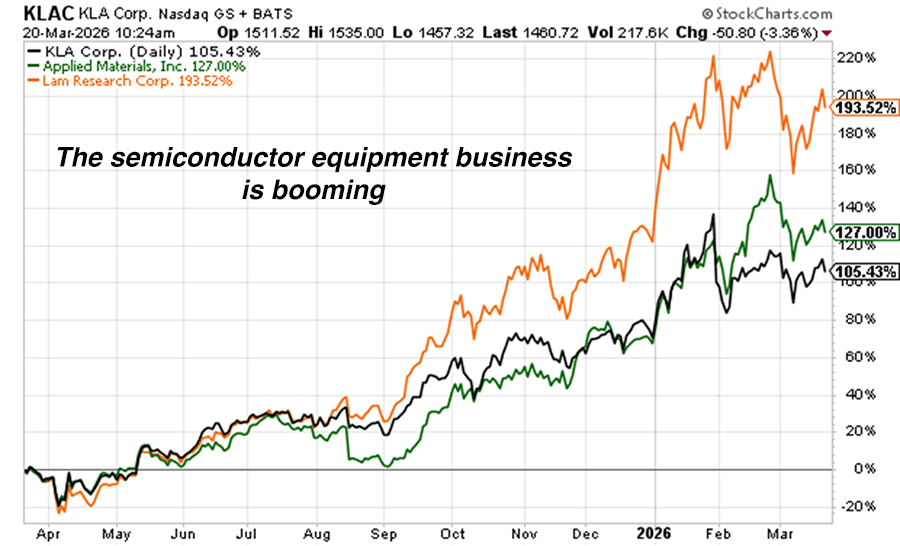
Given how well AI infrastructure builder stocks can do during the good times and how well they can hold up during bad times, it’s worth discussing the “AI semiconductor equipment” industry, which is also on the receiving end of big tech’s historic spending spree.
Semiconductor equipment makers play a special role in the AI megatrend. They do not build semiconductors themselves. Instead, they provide a wide range of services and equipment that support semiconductor production. They sell fabrication machines, chip components, perform testing services, and many other vital things that make the semiconductor industry go.
No semiconductor equipment industry, no AI boom.
The three U.S. leaders in semiconductor equipment are Applied Materials (AMAT), Lam Research (LRCX), and KLA (KLA). Each firm enjoys a dominant role in the AI semiconductor equipment industry, each is enjoying terrific revenue growth, and each is enjoying a strong stock uptrend. They are all up more than 100% over the past year.
I often say you want to work and invest in booming industries that are enjoying such strong revenue growth… such huge investment flows… and have so much future demand… that financially, you’re essentially running downhill. Given big tech’s historic trillion-dollar-plus AI infrastructure spending spree, we can say one such industry is semiconductor equipment. Bullish!
Market Notes
- Our Sept. 29 recommendation to own oil stocks is paying off like a broken slot machine. Energy giants ConocoPhillips (COP), Halliburton (HAL), and Chevron Corp (CVX) all reached all-time highs today. US Brent Oil ETF (BNO) also just hit a new one-year high
- Our January 12threcommendation to own AXT (AXTI) has paid big. The optics bottleneck play is now up 160% since our initial recommendation.
- Our September recommendation to own space stocks is in the green. Satellite operator Planet Labs (PL) just hit a new one-year high, jumping 31% today. It’s now up 733% in the last year alone.
- Our January 21st recommendation to own solar stocks is winning. Solar technology company Solar Edge (SEDG) is up 10% today and 192% over the last year as it hits a new one-year high.
- The AI lawnmower is still in full effect. Adobe Systems (ADBE) just hit a new one-year low.
Regards,


Brian Hunt
Editor, Money & Megatrends
An urgent message from our colleagues:
‘The Worst Losses We’ve Suffered in Years Could Be Dead Ahead’

He accurately predicted the brutal 2022 bear market weeks before it struck. He predicted the COVID-19 crash, too… and even the tariff sell-off in April 2025. Now, legendary analyst Marc Chaikin is sounding the alarm again – and on March 25, he will reveal the money move he says everyone should make immediately.