
Today’s issue in preview:
-
An AI “demand shock” is set to hit this industry and drive stock prices higher
-
Why oil stocks are poised to go lower
-
Operation Epic Fury sends natural gas and fertilizer stocks to new highs.
An AI “demand shock” is set to hit this industry and drive stock prices higher
Credit: AvigatorPhotographer
Is an AI “demand shock” set to hit the chemical industry and create big stock market winners?
It’s an important question, and the answer could make you a lot of money.
In our February 13 issue, I detailed how, for three years, the best way to make money quickly in stocks has been to locate an industry where an AI “demand shock” is about to strike… and then invest there before the shock arrives.
Not a supply shock, mind you, where a war or a pandemic abruptly cuts off the supply of a resource like oil.
Instead, I’m talking about a “demand shock,” where demand for a specific resource or manufactured product suddenly skyrockets… and sends its price hundreds of percent higher. This creates boom times for the companies involved, as their unit sales and per-unit prices skyrocket simultaneously.
Twenty years ago, demand shocks for manufactured goods and natural resources were relatively rare. Businesses had time to anticipate new sources of demand and plan accordingly. For many industries, those days are over.
Recommended Link:
When Fear Rules the Market, This Is the Man You Want in Your Corner…

In 2022, when the Russian invasion of Ukraine shocked the world, Greg Diamond recommended a trade that returned 116% in 34 days… and another trade that soared 100% in 17 days. Now that the U.S.-Iran conflict is wreaking havoc on the global economy, how is Greg leveraging this market turmoil to benefit folks? . Find out at the 2026 Market Crash Summit.
AI – the fastest-evolving technology in history and the focus of the largest capex spending cycle in history – has changed the rules.
AI’s power, adoption rates, and capacity are exploding… from just one quarter to the next.
AI is advancing at such a rapid pace… and large tech firms such as Google, Microsoft, and Amazon are spending such huge, unprecedented amounts of money on it (over $600 billion in 2026 alone) that AI-driven demand shocks are now happening every year… and creating the biggest, fastest stock market moves we’ve ever seen.
Recent “AI demand shock” bull markets include:
**In 2023, just after ChatGPT was introduced, there was an AI demand shock for Nvidia’s advanced semiconductors. The company’s revenue soared as a result, and so did its stock price. Nvidia advanced 525% in less than two years.
**Around the same time, there was a demand shock for systems that cool AI data center components. This drove shares of cooling systems maker Vertiv up 1,050% in under three years. It sent Comfort Systems’ shares up 1,000% in three years.
**AI data centers require advanced optical systems that allow fast data transfer. This demand shock drove the stock of optics firm Coherent up 295% in two years. It drove the stock of optics firm Lumentum up 1,164% in two years. It drove shares of optics materials firm American Xtai up by 1,035% over two years.
**AI data centers also drove a demand shock in memory systems that support computer processing. This drove SanDisk’s stock up 1,567% in just one year and Western Digital’s stock up 579% in two years.
These are among the largest and fastest wealth-creation events in history.
They are happening because Big Tech’s historic investment spree and AI’s breakneck rate of advancement are creating massive demand spikes that traditional manufacturing and resource chains are simply not equipped to handle. They don’t have enough lead time to adjust to rapid demand shocks. The trends are taking shape and exploding too quickly.
One day, an aggressive demand forecast for AI infrastructure components such as optical lasers or memory or semiconductors is just a spot on the horizon to conventional thinkers… a futurist’s fantastical estimate…
The next day, the demand spike is on us… and we don’t even have blueprints for the new factories we need today. So, prices explode by 3, 5, even 10 times or more. The demand shock hits the market like a meteor.
The typical manufacturing industry needs 5-10 years to build operations capable of meeting increasing demand. Same with mining industries that supply critical raw materials.
But our new, lightning-fast technological cycles now move way, way faster than that. They are hitting our economy like supersonic tidal waves. We now have crazy mismatches in the economy’s interlocking and interdependent parts. It’s like we have a 12,000-horsepower funny car engine but the drivetrain from a 1996 Hyundai Elantra.
These factors are creating a market environment where the market values of well-positioned companies can rise 100%… 300%… and 1,000% in less than two years.
With this in mind, an investor should ask: “Where will the next AI demand shock take place? Where will AI take almost everyone by surprise as it did in semiconductors, memory, optics, and cooling?”
One leading candidate is the chemicals industry.
The chemicals sector is commonly thought of as an “old economy” industry that produces products such as plastics, paints, solvents, cleaners, and pesticides. However, some chemical firms are involved in “brand new economy” activities related to AI.
The chemicals industry sits upstream of almost every physical component in the AI stack: from the specialty gases and materials used to manufacture semiconductors to the high‑purity solvents, coatings, coolants, flame retardants, and advanced polymers that make modern data centers possible.
Every AI server relies on a long chain of ultra-specific and ultra-pure chemicals. As AI usage explodes, the need for more chemicals and more sophisticated, higher-purity ones increases.
Companies poised to benefit from rising AI-related demand include:
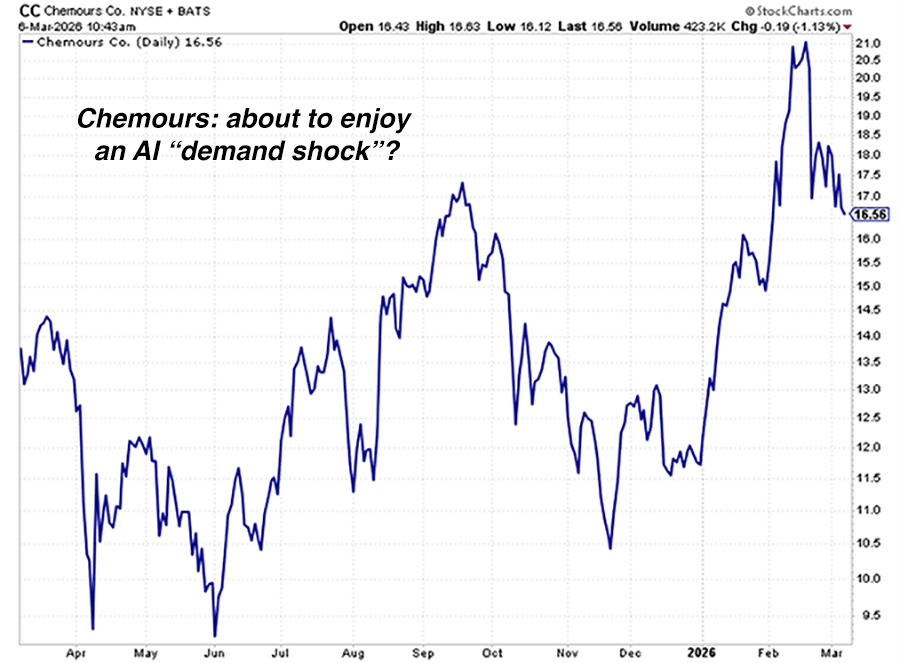
Chemours (CC) is a $2.5 billion firm positioning itself as a key “picks and shovels” supplier to AI data centers via advanced thermal management fluids. Its liquid-cooling technologies are now being deployed and claim up to 90% lower cooling energy use vs air systems. If liquid cooling becomes the default way to cool AI data centers, CC quickly shifts from a cyclical chemical story to a bottleneck on the AI capex cycle.
Element Solutions (ESI) is a $8 billion specialty chemicals company that provides wet chemistries and materials that connect the circuitry in AI data centers. As AI leads to more complex packaging, the value of reliable, high-performance chemistries will rise. More layers packed means more ESI chemicals needed.
Entegris (ENTG) is the purest AI chemicals play of this group. It’s an $18 billion market-cap producer of ultra-high-purity chemicals, filtration systems, and materials-handling solutions that enable advanced semiconductor manufacturing. No ENTG, no advanced semiconductors. Again, as complexity increases and more layers pass through fabs (AI factories), more chemicals, filters, and specialty materials are needed. This puts ENTH in the center of the potential chemical demand shock.
AI is the fastest-evolving technology in history. Big tech firms are spending record amounts of money to fuel its progress. This will continue to create big “demand shocks” and investment opportunities. The next one could happen in the chemicals industry.
Why oil stocks are poised go lower

Credit: mysticenergy
Get ready to see lower oil stock prices soon. After sprinting flat out for more than a month, the sector is due for well-deserved rest.
Regular readers are familiar with our hugely profitable September 2025 call to go long oil stocks, which looked to be starting an uptrend at the time. Soon after that call, oil stocks started soaring. They received an extra boost in February as investors began anticipating higher oil prices thanks to Operation Epic Fury’s disruption of oil shipping lanes. Many oil stocks packed in a good year’s worth of returns (15%-25%) into one month.
And now, the sector is due for a break. Because of mean reversion.
In the stock market, mean reversion is the idea that after a financial instrument has experienced a large move in one direction and is in an abnormal state, it is likely to “revert” to a more normal state.
Put differently, assets that stage a huge move in one direction are likely to “snap back” in the opposite direction… much like a rubber band snaps back when stretched. No upside move – no matter how strong – moves in a straight line. The move will have many corrections to the downside along the way.
Because of these dynamics, I often say markets are like runners. They can’t sprint flat out for miles at a time. They need to take breaks… or “breathers.”
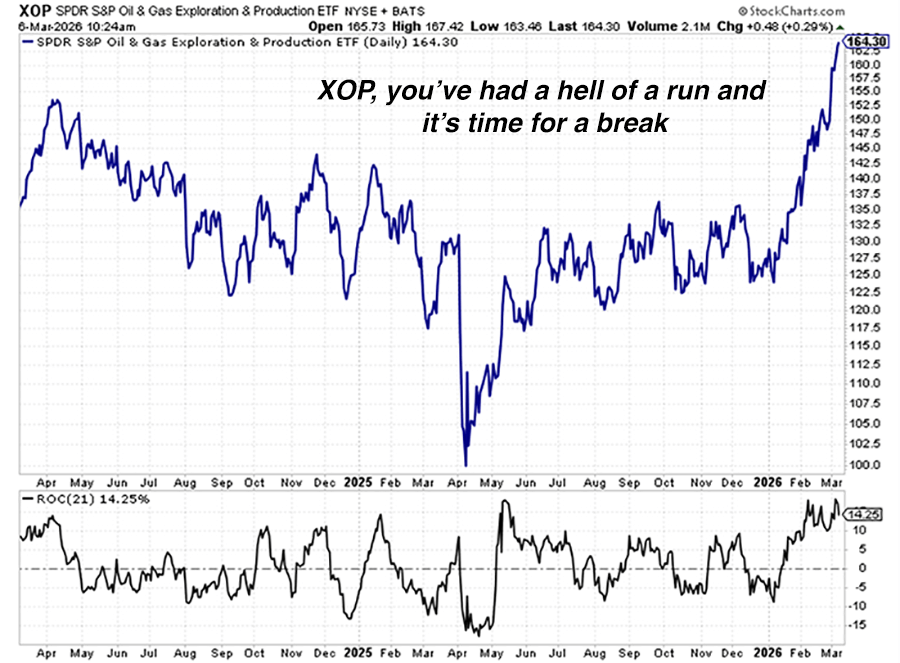
Below is a two-year chart of the S&P Oil & Gas Equipment & Services ETF (XOP) with its “21-day Rate of Change (ROC)” plotted below it. Rate of change is a metric that measures the price change of a security over a specific time period. In this case, it’s 21 trading days, or about one calendar month.
As you can see, XOP’s rate of change is at the upper level of its two-year range. This tells us XOP has been sprinting flat out… and is due for a breather.
The White House is fully aware that Operation Epic Fury could have painful “bad domino effects.” Epic Fury is raising oil prices… which could raise American gasoline prices… which could hurt the Republican party during the mid-term election season. There is enormous incentive for Trump to end this quickly and let the markets calm down.
Of course, there’s a chance Epic Fury gets truly ugly and protracted. We’re talking the Middle East and Donald J. Trump here. But the odds favor a big correction in oil and oil stocks soon.
Market Notes
-
Our November 10th recommendation to own natural gas is paying off. The First TrustNatural Gas ETF (FCG) just hit a new one-year high.
-
Operation Epic Fury is constricting fertilizer shipments from the Middle East… which is driving up fertilizer prices. Fertilizer giants Intrepid Potash (IPI) and CF Industries (CF) reached new one-year highs today as a result.
-
Our recommendation to own energy pipelines continues to pay off. Giant pipeline operator Enterprise Products Partners (EPD) reached a new all-time high today.
Regards,


Brian Hunt
Editor, Money & Megatrends
An urgent message from our colleagues:
Is Jeff Flip-flopping on Nvidia?

Jeff Brown recommended Nvidia in 2016. But now he believes Nvidia is going to trigger a massive crash on March 16. Hundreds of popular stocks could freefall. This Thursday, March 12, at 2 pm ET he’s revealing: Why he believes this crash is a sure thing… Which types of stocks are at the highest risk… The names of a bullish pick and a bearish pick… And much, much more. Plus, he’ll also reveal a solution unlike anything he’s ever revealed before.
Click here to register.