
Today’s issue in preview:
-
AI is poised to drive a revolution in money and banking. Three stocks for the coming transformation.
-
How to partner with the U.S. government and make hundreds of percent returns
AI is poised to drive a revolution in money and banking. Three stocks for the coming transformation.

Credit: jroballo
On March 16, we detailed how society is on the cusp of an “Agent Supernova.”
AI has progressed to the point that tech-savvy businesses and individuals are using AI programs as workers that can write, program software, build websites, send emails, create marketing, create videos, and dozens of other things.
I’m confident in saying that two years from now, there will be at least 100 million AI workers (aka “agents”) in our economy… and possibly billions.
Soon, we will have agents doing business with other agents… negotiating with other agents… managing other agents… and so on.
Very soon, there may be more AI agents than humans transferring money and making payments in our economy.
That’s not our claim. That’s what the CEO of Coinbase, Brian Armstrong, said on March 9:
“Very soon, there are going to be more AI agents than humans making transactions. They can’t open a bank account, but they can own a crypto wallet. Think about it.”
And then on March 10, Meta bought Moltbook, a social network where AI agents (bots) talk, trade, and “live” together online. A social media for AI agents. It sounds otherworldly, but it’s real and happening today.
Meta CEO Mark Zuckerberg is a very smart guy. His bet on Moltbook is a bet that bots will do far more over time than just chat or post. They’ll be economically valuable. They’ll spend money, earn money, and pay each other like real humans.
Put these two headlines together, and you get this idea:
Money is about to have far more machine use than human use. And once you understand that machines and AI agents can’t use bank accounts as we know them… the only logical use case will be stablecoins… aka “dollars that computers use without having bank accounts.”
It might all sound far-fetched, but the market value of key stablecoin player Circle Internet Group (CRCL) has risen by 100% in the last month alone.
Why does more AI agents mean more stablecoins?
Currently, AI agents can do the following:
-
Talk to other APIs (services)
-
Rent computer power
-
Buy and sell data
-
Send lots of small payments every day.
That is all programmed in advance and easy for an agent to do.
However, an agent cannot go to a bank, show an ID, sign forms, or open an account. That’s why the traditional banking system as we know it today isn’t agent-friendly.
But an agent can manage a digital wallet protected by a key or code. Stablecoins are simply dollars that live inside these keyed, or coded, wallets that can move dollars instantly, anytime, anywhere. This makes them a natural fit for how agents spend and receive money.
Stablecoins are already a large industry, and we’re only just getting started. In 2025, stablecoin transaction volume reached $33 trillion, up 70% from the previous year. This puts stablecoins in the same ballpark as some of the world’s largest card networks.
Given the coming Agent Supernova, it makes sense to know the key players in this space. Companies poised to benefit include:
Coinbase (COIN) is the clearest stablecoin infrastructure play. It’s the world’s largest cryptocurrency exchange and a major provider of stablecoin infrastructure.
COIN’s stock price used to move in step with the crypto markets. This made it a volatile stock. However, today it generates about 20% of revenue from stablecoins alone, which will not vary with crypto prices. It is transitioning from a “crypto exchange” play to the tollbooth on stablecoin volume. The stock is completely flat over the last year but has shown some nice strength YTD.
SoFi Technologies (SOFI): SOFI is a $22 billion digital banking and payments company. It is also going after the stablecoin market, but from the traditional bank side. Its own bank created a dollar-backed stablecoin called SoFiUSD. SOFI and Mastercard (MA) have now partnered, meaning that SoFiUSD can be used behind the scenes to settle payments on Mastercard’s network, rather than traditional bank transfers, which are more expensive and can take days to settle. If the king of payments, Mastercard, is going after stablecoins, then you know you’re on the right track with this trend.
Circle (CRCL): CRCL is a $30 billion digital payments company. It has already moved 100% over the last month as the market begins to price in this AI-plus-stablecoin play. CRCL is a bet on USD Coin (USDC) winning the stablecoin race. USDC is a “digital dollar.” For every one real US dollar, there is one USDC on the blockchain. This means USDC moves like crypto, but it is priced like a real dollar bill. CRCL is the company behind USDC, and it’s where the majority of stablecoin payments have happened so far. If agents keep using USDC, CRCL could be a high-reward play to ride that trend.
If Brian Armstrong and Mark Zuckerberg are even half right, the next big user of money won’t be humans. It’ll be agents. If that’s true, stablecoins become the default money for machines, and COIN, SOFI, and CRCL all could enjoy huge tailwinds.

Recommended Link:
REVEALED: The EXACT Day to Move Your Money

Wall Street legend Marc Chaikin accurately predicted the crashes in 2020 and 2022. Now, on March 25, he’s stepping forward with an urgent update and timeline on the next bear market. He’ll show you exactly what’s coming… and tell you the EXACT DAY to move your money to prepare for a period of extreme pain, uncertainty, and loss. Learn more here.
How to partner with the U.S. government and make hundreds of percent returns

Credit: Sunshine Seeds
In June 2025, I wrote a research piece on how the U.S. government has become a powerful partner for investors in the critical resource industry. It’s a development with huge financial implications.
My megatrend thesis goes like this: President Donald Trump has staked his legacy and reputation on massively expanding U.S. manufacturing capacity. The Trump administration is working with business leaders to invest trillions to pursue this goal.
However, any plan to increase domestic manufacturing capacity has a big problem: we lack the critical resources to build the required infrastructure.
We don’t have the copper, iron ore, rare earths, lithium, antimony, nickel, and other vital building blocks required to build all those data centers… all those factories… all those robots… all those electric grids… all those power plants… and so on.
To make matters worse, we also lack the refining, smelting, and processing facilities needed to turn the raw forms of those resources into ready-to-use end products. We rely on China for a lot of that.
It’s like we very much want to build a big house… but we don’t have the lumber, the screws, or the nails we need to make it happen. It’s a major hindrance to Trump achieving one of his ultimate goals.
Solving this problem is possible…and it is an enormous financial opportunity.
To ensure we have the critical resources to build trillions of dollars in infrastructure, the U.S. government will change any law, kill any regulation, and write any check that will lead to more production.
This means that after more than 30 years of the U.S. government being hostile to domestic mines and mineral processing facilities, it is now supporting them. Trump can’t have his big manufacturing dream without them.
Mining investors and entrepreneurs are now operating in an incredible new era… one where the U.S. government is their best friend. It means the critical resource industry is a rewarding place for investment capital… helped massively by its powerful, big-spending partner.
This isn’t some wild forecast. It’s a trend that is playing out right now. As I detailed recently, Operation Epic Fury is demonstrating that in a deglobalizing world where individual countries and regional economic blocs hoard and nationalize scarce, desperately needed critical resources, the price of those resources will rise and often spark armed conflict.
For example, the share price of US Antimony (UAMY) is up 13% over the past month and up 384% over the past year.
Antimony is a critical resource used to make batteries, acting as a hardener to improve their performance and durability. It is also used as a flame retardant and in the defense industry for items such as explosives, munitions, and night-vision gear. US Antimony is an antimony processor working with the U.S. government to increase supplies.
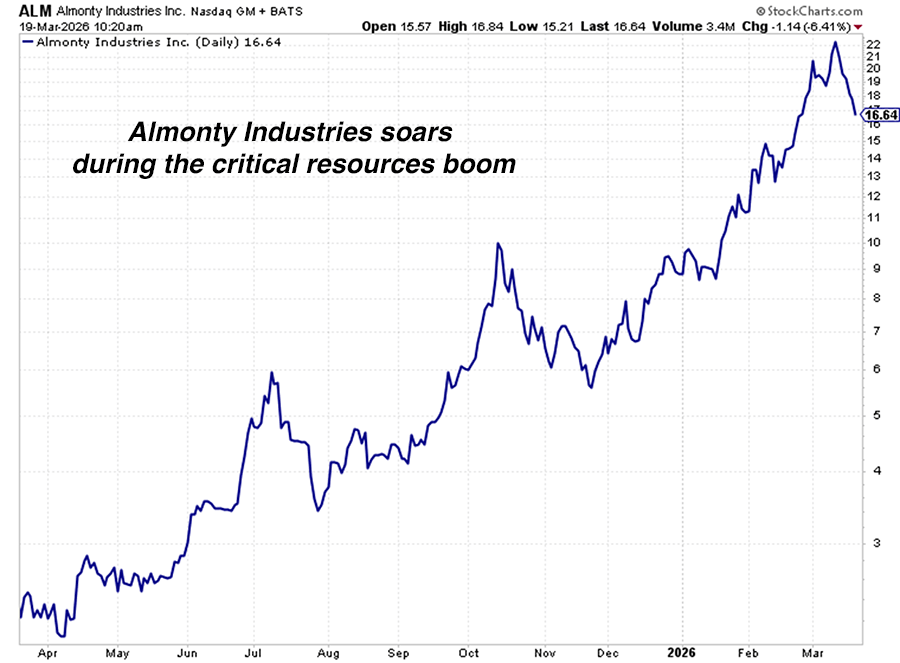
Then there’s the uptrend in Almonty Industries (ALM). Almonty is a major miner and processor of tungsten. Tungsten is a critical metal used in munitions, armor, cutting tools, drill bits, electronics, and welding. Almonty shares are up 577% over the past year and reached a new all-time high during Epic Fury.
Given this incredible price action, I stand by my original thesis: Partnering with the U.S. government to increase domestic and friendly-country supplies of critical resources will prove to be one of the most lucrative financial activities of this decade.More gains in stocks like the ones mentioned above lie ahead.
Market Notes
-
Our March 6 recommendation to own the chemicals niche is paying well. LyondellBasell Industries (LYB) just hit a new yearly high, now up 71% YTD alone.
-
Our Sept. 29 recommendation to own oil stocks is paying off like a broken slot machine. Energy giants BP (BP), Cheniere (LNG), Devon Energy (DVN), Woodside Energy (WDS) and Coterra Energy (CTRA) all reached all-time highs today. US Brent Oil ETF (BNO) also just hit a new one-year high.
-
Taiwan Semiconductor (TSM) just hit a new one-month low today.
-
Payment giant Visa (V) just hit a new one-year low today while rival Mastercard (MA) hit a new six-month low.
-
Alcohol giant Diageo (DEO) reached a new one-year low today. The booze industry is suffering from a decline in drinking rates.
Regards,


Brian Hunt
Editor, Money & Megatrends
An urgent message from our colleagues:
BEWARE: ‘The “Bear Market Window” Is About to Open’

For more than 75 years, one powerful market cycle has accurately signaled the arrival of extraordinary losses in the U.S. stock market: the Bear Market Window. Now, the man who accurately predicted the 2020 and 2022 crashes warns that we’re just days away from this Bear Market Window opening again. On March 25, he’ll explain why it could usher in the greatest potential losses we’ve seen in years… and the ONE critical move you should make with your money now.
Find the full details here.