Investors looking to build wealth over time can turn to growth exchange-traded funds (“ETFs”) for their many benefits. Whether you’re a beginning investor or more advanced, the best growth ETFs can deliver attractive returns and make it easy for anyone to invest successfully in the stock market.
The best growth ETFs offer investors many advantages, including the following:
- A track record of high annual returns
- A diversified portfolio of stocks, thereby reducing your risk
- Returns that outperform the bellwether S&P 500 Index
- Easy to research and invest in, without having to do heavy analysis
- May pay a small and growing cash dividend
Below are some of the best-performing growth ETFs, including their average long-term annual returns.
How Marketwise Selected These Funds
Marketwise chose its top funds based on the following factors:
- Broad-based funds categorized as growth, according to Morningstar
- Returns that beat the S&P 500’s long-term average annual gain of 10%
- An expense ratio below 0.3%
- Assets under management of at least $1 billion
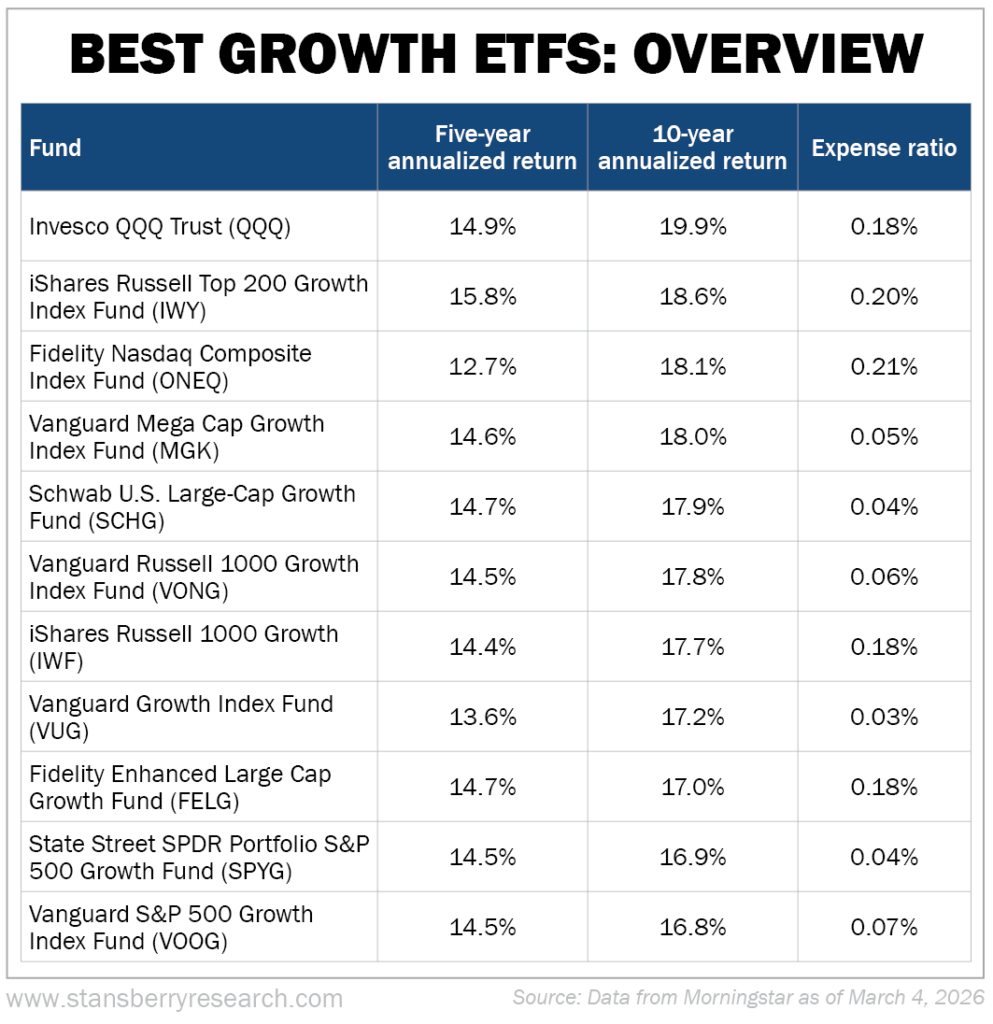
These funds have outstanding long-term returns and charge a low expense ratio, which is the fund’s annual cost as a percentage of your investment. The highest-cost fund here charges just 0.21%, or $21 annually, for every $10,000 invested in it. Many funds here are much cheaper still.
The fund’s long-term performance is your best predictor of how the fund may perform in the future. Of course, past performance is no guarantee of future returns, but these results indicate what the fund could possibly return.
11 Top Growth ETFs: Strong Long-Term Returns
Below are the details on these top growth ETFs, including their strategy and a few of their largest holdings. Note that these funds hold many of the same largest positions.
1. Invesco QQQ Trust (QQQ)
This fund tracks the Nasdaq 100 Index, which includes the world’s largest tech stocks. So, a stock has to be part of that index to qualify for this fund. The largest holdings include Nvidia (NVDA), Apple (AAPL), Microsoft (MSFT), and Amazon (AMZN).
2. iShares Russell Top 200 Growth Index Fund (IWY)
This index ETF tracks the Russell Top 200 Growth Index, which includes stocks in the Russell 200 Index with higher valuations and higher expected growth, relative to all stocks in that index. Top holdings include Nvidia, Apple, Microsoft, and Alphabet Class A (GOOGL).
3. Fidelity Nasdaq Composite Index Fund (ONEQ)
This index ETF tracks the Nasdaq Composite Index, which includes stocks trading on the Nasdaq, namely some of the world’s largest tech stocks. This fund’s largest holdings include Nvidia, Apple, Microsoft, and Amazon.
4. Vanguard Mega Cap Growth Index Fund (MGK)
This index fund tracks the CRSP U.S. Mega Cap Growth Index, which includes the largest stocks by market capitalization – the mega caps – trading on U.S. exchanges. Its portfolio consists of 60 stocks, and the largest positions include Nvidia, Apple, Microsoft, and Alphabet Class A.
5. Schwab U.S. Large-Cap Growth (SCHG)
This index fund tracks the Dow Jones U.S. Large-Cap Growth Total Stock Market Index, which includes large-cap U.S. stocks that show characteristics such as high sales growth. The fund’s most important positions include Nvidia, Apple, Microsoft, and Amazon.
6. Vanguard Russell 1000 Growth Index Fund (VONG)
This index fund tracks the Russell 1000 Growth Index, which includes large-cap stocks in the Russell 1000 Index that exhibit more growth, relative to all stocks in the index. This Vanguard fund’s top stakes include Nvidia, Apple, Microsoft, and Amazon.
7. iShares Russell 1000 Growth (IWF)
This iShares index fund tracks the Russell 100 Growth Index, which includes large-cap and mid-cap stocks in the Russell 100 Index with higher valuations and higher expected growth, relative to all stocks in the index. This fund’s top holdings include Nvidia, Apple, Microsoft, and Broadcom (AVGO).
8. Vanguard Growth Index Fund (VUG)
This ultra-low-cost index fund tracks the CRSP U.S. Large Cap Growth Index, which includes large-cap stocks trading on American exchanges. The fund’s top positions include Nvidia, Apple, Microsoft, and Alphabet Class A.
9. Fidelity Enhanced Large Cap Growth Fund (FELG)
This fund tracks the Russell 1000 Growth Index, which includes large-cap stocks in the Russell 1000 Index that show more growth characteristics, compared with other stocks in the index. The Fidelity fund’s largest stakes include Nvidia, Apple, Microsoft, and Broadcom.
10. State Street SPDR Portfolio S&P 500 Growth Fund (SPYG)
This index fund tracks the S&P 500 Growth Index, which includes stocks in the S&P 500 Index that show the strongest sales growth, earnings change to price, and momentum. The fund’s biggest positions include Nvidia, Apple, Microsoft, and Alphabet Class A.
11. Vanguard S&P 500 Growth Index Fund (VOOG)
This Vanguard index fund tracks the S&P 500 Growth Index, which includes stocks in the S&P 500 Index that show the strongest sales growth, earnings change to price, and momentum. The fund’s largest positions include Nvidia, Apple, Microsoft, and Alphabet Class A.
How to Invest in Growth ETFs
Growth ETFs invest in equities that have been classified as growth stocks. These stocks show the characteristics of growth companies at a greater degree than other stocks. These traits include high sales growth, high earnings growth, a high valuation (such as a high price-to-earnings ratio), or strong price momentum.
Growth stocks tend to be more volatile than the average stock. These stocks usually represent faster-growing segments of the market that are priced for higher expectations. If those expectations are met, the stock may zoom higher. If they’re not, the stock may often plunge.
It’s this set of built-in expectations that helps create the higher volatility of growth stocks. In contrast, the best dividend ETFs tend to be much less volatile… and they pay a higher dividend.
In contrast, growth companies are reinvesting their cash in the business to grow it faster, rather than sending it to shareholders. That said, some growth stocks may pay dividends, but these cash payouts tend to be much lower than those of well-known dividend stocks.
Here are some tips for investing safely in growth ETFs and what you need to watch out for:
- Passive funds do well:All the funds listed above are passive funds. That is, they track an established index mechanically rather than paying an expensive group of analysts to manage an active portfolio. Research shows that passive funds tend to outperform active funds, so it can make a lot of sense to go with an index fund. Plus, passively invested index funds are usually lower cost than actively managed funds.
- Look for a low expense ratio: The expense ratio is the fee you pay to the fund company for managing the fund. The lower this number, the better for you. Every dollar that doesn’t go to the fund company can continue to compound in the fund. An expense ratio below 0.5% is good, but many of the best index funds are much lower cost still. For example, many of the funds in the list above charge less than 0.1%. At a 0.1% expense ratio, you’ll pay just $10 annually for every $10,000 invested in the fund.
- Find broad-based funds: The funds above cut across industries, even if they have some concentration in tech stocks. This broader diversification reduces your risk, since stocks in different industries will respond differently depending on the economic cycle. While some stocks zig, others zag. This diversification smoothens your returns, too.
- Analyze the fund’s long-term record: To see what your fund might return over time, look at the long-term track record, such as five-year and 10-year returns. Those will give you a better gauge for how a fund will perform than its one-year performance.
- Watch out for the year’s hottest funds: The best-performing funds each year usually don’t stick around. Many investors look at only recent returns and rush in to buy. But the fund has already run up and can’t repeat the great performance again the next year. Instead, stick to funds with strong performances year after year.
One of the best things about ETFs is the ability to build wealth over time without needing to do the heavy analysis that’s required to invest in individual stocks. Literally anyone can take advantage of ETFs to build wealth, and legendary investor Warren Buffett has long advised investors to take a long-term buy-and-hold approach using index funds.
Regards,
James Royal
Editor’s Note: True Wealth senior analyst Brett Eversole just issued a warning. He says millions of Americans hold a certain “safe” asset that could prove costly to their retirement plans. And no, it’s not one of the AI stocks.
Instead, he says, it’s a move that could cause investors to miss out on what he calls the “Melt-Up Tsunami” – a market phenomenon that could soon send today’s record bull market soaring even higher. In his latest presentation, he names the No. 1 stock you should own instead. You can get a closer look, including the ticker, at this link.